Moon Conjunct Moon Synastry: When Two Inner Tides Recognize Each Other
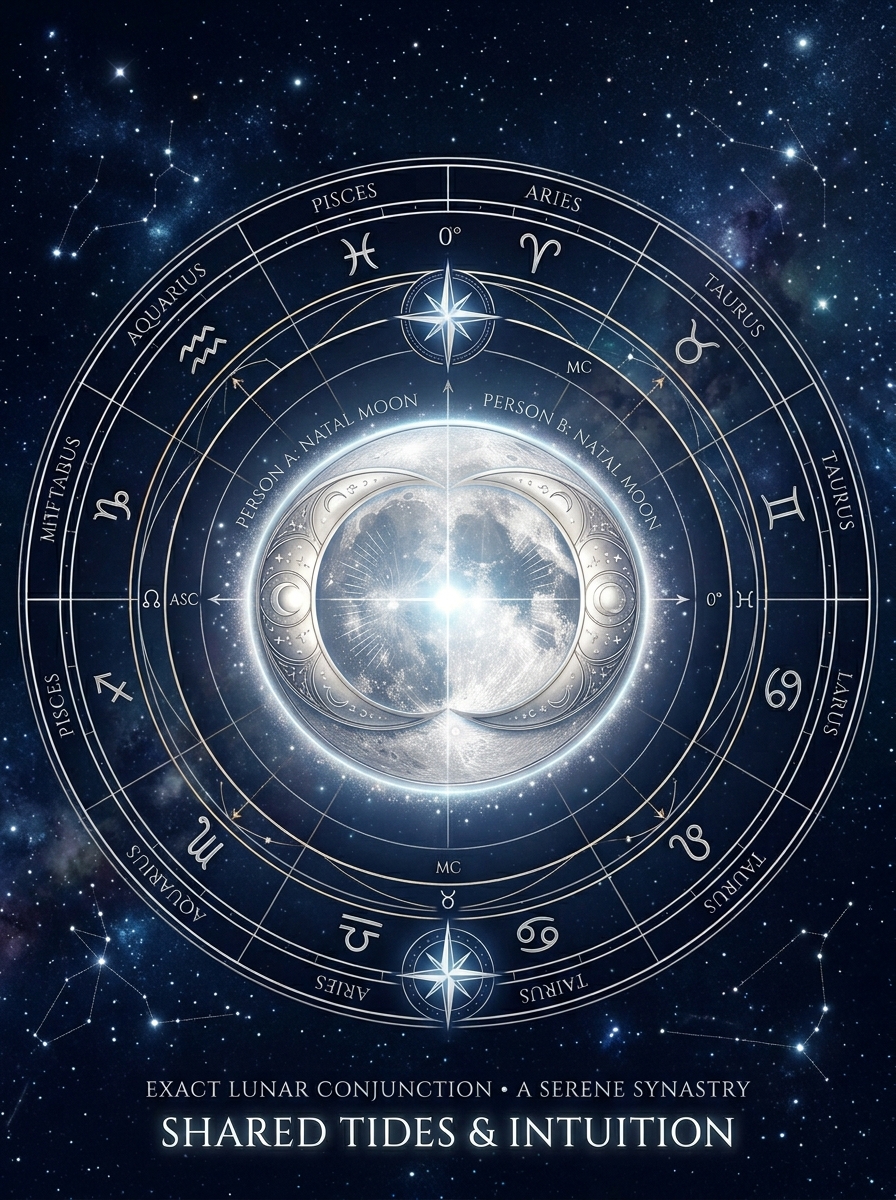
Moon conjunct Moon in synastry is not a romance of opposites. It is the meeting of two emotional nervous systems that speak the same preverbal language. The attraction feels less like desire and more like recognition: the body relaxes before the mind has decided to trust. Each person senses that the other holds the same instinctive rhythm—how fast they open, what soothes them, what feels like home. That shared lunar wavelength can create an almost eerie ease, but it also eliminates distance. The bond is immediate, intimate, and impossible to fake. What matters is what happens when the initial recognition gives way to the daily task of living together inside that sameness.
The core dynamic: emotional weather without translation
The Moon governs appetite, attachment, memory, and the nervous system’s private archive. When two Moons conjoin, they do not negotiate across difference; they merge into a single emotional climate. Each person becomes a barometer the other reads without effort. One cries, the other does not flinch. One goes quiet, the other instinctively lowers the volume of the room. The psychological term for this is implicit relational knowing—the kind of knowing that operates below conscious thought. It is why a Moon conjunct Moon bond often feels less like falling in love and more like coming home to a place you never knew you left.
This aspect does not produce the charged negotiation of desire that marks a Venus-Mars synastry or the tender longing of a Moon-Venus contact. It produces attunement. The couple can share a domestic life that runs on unspoken cues: they know when to shop, when to cocoon, when to avoid social overload. Their private world can feel womb-like. And that is the gift—but also the hazard.
Why the bond feels fated: the child-level hook
A Moon-Moon conjunction bypasses the adult ego and goes straight to the infant layer of the psyche. The Moon is where we carry what was never fully metabolized from early attachment: the hunger for comfort, the fear of abandonment, the need to be seen without having to ask. When two Moons meet, each person unconsciously projects that old material onto the other. The other feels familiar not because they are similar in personality but because they match an internal template of what care felt like—or what care failed to feel like.
That is why the bond often arrives with an uncanny sense of destiny. It is not that the relationship is written in the stars; it is that the relationship mirrors an internal pattern the psyche already knows. One partner’s need to be checked on may awaken the other’s memory of invisibility. One partner’s longing for softness may awaken the other’s panic about dependence. The conjunction can become a stage on which each person repeats a childhood dynamic while believing they are being understood for the first time. This is neither pathological nor spiritual—it is structural. If you want to understand how this fits into the larger architecture of relationship astrology, synastry step-by-step provides the framework for weighing such deeply embedded patterns against the rest of the chart.
When the shared tide turns static: maturation versus shadow
The healthy version of Moon conjunct Moon is what Steven Forrest calls mutual mercy: the ability to recognize a familiar wound without weaponizing it. Each person learns to hold their own emotional weather while staying present for the other. They can merge when comfort is needed and individuate when growth requires distance. The relationship becomes a shelter, not a prison.
The shadow expression is emotional recursion. Because both people share the same defense system, they can inadvertently reinforce each other’s moods. A worried Moon meets a worried Moon and doubles the worry. A guarded Moon meets a guarded Moon and builds a beautiful but empty fortress. There may be surprisingly little overt conflict—but a lot of emotional stagnation. The bond feels safe because it is familiar, but familiarity is not the same as nourishment. When two people default to the same retreat, nobody reaches for the door handle. The relationship becomes a closed loop.
The shadow appears most sharply when the conjunction is the only strong aspect in the chart, or when both Moons fall in water signs without modulating air or fire elsewhere. In such cases, the couple may mistake fusion for intimacy. They may avoid friction at all costs, losing the shaping force that difference provides. This is where the larger synastry matrix matters: the conjunction tells you the emotional baseline, but synastry aspects like a Sun-Moon trine or a Mars square will determine whether that baseline is stretched into growth or sealed into habit.
Where the sameness lands: house overlay and sign nuance
The Moon-Moon conjunction alone says, we feel the same way. But the house overlay asks, where does that sameness live in the world? If one person’s Moon falls into the other’s fourth house, the bond often centers on home, family history, and private belonging—the relationship becomes a nest. If it falls in the seventh house, the partnership may define itself rapidly as “us” and resist outside interference. If it falls in the twelfth, the emotional tie can become porous, psychic, difficult to name—a bond that feels spiritual but can also create confusion about boundaries. The synastry house overlays guide unpacks how each house colors the lunar connection.
Sign nuance adds texture without changing the core. Two Moons in fire signs bond through enthusiasm and quick emotional response; comfort arrives through honesty and directness. Two in earth bond through reliability and routine; care is practical, not verbal. Two in air bond through talk and perspective; they name feelings to manage them. Two in water bond through intuition and memory; they feel before they think. The conjunction remains the same contact, but the element decides whether the shared water is a tide, a mist, or a flood.
This aspect also interacts powerfully with the Sun. A Moon-Moon conjunction paired with harmonious Sun contacts can create the classic identity-emotion harmony explored in Sun-Moon synastry—the couple knows who they are together and how they feel together. But if the Suns are in hard aspect, the emotional ease of the Moon contact may mask a deeper identity misalignment. The conjunction can become a comfort zone that prevents either person from addressing what the Sun demands.
What the bond asks of you
A Moon conjunct Moon relationship does not sustain itself on automatic pilot. It asks each person to remain an individual with their own weather. The highest expression of this contact is not cozy sameness; it is the ability to recognize a familiar wound and choose not to repeat it. The couple must learn when to merge and when to individuate, when to soothe and when to speak, when to protect the nest and when to leave it for the sake of growth.
If you carry this aspect, you already know how to read each other. The work is to stop treating that skill as a substitute for conscious relationship. The bond can be deeply humane—a shelter against the hard edges of life—but only if both people are willing to let the shared Moon be a starting point, not a final destination. For a full map of how this lunar contact sits inside the overarching relationship chart, return to astrological synastry and the guide to love synastry. Moon conjunct Moon is the room where the story first speaks itself into being—dimly lit, emotionally exact, and impossible to fake. The question is whether you will furnish that room or let it become a cave.
Related
- Synastry: Sun Conjunct Moon — When Identity Meets Instinct
- Moon Opposite Moon in Synastry: Desire, Distance, and Emotional Truth
- Moon Sextile Moon in Synastry: The Quiet Ease of Shared Weather
- Synastry Moon Square Moon: When Two Weather Systems Share a Sky
- Synastry Moon Trine Moon: The Quiet River of Emotional Compatibility
Comments
Loading comments…