Moon Opposite Moon in Synastry: Desire, Distance, and Emotional Truth
The Polar Moon — Core Dynamic
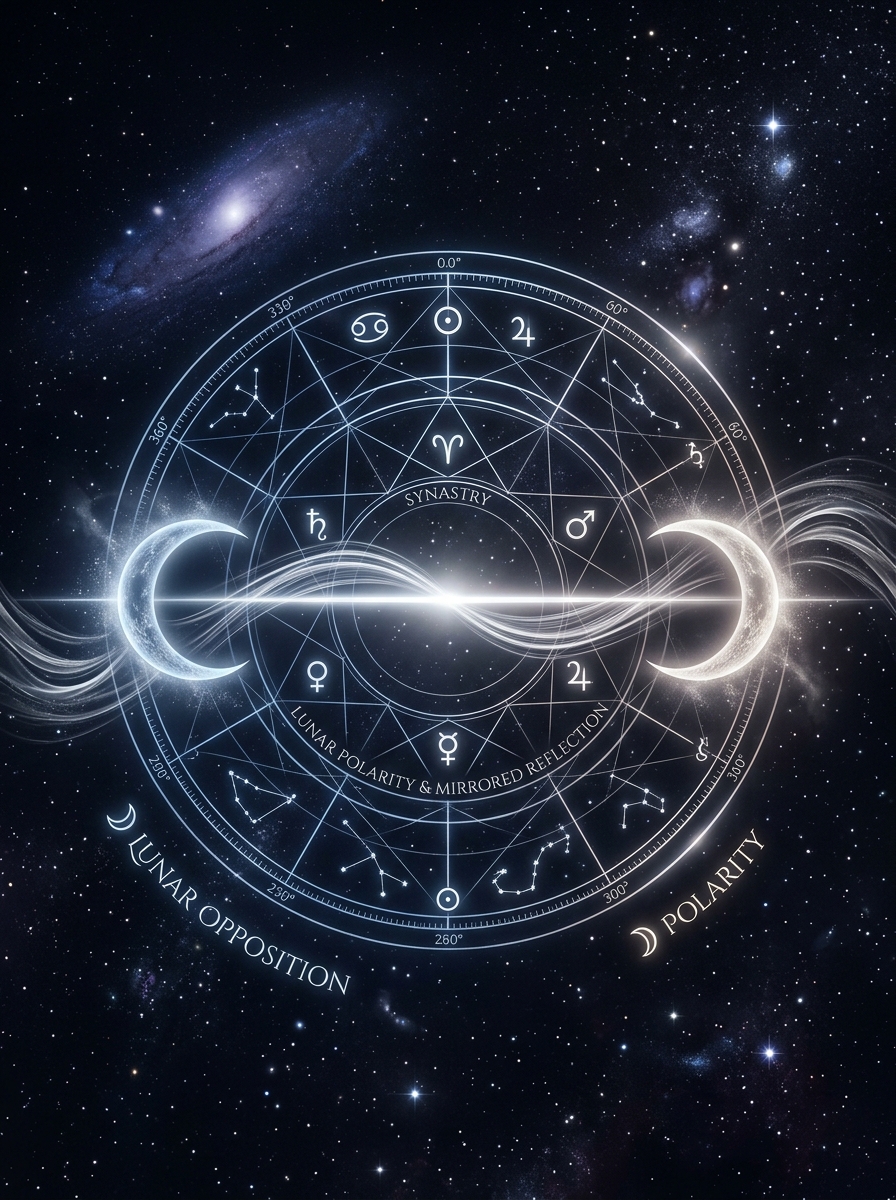
Moon opposite Moon in synastry is not emotional sameness; it is emotional counterpoint. Each partner’s lunar instinct — their pre-verbal sense of safety, their bodily memory of comfort — points toward the other’s blind spot. The attraction is immediate and cellular because the contact is lunar: private, somatic, rooted in childhood rhythm. The friction is just as immediate because an opposition does not merge — it mirrors. One person’s need to process aloud meets the other’s need to digest silently; one reaches for proximity under stress, the other reaches for space. Neither is wrong, but they speak different dialects of the same language.
This aspect belongs to the wider family of the opposition aspect, whose geometry is that of a seesaw: each side defines the other by contrast. In synastry, the opposition between two Moons creates a relational ecosystem where care is expressed through polarity rather than unison. The bond can feel fated because each person recognizes in the other a living example of an emotional mode they themselves do not inhabit. That recognition is not always comfortable. The Moon governs the self before language, so the other’s lunar style can feel like a challenge to one’s very right to exist in a particular way. The core thesis is this: Moon opposite Moon is a contract to learn how to hold difference without pathologizing it.
Why the Nervous System Recognizes a Stranger
The psychological root of this aspect lies in the Moon’s dominion over early attachment. What feels like an inexplicable pull toward someone with radically different emotional habits is often the unconscious meeting of exiled material. Each partner carries a lunar quality they learned to suppress or devalue — and the other embodies it with unapologetic ease. A lunar Cancer may have learned that vulnerability is weakness, only to meet a lunar Aquarius who treats emotional distance as integrity. A lunar Scorpio may have buried their need for predictability under a demand for depth, only to find a lunar Taurus who rests in routine without apology. The attraction is not merely elemental; it is psychical. The other person becomes a living mirror of the self’s forbidden emotional vocabulary.
This is why the first encounter often carries a jolt of uncanny familiarity — “I know this person” — followed quickly by a reactive tension. The body registers the other as significant before the mind can name why. In Jungian terms, the partnership activates the shadow of the lunar function. What one has exiled, the other carries. This can make the bond feel initiatory: each person is forced to meet the very feeling they have spent a lifetime avoiding. The contrast with Sun-Moon synastry is instructive. A Sun-Moon contact tends to feel like core recognition, a sense of being “seen” at identity level. A Moon-Moon opposition feels like core provocation — as if the other person’s very presence is a question about one’s own emotional architecture.
The Pull-Push Cycle — From Defense to Discipline
In daily life, the opposition manifests as a loop of approach, tension, retreat, and return. Because the Moon governs safety, each partner’s self-protective reflex is triggered when the other’s style feels invasive. The Cancer Moon, overwhelmed by an Aquarian need for intellectual distance, may interpret it as coldness. The Aquarius Moon, flooded by the Cancerian demand for constant emotional disclosure, may feel engulfed. Neither is trying to hurt the other; each is responding to a perceived threat to their own equilibrium. The danger lies in mistaking this reflex for incompatibility.
The unconscious version of the aspect is a tug-of-war over who gets to define the emotional climate. Each partner insists that their own style is the “right” way to care, and the relationship becomes a power struggle over whose need takes priority. Blame substitutes for curiosity: “You never need me,” “You’re too much.” The bond destabilizes because each Moon tries to force the other into its own survival pattern.
Consciousness transforms the aspect. When both partners recognize that the opposition is not a defect but a design, the dynamic shifts from defense to calibration. The question becomes not “Who is right?” but “Which need is active right now?” This requires emotional literacy: the ability to distinguish between being triggered and being endangered, between difference and rejection. The relationship becomes a discipline in timing — knowing when to reach and when to wait, when to speak and when to hold silence. For a full framework on how such aspects interact with other chart factors, the broader study of synastry aspects is indispensable. The opposition alone is never the whole story; its expression depends heavily on the rest of the birth charts.
Living the Opposition — Love, Work, and Domestic Life
Because the Moon is somatic, this opposition registers in the body before it reaches words. In love, the couple may experience a chemistry that is electric yet hard to soothe. Physical intimacy can be either the bridge or the battlefield — one partner may need touch to regulate, the other may need distance before touch becomes possible. In work, the aspect often appears in partnerships where one person excels at emotional insight and the other at structure; they can complement each other brilliantly if they respect their different paces. But deadlines and stress magnify the lunar conflict: the one who needs to talk through a decision will irritate the one who needs to think in silence.
Domestic life is where the opposition reveals its most intimate texture. Shared meals, sleep rhythms, and responses to illness all become negotiable terrain. One partner may prefer a clean, quiet home as a sanctuary; the other may need clutter and movement to feel alive. The aspect does not just describe feelings — it describes how feeling arranges space. The couple may discover that they can fight for an hour and then instinctively care for each other in practical ways, because the Moon’s bond is deeper than its disagreements. House overlays matter enormously here: the same opposition can feel invasive or supportive depending on which houses the Moons occupy. A thorough reading of synastry house overlays can clarify why one couple experiences the aspect as daily tenderness and another as a recurring crisis.
When reinforced by gentler contacts such as Moon-Venus synastry or the dynamic polarity of Venus and Mars synastry, the opposition’s rough edges can soften. These secondary aspects supply the missing bridge — the moments of ease that remind both partners why they chose each other in the first place. The Moons alone may disagree about how to soothe, but the rest of the chart can provide the translation service.
The Hidden Gift of Reciprocity Through Contrast
The deepest gift of Moon opposite Moon is that it teaches reciprocity without replication. Each partner can become the other’s emotional antidote. The one who overreacts learns steadiness; the one who numbs learns presence. The opposition does not ask for merger — it asks for complementarity. Over time, the relationship can develop a rhythm where each person knows instinctively what the other cannot provide for themselves. One holds the tension so the other can rest; one brings novelty when the other is stuck; one restores scale when the other is drowning in drama. This is not a love of easy agreement, but a love built on the mutual education of two different nervous systems.
Used unconsciously, this aspect produces projection and chronic misunderstanding. Used consciously, it produces depth — a bond in which each person becomes more emotionally articulate through contact with the other’s missing half. The relationship grows not by eliminating difference but by learning to keep company across it. For readers constructing a full synastry picture, synastry step-by-step offers a method for integrating this opposition with the whole chart. The final measure is simple: can the two Moons stop trying to become one another and instead, through sustained attention, become each other’s most reliable emotional witness? When they can, the opposition stops being a wound and starts being a source of emotional truth — and that, in lunar terms, is a rare and earned kind of love.
Related
- Moon Opposite Mercury in Synastry: When Feeling and Speech Pull Against Each Other
- Sun Opposite Moon in Synastry: The Magnetic Fault Line
- Moon Opposite Venus in Synastry: The Beauty That Pulls and the Feeling That Pushes
- Moon Conjunct Moon Synastry: When Two Inner Tides Recognize Each Other
- Moon Opposite Mars in Synastry: Desire, Friction, and the Pulse of Attraction
- Sun Opposition Moon: The Split That Learns to Speak
Comments
Loading comments…