Synastry Moon Trine Moon: The Quiet River of Emotional Compatibility
The Core Dynamic: Mutual Emotional Legibility
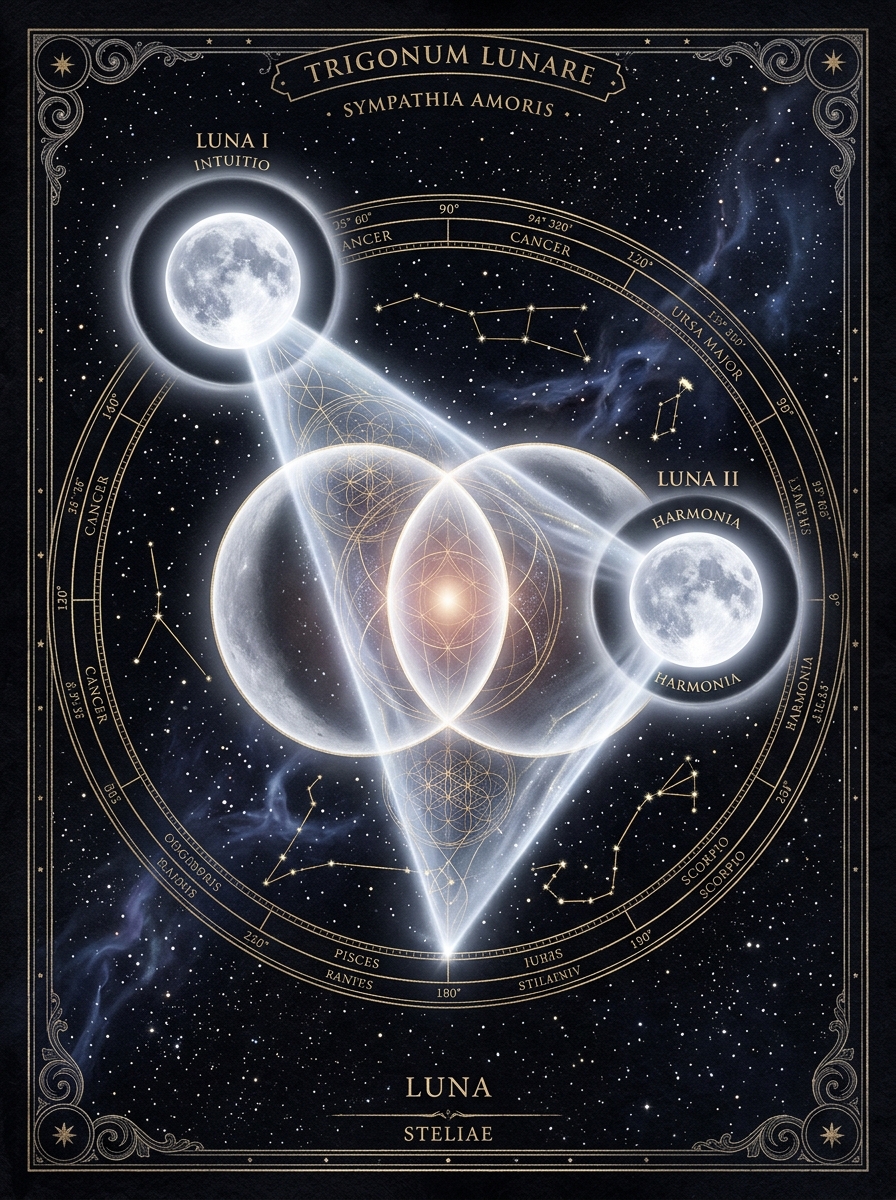
Moon trine Moon in synastry says two people read each other’s feeling-language with uncommon fluency. The bond is not built on dramatic polarity or the thrill of misunderstanding; it rests on recognition. One person’s instinctive rhythm tends to fit the other’s. What comforts one also tends to comfort the other. What feels risky, intimate, or restorative is often shared, even if the pair comes from different backgrounds or personalities. This is why the aspect can feel disarmingly natural: it doesn’t ask two emotional systems to translate themselves from scratch.
That ease is real, but it is not trivial. In relationship astrology, the Moon is not a decorative detail; it is the body’s memory, the private weather, the way affection is metabolized before language arrives. When two Moons form a trine, the result is often a baseline of emotional consent. The relationship tends to “land well” in the nervous system. People may not always have the same opinions, but they usually understand the tone of one another’s needs. Compare that with the more explicitly sheltering Moon-Venus synastry, where sweetness and admiration dominate the field; here, the deeper signature is attunement.
A trine is a 120-degree aspect, and in astrology its gift is flow. It does not force development through crisis. It allows energy to move along an elemental current with relatively little friction, a theme explored in the trine aspect. With Moon trine Moon, that current is emotional and lunar: memory, caregiving, instinct, habit, safety, and the private rituals that make a bond feel livable.
What the Chemistry Feels Like in Daily Life
Immediate familiarity without performance
The first thing people notice is often not passion but ease. The Moon person in one chart seems to intuit when the other needs silence, food, reassurance, humor, or a change of atmosphere. Conversations may feel like they resume rather than begin. The pair can slip into domestic timing quickly: who likes the windows open, who prefers texting over calling, who needs space after work before speaking, who softens when touched on the shoulder. These are not glamorous details, but they are the architecture of sustained closeness.
This aspect can produce a relationship that feels older than it is. The two may say, in effect, “I know how you are.” That sentence can be loving, but it can also become a trap if it hardens into assumption. Still, in its healthiest form, Moon trine Moon creates an atmosphere where vulnerability does not have to prove itself. The person can arrive already emotionally understood. That is one reason this aspect often appears in long-term partnerships, sibling-like attachments, and friendships that quietly become family.
Attraction that comes through safety
The attraction here is often subtle before it is overt. It is not always the catalytic heat of Venus and Mars synastry, where desire has a visible spark and a clear voltage. With Moon trine Moon, attraction frequently emerges as relief. The body relaxes. The voice lowers. People laugh at the same private things. There is a kind of emotional gravity that says, “You do not need to defend yourself here.”
That can be profoundly erotic, though not always in an obvious way. The eroticism of this aspect is the pleasure of being received without strain. For some couples, that is the very condition that allows sexual trust to deepen. For others, the relationship never becomes especially charged, but it remains deeply satisfying because the emotional climate itself is nourishing. The trine does not guarantee intensity; it guarantees compatibility of needs, which is often more useful over time.
Shared instincts, shared blind spots
A lunar trine can also mean that both people default to similar coping strategies. If one person withdraws when hurt, the other may do the same. If both crave reassurance, both may wait for the other to initiate it. If both soothe through routine, neither may challenge stagnation quickly. This is one of the quiet hazards of harmonious aspects: they can preserve comfort long after comfort has become inertia.
That is why this synastry pair sometimes needs outside stimulation from other inter-aspects or house overlays to keep the relationship evolving. The chart may show tenderness, but not enough pressure to define boundaries or move through conflict cleanly. The easy bond can become emotionally circular, especially if other factors in the composite or synastry mirror the dynamics of a grand trine or a broader elemental ease described in the grand trine glossary. In those cases, the relationship can feel blessed and slightly under-challenged at the same time.
Where the Friction Hides Inside the Harmony
Compatibility can disguise emotional passivity
A Moon trine Moon bond rarely fails because of obvious mismatch. It is more likely to stall because neither person wants to disturb the emotional weather. That means necessary conversations can be postponed indefinitely. Resentment may not explode; it may evaporate into politeness. One partner might assume the other already knows what is wrong, and because the aspect encourages intuitive understanding, that assumption can seem reasonable even when it is false.
This is the shadow side of lunar harmony: not conflict, but under-articulation. The relationship may become so accustomed to mutual comprehension that it stops making room for conscious differentiation. The pair can confuse resonance with agreement. They can also mistake shared mood for shared values. A Moon trine Moon makes it easy to feel together; it does not by itself explain whether two people want the same life.
The house story matters as much as the aspect
A lunar trine can feel radically different depending on where the Moons land by house. One person’s Moon may fall into the other’s fourth house, creating a deeply familial feel. Another placement may activate the tenth, where care is expressed through ambition, reputation, or practical support. A third may touch the sixth, making the bond live inside schedules, health routines, and labor. The same trine can therefore read as homey, public, service-oriented, or quietly private.
This is where synastry house overlays become indispensable. The aspect explains the emotional grammar; the house placement explains where the sentence is spoken. Without that context, readers often overgeneralize the trine into a vague “good chemistry” label. In reality, the chemistry has a setting. A Moon trine Moon across watery houses can feel like merging; across earth houses, it can feel like dependable mutual maintenance; across angular houses, it can become a visible partnership that others experience as composed and secure.
Emotional ease is not the same as evolutionary ease
Some bonds are soothing precisely because they do not push either person toward growth. That is not a flaw in itself; rest is a real function of relationship. But if the rest becomes the whole story, the aspect can lull both people into emotional sleepwalking. The trine’s generosity should be used, not worshiped. It works best when it creates a safe base from which harder truths can be spoken.
This is where a psychologically mature reading differs from a sentimental one. A Moon trine Moon does not mean the pair will never hurt one another. It means they are more likely to forgive, re-regulate, and re-enter intimacy without drama. But if the same old pattern repeats, the emotional ease can become the very thing that hides the pattern from view. Harmony can anesthetize as well as heal.
How It Changes by Sign, Element, and the Rest of the Chart
Element determines the flavor of the ease
A trine works most cleanly within the same element, and the emotional style of the bond is shaped accordingly. Two fire Moons often create an upbeat, encouraging, emotionally brave atmosphere. Two earth Moons tend to share practical care, loyalty, and a preference for the tangible. Two air Moons communicate feeling through conversation, perspective, and mutual wit. Two water Moons can develop a bond of near-psychic tenderness, though sometimes with porous boundaries.
The aspect itself remains the same, but the lived experience changes. Fire Moons may make each other more confident. Earth Moons may make each other more secure. Air Moons may make each other more articulate about feeling. Water Moons may make each other more receptive, protective, and inwardly entwined. A trine can therefore be either stabilizing or soothingly atmospheric depending on the element.
Sign symbolism refines the emotional style
The Moon in Cancer expresses differently than the Moon in Taurus, Scorpio, or Pisces, and in synastry those signs matter. Two Cancer Moons may create an almost immediate homecoming. Two Taurus Moons often prize consistency, sensuality, and predictable devotion. Two Scorpio Moons can recognize each other’s emotional depth and survival intelligence, though they may also collude in secrecy. Two Pisces Moons may bond through compassion, imagination, and an instinctive tolerance for vulnerability.
This is also why it helps to read the lunar trine alongside each person’s Sun-Moon synastry. If one person’s core identity is not comfortable with the emotional mode of the Moon trine, the bond can still feel good but not fully livable. The Sun describes how a person directs life; the Moon describes how they receive it. When those two levels are in harmony across the charts, the trine becomes a genuine relational home rather than just a pleasant current.
The broader aspect matrix decides whether the trine gets to breathe
No synastry aspect exists in isolation. A Moon trine Moon may be the emotional green light in a chart that also contains frictional contacts demanding growth. That friction is not a problem if the lunar trine provides enough trust to hold the tension. In fact, difficult aspects often become workable only when a couple has some soft territory to stand on.
If the synastry also contains strong harmonic patterns, the relationship may feel almost too seamless, especially when a trine-aspect or astrological synastry reading reveals several easy links at once. Then the question becomes whether the pair can use the comfort as a foundation rather than as a hiding place. A good synastry chart does not merely tell you whether two people fit; it tells you what kind of growth their fit makes possible.
What This Aspect Is Good For, and What It Cannot Do Alone
Moon trine Moon is excellent for domestic peace, emotional trust, caregiving rhythms, and the low-drama intimacy that makes a shared life sustainable. It helps two people co-regulate. It encourages tenderness without display. It often shows why one person feels “safe” with the other in a way that is hard to explain but easy to recognize. That safety can be the quiet miracle of the relationship.
But the aspect cannot, by itself, guarantee desire, purpose, or long-term direction. It does not tell you whether the couple will build, choose, commit, or endure. For that, the rest of the chart must speak: Saturn for structure, Venus and Mars for magnetism, the Sun for identity, the house overlays for lived context, and the total synastry pattern for pressure and movement. If the lunar trine is the soft bedrock, the other factors are the walls, beams, and weatherproofing.
Read well, this aspect is not about “perfect compatibility.” It is about the rare experience of feeling emotionally fluent with another person. That can be a love story, a family bond, a friendship, or the invisible glue that makes partnership durable. In a chart with enough depth to sustain it, the Moon trine Moon is the sound of two inner lives moving in a shared tide.
Related
- Synastry Sun Trine Moon: The Quiet Chemistry of Being Felt
- Moon Trine Mars Synastry: Desire, Protection, and Easy Emotional Heat
- Moon Trine Mercury in Synastry: When Feeling Finds a Voice
- Moon Trine Venus in Synastry: The Soft Geometry of Being Easily Loved
- Moon Sextile Moon in Synastry: The Quiet Ease of Shared Weather
Comments
Loading comments…