Astrological Synastry: The Complete Guide to Relationship Chart Overlay
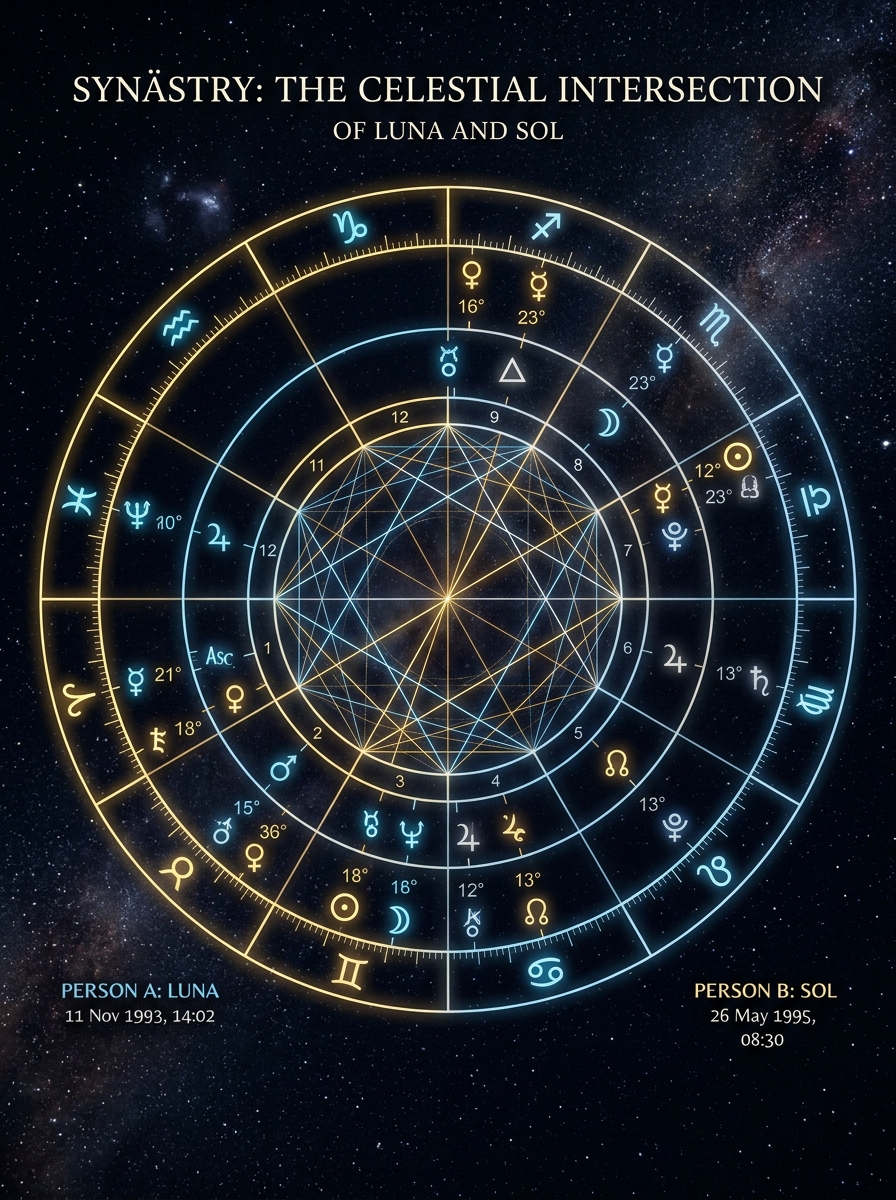
Synastry is the astrology of the space between two people. Where a natal chart describes a single psyche—its appetites, defenses, and gifts—synastry asks a different question: what happens when this psyche meets that one? It is the difference between studying an instrument and listening to a duet. Two charts laid over each other become a living conversation, full of harmony, dissonance, surprising resolutions, and recurring arguments that never quite settle. This guide walks through the mechanics of that conversation and the deeper psychology underneath it, drawing on the Western evolutionary and depth-astrology traditions associated with Liz Greene, Steven Forrest, and the work of Carl Jung.
Introduction to Synastry: Etymology and the Mechanics of Chart Overlay
The word synastry comes from the Greek syn (together) and astron (star)—literally, "stars together." That etymology is more than trivia. It frames the entire practice: synastry is never about one star, one sign, or one fate. It is about combination, the way two complete sky-maps interlock and produce something neither chart contains alone.
What actually gets overlaid
A natal chart is a frozen photograph of the heavens at the exact moment and place of someone's birth. It records the zodiacal position of the ten traditional bodies—the Sun, Moon, Mercury, Venus, Mars, Jupiter, Saturn, Uranus, Neptune, and Pluto—along with the angles, most importantly the Ascendant and Midheaven, and the twelve houses that divide lived experience into domains like identity, resources, communication, home, and partnership.
In synastry, you take two of these complete charts and lay one on top of the other, usually drawn as concentric wheels: one person's planets on the inner ring, the other's on the outer. Now you can read two distinct kinds of information at once. First, the cross-aspects: the geometric angles formed between Person A's planets and Person B's planets. Does her Venus sit exactly on his Mars? Does his Saturn press down on her Moon? Second, the house overlays: which of your houses each of your partner's planets falls into. If his Sun lands in your seventh house of partnership, he tends to show up, almost from the first meeting, wearing the costume of "the partner."
Why the overlay reveals dynamics, not verdicts
The crucial mental shift is to stop reading synastry as a scorecard and start reading it as choreography. Every contact describes a behavior pattern that activates when the two of you are in a room together. Her Mercury squaring his Moon does not mean "incompatible." It means that when she speaks plainly and logically, he feels something in his gut before he has words for it, and the two reactions arrive at slightly different speeds. That is a dynamic you can learn, name, and work with. Synastry hands you the map of those repeating patterns so the relationship becomes legible rather than mysterious.
This is also why synastry resists fatalism. The chart shows the raw material and the predictable flashpoints, but two conscious people decide what to build from them. The overlay is a description of the current, not a sentence handed down from the sky.
Beyond the Sun Sign: Why Synastry Outclasses Basic Zodiac Compatibility
Magazine compatibility columns compare two Sun signs and pronounce a verdict: fire and air "get along," water and fire "clash." It is astrology reduced to a seating chart. Synastry exists precisely because that reduction throws away almost all the information.
The Sun is one voice in a choir
Your Sun sign describes your core vitality and the direction your will wants to grow—roughly one-twelfth of you. But you are also a Moon, a Mercury, a Venus, a Mars, and a Saturn, each in its own sign and house, each with its own appetites. Two people with "incompatible" Sun signs can have a Moon-Venus trine that makes daily life feel like a warm kitchen, a Mercury conjunction that lets them finish each other's sentences, and a Mars sextile that keeps the bedroom alive. The Sun-sign verdict would have told them to walk away from one of the most nourishing bonds of their lives.
Compatibility is multidimensional
Real relationships run on several independent channels at once, and synastry lets you read each one separately:
- Mental rapport lives in Mercury contacts—how you think, talk, joke, and argue.
- Emotional safety lives in Moon contacts—how you soothe, react, and need.
- Affection and values live in Venus contacts—how you give and receive love, and what you find beautiful.
- Desire and drive live in Mars contacts—how you pursue, assert, and ignite.
- Durability and commitment live in Saturn contacts—how you bind, define, and endure.
A couple can be brilliant on one channel and clumsy on another. Synastry refuses the single number and instead hands you a panel of dials. That granularity is the whole point. It tells a couple where they flow and where they will have to do the conscious work, instead of pretending a relationship is one undifferentiated thing that either "works" or doesn't.
From prediction to self-knowledge
There is a deeper reason synastry outperforms sun-sign matching. Sun-sign compatibility treats you as a fixed type to be sorted. Synastry treats the relationship as a developmental field. In the evolutionary tradition Steven Forrest helped popularize, the chart does not say who you are so much as it describes the work your soul came to do. Read that way, a synastry overlay is less a compatibility test and more a curriculum: here is what these two people can teach each other, here is the friction that will force the lessons, and here is the support that will make the lessons survivable.
The Psychological Mirror: Jungian Projection, Anima, and Animus
To understand why certain people pull at us with almost gravitational force, astrology borrows from depth psychology—above all from Carl Jung. Synastry is, among other things, a map of projection.
Projection and the hook
Jung observed that the contents of the unconscious do not stay politely inside us. We project them outward, casting our disowned qualities, fears, and ideals onto other people, who then seem to carry those qualities for us. We fall in love not only with a person but with the part of ourselves we have hidden and now see glittering, apparently, in them. Synastry shows where the hooks are. When your partner's planet lands tightly on one of your own, especially on a planet or angle you have trouble owning, that contact becomes a screen onto which you project. Their Pluto on your Venus may make them feel fated, obsessive, impossible to look away from—because they are carrying your own buried intensity back to you.
Anima and Animus
Jung named two of the most powerful projection figures the anima and the animus: the contrasexual image each of us carries inside, the inner feminine in a man's psyche and the inner masculine in a woman's, though contemporary readers rightly take these as archetypal energies rather than literal genders. We tend to fall hard for partners who fit the contours of that inner image. In synastry, Venus, the Moon, Mars, and the outer planets frequently mark where the anima or animus gets projected. The partner seems to be the dream—until the projection wears thin and a real, limited human being is standing there instead.
The mirror as an invitation
This is where Liz Greene's contribution is so valuable. In her psychological reading of the chart, the hard contacts and intense projections are not problems to be eliminated but invitations to consciousness. The person who triggers you is showing you a part of yourself you have not yet integrated. A relationship rich in projection can either collapse when the fantasy fails or deepen as each partner gradually withdraws the projection and takes responsibility for the energy they had outsourced. Synastry diagrams exactly which planets are doing the projecting and onto which placements—so two people can recognize the mirror for what it is. The goal is not to stop projecting (we always will) but to notice it, and to let the beloved become a real other rather than a screen for our own unlived life.
Harmonious Flow vs. Growth-Promoting Friction: Trines, Squares, and Oppositions
Cross-aspects are the heart of synastry, and they fall broadly into two families: the flowing aspects that feel like ease, and the hard aspects that feel like friction. The mature reading refuses to label one "good" and the other "bad."
The flowing aspects: trine, sextile, conjunction
A trine (120 degrees) connects planets in compatible elements and feels like a current you can float on. When her Venus trines his Moon, affection and emotional comfort move between them without effort; it simply works. A sextile (60 degrees) is a gentler version—opportunity and easy stimulation rather than a downhill glide. The conjunction (0 degrees) fuses two planets so completely that the energies become inseparable, for better and worse; its flavor depends entirely on which planets are involved.
Flowing aspects are the comfort and the glue. But a relationship built only on them can stagnate. Ease, unbroken, becomes inertia. Nothing pushes either person to grow, and the bond can quietly go to sleep.
The hard aspects: square and opposition
A square (90 degrees) is the classic friction aspect: two planets pulling in directions that cross and snag. His Mars square her Saturn can feel like an accelerator and a brake pressed at once—he pushes, she restrains, both feel thwarted. Yet that same tension is dynamic. Squares demand action; they refuse to let the relationship coast.
An opposition (180 degrees) places two planets face to face across the wheel. Oppositions are the aspect of relationship par excellence, because they externalize: you tend to see the opposing energy in your partner rather than in yourself. His Sun opposite her Moon can feel like two people standing at opposite ends of a seesaw, each holding what the other lacks. That is precisely the projection dynamic Jung described—and precisely the raw material for integration.
Friction as the engine of attraction and growth
Here is the counterintuitive truth every experienced synastry reader knows: the hard aspects are often what create the charge. A relationship with no squares between the personal planets may be pleasant and utterly without spark. The grit, the magnetism, the sense that this person matters and unsettles you—that usually comes from the squares and oppositions. Forrest frames hard aspects as the "growth aspects" because they apply pressure exactly where the soul is meant to evolve. The work is to stay conscious under that pressure: to recognize that the partner who frustrates you is also the one stretching you, and to negotiate the tension rather than blaming the other for creating it. Friction handled consciously becomes intimacy. Friction handled unconsciously becomes the same fight, over and over, for years.
The Luminaries: Sun and Moon as the Foundation of Shared Consciousness
If synastry has a foundation, it is the relationship between the two luminaries—the Sun and the Moon—across the charts. These contacts describe whether two people can share daily consciousness, the basic compatibility of being and being-with.
Sun-Sun: two solar wills
When the Suns connect, two core identities meet directly. Sun conjunct Sun (often same-sign partners) brings instant recognition and a shared sense of life's direction, though it can also mean two egos competing for the same square of sky. Sun trine or sextile Sun gives an easy mutual respect: you simply get what the other is trying to become. Sun square or opposite Sun signals two strong wills aimed differently, which can be invigorating or exhausting depending on each person's maturity.
Sun-Moon: the classic marriage aspect
The Sun-Moon contact is one of the most prized in all of synastry, traditionally associated with marriage and deep complementarity. The Sun person supplies vitality, purpose, and conscious direction; the Moon person supplies emotional nourishment, instinct, and feeling. When they conjoin, trine, or sextile, the two click into a natural fit—the solar partner shines, the lunar partner reflects and tends, and each feels essential to the other. Even the opposition, with its seesaw quality, often binds two people powerfully, because each unconsciously recognizes the other as the missing half. This is the contact astrologers look for when asking whether a relationship can sustain a shared life rather than a brief affair.
Moon-Moon: emotional weather
When the Moons interact, two emotional natures meet at the level of instinct and habit. Harmonious Moon contacts mean your reflexes match—you find the same things comforting, you recover from stress in compatible ways, your nervous systems settle in each other's presence. Tense Moon contacts mean your emotional weather systems collide: what soothes one agitates the other, and you may keep miscalibrating each other's needs. Because the Moon governs the unspoken texture of everyday life, Moon-Moon harmony is what makes long cohabitation feel like home rather than negotiation.
Reading the luminaries together
In practice you weigh all three. Strong Sun-Sun with abrasive Moon-Moon describes partners who admire each other's purpose but rub each other raw at home. Gentle Sun-Moon with little Sun-Sun describes deep emotional fit without much shared external direction. The luminaries set the baseline frequency of the relationship; everything else plays on top of it.
Venus and Mars: The Spark of Passion, Attraction, and Sexual Chemistry
If the luminaries describe whether two people can be together, Venus and Mars describe whether they want each other. This is the erotic engine of synastry.
Venus and Mars as the archetypal lovers
Venus is the principle of attraction, pleasure, and value—what we find beautiful and how we draw love toward us. Mars is the principle of desire, drive, and pursuit—how we go after what we want. In the old mythic language they are the lovers themselves, and their cross-chart contacts are the single most reliable signature of sexual chemistry. When one person's Venus aspects the other's Mars, you get the classic dynamic of magnet and iron: the Mars person pursues, the Venus person attracts, and the polarity crackles.
Which Venus-Mars aspects do what
- Venus conjunct Mars is raw, immediate heat—often the instant, undeniable spark across a room.
- Venus trine or sextile Mars gives flowing chemistry that is easy to enjoy and easy to sustain; desire and affection move in the same direction.
- Venus square or opposite Mars produces intense attraction laced with friction—the on-again, off-again charge, the lovers who fight and reconcile. The tension is part of the pull, and it can either keep a relationship electric or wear it out, depending on how the friction is handled.
Mutual reception, where each person's Venus touches the other's Mars, is especially potent: both feel pursued and both feel attracted, the polarity flowing in both directions at once.
Beyond chemistry: the limits of Venus-Mars
It is worth saying plainly: strong Venus-Mars chemistry guarantees nothing about love or longevity. It guarantees heat. Many short, combustible affairs are built almost entirely on a tight Venus-Mars square with little luminary or Saturn support—pure spark, no hearth, no foundation. The art of synastry is to read the erotic contacts in context. Venus-Mars tells you the fire will light. The Moon, Venus-Venus, and Saturn tell you whether it can warm a home for decades or will simply burn bright and gutter out. Chemistry is necessary for passion and insufficient for partnership, and the chart shows the difference clearly.
Moon and Venus: Nurturing, Intimacy, and the Daily Domestic Life
Passion gets the headlines, but relationships are lived in the unglamorous hours—the morning coffee, the sick day, the thousand small gestures of care. Moon and Venus contacts govern that domestic intimacy, and they are what allow a relationship to sustain rather than merely ignite.
Moon-Venus: tenderness and ease
When one person's Moon contacts the other's Venus, something tender and nourishing flows between them. The Venus person's affection lands directly on the Moon person's emotional needs; the Moon person's care feels beautiful and welcome to the Venus person. Harmonious Moon-Venus aspects are among the kindest in synastry. They create the feeling of being looked after, of liking each other and not only desiring each other. This is the contact that makes a partner feel like comfort itself—the one you want beside you when you are tired rather than only when you are aroused.
Venus-Venus: shared taste and values
When the Venuses interact, two value systems and aesthetic worlds meet. Harmonious Venus-Venus means you enjoy the same pleasures, find the same things lovely, and agree, more or less, on what makes life worth living—how to spend a weekend, how to keep a home, what counts as a good evening. Tense Venus-Venus means your tastes and love languages diverge, so affection keeps getting lost in translation: you each give what you would want to receive, and neither quite feels loved. Because Venus also rules money and pleasure, these contacts color how a couple spends, indulges, and creates beauty together.
The hearth versus the spark
It helps to picture two complementary systems. Venus-Mars is the spark—ignition, heat, desire. Moon-Venus is the hearth—warmth, care, the slow steady heat that actually keeps a home livable. A relationship needs both. Spark without hearth burns hot and goes cold; hearth without spark is affectionate but unlit. When you read a chart with strong Venus-Mars and strong Moon-Venus, you are looking at a rare and durable combination: people who want each other and take good care of each other. That pairing—desire plus nurture—is far more predictive of lasting happiness than either alone.
Saturn's Role: Commitment, Responsibility, and the Cosmic Glue
Saturn has a grim reputation—the planet of limitation, time, and hard lessons. In synastry, that reputation is exactly why Saturn is the planet of commitment. Without Saturn, relationships tend to dissolve when the weather turns.
Saturn as binding agent
Saturn rules structure, duration, responsibility, and the willingness to stay. When one person's Saturn contacts the other's personal planets—Sun, Moon, Venus, or Mars—the relationship takes on weight and seriousness. There is a sense of obligation, of building something meant to last, of a bond you do not walk away from lightly. Astrologers often call Saturn the "cosmic glue" because Saturn contacts are statistically common in the charts of couples who marry and stay married. Saturn is what turns attraction into a vow.
The two faces of Saturn
Saturn's gift comes with a tax. The same aspect that creates durability can create heaviness, criticism, fear, or restriction. Saturn conjunct, trine, or sextile a partner's planet tends to feel supportive—the Saturn person becomes a steadying presence, a source of structure and reliability. Saturn square or opposite a partner's planet can feel like judgment or weight—the Saturn person inhibits, criticizes, or dampens the very thing the other planet wants to express. His Saturn on her Sun can make her feel both protected and quietly diminished, depending on how consciously he wields it. The challenge of Saturn contacts is to let the planet provide commitment and backbone without letting it curdle into control or cold disapproval.
Why a relationship needs gravity
Here is the deeper logic. Passion (Venus-Mars) and emotional fit (luminaries, Moon-Venus) generate the desire to be together. Saturn generates the capacity to stay together when desire flags, as it inevitably does. Every long relationship passes through stretches of boredom, conflict, and ordinary disappointment. Saturn is what holds two people in the room long enough to move through those stretches rather than fleeing at the first cold front. The most resilient synastry pairs warm contacts that make the bond feel good with Saturn contacts that make it hold. Warmth without Saturn drifts apart; Saturn without warmth becomes a duty rather than a love. The integration of the two—affection that endures because it is anchored—is the quiet signature of a partnership built to last.
Synastry vs. the Composite Chart: Two Different Lenses
Newcomers often confuse synastry with the composite chart. They answer related questions, but they are genuinely different instruments, and a complete relationship reading uses both.
What synastry is
Synastry, as this entire guide has described, keeps the two charts separate and studies the interaction between them. It is fundamentally a study of two people—two distinct psyches—and the dynamics that arise when they meet. Synastry is dialogue. It tells you how you affect me and how I affect you: who pursues, who soothes, who triggers, who steadies. It preserves both individuals and examines the current running between them.
What the composite chart is
The composite chart does something stranger. It takes the mathematical midpoints between the two charts—the midpoint of the two Suns becomes the composite Sun, the midpoint of the two Moons becomes the composite Moon, and so on—and assembles them into a single new chart. That chart does not belong to either person. It represents the relationship itself as a third entity, a being created by the union with its own Sun sign, its own Moon, its own ascendant and aspects. Where synastry studies two people interacting, the composite studies the creature they form together.
When to use which
Think of it as two complementary views. Synastry answers: what is the chemistry, the friction, the attraction, the dynamic between us? It is the better lens for understanding day-to-day interaction, why you trigger each other, and where the work lies. The composite answers: what is this relationship's own character and purpose? It describes the entity's vitality (composite Sun), its emotional life (composite Moon), and its destiny in the world (composite Midheaven). A relationship with difficult synastry but a strong, well-aspected composite can have a tough dialogue and yet a profound shared purpose. The reverse—easy synastry but a weak composite—can feel pleasant between the two people while never quite becoming a thing that goes anywhere.
Used together, the two charts give a stereoscopic view: synastry shows the two of you in conversation, and the composite shows the third thing your conversation has brought to life. Neither alone is complete, and the most skilled readers move fluidly between them.
Frequently Asked Questions
Is synastry more accurate than sun sign compatibility?
Synastry is far more detailed because it compares two complete birth charts rather than a single placement. A sun-sign column describes roughly one-twelfth of a personality and ignores the Moon, Venus, Mars, Saturn, the Ascendant, and the houses—exactly the placements that determine emotional fit, desire, and durability. Synastry weighs all of them, so it can explain why two "incompatible" Suns share a deeply nourishing bond, or why two "perfect" Suns can't stop fighting.
What is the most important aspect for long-term commitment?
Saturn contacts are the classic signature of staying power. When one person's Saturn touches the other's Sun, Moon, or Venus, the relationship carries weight, responsibility, and the willingness to endure. Saturn alone can feel heavy or restrictive, so the most resilient charts pair Saturn's gravity with warmth from the luminaries and Venus—commitment that endures and feels good.
Do squares and oppositions mean a relationship is doomed?
Not at all. Hard aspects generate friction, and friction is also the source of attraction, charge, and growth. A relationship built only on flowing aspects can feel easy but inert. Squares and oppositions keep two people awake, asking them to negotiate, integrate, and own the projections they would otherwise dump on each other. Handled consciously, friction becomes intimacy rather than a sentence.
What is the difference between synastry and a composite chart?
Synastry overlays two separate charts to study how two psyches interact—it is the dialogue between you. A composite chart blends both charts into a single new chart, built from the midpoints, that represents the relationship as its own third entity with its own Sun, Moon, and purpose. Synastry shows the conversation; the composite shows the shared being the conversation creates.
Can synastry work for friendships and family, not just romance?
Yes. Any two charts can be compared, and synastry is just as revealing for friendships, business partners, parents, and children. In non-romantic bonds, Mercury and Moon contacts—mental rapport and emotional safety—often matter more than the erotic Venus-Mars charge. The same tools apply; you simply weight different planets for the kind of relationship you are reading.
How wide should the orb be when reading synastry aspects?
Tighter contacts are stronger. Most practitioners allow up to about eight degrees of orb for aspects involving the Sun or Moon and around five to six degrees for the other personal planets, narrowing further for minor aspects. A contact that is exact within a degree or two acts like a spotlight on the relationship; a wide one is more like ambient light—present, but easy to miss in the glare of the closer aspects.
Frequently asked questions
- Is synastry more accurate than sun sign compatibility?
- Synastry is far more detailed because it compares two complete birth charts rather than a single placement. Sun sign columns describe roughly one-twelfth of a personality. Synastry weighs the Moon, Venus, Mars, Saturn, the Ascendant, and the houses, so it captures emotional rhythm, desire, and durability instead of a cartoon outline.
- What is the most important aspect for long-term commitment?
- Saturn contacts are the classic signature of durability. When one person's Saturn touches the other's Sun, Moon, or Venus, the bond carries weight, responsibility, and staying power. Saturn alone can feel heavy, so the most resilient charts pair it with warmth from the Sun, Moon, or Venus.
- Do squares and oppositions mean a relationship is doomed?
- No. Hard aspects generate friction, and friction is also the engine of attraction and growth. A chart with only soft aspects can feel pleasant but inert. Squares and oppositions ask both people to stay conscious, negotiate, and integrate the parts of themselves they would rather project onto a partner.
- What is the difference between synastry and a composite chart?
- Synastry overlays two separate charts to study how two psyches interact. A composite chart blends both charts into a single new chart that represents the relationship itself as a third entity. Synastry shows the dialogue; the composite shows the shared body the two of you create together.
- Can synastry work for friendships and family, not just romance?
- Absolutely. Any two charts can be compared. Mercury and Moon contacts often matter more than Venus and Mars in friendships and family bonds, since rapport, understanding, and emotional safety carry those relationships more than erotic charge.
- How wide should the orb be when reading synastry aspects?
- Tighter is stronger. Most practitioners allow up to about eight degrees for the Sun and Moon and around five to six degrees for the personal planets, narrowing further for minor aspects. An exact contact within a degree or two behaves like a spotlight; a wide one is more like background lighting.
Comments
Loading comments…