Venus and Mars Synastry: The Astrological Alchemy of Desire and Affection
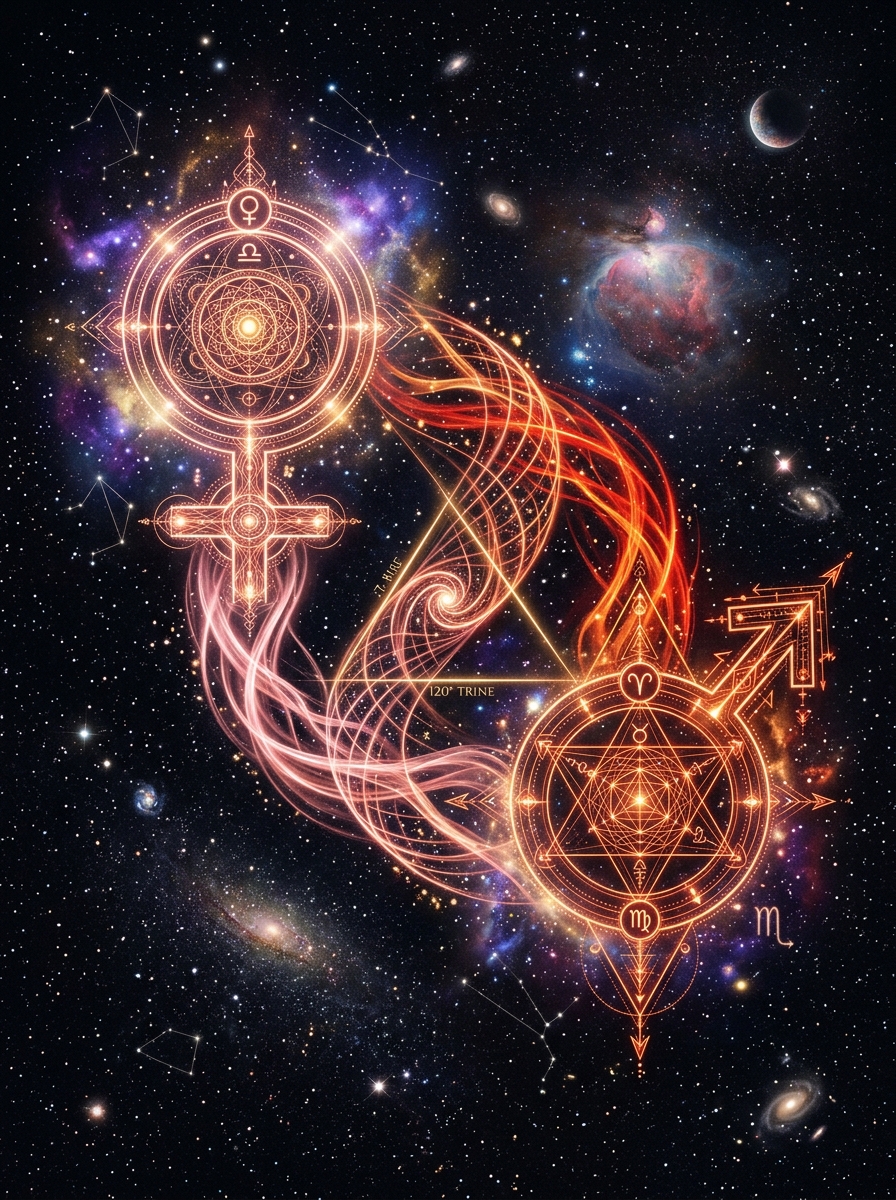
The Astrological Chemistry of Venus and Mars: Affection Meets Desire
In the celestial choreography of synastry, no planetary pairing ignites the imagination or the physical senses quite like Venus and Mars. To understand the chemistry between two birth charts, we must first disassemble these planetary principles into their fundamental psychological and esoteric functions. Venus represents the receptive, magnetic, and aesthetic dimension of the soul. Named after the Roman goddess of love, beauty, and fertility, Venus is the principle of attraction—how we draw people, resources, and experiences toward ourselves. It dictates our relational values, our aesthetic preferences, and the specific frequency of affection we require to feel secure and appreciated. Psychologically, as Carl Jung noted, Venus often aligns with the anima or the internal image of the feminine within the psyche, governing how we relate to the archetype of connection, harmony, and cooperative union. It is our capacity for intimacy, our value system, and the style in which we seek appreciation and relational validation.
Mars, conversely, represents the assertive, active, and outward-directed drive of the ego. It is the celestial warrior, named after the Roman god of war, symbolizing our vital energy, ambition, physical stamina, and erotic desire. While Venus asks, "How do I attract and receive?", Mars asks, "How do I pursue and conquer?" Mars is the engine of the chart, fueling our survival instincts and our capacity to establish boundaries through self-assertion. In Jungian depth psychology, Mars represents the animus—the active, initiating, and structuring force of the psyche. In synastry, the interplay between one person's Venus and another's Mars forms the bedrock of raw physical chemistry. It is the classic polarity of yin and yang, magnetic receptivity meeting kinetic drive. When one person's Mars contacts another's Venus, a circuit is established where the impulse to act directly meets the capacity to appreciate, creating an immediate exchange of energy.
To deepen this understanding, we must also consider the role of sign rulership and essential dignity. A Venus in Taurus or Libra, where the planet is in its home sign, possesses a refined, self-assured approach to attraction, whereas a Venus in Scorpio or Aries (signs ruled by Mars) behaves with a more urgent, passionate, and sometimes challenging style of relating. Similarly, Mars in Aries or Scorpio acts with unyielding, direct authority, while Mars in Taurus or Libra (signs ruled by Venus) must compromise its assertive drive, seeking permission and negotiating its path forward. When these planetary configurations meet in synastry, the relative strength and dignity of each planet determine who holds the upper hand in the relational dance, and how smoothly the alchemy of desire can unfold.
When these two planets form aspects in synastry, they create a bridge of desire. Astrologer Liz Greene describes this connection as the bridge between our need for intimacy and our drive for self-preservation. Without Mars, Venusian relationships can become overly polite, stagnant, and devoid of the creative friction necessary for growth. They risk falling into a polite arrangement where peace is valued over authenticity, leading to a quiet resentment. Without Venus, Martian drive is crude, aggressive, and lacking the refining influence of relational diplomacy. It lacks the capacity to soften and hold space, leading to conflict without resolution. In the words of evolutionary astrologer Steven Forrest, Venus is the invitation, while Mars is the response. When the invitation and response align through synastry, we witness the birth of a profound relational chemistry that transcends simple physical curiosity, acting as a portal for mutual psychological transformation.
The Conjunction: Visceral and Immediate Magnetic Attraction
The Chemistry of Union: When Receptivity Merges with Drive
The conjunction is the most potent aspect in synastry, representing a direct blending of planetary energies. When one person's Venus conjuncts another's Mars, the boundaries between affection and desire dissolve instantly. This alignment acts as a high-voltage energetic conduit, bridging two separate charts with a single current. The Mars person feels an immediate, visceral urge to pursue, protect, and energize the Venus person, finding the Venus person's natural aesthetic and social expression deeply captivating. Meanwhile, the Venus person feels validated, desired, and deeply attractive in the presence of the Mars person. The magnetic pull is felt almost instantly upon meeting, often manifesting as an undeniable physical attraction that defies logical explanation.
In the theater of daily life, this conjunction creates an environment of constant physical and emotional stimulation. The couple finds that even simple, mundane activities are charged with a subtle undercurrent of romantic interest. For example, when Mars in Leo conjuncts Venus in Leo, the relationship becomes a stage where both partners continuously celebrate, praise, and stimulate each other's creative self-expression. The Mars person takes pride in showing off the Venus person, while the Venus person acts as the ultimate audience and muse, refining the Mars person's creative output. This mutual validation creates a highly expressive and protective bond, though it requires both partners to keep their egos in check to avoid competitive drama.
Esoterically, the conjunction represents a sacred marriage (the hieros gamos) within the relational field. The Venus person's relational ideal is directly activated by the Mars person's physical presence and action. They find themselves in a mutual dance where the active partner and the receptive partner stimulate one another in a self-reinforcing loop. However, the conjunction is not without its psychological challenges. Because the energies are fused, there can be a lack of objectivity. The Mars person may become overly possessive or aggressive, viewing the Venus person as a prize to be won rather than a partner to relate to. The Venus person, seeking harmony, might suppress their own boundaries to maintain the connection, leading to a dynamic where Mars dominates and Venus capitulates.
To navigate this aspect constructively, both individuals must remain conscious of their projections. Liz Greene warns that the intensity of the conjunction can lead to rapid burnout if the initial erotic spark is not anchored in mutual respect and shared values. The partners must learn to step back from the heat of the attraction to see each other as individuals, rather than merely archetypal screens for their own inner Anima or Animus. This requires acknowledging that the intense pull is both an external connection and an internal invitation to integrate the opposite principle within oneself. When integrated, the Venus-Mars conjunction provides an inexhaustible source of vitality, keeping the relationship feeling alive, passionate, and creatively renewed over many years.
Harmonious Flow: Trine and Sextile Aspects in Synastry
The Trine: Natural Relational Symphony
When Venus and Mars form a trine (a 120-degree angle) in synastry, they occupy signs of the same element, creating a harmonious and natural flow of energy. The trine represents an inheritance of easy compatibility, where the flow between desire and appreciation is unobstructed. In this configuration, the way the Venus person expresses affection and seeks harmony aligns perfectly with the way the Mars person expresses desire and takes action. If the trine occurs in fire signs (Aries, Leo, Sagittarius), the attraction is expressive, passionate, and fueled by mutual adventure, playfulness, and a shared love for inspiration. If the trine occurs in earth signs (Taurus, Virgo, Capricorn), the connection is deeply sensory, stable, and anchored in material comfort, physical touch, and a shared appreciation for tangible reality.
In air signs (Gemini, Libra, Aquarius), the chemistry is intellectual, social, and communicative, where conversation acts as an aphrodisiac and ideas fuel physical interest. In water signs (Cancer, Scorpio, Pisces), the flow is intuitive, emotionally receptive, and profoundly empathetic, allowing physical intimacy to become a form of silent emotional communion. The beauty of the Venus-Mars trine lies in its lack of strain. The Mars partner does not have to modify their natural drive to make the Venus partner feel safe, nor does the Venus partner have to hide their vulnerability to appease the Mars partner's strength. There is a mutual understanding that allows physical intimacy to develop naturally, without the urgency or anxiety that often accompanies more tense aspects. Steven Forrest notes that while the trine is a blessing, its very ease can sometimes lead to relational laziness. Because the chemistry flows so naturally, the partners may take it for granted, failing to do the conscious work required to grow together.
The Sextile: Playful Opportunities and Creative Collaboration
The sextile (a 60-degree angle) between Venus and Mars in synastry operates similarly to the trine but requires a bit more active participation to bear fruit. The sextile occurs between compatible elements—fire and air, or earth and water. This aspect offers an invitation to play, experiment, and collaborate, acting as a supportive doorway that the couple must choose to open. The attraction here is often sparked by intellectual or social compatibility that quickly translates into physical warmth. The Venus partner appreciates the Mars partner's style of action, while the Mars partner is energized by the Venus partner's social charm and aesthetic sensibility.
In long-term relationships, the Venus-Mars sextile acts as a buffer against boredom. It provides a constant stream of creative ideas, encouraging the couple to pursue shared hobbies, travel, and build a social circle together. Unlike the trine, which can feel like a comfortable couch, the sextile is an invitation to dance. It requires a conscious step forward, but once the momentum is established, it generates a healthy, balanced chemistry that supports both individual autonomy and relational closeness. The partners inspire each other to try new things, keeping the physical and intellectual chemistry fresh through constant curiosity and shared engagement.
Creative Friction: Square and Opposition Aspects
The Square: The Dynamic Spark of Creative Conflict
The square aspect (a 90-degree angle) between Venus and Mars in synastry is the classic indicator of high-friction chemistry. Here, the planetary energies are at cross-purposes, operating in elements that do not easily mix. The Venus person's way of loving and seeking peace clashes with the Mars person's style of asserting power and pursuing desire. For example, a Venus in sensitive Cancer may feel bruised by a Mars in blunt, independent Aries. Yet, it is precisely this tension that generates an incredibly powerful, almost obsessive magnetic pull. The attraction is fueled by the challenge of overcoming the difference between them, creating a volatile but highly stimulating connection.
This friction acts as a heat source that forces both individuals out of their comfort zones. In a square, the partners are constantly challenged to adjust their behavior. The Mars person is forced to develop patience and consideration for the Venus partner's emotional pace, while the Venus person is challenged to find their own voice and assert their needs in the face of Mars's directness. Instead of settling into a predictable routine, the relationship requires constant re-negotiation, making it a powerful vehicle for personal development.
Psychologically, the square represents a profound opportunity for individuation. The irritation that the partners trigger in each other is often a projection of their own repressed shadow material. The Mars partner may project their unacknowledged vulnerability onto the Venus partner, while the Venus partner projects their unexpressed anger onto the Mars partner. Liz Greene suggests that the Venus-Mars square demands that we learn to tolerate tension without resorting to destructive conflict. If the partners can move past the initial defensiveness, the square becomes a catalyst for deep self-awareness and explosive passion, ensuring the relationship never suffers from emotional stagnation. It forces both individuals to grow, demanding that they develop the capacity to contain both their drive for self-assertion and their longing for relational peace.
The Opposition: The Polarized Tug-of-War
The opposition (a 180-degree angle) represents the ultimate axis of relationship: self versus other. When one person's Venus opposes another's Mars, they are standing on opposite sides of the astrological wheel, looking directly at their mirror image. This aspect generates a powerful "push-pull" dynamic. The attraction is immense, often experienced as an intoxicating fascination with someone who seems to possess everything one lacks. However, this fascination can easily turn into polarization, where the partners find themselves locked in a repetitive cycle of pursuit and withdrawal, where one plays the pursuer and the other plays the pursued.
The opposition forces both individuals to confront the archetype of the shadow. The Venus person must integrate their inner Mars, learning to assert themselves directly rather than relying on passive-aggressive charm. The Mars person must integrate their inner Venus, learning to yield, listen, and value relational harmony. When this integration occurs, the opposition transforms from a volatile tug-of-war into a beautiful dance of balanced opposites, where the partners complement each other perfectly, bridging the gap between raw desire and tender affection. It teaches the couple that true intimacy requires holding the space between difference and unity, navigating the threshold where self and other meet.
Bidirectional (Double) Venus-Mars Aspects: The Anima and Animus Mirror
In advanced synastry analysis, we occasionally encounter a phenomenon known as a double or bidirectional aspect. This occurs when Person A's Venus forms an aspect to Person B's Mars, while simultaneously Person B's Venus forms an aspect to Person A's Mars. This reciprocal connection creates a closed circuit of psychological energy, a profound mirror of the Anima and Animus archetypes within both individuals. It is one of the most reliable astrological signatures of a highly significant, transformative relationship that leaves a permanent mark on the soul's journey, demanding total engagement from both participants.
When a double Venus-Mars aspect is present, the traditional gender-typed roles of pursuer and pursued, yin and yang, become fluid and interchangeable. Both partners take turns playing the role of the magnet (Venus) and the initiator (Mars). This fluid exchange of energy fosters a deep sense of equality and mutual understanding. The psychological projection of the inner opposite (the Anima or Animus) is met with immediate, tangible feedback from the partner. This mirroring effect reduces the likelihood of one-sided projection, as both individuals are forced to confront their own relational capacity and drive in equal measure.
Esoterically, this bidirectional link suggests a profound alignment of relational paths. The relationship becomes a laboratory for self-discovery. As Steven Forrest writes, such connections often indicate that the two souls have entered into a contract to work through their relational patterns together, using the heat of their mutual attraction as the fuel for psychological alchemy. The attraction in a double aspect is rarely superficial; it penetrates the deeper layers of the psyche, demanding honesty, vulnerability, and a willingness to grow through the mirror of the beloved. It binds the partners in a shared evolutionary curriculum where every conflict and every moment of harmony serves a greater developmental purpose.
Mythology of Aphrodite and Ares: Navigating Harmony, Fear, and Individuation
To fully comprehend the psychological depth of Venus-Mars aspects, we must turn to the rich mythological narratives of ancient Greece. Venus and Mars find their archetypal templates in Aphrodite, the goddess of love, beauty, and erotic desire, and Ares, the wild, visceral god of war. In classical mythology, their love affair was legendary—a passionate, illicit union that stood in stark contrast to Aphrodite's legitimate marriage to Hephaestus, the crippled blacksmith god of technology, craft, and societal structure. The union of Aphrodite and Ares was not merely a tale of physical indulgence; it was a cosmic alignment of opposing universal principles. It represented the eternal attraction between the beauty that refines and the strength that defends.
From their passionate union, several children were born, each representing a psychological byproduct of the Venus-Mars dynamic. The most famous of their offspring are Harmonia (Harmony) and the twins Phobos (Fear) and Deimos (Terror). This mythological genealogy holds a profound lesson for synastry. When we bring Venus and Mars together in relationship, we do not only generate Harmonia—the sweet, peaceful flow of mutual affection. We also inevitably invoke Phobos and Deimos—the fear of vulnerability, the terror of losing our individuality, and the anxiety of being consumed by the other. The very passion that draws us close triggers our defense mechanisms, forcing us to confront the fear of being dominated or erased.
Confronting these fears is a vital step in the process of individuation. The intense chemistry of Venus-Mars aspects often triggers our deepest relational wounds. The Mars partner may fear that entering the Venusian garden of intimacy will rob them of their independence and strength, reducing their vital drive to a domestic compliance. The Venus partner may fear that the raw, aggressive drive of Mars will destroy the delicate harmony they strive to maintain, shattering their peace with conflict. Astrologer Liz Greene emphasizes that true harmony is not the absence of conflict, but the conscious integration of these fears. By acknowledging the presence of Phobos and Deimos alongside Harmonia, partners can use the mythology of Aphrodite and Ares as a guide to navigate the stormy waters of intimacy, finding a way to love deeply without sacrificing their personal sovereignty.
Evolutionary Astrology: Karmic Contracts and Relational Healing
In the framework of evolutionary astrology, as taught by Steven Forrest and others, relationships are viewed not merely as arrangements for mutual comfort, but as primary vehicles for the evolution of the soul. From this perspective, the aspects between Venus and Mars in synastry represent specific karmic contracts—agreements made prior to incarnation to work through unresolved relational patterns, heal ancient emotional wounds, and cultivate specific psychological virtues. The magnetic attraction we feel is the evolutionary bait, drawing us into the relational dynamics necessary for our spiritual maturity.
When Venus and Mars aspect each other, the souls are drawn together by a powerful evolutionary necessity. A difficult aspect, such as a square or opposition, suggests that in past cycles, the individuals may have struggled to balance their personal desires with the needs of the relationship, perhaps resulting in power struggles, betrayal, or the suppression of one partner's individuality. In the current lifetime, the friction of the aspect forces these unresolved issues to the surface, presenting a precious opportunity for relational healing. It allows the partners to see their past patterns played out in real-time, giving them the choice to respond with consciousness rather than unconscious reaction.
Conversely, harmonious aspects like the trine or sextile indicate a history of cooperative relational work, providing the couple with a reservoir of shared trust and natural understanding that they can draw upon to face other, more challenging areas of their charts. These easy aspects act as spiritual capital, allowing the partners to find refuge in their mutual affection when navigating other areas of life. Evolutionary astrology reminds us that the chemistry we feel is not random; it is the magnetic lure that draws us into the specific classroom our soul requires. By treating the Venus-Mars dynamics in our synastry as a sacred contract, we can move beyond blame and projection, viewing our partner as a valuable ally in our journey toward wholeness and spiritual maturity.
Practical House Placements: Where the Chemistry Manifests in Life
While the aspects between Venus and Mars determine the quality and flow of the chemistry, the house placements of these planets in the synastry chart reveal the concrete areas of life where this chemistry will actually manifest. House overlays show us the stage upon which the planetary drama is performed, translating archetypal potential into daily experience.
When one partner's Venus or Mars falls into the other's First House, the impact is immediate and highly visible. The First House represents the physical body, the persona, and the immediate approach to life. A planet here acts as an instant mirror. The partner whose house is visited feels physically seen, stimulated, and validated. This placement generates a strong desire for physical proximity and shared activity. The attraction is written directly onto the physical environment, making it impossible to ignore.
If the overlay occurs in the Fifth House, the relationship takes on a playful, romantic, and highly creative character. The Fifth House is the domain of self-expression, romance, pleasure, and artistic creation. Venus or Mars here infuses the connection with a sense of joy, encouraging the partners to flirt, play games, create art, and celebrate life together. The romantic spark is easily maintained, as both partners find joy in the act of courtship and continuous creative expression.
In the Seventh House, the focus shifts to partnership, commitment, and the formal contract of marriage. This is the traditional house of Venus. When Venus or Mars occupies the partner's Seventh House, the chemistry is directed toward building a shared life. The desire to cooperate, make decisions together, and establish a balanced, long-term partnership becomes the primary focus, grounding the initial passion in a solid foundation of mutual commitment and social integration.
Finally, the Eighth House overlay brings the Venus-Mars dynamic into the realm of deep psychological intimacy, shared resources, and sexual transformation. The Eighth House is the laboratory of the soul, where we confront our shadows and undergo psychological death and rebirth. Venus or Mars here intensifies the emotional and sexual connection, turning the relationship into a profound, sometimes obsessive, search for total union. Here, the physical chemistry becomes a vehicle for spiritual and psychological alchemy, breaking down the ego boundaries to allow a truly transformative bond to emerge, forcing both individuals to surrender their defenses.
Frequently Asked Questions
What happens if we have no Venus-Mars aspects in synastry?
While Venus-Mars aspects are the classic indicators of physical chemistry, their absence does not mean a relationship is doomed to be sexless or cold. Other planetary pairings can generate powerful attraction and relational depth. For example, Moon-Pluto aspects can create deep emotional obsession and psychological bonding, Sun-Uranus aspects can bring exciting electrical sparks and sudden fascination, and Ascendant-Descendant connections can foster strong physical attraction and immediate recognition. The absence of Venus-Mars aspects simply suggests that the flow between affection and physical drive is not a primary focal point or a major source of friction in the relationship. The couple may find that their chemistry is expressed through other planetary dynamics, such as intellectual compatibility (Mercury) or shared emotional safety and domestic harmony (the Moon).
Is a Venus-Mars square in synastry a dealbreaker for long-term relationships?
Absolutely not. In fact, many long-term couples have Venus-Mars squares in their synastry. While the square creates tension, tension is often what keeps the physical spark alive over many years. Without some form of dynamic tension, relationships can slide into a platonic, sibling-like comfort. The key to managing a Venus-Mars square is consciousness. If the partners are aware of their differing styles of expression—understanding that one's need for space or directness (Mars) is not a rejection of the other's need for connection or harmony (Venus)—they can use the friction constructively as a source of creative and sexual energy rather than destructive conflict. It requires mature communication and the willingness to give each other room to express different needs without taking them as personal attacks.
How do double Venus-Mars aspects feel in a relationship?
A double (or bidirectional) Venus-Mars aspect feels like an incredibly strong, mutual magnetic pull where the roles of lover and beloved are completely shared and balanced. Both partners feel equally desired and equally capable of pursuing the other. There is a sense of psychological completeness and deep recognition, as if you have met your mirror image. The chemistry is typically very resilient, as both individuals are actively participating in the exchange of energy, reducing the classic pursuer-chaser dynamic. It can feel like a profound, fated connection that demands continuous growth, vulnerability, and self-awareness from both people involved, acting as a powerful engine for mutual development.
What is the difference between Venus-Mars aspects and Moon-Pluto aspects?
Venus-Mars aspects primarily govern the realms of romantic attraction, aesthetic compatibility, and physical chemistry. They describe how we flirt, how we express physical desire, and how we establish relational harmony. Moon-Pluto aspects, on the other hand, operate in the deep waters of the unconscious. They govern emotional survival, vulnerability, psychological bonding, and the processing of shadow material. While a Venus-Mars aspect might make you want to dance or share a physical connection, a Moon-Pluto aspect forces you to confront your deepest fears of abandonment, intimacy, and control. Venus-Mars is the dance of desire; Moon-Pluto is the alchemy of emotional rebirth and psychological transformation.
How do houses like the 8th or 5th house affect Venus-Mars aspects?
House overlays modify the expression of the aspects by defining the environment where the energy is experienced. If you have a harmonious Venus-Mars trine, but the planets fall into each other's Eighth House, the easy flow of chemistry will be experienced in a very deep, intense, and transformative setting. It won't feel light and breezy; it will feel profound, intimate, and perhaps a bit mysterious. Conversely, if you have a challenging Venus-Mars square, but it plays out in the Fifth House, the tension might manifest as playful competition, dramatic flirting, or creative rivalry rather than heavy conflict. The houses tell us where the planetary energy is directed, while the aspects describe how that energy behaves.
How do Secondary Progressions of Venus and Mars affect relationship chemistry over time?
Secondary Progressions represent the slow, internal evolution of our natal charts as we grow. When progressed Venus or progressed Mars in one partner's chart forms a new aspect to the other partner's natal Venus or Mars, it can activate a chemistry that was not prominent at the beginning of the relationship. For instance, a couple with no natal Venus-Mars aspects might experience a sudden, intense phase of physical passion or creative collaboration when their progressed planets come into a conjunction or trine. Conversely, a progressed square can bring temporary friction that forces the couple to work through unresolved desires or boundary issues. These progressions highlight that relationship chemistry is not static; it evolves as the individuals grow, offering new chapters of intimacy and psychological work.
Comments
Loading comments…