Moon Sextile Moon in Synastry: The Quiet Ease of Shared Weather
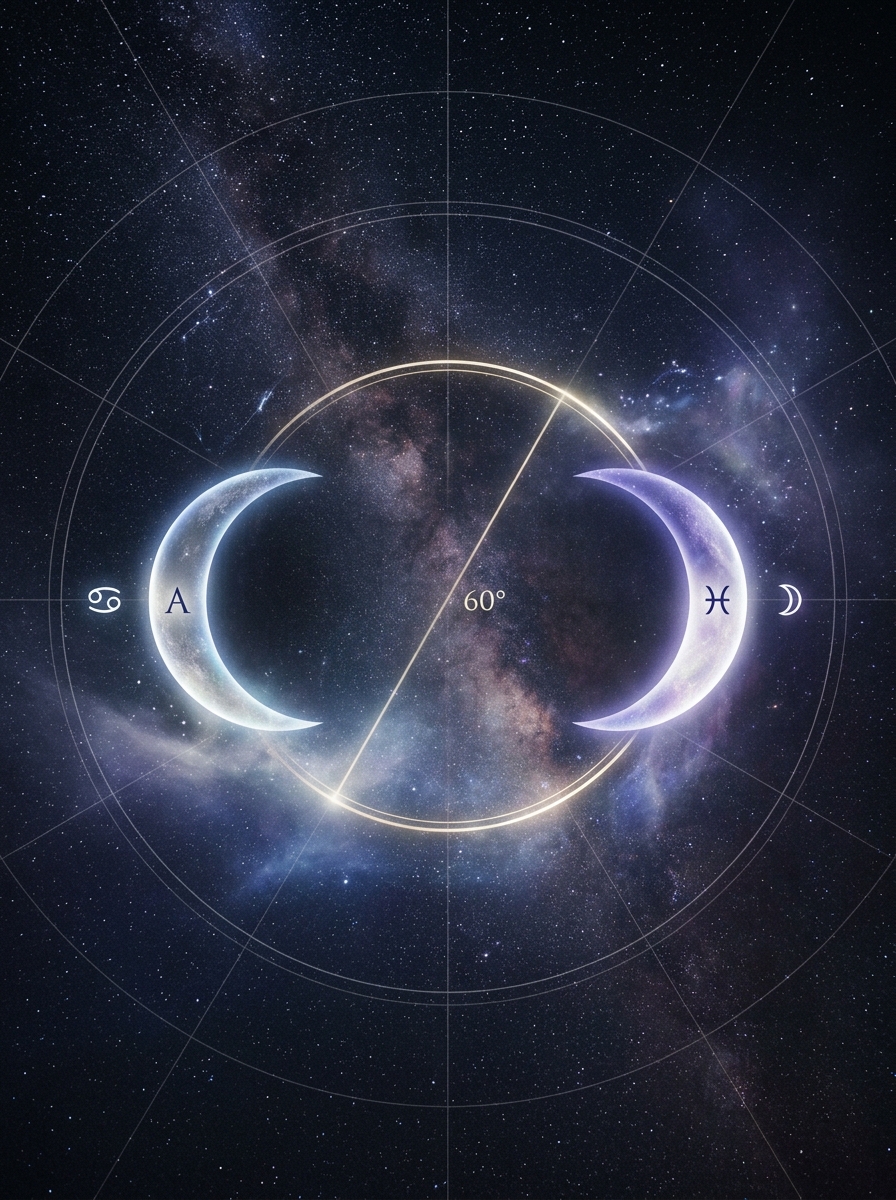
Moon sextile Moon in synastry is not the blaze of destiny — it is the relief of being emotionally legible to one another. A sextile (60-degree aspect) is a door ajar, not a fully open gate. It offers opportunity that must be walked through. In the lunar realm, that opportunity is a cooperative rhythm between two inner worlds: instinct recognizes instinct, and feelings circulate without constant translation. The core thesis is simple — this aspect creates a workable, low-friction exchange where each person's emotional reflexes land as helpful rather than intrusive. That helpfulness is the hidden magnetism. Unlike the compelling wounds activated by squares or oppositions, Moon sextile Moon draws people together through a quieter pull: “I can be myself around you, and you won’t misread me much.” It is the aspect that makes long domestic partnerships, enduring friendships, and relationships survive because the daily emotional climate is manageable. To place it in the broader system, see the full overview of astrological synastry — but here we focus on what this specific lunar contact actually does.
The Psychological Roots: How Shared Weather Forms
The Moon governs the preverbal self — the part that learned safety, feeding, soothing, and retreat in childhood. It does not argue or perform; it remembers. When two Moons are sextile, each person’s early emotional training tends to harmonize without effort. One may have learned to seek comfort through proximity, the other through ritual; but both instinctively recognize that the other’s approach is not a threat. This recognition happens below language, in the body’s response to tone of voice, posture, and pacing.
The aspect does not require identical emotional styles. A Moon in Cancer and a Moon in Taurus, for example, are both receptive, but one wants verbal reassurance and the other wants physical presence. The sextile allows these differences to cooperate rather than collide. The Cancer Moon learns to trust stillness; the Taurus Moon learns to receive words. Compare this with the more overt circuitry of Sun-Moon synastry, where identity and emotion must align directly; here the alignment is lateral, a side-by-side compatibility that grows through shared habits.
Because the sextile is a secondary aspect, it is often overlooked in favor of conjunctions or oppositions. Yet its psychological root is the most practical: two people who can coexist without exhausting each other’s nervous system. This is why the aspect so often appears in charts of couples who report that they “just get along.” The bond is built on mutual permission — each person unconsciously tells the other: you do not have to perform your feelings for me. That permission is the foundation of durable intimacy. For a deeper look at how all lunar contacts function in relationship astrology, synastry step-by-step is the method to follow.
Maturation vs. Shadow: The Quiet Edge
The mature version of Moon sextile Moon is a field of shared growth. The pair learns to name need without drama, repair after disappointment with minimal friction, and maintain a benevolent memory of one another’s preferences and trigger points. This aspect supports emotional timing — knowing when to speak and when to hold a silence intact. It also supports recovery: after conflict, the bond’s basic climate remains livable. People with this contact can acknowledge hurt without theatrical apology or emotional amnesia. In longer relationships, this is the difference between a bond that survives the ordinary pressures of life and one that fractures under them.
But the shadow is real: complacency. Because the sextile feels so comfortable, the pair may mistake smoothness for depth. They might avoid naming real emotional differences to preserve the pleasant weather. One partner could carry distress privately to protect the ease; the other interprets the lack of complaint as true contentment. The bond remains “nice” but unexamined. The risk is emotional courtesy replacing emotional honesty. This is especially likely if either Moon is heavily burdened by hard natal aspects — say, a Moon square Saturn or Moon opposite Pluto. The sextile provides a safer container, but it does not remove the underlying guardedness; it may even allow it to go unaddressed.
The mature response is to use the ease as a launching pad for curiosity, not assumption. Ask: “Is this silence true peace, or unvoiced need?” The shadow is not aggression but passive stagnation. For more on how lunar softness can interact with the sharper edges of desire, see the interplay in Moon-Venus synastry, where affection and safety meet. Also note the difference between this sextile and the semi-sextile — the semi-sextile (30 degrees) carries a more awkward, developmental tension; the sextile cooperates more readily. A fuller explanation can be found in our guide to the semi-sextile in astrology.
How It Plays Out in a Life: Love, Work, and Domestic Ground
Apply the dynamic already established to three domains — not re-explaining it, but showing its concrete expression.
In love, Moon sextile Moon often creates attraction through ordinary proximity rather than lightning-strike chemistry. Shared meals, mutual concern, private jokes — these accumulate into a bond that feels both familiar and safe. The other person’s presence calms the body before exciting the imagination. That is not a lesser form of desire; it is the compost in which durable passion grows. When paired with a sharper Venus-Mars contact like the kind described in Venus and Mars synastry, the heat has somewhere safe to land. The sextile keeps desire from exhausting itself in friction.
In work and collaboration, the aspect supports teams that share an emotional rhythm about deadlines, communication, and feedback. One person’s way of checking in does not feel like prying; another’s need for autonomy does not feel like rejection. The pair can handle stress without turning it into personal conflict. This is especially relevant when the synastric overlay falls across houses 6 and 10 — the domains of daily service and public life. The synastry house overlays page shows how the house placement can shift the tone, but the core lunar compatibility remains the stabilizer.
In domestic life, the aspect’s cooperative grammar appears in shared agreement on how a home should feel: orderly but not sterile, warm but not smothering. The couple may coordinate food, rest, routines without lengthy negotiations. They remember one another’s sentimental landmarks — what a hard day looks like, how to make each other feel at home. This is why the aspect often appears in charts of people who remain emotionally useful to one another over years, not just as lovers but as co-parents, housemates, or trusted intimates. The bond is not about spectacle; it is about livable companionship.
Reading It in the Larger Chart
Moon sextile Moon should never be read in isolation. Its effect depends heavily on the signs occupied and the houses activated. A Water Moon and an Earth Moon (e.g., Moon in Pisces sextile Moon in Capricorn) will feel immediately usable: emotional depth anchored by practical care. Fire and Air Moons (e.g., Moon in Aries sextile Moon in Gemini) may experience the contact as enlivening through shared curiosity and encouragement. But if either Moon is made difficult by hard aspects to Saturn, Pluto, or Uranus natally, the sextile may function more as a relief valve than as a full emotional match. It provides a safe space, but the person’s ingrained patterns of guardedness or control still need conscious work.
Houses matter equally. A Moon sextile Moon that falls across the 4th and 6th houses tends to express through home management, health rituals, and everyday service. If the overlay involves the 5th and 11th houses, the same aspect feels like play, friendship, and creative encouragement. The Alchemy of Love Synastry guide offers a framework for integrating multiple factors, but the key is to treat the sextile as one thread in a larger weave — not the whole story.
When strong Sun-Moon support appears alongside this aspect, identity and emotion reinforce each other naturally, often the difference between liking someone and building a life with them. For those seeking that layer of alignment, Sun-Moon synastry is the companion reading. And if the chart contains a semi-sextile between Moons (a 30-degree gap), the dynamic shifts again — the article on the astrological semi-sextile aspect explains why that smaller distance can feel more awkward and developmental than a sextile’s grace.
Ultimately, Moon sextile Moon is one of the most livable forms of lunar contact because it asks little theatrically and much behaviorally. It generates climate, not events. That makes it easy to undervalue — and hard to replace. The relationship may never announce itself with thunder, but it often endures because the emotional weather is negotiable, humane, and quietly affectionate. That is the quiet ease of shared weather.
Related
- Synastry Sun Sextile Moon: When Warmth Finds a Home
- Moon Sextile Mars Synastry: The Warmth That Knows How to Move
- Synastry Moon Sextile Venus: The Soft Geometry of Feeling and Affection
- Synastry Moon Sextile Mercury: When Feeling Finds a Voice
- Moon Conjunct Moon Synastry: When Two Inner Tides Recognize Each Other
Comments
Loading comments…