Synastry Sun Trine Moon: The Quiet Chemistry of Being Felt
The architecture of recognition
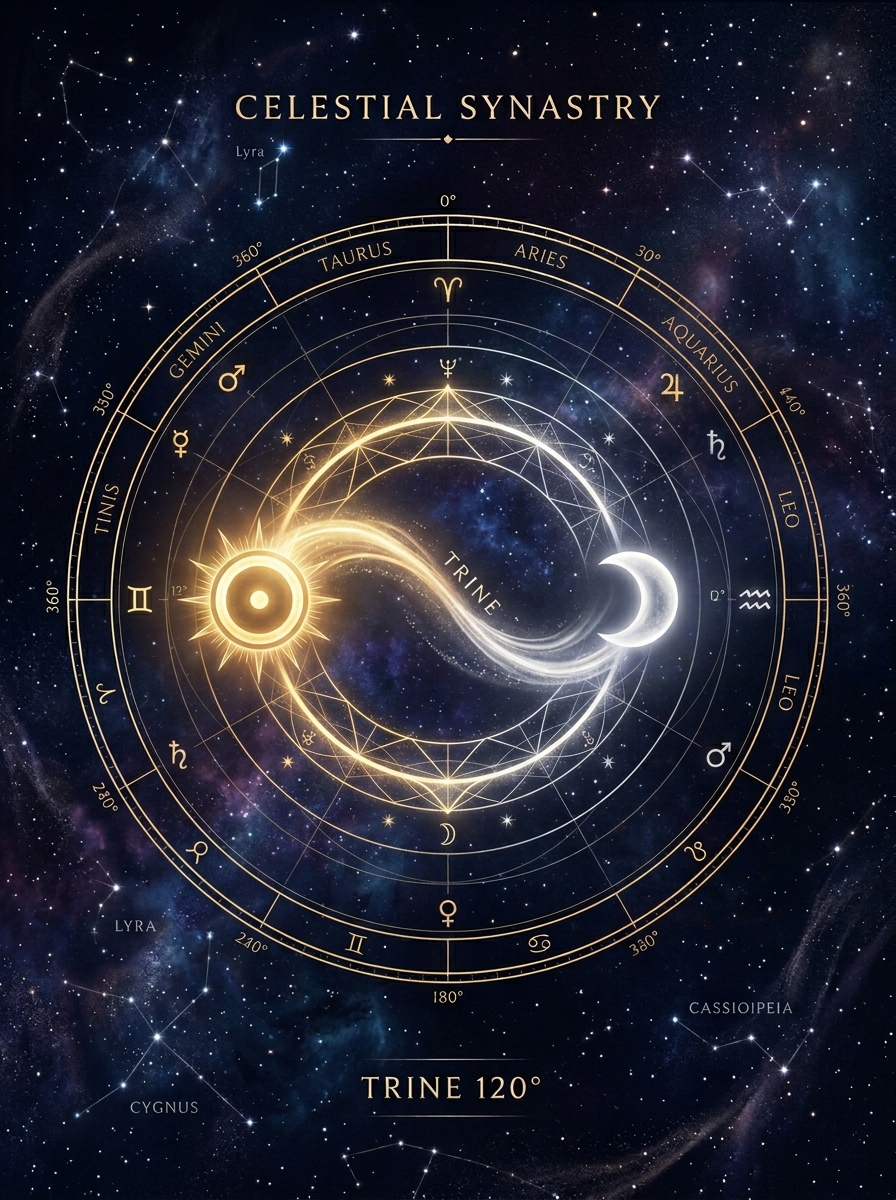
In synastry, Sun trine Moon is not the loudest aspect in the chart, but it may be the most livable. The solar person’s core identity and the lunar person’s emotional instinct meet across a harmonious 120‑degree arc, which means they support rather than challenge each other. The result is not the crackle of opposition or the gravity of a conjunction — it is something rarer: an ease that feels less like chemistry and more like the relief of being understood without having to explain.
This contact links the two central luminaries, the day‑star and the night‑water of any birth chart. When they flow together in a relationship, the couple gains an instinctive fit in timing, tone, and basic emotional expectations. The Sun person tends to experience the Moon person as emotionally legible, responsive, and grounding; the Moon person in turn feels warmed, seen, and quietly claimed by the Sun’s presence. There is attraction here, but it is rarely the driven kind. It is the slower, more durable gravity of two people who find it easy to share a room, a schedule, a silence.
For the broader framework of how relationship charts are read, see Astrological Synastry and Synastry Aspects. This aspect matters because it describes the underlying weather of a bond — the climate in which every other aspect either flourishes or struggles.
Psychological roots and the mechanism of flow
The trine is a flowing aspect. In elemental terms, a Sun trine Moon means the Sun and Moon are in signs of the same element (or elements that naturally harmonize, like water and earth). This does not mean they agree on everything — it means their fundamental languages do not clash. The Sun person’s self‑expression does not threaten the Moon person’s emotional safety; the Moon person’s moods do not derail the Sun person’s direction.
This dynamic produces a particular kind of attraction: one without conquest. The Sun does not have to perform or dominate to hold the Moon’s attention. The Moon does not have to shape‑shift to earn the Sun’s approval. Instead, each offers the other what they most need. The Sun person radiates vitality, and the Moon person absorbs it, feeling more alive. The Moon person extends emotional permission, and the Sun person relaxes into being a person rather than a performer.
This can feel almost suspiciously easy, especially in a culture that equates passion with friction. But ease is not emptiness. The trine describes a rapport that allows a relationship to endure past the first flame. It does not depend on dramatic gestures; it lives in the ordinary — the right word at the right moment, the instinctive adjustment of tone, the shared laugh that needs no explanation. In this sense, it is closer to the sanctuary described in Moon‑Venus Synastry than to the charge of a hard aspect. The difference is that Moon‑Venus decorates the bond with sweetness; Sun‑Moon feeds it with basic mutual recognition.
For a deeper look at the geometry of trines and why they can feel like predestined flow, see the Trine Aspect in Astrology.
The shadow of under-articulation
Every harmonious aspect has a blind side. With Sun trine Moon, the greatest risk is not conflict — it is silence. Because the relationship feels so accommodating, the couple may stop doing the hard work of articulating what they actually need. The Sun person assumes the Moon person is fine because there is little resistance. The Moon person assumes the Sun person is satisfied because no tension surfaces. Harmony becomes a shared guesswork, and the guess can slowly drift out of alignment.
This is the shadow of trines in general: the inertia of comfort. The Grand Trine teaches the same lesson writ large — that natural ease can anesthetize growth. In a Sun‑Moon trine, the issue is specifically emotional. The relationship can remain pleasant while the living edge dulls. Small disappointments go unnamed; asymmetries go unexamined. One day the couple wakes up to a distance that accumulated without a single loud argument.
Another subtle trap is role specialization. The Sun person becomes the competent one, the Moon person the understanding one. This can feel complementary for years, but over time it hardens into emotional caste. The Sun person over‑identifies with initiative; the Moon person becomes the emotional custodian, soothing everyone at the cost of self‑expression. Because the aspect is harmonious, the imbalance can remain invisible until it is entrenched.
The trine does not eliminate friction — it anesthetizes it. The couple must learn to choose honesty inside the harmony, or the harmony becomes a hollow container. That choice is the work that turns a lucky aspect into a mature one.
How signs and houses color the trine
A Sun trine Moon does not feel identical in every sign pair. The element matters as much as the aspect. Fire‑trine‑fire (e.g., Sun in Aries trine Moon in Leo) generates mutual confidence, applause, and forward momentum. Earth‑trine‑earth (Sun in Taurus trine Moon in Virgo) produces practical trust, sensual ease, and a bond that may be less demonstrative but more durable. Air‑trine‑air (Sun in Gemini trine Moon in Libra) favors conversation, shared ideas, and the pleasure of mental recognition. Water‑trine‑water (Sun in Cancer trine Moon in Scorpio) can create profound emotional attunement, sometimes so seamless that boundaries blur.
The house placement of the luminaries adds another layer. If the Sun or Moon lands in the 4th, 7th, or 8th houses, the bond feels especially intimate — suited for domestic life or deep emotional exchange. If they fall in the 1st and 5th, the relationship becomes more visibly affectionate, expressive, and identity‑affirming. House overlays do not override the aspect, but they tell you where the harmony gets lived. For a full map of that geography, Synastry House Overlays is the essential reference.
Understanding the element and house of each luminary transforms the trine from a generic “good aspect” into a specific, textured reality. It is the difference between knowing that two people get along and knowing how they get along.
What it builds and what it still needs
Sun trine Moon is excellent for any bond that requires repeated emotional calibration: long‑term cohabitation, parenting, business partnerships with a personal component, and committed love. It supports the mundane devotions that make a relationship real — remembering preferences, reading moods accurately, timing difficult conversations well. When the Sun person’s life direction and the Moon person’s needs do not constantly compete, the couple can focus on building rather than merely surviving.
Yet a trine between the luminaries does not automatically solve desire, communication style, or long‑range values. A couple can have lovely Sun‑Moon harmony and still struggle with the polarity of Venus and Mars, or with Saturn contacts that introduce timing, fear, or obligation. The full erotic and relational texture of a chart requires the rest of the synastry matrix. Venus and Mars Synastry covers the more overt dance of attraction; The Alchemy of Love Synastry explains why love is never reducible to one aspect, however blessed.
The deeper truth is simple: Sun trine Moon makes it easier to be ourselves in one another’s presence. It does not make us wiser by default. That wisdom has to be chosen, renewed, and tested against reality. If the couple can keep speaking honestly inside the harmony, the aspect becomes more than comfort — it becomes a vessel for trust. In that sense, the trine is not a finished answer but a permission structure. It invites two people to inhabit each other’s humanity without excessive armor. And when that works, the relationship does not merely feel pleasant; it feels inhabited.
Related
- Synastry Moon Trine Moon: The Quiet River of Emotional Compatibility
- Synastry: Sun Trine Sun — Shared Fire, Easy Recognition, and the Art of Not Taking It for Granted
- Synastry Sun Trine Venus: The Easy Warmth of Being Wanted
- Synastry Sun Trine Mercury: When Identity Finds a Language
- Moon Trine Venus in Synastry: The Soft Geometry of Being Easily Loved
Comments
Loading comments…