Moon Conjunct Venus in Synastry: The Tender Current That Turns Chemistry into Care
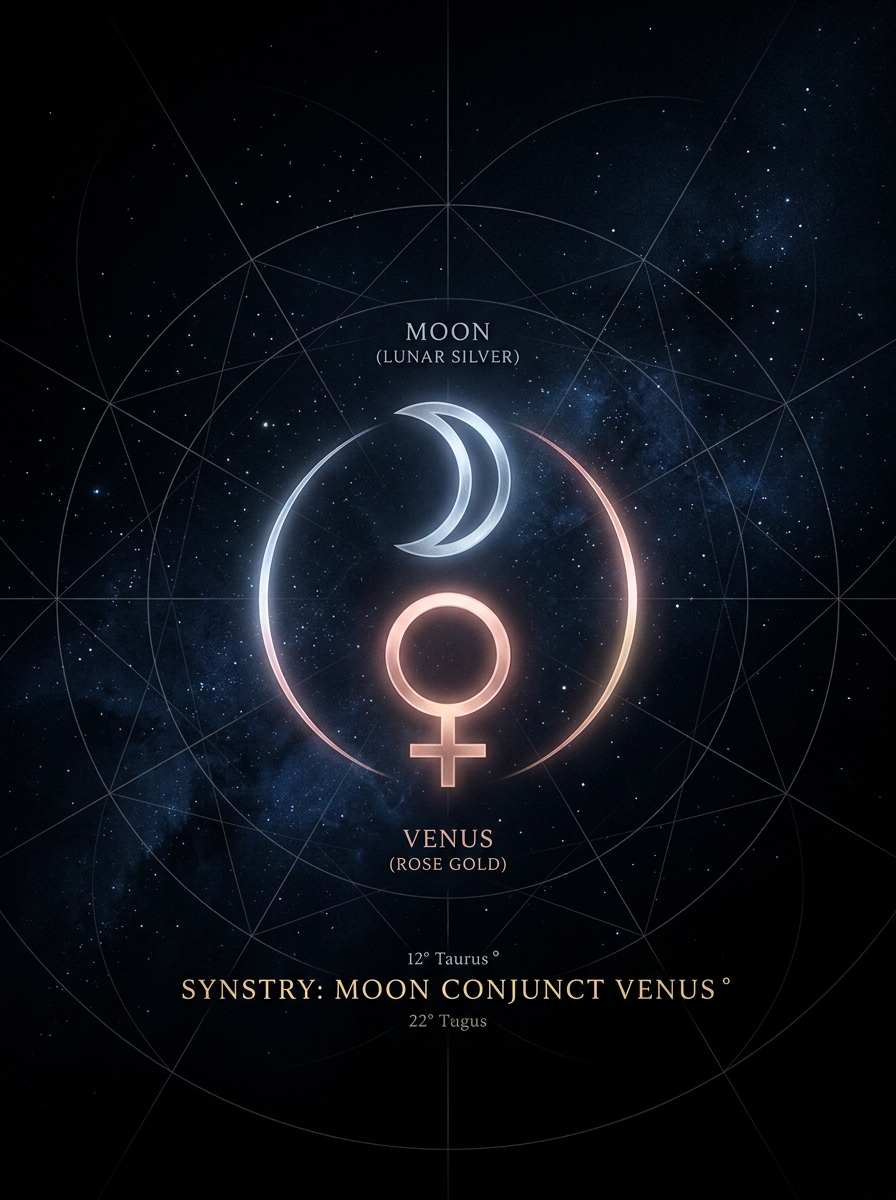
The fusion of safety and desire
Moon conjunct Venus in synastry is not simply a "good" aspect; it is a specific anatomical event in the relationship chart. The Moon person's emotional need to be held, fed, and attuned meets the Venus person's drive to create pleasure, beauty, and reciprocity. When their planets occupy the same degree, these two impulses lock together in a single gesture: affection becomes care, care becomes affection. There is no distance between feeling wanted and feeling loved.
This is why the bond often arrives before words do. The Moon person senses that their private moods are not tolerated but welcomed; the Venus person feels their giving nature is met with genuine warmth rather than obligation. The result is a relationship that feels less like an encounter and more like a homecoming. But the conjunction's power lies in its fusion: the Moon's hunger for safety and Venus's appetite for harmony become indistinguishable. To please the other is to soothe the self, and to soothe the self is to please the other. That collapse is the root of both the aspect's sweetness and its shadow.
For the broader context of how this fits into chart comparison, the Moon-Venus synastry page covers the full aspect family; the conjunction is its most concentrated expression.
How the bond forms: emotional taste and bodily memory
The attraction created by this conjunction bypasses the rational mind. The Moon governs the body's ancient survival intelligence—what feels safe enough to sleep near, what tone of voice signals no threat. Venus governs what the nervous system registers as agreeable: a certain scent, a particular light, the right pressure of a hand. Together, they create a kind of sensory imprinting. The Moon person may not know why the Venus person's presence calms their anxiety; they only know it does. The Venus person may not understand why the Moon person's laugh feels like permission to be soft; they simply relax into it.
This imprinting builds a shared memory palace made of texture and timing: the way morning light falls on the kitchen table, the exact cadence of reassurance after a hard day, the habit of leaving a cup of tea at a precise temperature. These are not romantic gestures in the conventional sense; they are the language of the aspect. The relationship becomes unforgettable not because of dramatic events but because it feels physically good in a way that few connections do.
This is fundamentally different from the charge of Venus-Mars synastry. Venus-Mars generates pursuit, heat, and the spark of difference; Moon-Venus generates belonging, comfort, and the ease of sameness. The former ignites, the latter nourishes. When both are present, the relationship can burn and cradle simultaneously. But Moon-Venus alone risks becoming too cozy, because there is no inherent friction to keep the flame alive.
The shadow: when tenderness becomes enmeshment
Because the conjunction fuses emotional safety with relational pleasure, both partners have a strong incentive to avoid anything that might break the harmony. The Moon person may suppress irritation rather than risk losing the Venus person's soothing presence. The Venus person may over-function as the emotional diplomat, smoothing over rough edges until they forget they have preferences of their own. The result is a relationship that feels beautiful in the way a well-kept room is beautiful: lovely, but slightly airless.
The key hazard is not coldness but over-accommodation. Neither partner wants to be the one who introduces tension, so the bond drifts toward a polite emotional anesthesia. Disagreements go unspoken; needs are swallowed; the couple becomes experts in reading each other's moods without actually naming what is wrong. This is not intimacy; it is a mutual protection pact that starves the relationship of oxygen.
The difference between healthy tenderness and unhealthy enmeshment lies in whether each individual retains a separate emotional spine. A mature Moon-Venus bond allows the Moon person to feel held without demanding constant reassurance, and the Venus person to give without losing their own center. When the rest of the chart provides friction—hard aspects to Saturn, Pluto, or Mars—those forces introduce necessary boundaries. If the chart lacks that tension, the couple may need to learn it consciously. For a deeper look at how house placements shape where this sweetness settles and potentially suffocates, see synastry house overlays.
How it lives: sign, house, and the Venus person's nature
The conjunction itself is the engine; the sign and house determine where it drives. Moon conjunct Venus in Taurus creates a bond rooted in physical steadiness, shared meals, and slow, dependable touch. In Gemini, affection arrives as banter, intellectual curiosity, and a stream of small conversational gifts. In Scorpio, the sweetness is intense, private, and laced with emotional risk—the Moon person's vulnerability is met not with softness but with depth. In Aquarius, the bond may express through shared ideals, friendship, and a kind of cool but genuine loyalty.
The house overlay determines the domain of life where the conjunction does its work. In the fourth house, the relationship becomes a literal home—a sanctuary of domestic rituals and psychic nesting. In the seventh house, it manifests as visible partnership and mutual devotion, often with a public face. In the fifth house, it turns playful, creative, and romantically effusive; in the twelfth, the attachment can be quietly sacrificial, devotional, or so private that neither person fully understands its grip until years have passed. For a closer look at how Venus behaves when ruling these houses, consult Venus in the fourth house or Venus in the seventh house.
Equally important is the Venus person's natal sign. Venus in Libra seeks elegance, reciprocity, and explicit fairness; the same lunar conjunction will feel like a dance of deliberate grace. Venus in Virgo shows love through service and discernment—the Moon person may feel cared for through small, precise acts of attention. Venus in Pisces dissolves boundaries, creating a bond that feels fated and boundaryless. The conjunction amplifies whatever Venus already values, so reading the Venus person's natal chart is essential to see what "pleasure" and "harmony" actually mean to them. The archetypal framework of Venus in astrology provides the foundational lens.
When the bond matures
The most durable Moon-Venus relationships share three elements: enough warmth to feel nourishing, enough honesty to prevent sentimental fog, and enough distinction between the two people that affection remains a choice rather than a reflex. Paradoxically, the aspect lasts when it is not treated as self-sustaining. The couple must keep choosing each other, because the bond is so pleasant that complacency is always nearby.
When it works well, the conjunction becomes a sanctuary that supports individuation. The Moon person learns that closeness does not require crisis; the Venus person learns that beauty can be practical, not just decorative. Together they discover that devotion is not merely feeling good about each other—it is making a life where tenderness has a reliable shape. This is why the aspect appears so often in long-term unions, family-like partnerships, and friendships that have outgrown the need for romance but kept its warmth.
In the evolutionary reading of Steven Forrest, the developmental task of Moon conjunct Venus is to refine the art of loving without sentimental fraud. It invites grace, but it also asks for awareness. When the chart context supports it, this aspect does something almost old-fashioned in the best sense: it makes affection feel like a place you can live, not just a feeling you can visit. For a fuller map of how this fits into the broader relational chart, the alchemy of love synastry guide places it among the other love signatures.
Related
- Synastry Moon Sextile Venus: The Soft Geometry of Feeling and Affection
- Moon Trine Venus in Synastry: The Soft Geometry of Being Easily Loved
- Moon Opposite Venus in Synastry: The Beauty That Pulls and the Feeling That Pushes
- Synastry Sun Conjunct Venus: Attraction, Ease, and the Point Where Admiration Becomes Appetite
- Moon Sextile Venus: The Quiet Accord of Feeling and Grace
Comments
Loading comments…