Synastry House Overlays: The Astrological Geography of Relational Resonance
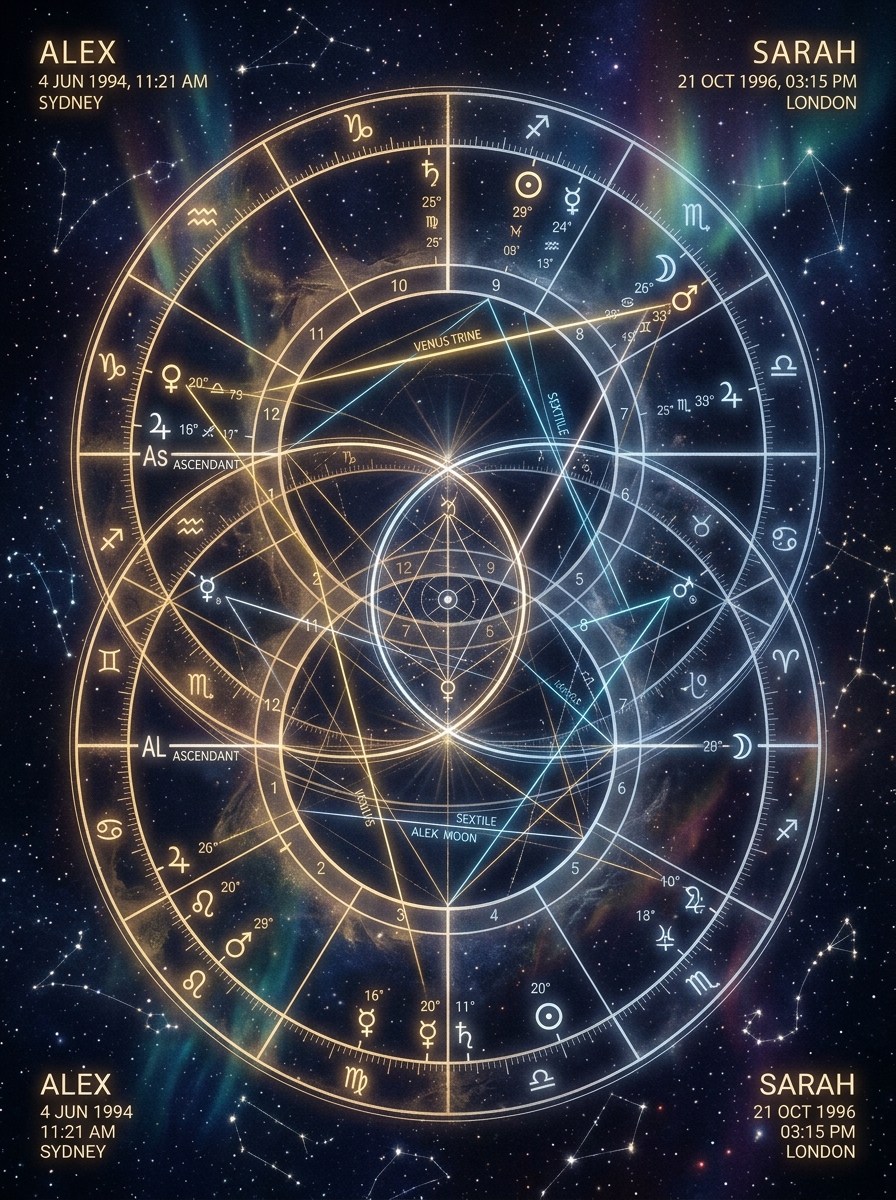
The Concept of House Overlays: The Host-Guest Dynamic in Synastry
When two lives intersect, their individual birth charts do not merely sit side by side; they overlay, creating a dynamic, multidimensional field of mutual influence. In the practice of synastry, the comparison of two astrological charts, we frequently look to inter-chart aspects—how my Mars aspects your Venus, or how your Saturn squares my Moon. While these aspects describe the energetic friction and harmony between psychological functions, they do not tell us where these interactions physically and psychologically take place. For that, we must turn to house overlays.
House overlays represent the symbolic geography of relationship. They map the exact areas of life where one person’s energy is introduced into the other’s developmental field. In this relational landscape, we can employ the metaphor of the Host and the Guest. The person whose chart provides the houses is the Host. Their natal house structure represents a series of twelve private rooms, each representing a specific area of psychological and external experience—from the deeply personal sanctuary of the fourth house to the public theater of the tenth. The person whose planets fall into those houses is the Guest.
When a Guest’s planet enters a Host’s house, it acts as an active force, a celestial visitor carrying a specific agenda. The Guest does not change the inherent nature of the Host’s house, but they turn on the lights, rearrange the furniture, and demand that the Host pay attention to the affairs of that room. If your Sun falls in my third house, your core identity shines a bright light into my everyday communication, intellectual pursuits, and immediate environment. You become a catalyst for my mental growth, forcing me to speak, write, and think in new ways.
This dynamic is rarely symmetrical. Your planets may crowd into my eighth house, triggering profound psychological transformations and intense intimacy, while my planets might scatter across your intellectual and social houses, making you feel intellectually stimulated but emotionally safe. Understanding the Host-Guest dynamic requires us to look at the chart through both lenses: how you activate my private chambers, and how I animate yours. Through this lens, relationships cease to be simple compatibility scores and instead become rich, unfolding landscapes of mutual exploration and psychological integration.
Psychological Projection and Resonance in Activated Houses
The activation of a natal house by another person’s planets is rarely a passive experience; it is a profound trigger for psychological projection and resonance. As Carl Jung observed, everything that is unconscious in ourselves is projected onto the other. In the context of synastry, house overlays map the specific arenas where these projections are staged. When a partner's planet lands in a particular house, it often acts as a hook for our own unexpressed potential or unresolved shadows associated with that house.
For example, if a person has a completely empty twelfth house natally, they may be largely disconnected from their own subconscious depths, spiritual yearnings, or tendencies toward self-sabotage. When a partner enters their life with a cluster of planets—say, the Sun and Venus—falling into that twelfth house, the host partner experiences a sudden, overwhelming activation of these hidden realms. Because they cannot immediately own these twelve-house qualities, they project them onto the partner. The partner is seen as mystically enlightened, elusive, or perhaps Savior-like. Over time, as the projection wears off, the host must grapple with the reality of their own subconscious landscape.
This process is what Liz Greene refers to as the "relational catalyst for individuation." The planets of the guest do not simply cause external events; they resonate with the archetypal potentials already sleeping within the host's natal structure. If the host has a natal Saturn in the seventh house, they already possess an inner blueprint of fear, structure, and duty regarding partnerships. When a partner's Mars overlays this Saturn, it activates the latent tension. The partner's assertive drive feels like a direct threat or a heavy burden, initiating a psychological crisis that forces the host to confront their own Saturnian defenses.
Resonance also means that the guest is affected. The guest is forced to play a role dictated by the host's house theme. If your Mercury falls in my eighth house, you may find yourself speaking to me about secrets, taboos, and deep psychological traumas that you rarely discuss with anyone else. The pressure of my eighth-house container pulls those deep, hidden communications out of your Mercurial intellect. Thus, both partners are caught in an alchemical loop where the house acts as the crucible, and the visiting planet acts as the transforming fire.
Technical Clarification: House Overlays vs. Traditional Derived Houses
In contemporary astrology, there is occasionally technical confusion between the terms "house overlays" and "derived houses." While both concepts involve looking at houses through a secondary lens, they are distinct techniques with different applications in chart interpretation. Clarifying these terms is essential for any practitioner seeking to apply these methods accurately in relationship analysis.
Historically, the term "derived houses" (sometimes referred to as turn-chart astrology or prashna derivatives in horary) is a technique where we turn the natal chart to view it from the perspective of a specific house. For example, if we want to look at the assets of the spouse, we take the seventh house (representing the spouse) as the temporary first house. The eighth house of the natal chart then becomes the "second house from the seventh" (representing the spouse's money or resources). Similarly, the fourth house (the mother) can be turned so that the sixth house (three houses away from the fourth) represents the mother’s siblings. This is a mathematical abstraction used to extract information about third parties from a single natal chart.
House overlays in synastry, however, are not abstract turnings of a single chart. Instead, they represent the concrete, physical overlay of two distinct astronomical frameworks. We take the exact coordinates of Partner A's planets and project them directly onto the template of Partner B's natal houses, calculated for Partner B's specific birth time and location. This is a comparison of two actual, living energy fields.
In some older astrological texts, writers used the term "derived houses" colloquially to describe how my planets function when placed in your houses. However, to maintain technical precision, we should reserve "derived houses" for the turning-chart technique within a single radix, and use "house overlays" exclusively to denote the inter-chart mapping of synastry. Recognizing this distinction prevents us from confusing the literal presence of a partner's psychological drive (an overlay) with the theoretical status of a relative or partner in our own natal chart (a derived house).
House 1 Activation: Identity, Vitality, and Self-Image
The first house is the threshold of the psyche, the Ascendant, representing the persona, physical vitality, and the immediate interface through which we meet the world. When a partner's planets overlay our first house, the impact is immediate, visible, and deeply felt. There is no hiding from first-house activation; it occurs at the surface of our awareness, affecting our very self-image and how we project our identity.
When the Guest’s Sun, Moon, or Venus lands in the Host’s first house, a powerful magnetic attraction is generated. The Host feels instantly "seen" and validated by the Guest. The Guest's planets act as a mirror, reflecting the Host's physical presence and personality back to them in a way that feels affirming. For instance, Venus in the first house overlay often makes the Host feel physically attractive, cherished, and socially at ease in the Guest’s presence. The Guest appreciates the Host’s natural mannerisms and appearance, creating an immediate visual and aesthetic harmony.
However, more challenging planets in the first house can bring friction. If the Guest's Mars overlays the Host's first house, the Host may feel constantly challenged, provoked, or energized by the Guest. While this can manifest as strong physical chemistry, it can also lead to competitive dynamics or a sense that the Guest is invading the Host’s personal space. The Guest may perceive the Host as overly sensitive or defensive, while the Host views the Guest as aggressive or pushy.
Ultimately, first-house overlays act as catalysts for how we define ourselves. The Guest's planets stimulate our vitality and force us to ask: Who am I in the presence of this person? Through their presence in our first house, the Guest encourages us to embody our Ascendant more fully, helping us step out of the shadows and claim our right to exist as distinct individuals.
The Axis of Value (2nd and 8th Houses): Resources, Self-Worth, and Deep Intimacy
The second and eighth houses form the axis of value, security, and transformation. This axis governs what we own, what we value, and how we merge our resources—both material and psychological—with another. When overlays occur along this axis, the relationship shifts from superficial attraction to deep questions of survival, power, and shared destiny.
The Second House: Concrete Security and Shared Values
When a partner's planets fall into our second house, they activate our sense of self-worth, financial attitudes, and material security. The Guest’s planets interact with the Host's relationship to the physical world. If the Guest's Jupiter lands here, it can bring a sense of abundance, optimism, and financial opportunity to the Host. The Guest acts as a supporter of the Host’s talents, encouraging them to value their skills and build material stability.
Conversely, if Saturn overlays the second house, the Host may feel restricted, financially pressured, or judged by the Guest regarding their spending habits and self-worth. Yet, this can also ground the relationship, providing a practical structure for building long-term wealth. The core dynamic of the second house overlay is concrete: the Guest influences how the Host manages their assets and how they value themselves on a fundamental, physical level.
The Eighth House: Psychological Alchemy and Sexual Fusion
The eighth house is the dark mirror of the second, representing shared resources, intimacy, taboos, and the psychological underworld. When a partner's planets fall here, it triggers what Steven Forrest describes as a deep, instinctual pull that cannot be easily rationalized. The Guest’s planets enter the Host's private vault of secrets, fears, and sexual desires.
If the Guest's Pluto or Mars lands in the Host's eighth house, the relationship can feel intensely magnetic, obsessive, and transformative. The Host cannot keep secrets from the Guest; the Guest naturally probes the Host's subconscious motivations. This activation can lead to profound psychological healing and sexual fusion, but it carries the risk of power struggles, emotional manipulation, and mutual codependency. The Guest acts as an alchemist, stirring the Host’s deepest waters to catalyze a complete death-and-rebirth process within the Host’s psyche.
The Axis of Intellect (3rd and 9th Houses): Everyday Communication and Mental Expansion
The third and ninth houses form the axis of the mind, bridging our immediate, everyday intellectual environment with our search for higher truth, philosophy, and broad horizons. Overlays on this axis determine how partners communicate, share ideas, and expand each other's worldviews.
The Third House: The Chemistry of Casual Exchange
The third house governs local environments, sibling relationships, and the linear, rational mind. When a partner's planets fall here, they stimulate the Host's daily thoughts, communication patterns, and immediate curiosity. If the Guest's Mercury overlays the Host's third house, conversation flows effortlessly. The partners can talk for hours about mundane details, local gossip, or intellectual interests without feeling drained.
This overlay creates a comfortable, neighborly rapport. The Guest feels like someone the Host can brainstorm with, write with, or take short road trips with. It is an excellent overlay for intellectual companionship, ensuring that the daily, verbal traffic of the relationship remains active and mentally stimulating. The primary risk is that the relationship can become overly intellectualized, avoiding deeper emotional waters in favor of endless debate and analysis.
The Ninth House: Philosophical Alignment and Spiritual Journeys
The ninth house represents the search for meaning, higher education, long-distance travel, and belief systems. When a partner's planets activate this house, they act as a guide or a teacher, expanding the Host’s intellectual and spiritual boundaries. If the Guest's Sun or Jupiter overlays the Host's ninth house, the Host views the Guest as an inspiring figure who opens doors to new cultures, philosophies, or spiritual paths.
The Guest encourages the Host to think larger, leave their comfort zone, and seek a higher purpose. The relationship often involves shared journeys—either literal travels to foreign lands or intellectual voyages through academia and esoteric studies. If the Guest's Saturn overlays this house, they may challenge the Host's dogmatic beliefs, forcing them to build a more structured, mature philosophy of life.
The Axis of Structure (4th and 10th Houses): Domestic Roots and Shared Public Life
The fourth and tenth houses anchor the vertical axis of the chart—the Meridian. This axis represents our roots, family conditioning, and private sanctuary (fourth house/IC) balanced against our public calling, career, and social standing (tenth house/MC). Overlays here determine how a couple builds a private life together and how they present themselves to the wider world.
The Fourth House: Anchoring the Soul in Private Spaces
The fourth house is the base of the chart, representing the home, ancestral roots, emotional security, and the private self. When a partner's planets land here, they enter the Host's most private sanctuary. If the Guest’s Moon or Venus overlays the Host’s fourth house, there is an immediate, comforting feeling of familiarity—a sense of "coming home."
The Host feels safe showing their raw, unmasked emotions to the Guest. This is a foundational overlay for long-term domestic harmony and cohabitation. The Guest naturally fits into the Host’s family dynamic and private life. However, if the Guest's Saturn or Pluto activates this house, it can stir up early childhood wounds, parental projections, and deep-seated insecurities, requiring the Host to rebuild their emotional foundations from the ground up.
The Tenth House: The Public Arena and Shared Status
The tenth house is the pinnacle of the chart, representing career, public status, authority, and destiny. When a partner's planets overlay this house, they shine a public spotlight on the Host. If the Guest's Sun or Midheaven ruler lands in the Host's tenth house, the Guest acts as a significant catalyst for the Host’s professional ambition and public success.
The Guest encourages the Host to step into their authority and achieve recognition. The Host may view the Guest as a mentor, a professional partner, or an authority figure. In the eyes of the public, the couple is seen as a power duo, with their status and career goals closely aligned. The challenge arises if the Guest attempts to control or dominate the Host’s public image, leading to professional rivalry or resentment.
House 5 Activation: Passion, Romance, and Creative Play
The fifth house is the house of joy, creativity, romance, and self-expression. When a partner's planets overlay this house, they activate the inner child of the Host, infusing the relationship with playfulness, flirtation, and creative inspiration.
When the Guest's Sun, Venus, or Mars falls into the Host’s fifth house, the classic sparks of romantic infatuation are ignited. The Host finds the Guest incredibly fun, attractive, and exciting. This is the overlay of dating, creative collaboration, and mutual admiration. The Guest inspires the Host to create art, take risks, and express themselves without fear of judgment.
If Mars is the activating planet, the sexual chemistry is often highly creative and playful, full of pursuit and excitement. The Host feels a youthful vitality in the presence of the Guest. However, the fifth house is also the house of drama and ego projection. If challenging planets are involved, the relationship can suffer from theatrical conflicts, attention-seeking behavior, and a lack of emotional depth. The partners may become addicted to the initial stage of romantic pursuit, struggling to transition into the deeper, quieter intimacy required by the sixth or eighth houses.
House 6 Activation: Daily Routines, Devotion, and Domestic Harmony
The sixth house is often misunderstood as the house of mundane labor and health, but in synastry, it is the house of daily devotion, acts of service, and the practical rhythm of shared life. When a partner's planets overlay this house, they influence how the Host manages their daily routines, self-care, and work habits.
If the Guest’s Venus or Moon falls in the Host’s sixth house, the mundane aspects of life become a source of comfort and connection. Cooking meals, cleaning, running errands, and caring for pets feel like natural expressions of love rather than chores. The Guest brings a soothing, organized energy that helps the Host feel grounded and physically nurtured.
However, if the Guest's Saturn or Mars activates this house, the Host may feel criticized, micromanaged, or burdened by the Guest’s expectations. The relationship can take on a unequal dynamic, resembling employer and employee rather than equal partners. When integrated healthily, sixth-house overlays build the practical foundation of a lasting partnership, showing that true love is expressed through consistent, daily devotion and mutual support.
House 7 Activation: The Traditional Signature of Formal Partnership
The seventh house, the Descendant, is the traditional house of marriage, committed partnerships, and "open enemies." It represents what we seek in an equal partner—the qualities we project onto the other to feel complete. When a partner's planets fall into our seventh house, they directly match our relationship blueprint.
When the Guest's Sun, Moon, Venus, or Jupiter overlays the Host's seventh house, there is an immediate recognition of partnership potential. The Host perceives the Guest as the ideal partner, someone who complements their identity perfectly. This is one of the most common overlays found in long-term marriages. The Guest naturally steps into the role of the committed companion, and the Host willingly integrates the Guest’s energy into their life.
Yet, because the seventh house is also the house of projection, the Host may project their own shadow or unowned qualities onto the Guest. If the Guest's planets are afflicted or challenging (such as Uranus or Pluto), the Host may experience the partner as unstable or controlling, revealing the Host’s own internal conflicts about commitment and vulnerability. The seventh house forces both partners to negotiate the delicate balance between "I" and "We," learning to relate as equal, distinct individuals.
The Transpersonal Realm (11th and 12th Houses): Shared Ideals, Karma, and Subconscious Bonds
The eleventh and twelfth houses represent our connection to the collective, the transpersonal, and the vast currents of the unconscious. Overlays in these houses lift the relationship out of purely personal dynamics and place it into a wider, spiritual, or ideological context.
The Eleventh House: Allies in the Collective Future
The eleventh house is the house of community, friendships, hopes, wishes, and collective ideals. When a partner's planets activate this house, the relationship is built on a foundation of shared vision and social alignment. If the Guest's planets land here, the Host views the Guest as a true ally, a friend who shares their dreams for the future.
The couple often works together within groups, humanitarian causes, or social networks. The Guest helps the Host feel connected to the wider world, expanding their social circle and encouraging their intellectual aspirations. This overlay provides a light, supportive, and non-possessive bond, ensuring that the partners always have a shared destination to work toward.
The Twelfth House: Solitude, Sacrifice, and the Unconscious Depths
The twelfth house is the realm of the collective unconscious, karma, hidden enemies, and spiritual transcendence. When a partner's planets overlay this house, the connection is deeply psychic, mysterious, and often confusing. The Guest’s planets act as a searchlight in the Host's private ocean, bringing buried memories, ancestral patterns, and spiritual longings to the surface.
If the Guest's Sun or Moon falls here, the Host may feel a telepathic connection to the Guest, sensing their moods and thoughts without words. However, this overlay can also create a sense of vulnerability and fear. The Host may feel exposed, as if the Guest can see their deepest weaknesses. In some cases, the relationship carries a karmic or sacrificial tone, where one partner must support or heal the other. To navigate a twelfth-house overlay, both partners must cultivate absolute honesty, spiritual maturity, and healthy emotional boundaries.
Practical Guide: Synthesizing Overlays and Aspects in a Biwheel Chart
To interpret house overlays accurately, one must look at the relationship through a synthesized lens, combining overlays with inter-chart aspects in a biwheel chart. A single overlay should never be read in isolation; it must be qualified by the planets involved, the signs on the house cusps, and the aspects connecting the two charts.
Here is a step-by-step methodology for synthesizing these dynamics:
- Analyze the House Cusp Sign and Natal Rulers: Before looking at the Guest’s planets, examine the Host’s natal house. What sign is on the cusp? Where is the ruler of that house located in the Host's natal chart? This tells you the Host's baseline expectation and psychological patterning for that area of life. If your seventh house cusp is in Scorpio, and the ruler Pluto is in your fourth house, your partnership dynamics are already tied to deep emotional security and family patterns.
- Identify the Guest's Visiting Planets: Look at which of the Guest’s planets fall into the Host's house. Note the nature of the planet. Personal planets (Sun, Moon, Mercury, Venus, Mars) will be felt directly and personally on a daily basis. Outer planets (Uranus, Neptune, Pluto) represent collective, generational forces that will bring slower, structural, or spiritual transformations to that house, especially if they aspect the Host's personal planets.
- Assess the Inter-Chart Aspects: This is the crucial step of synthesis. A Guest’s planet sitting in the Host’s fourth house does not exist in a vacuum. Does that planet aspect the Host's natal planets? If the Guest's Moon is in the Host's fourth house, making a tight conjunction to the Host's natal Venus, the domestic connection is exceptionally sweet, affectionate, and emotionally supportive. If that same Moon squares the Host's natal Mars, the domestic sphere will be prone to sudden arguments, emotional volatility, and domestic friction.
- Evaluate the Reciprocity: Check the reverse overlay. Where do the Host’s planets fall in the Guest's chart? A balanced relationship will show mutual activation of personal and relationship houses (1st, 4th, 5th, 7th, 8th). If all of your planets fall in my twelfth house, but my planets fall in your tenth house, our relationship will suffer from a severe imbalance—you will feel mystically bound and vulnerable to me, while I will view you primarily as a career asset or a public associate.
- Synthesize the Narrative: Combine these elements into a cohesive psychological narrative. Avoid predictive statements like "This overlay means you will get married" or "This overlay means you will break up." Instead, explain the developmental lesson: Your partner's Venus in your eighth house activates your fear of intimacy, but because it trines your natal Mercury, it provides a safe channel for you to talk through your trust issues and transform your self-worth.
By following this systematic approach, you transform the technical mechanics of the biwheel chart into a profound map of relational consciousness, helping clients navigate the complex tides of intimacy and growth.
Frequently Asked Questions
What happens if a partner's planet falls into an empty house in my chart?
An empty house in a natal chart simply means that the area of life represented by that house is not a primary focus of development in this lifetime, or that its themes are integrated more quietly. However, when a partner's planet overlays an empty house, they "turn on the lights" in that room. The host suddenly experiences an influx of energy in a dormant area of life. For instance, if you have an empty fifth house and your partner’s Sun lands there, they will spark a sudden desire for play, creative expression, and romance that you may have previously ignored.
Which is more important: house overlays or inter-chart aspects?
Both are essential, but they serve different functions. Inter-chart aspects (such as Venus conjunct Mars) describe the energetic chemistry, compatibility, and friction between two people's psychological functions. House overlays describe the practical, situational arena where that chemistry plays out. You can think of the aspects as the actors and their script, while the house overlays represent the physical stage and settings. Both are required to understand the full narrative of the relationship.
Can a house overlay indicate a fated or karmic relationship?
While terms like "fated" are subjective, overlays in the transpersonal houses—particularly the eighth and twelfth houses—often carry a distinct feeling of karmic depth, psychic familiarity, and inevitable connection. These houses deal with the subconscious and the collective realms. When a partner's personal planets (like the Sun, Moon, or Venus) fall here, the connection can feel magnetic and destined, as it forces both partners to confront unresolved psychological material and spiritual lessons.
How do outer planets (Uranus, Neptune, Pluto) behave in house overlays?
Outer planets in overlays bring slow, evolutionary, and often destabilizing transformations to the house they activate. Unlike personal planets, which are felt as immediate personal dynamics, outer planets represent collective forces. If a partner’s Pluto falls in your fourth house, they will act as a catalyst for deep, psychological restructuring of your home life and childhood conditioning. If their Uranus lands in your seventh house, they will introduce a need for freedom, unconventional structures, or sudden changes in how you view commitment.
Is it bad if my partner's planets only activate my challenging houses (6th, 8th, 12th)?
No, it is not inherently bad. While these houses are traditionally associated with challenges, service, and the subconscious, they are also the most powerful engines of psychological growth and healing. A relationship with heavy sixth, eighth, or twelfth house activations may require more conscious work, boundaries, and emotional maturity, but it often yields the deepest bonds of devotion, intimacy, and spiritual evolution. It is simply a sign that the relationship is serving as a crucible for profound personal transformation.
Related
- Astrological Synastry: The Complete Guide to Relationship Chart Overlay
- Synastry Step-by-Step: The Complete Astrological Guide to Relationship Compatibility
- The Alchemy of Love Synastry: A Psychological and Esoteric Guide to Relationship Astrology
- Synastry Aspects: The Astrology of Relationship Dynamics
- The Alchemy of Togetherness: A Psychological Guide to Relationship Astrology
Comments
Loading comments…