Sun-Moon Synastry: The Alchemy of Core Identity and Emotional Compatibility
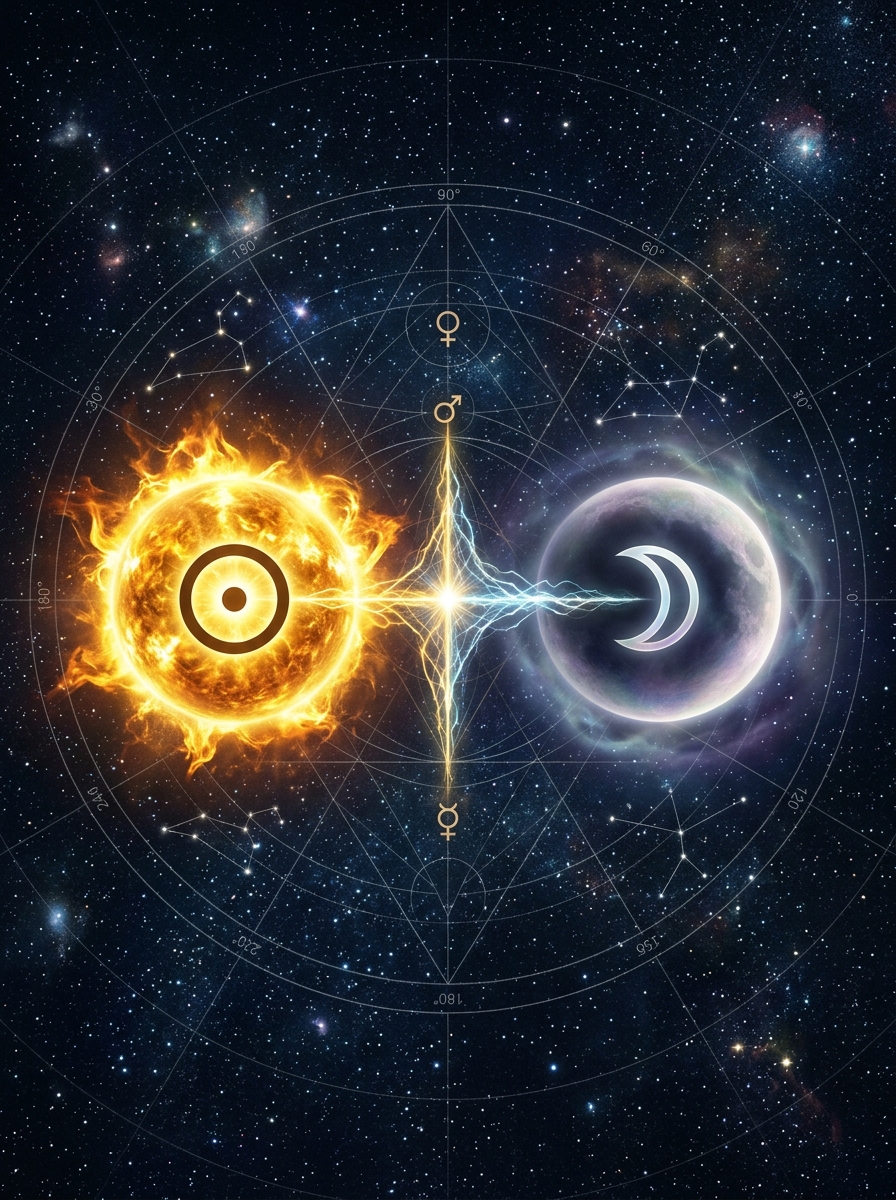
The Importance of the Luminaries in Synastry: The Primal Lights of Relationship Chemistry
In the study of astrological compatibility, or synastry, there is a temptation to jump straight to the romantic and erotic signatures of Venus and Mars, or the binding, karmic glue of Saturn. Yet, any seasoned practitioner of psychological astrology knows that these details are secondary to the foundational landscape mapped by the two luminaries: the Sun and the Moon. Often referred to in hermetic traditions as the Sol and Luna, or the two great lights of the cosmos, the Sun and Moon represent the core polarity of human consciousness. To analyze synastry without first thoroughly examining the relationship between the luminaries is akin to studying the architectural details of a house without looking at its foundation. The luminaries dictate the baseline frequency of a relationship, determining whether two people can coexist in the same space, share a domestic life, and support each other's evolutionary growth over time.
The Solar Principle: Individuation and the Conscious Self
The Sun is the active, radiant core of the natal chart. In the psychological framework championed by Carl Jung and later integrated into astrology by Liz Greene, the Sun represents the archetype of the hero’s journey and the lifelong process of individuation. It is the conscious ego, the path toward self-realization, and the essential life force that seeks expression. When we look at the Sun in synastry, we are asking: Who is this person becoming, and does the partner’s energy support or hinder that journey of self-actualization?
The Sun is not merely a passive bundle of personality traits; it is an active, purposive center of identity. It represents our sense of purpose, our vitality, and the unique creative spark we are here to manifest. If a partner’s chart denies, eclipses, or drains this solar energy, the relationship will eventually feel stifling or soul-crushing, regardless of how many harmonious Venus aspects are present. The Sun demands to be seen and validated; it requires space to shine. In synastry, the Sun of one person interacting with the chart of another shows where conscious awareness, creative will, and identity collide.
The Lunar Principle: The Receptive Soul and the Subconscious Hearth
In contrast to the solar daytime world of conscious identity, the Moon represents the nighttime world of the subconscious, the instinctual self, and the emotional landscape. If the Sun is the active agent of our self-expression, the Moon is the receptive vessel that processes, feels, and integrates our experiences. It represents our subjective security needs, our habit patterns, our childhood conditioning, and the way we seek comfort and safety. In the vocabulary of Steven Forrest, the Moon is the emotional "hearth" of the personality—the place we retreat to when we are tired, vulnerable, or hurt.
When two people enter a relationship, their Moons inevitably meet. While solar connections can create mutual respect and shared goals, lunar connections determine the ease of daily, domestic life. The Moon governs the rhythms of the home: how we eat, how we sleep, how we argue, and how we comfort one another. It is the silent language of emotional resonance. Without a functional lunar connection, two people may respect each other intellectually (Sun) and desire each other physically (Mars/Venus), but they will find it profoundly difficult to relax in each other's presence. The Moon is our soft, undefended underbelly; it requires psychological safety to reveal itself.
Sun-Sun Aspects: When Core Paths of Individuation Collide and Coalesce
When we examine the aspects between one partner's Sun and the other partner's Sun, we are looking at the compatibility of their essential identities and paths of individuation. This is the meeting of two sovereign wills. In the language of Western esotericism, Sun-Sun aspects reveal whether the two individual journeys are aligned in their trajectories or if they are moving in fundamentally incompatible directions.
The conjunction of two Suns represents a powerful mirroring effect. When two individuals share the same Sun sign, there is an immediate, intuitive understanding of each other's core motives and life purposes. They share a similar basic vitality and orientation toward life. However, this configuration can also foster a subtle, sometimes unconscious competition. Because both partners are striving to individuate along the same energetic path, they may struggle to find unique expressions of their identity within the partnership, leading to ego clashes. This is particularly true in cardinal signs (Aries, Cancer, Libra, Capricorn) where the drive for leadership and initiative is strong.
Harmonious Sun-Sun aspects, such as the trine and sextile, provide a flowing cooperation between the two identities. In a trine, the Suns reside in the same element, meaning their core purposes share the same fundamental substance—be it fire, earth, air, or water. This creates an effortless mutual validation. The partners feel naturally supported in their respective paths of self-realization. There is little need to explain themselves; their conscious values align. The sextile offers a similar, though slightly more conscious and active, opportunity for collaborative growth, requiring a small degree of effort to unlock the creative potential of the relationship.
Conversely, the square aspect between two Suns introduces essential tension. Here, the two paths of individuation run at right angles to each other. The goals and methods of one partner's ego development are perceived as disruptive or challenging to the other's. For example, a Aries Sun's impulsive urge to initiate action will square a Cancer Sun's need to protect emotional security and proceed with caution. This tension is not inherently destructive; rather, it acts as a powerful catalyst for growth, forcing each partner to define their boundaries and develop a more nuanced understanding of an alternative way of being.
The opposition between two Suns represents a classic polar dynamic. The partners occupy opposite ends of the same astrological axis, representing two sides of a single coin. This aspect generates a powerful pull of attraction, as each partner possesses qualities that the other lacks. Yet, it also presents a constant challenge of projection. In Jungian terms, one partner may project their own unintegrated shadow onto the other, leading to conflicts where each person feels the other is blocking their light. Resolving a Sun-Sun opposition requires the realization that the partner is not an adversary, but a mirror reflecting a hidden dimension of one’s own psyche.
Moon-Moon Aspects: The Silent Rhythm of Shared Domesticity
If Sun-Sun aspects govern the outer alignment of purpose, Moon-Moon aspects govern the inner alignment of feeling. These aspects describe the emotional climate of the home and the instinctual, non-verbal communication between partners. When two people live together, their Moons are constantly interacting, negotiating domestic rhythms, emotional triggers, and vulnerability.
A Moon-Moon conjunction represents emotional synchronization. When partners share the same Moon sign, they possess a nearly identical emotional language and instinctual response mechanism. They get tired at the same time, crave the same comfort foods, and retreat into the same coping strategies when stressed. This creates an unparalleled sense of safety and mutual validation; in each other, they find a sanctuary. However, the shadow side of this conjunction is the potential for emotional codependency or shared blind spots. If both partners possess the Moon in Scorpio, for example, they may both retreat into silent, brooding withdrawal when hurt, amplifying the emotional tension without a clear path toward resolution.
When Moons are in trine or sextile, there is an easy, flowing emotional compatibility. The partners understand each other's moods without requiring extensive verbal explanation. The domestic environment is typically harmonious, characterized by a natural flow of give-and-take. If one partner's Moon is in Taurus and the other's is in Virgo, they share a grounded, sensory approach to security and comfort. They show love through practical acts of service and physical presence. This flowing connection acts as an emotional buffer against the inevitable storms of life, giving the relationship a resilient foundation of peace.
A Moon-Moon square, however, signals conflicting emotional needs and domestic friction. The partners operate on completely different emotional wavelengths, and their instinctual responses to stress are mutually frustrating. A Moon in Leo, which seeks dramatic expression, validation, and warmth when upset, will clash with a Moon in Scorpio, which demands privacy, depth, and silent containment. The Leo partner may perceive the Scorpio partner as cold and secretive, while the Scorpio partner views the Leo partner as performative and shallow. These squares require a conscious effort to learn a foreign emotional language, demanding that each partner step outside their own instinctual comfort zone to meet the other.
The Moon-Moon opposition creates a dynamic of emotional polarities. Here, the partners have opposite ways of seeking comfort, yet they are deeply drawn to one another's emotional worlds. The opposition can manifest as a highly complementary relationship, where one partner's emotional objectivity (e.g., Moon in Aquarius) balances the other's subjective emotional intensity (e.g., Moon in Leo). However, if projection dominates, the relationship can devolve into a repetitive cycle of emotional polarization, where one partner plays the role of the rational observer while the other plays the emotional reactor. Finding equilibrium requires acknowledging that both polarities are valid and necessary aspects of the emotional whole.
Crossed Sun-Moon Aspects: The Alchemical Conjunction of Will and Feeling
Among the most celebrated configurations in classical and modern synastry is the crossed Sun-Moon connection. This occurs when Person A’s Sun aspects Person B’s Moon, or vice versa. In the history of Western astrology, this is considered the archetypal signature of a deeply compatible, long-lasting partnership—what is historically referred to as a "stellar marriage."
The Classic Marriage Signature: Archetypal Union
The crossed Sun-Moon aspect represents a profound integration of the masculine and feminine polarities within the relationship dynamic, mirroring the alchemical coniunctio—the sacred marriage of Sol and Luna. In this connection, the conscious identity and creative will of the Sun partner find a receptive, nourishing vessel in the emotional landscape of the Moon partner. The Sun partner feels deeply understood, validated, and emotionally supported in their quest for individuation. Conversely, the Moon partner feels consciously seen, protected, and vitalized by the radiant presence of the Sun partner.
Person A (Sun / Conscious Will)  <====== Aspects ======>  Person B (Moon / Subconscious Receptivity)
         Provides: Direction, Vitality, Purpose                   Provides: Sanctuary, Care, Reflection
This exchange is not one-sided; it is a reciprocal loop of energy. The Sun partner provides a sense of direction and purpose that helps organize and clarify the Moon partner's fluid emotional world. The Moon partner, in turn, provides an intuitive sanctuary, offering the emotional security and psychological containment that allows the Sun partner to shine brighter in the outer world. In couples who share this aspect, there is often an immediate sense of familiarity and developmental rightness, as if the relationship itself is a vehicle for healing early childhood wounds related to the parental archetypes.
The Psychological Mechanics of the Cross-Aspect
From a psychological perspective, the crossed Sun-Moon aspect creates a powerful link between one partner's ego-consciousness and the other's subconscious. This allows for an unusually high level of empathy. The Moon partner is naturally attuned to the Sun partner's moods and underlying motivations, often anticipating their needs before they are verbally expressed. The Sun partner, observing this, feels a deep sense of safety and relaxation, knowing that their core self is accepted without judgment.
This aspect acts as a powerful stabilizing force in a relationship. Even when other planets (such as Venus and Mars) indicate differences in tastes or sexual styles, a strong crossed Sun-Moon connection ensures that the core identities and emotional foundations of the partners remain aligned. It builds a bridge of basic goodwill and mutual respect that helps the couple navigate external crises and internal developmental shifts. It is the signature of partners who are not just lovers, but true companions on the evolutionary journey.
Soft Aspects: The Easy Flow and Subtle Traps of Luminary Harmony
Soft aspects between the luminaries—namely the trine (120 degrees) and the sextile (60 degrees)—are generally regarded as the most beneficial connections in synastry. They represent areas of natural compatibility where energy flows between the partners without resistance or friction.
When the Sun of one partner trines or sextiles the Moon of the other, there is a gentle, effortless harmony between identity and emotion. The partners naturally "get" each other. The Sun partner's actions and goals do not threaten the Moon partner's emotional peace, and the Moon partner's feelings do not overwhelm the Sun partner's sense of self. This creates a deeply comfortable bond, characterized by a feeling of safety and mutual validation. In a busy, demanding world, a relationship with strong soft luminary aspects feels like a peaceful harbor—a place where both partners can let down their guard and simply exist.
The Danger of Stagnation: The Golden Cage of Ease
However, the very ease that makes soft aspects so comfortable can also become a subtle trap. In psychological astrology, tension is recognized as a necessary driver of consciousness and growth. When there is no tension between the core elements of two charts, a relationship can easily fall into stagnation. The partners may become so comfortable in their shared patterns that they stop challenging each other to grow.
+-------------------------------------------------------------+
|                      THE SOFT ASPECT TRAP                   |
|  Unconditional Ease  ===>  Comfort Zones  ===>  Stagnation  |
|  (Lack of friction leads to a loss of developmental drive)  |
+-------------------------------------------------------------+
This phenomenon is sometimes described as the "golden cage" of synastry. Because everything feels so easy and agreeable, the couple may avoid addressing underlying problems or initiating necessary changes. They may collude in maintaining a pleasant facade, suppressing individual developmental urges that might disrupt the harmony of the relationship. Over time, this lack of creative challenge can lead to a loss of vitality, turning a deeply supportive bond into a stagnant, routine partnership. To counteract this, couples with predominantly soft aspects must consciously seek out external challenges, personal projects, or intellectual pursuits that keep their individual flames alive.
Hard Aspects: Creative Tension and the Catalyst for Psychological Evolution
Hard aspects between the luminaries—specifically the square (90 degrees) and the opposition (180 degrees)—are often feared by astrology students who interpret them as signs of incompatibility. This is a misunderstanding born of a fatalistic view of astrology. In the tradition of psychological and evolutionary astrology, hard aspects are seen not as indicators of failure, but as rich engines of growth and consciousness.
When the Sun of one partner squares or opposes the Moon of the other, there is an inherent challenge in aligning conscious will with emotional security. The Sun partner's expression of identity can feel disruptive, demanding, or insensitive to the Moon partner's emotional needs. Conversely, the Moon partner's emotional reactions, moods, and demand for safety can be perceived by the Sun partner as limiting, draining, or irrational. For instance, a partner with Sun in Aries may want to aggressively pursue career goals, while a partner with Moon in Cancer feels emotionally abandoned and demands more quality time at home.
Reframing the Square and Opposition as Alchemical Catalysts
Rather than viewing this friction as a deal-breaker, it is far more productive to reframe it as a creative crucible. The tension generated by hard luminary aspects acts as a powerful catalyst for psychological evolution. It forces both individuals to become conscious of their own patterns and projections. The Sun partner is forced to develop emotional intelligence, empathy, and active listening skills, learning to respect a world of feelings that does not conform to ego-logic. The Moon partner is challenged to build inner security and express their emotional needs clearly, rather than retreating into passive-aggressive withdrawal or expecting the partner to read their mind.
       [Solar Identity / Will] <--- Creative Tension ---> [Lunar Subconscious / Emotion]
                                          |
                                          v
                              Psychological Growth &
                              Heightened Consciousness
This dynamic tension prevents the relationship from becoming stagnant. It ensures that both partners are constantly engaged in a dialogue of self-discovery. In many long-term relationships, it is the hard aspects that provide the passion, the drive for mutual understanding, and the ultimate reward of shared wisdom. When navigated with maturity and a commitment to inner work, these challenging aspects can lead to a deeper, more resilient bond than that which is produced by effortless harmony alone.
The Great Conjunctions: Unifying the Sovereign Identity and the Instinctual Soul
The conjunction is the most potent aspect in synastry, representing a total blending of planetary energies. When luminaries conjunct, the boundaries between the partners in those specific areas of life are dissolved, leading to a powerful, concentrated focus of energy.
A Sun-Sun conjunction brings two paths of individuation into direct alignment. This aspect behaves like a powerful magnifying glass. It amplifies the traits of the shared zodiac sign, making both partners highly conscious of their solar goals and challenges. While it creates a strong sense of shared destiny and identity, it requires conscious management to prevent ego competition. The partners must learn to share the spotlight and support each other's individual achievements without feeling overshadowed.
A Moon-Moon conjunction creates a deep, instinctual emotional resonance. This is the hallmark of partners who feel like family from the moment they meet. They share an identical inner world, reacting to external events with the same emotional vocabulary. The challenge of this conjunction lies in the potential for emotional enmeshment. Because their feelings are so closely aligned, it can be difficult for one partner to remain grounded when the other is experiencing an emotional crisis. They must work to maintain healthy emotional boundaries, ensuring that they do not drown in a shared sea of feeling.
The Sun-Moon conjunction is the ultimate synastry aspect, representing the direct union of identity and emotion. In this alignment, the Sun partner’s conscious purpose is in immediate contact with the Moon partner’s subconscious security needs. The relationship has a powerful centripetal force, pulling the partners together into a cohesive unit. The Sun partner feels inspired to lead and create, while the Moon partner feels safe to nurture and support. This conjunction creates a profound sense of completeness within the relationship, making it one of the most reliable indicators of long-term compatibility and shared life path.
The "Stellar Marriage" Phenomenon: Multi-Layered Luminary Chemistry
In modern astrological practice, the term "stellar marriage" has evolved to describe relationships that exhibit multiple, reinforcing luminary connections. It is rarely a single aspect that sustains a partnership over decades; rather, it is a web of interlocking connections between the Suns and Moons of both individuals that builds an exceptionally stable foundation.
A classic "double whammy" occurs when both partners' charts feature cross-connections. For example, Person A’s Sun is conjunct Person B’s Moon, and Person B’s Sun is in trine to Person A’s Moon. This configuration creates a highly balanced, reciprocal flow of energy. Neither partner dominates the relationship; instead, both play the roles of the leader (Sun) and the nurturer (Moon) in different areas of their shared life. This mutual exchange of conscious and subconscious support creates a powerful psychological container that can withstand immense external pressure.
+-------------------------------------------------------------------------+
|                      THE DOUBLE WHAMMY DYNAMIC                          |
|                                                                         |
|   Person A: Sun (Aries)   <=== Conjunction ===>   Person B: Moon (Aries) |
|   Person A: Moon (Leo)    <===   Trine     ===>   Person B: Sun (Aries)  |
|                                                                         |
|             Result: A balanced, self-sustaining loop of energy           |
+-------------------------------------------------------------------------+
These multi-layered connections build a shared reality that is highly resilient. Even when the couple faces severe external challenges—such as financial stress, health issues, or family conflict—their core compatibility remains intact. They possess a shared vocabulary of identity and feeling that allows them to retreat into the relationship as a source of strength. In the hands of psychologically mature individuals, a relationship rich in luminary connections becomes a vehicle for mutual self-actualization, allowing both partners to become more fully themselves than they ever could have been alone.
How to Integrate Luminary Analysis: A Guide to Holistic Luminary Integration
To make practical use of luminary synastry, we must learn to synthesize these aspects within the context of the entire chart. An aspect does not exist in isolation; it is modified by the signs, elements, and modalities in which the planets reside, as well as their interactions with other planets in the chart.
The Element and Modality Matrix
The first step in integrating luminary analysis is to look at the elemental balance between the Sun and Moon. Elements (Fire, Earth, Air, Water) describe the basic temperament and energy state of the planets.
- Fire (Aries, Leo, Sagittarius): Seeks inspiration, action, and creative self-expression.
- Earth (Taurus, Virgo, Capricorn): Seeks stability, material security, and practical results.
- Air (Gemini, Libra, Aquarius): Seeks connection, intellectual stimulation, and objective perspective.
- Water (Cancer, Scorpio, Pisces): Seeks emotional depth, intimacy, and intuitive understanding.
When analyzing Sun-Moon aspects, note how these temperaments interact. A Sun in a Fire sign aspecting a Moon in a Water sign creates a complex, steam-like dynamic where the drive for action can easily boil or evaporate the emotional container. Modalities (Cardinal, Fixed, Mutable) also play a crucial role. They describe how the energy is directed and managed. Cardinal signs initiate, Fixed signs consolidate, and Mutable signs adapt. Recognizing these elemental and modal dynamics helps astrologers understand the underlying mechanics of the luminary aspects, moving beyond simple interpretations to a nuanced appreciation of the relationship's energetic flow.
Integrating the Whole Chart
Finally, we must integrate our luminary analysis with the rest of the synastry. While the Sun and Moon establish the foundational compatibility, other planets add crucial layers of detail.
- Venus and Mars: Describe the romantic attraction, aesthetic alignment, and sexual chemistry. They show how the couple initiates connection and expresses passion.
- Saturn: Provides the commitment, structure, and developmental gravity. Saturn aspects show where the relationship faces its greatest responsibilities and where the partners must build long-term trust.
- Jupiter: Brings growth, optimism, and shared philosophy, showing where the partners inspire each other to expand their horizons.
     Outer Layer: Venus, Mars, Jupiter (Chemistry, Romance, Growth)
          ^
          |
     Inner Core: Sun & Moon (Identity, Consciousness, Emotion, Safety)
          |
          v
     Base Anchor: Saturn (Commitment, Structure, Responsibility)
A relationship with beautiful Venus-Mars chemistry but weak Sun-Moon connections may start with intense passion but struggle to build a stable life together once the initial romance fades. Conversely, a relationship with strong luminary connections but challenging Venus-Mars aspects may feel like a deeply secure, brotherly partnership that lacks romantic fire. By placing the Sun and Moon at the center of our analysis, we can understand the core psychological dynamics of the relationship, allowing us to interpret the rest of the chart with greater accuracy and wisdom.
Frequently Asked Questions About Sun-Moon Synastry
What does it mean if my partner and I have no aspects between our Suns and Moons?
A lack of direct aspects between the luminaries does not mean a relationship is doomed, but it does indicate that your core identities and emotional worlds do not automatically interact. In these cases, the relationship may rely on other planetary connections, such as Venus, Mars, or Saturn, to bridge the gap. The couple may need to work more consciously to build mutual understanding, as their natural rhythms and core purposes do not align effortlessly. It requires conscious effort to create shared channels of communication and emotional connection.
How do crossed Sun-Moon aspects affect long-term relationship commitment?
Crossed Sun-Moon aspects are among the strongest indicators of long-term stability in synastry. They create a powerful psychological bond based on mutual respect, validation, and emotional security. While they do not guarantee that a relationship will last forever, they provide a highly resilient foundation that helps the couple navigate external stress and personal growth. This configuration is frequently found in the charts of couples who remain married for decades, as it fosters a deep sense of companionship and developmental alignment.
Can a relationship survive with hard aspects (squares or oppositions) between the Sun and Moon?
Absolutely. In fact, many of the most dynamic and growth-oriented relationships feature hard aspects between the luminaries. These aspects create a healthy level of creative tension that prevents the relationship from falling into stagnation. While they require the partners to work harder to understand each other's needs, they also act as powerful catalysts for psychological growth and self-awareness. Success depends on the maturity of the individuals and their willingness to engage in self-reflection and open communication.
Which is more important in synastry: Sun-Sun compatibility or Moon-Moon compatibility?
Both are crucial, but they govern different areas of the relationship. Sun-Sun compatibility determines whether your conscious identities, values, and life paths are aligned. It is essential for mutual respect and shared goals. Moon-Moon compatibility governs your emotional language, instinctual reactions, and domestic rhythms. It is critical for the ease of daily life and cohabitation. Ideally, a relationship will feature a balance of both connections, allowing the partners to feel both inspired in their outer goals and secure in their inner lives.
How does the element of the Sun and Moon signs affect their compatibility?
Elements describe the basic temperament of the planets, and their alignment shapes how the aspects manifest. Harmonious aspects (trines and sextiles) usually occur between planets in compatible elements (Fire and Air, or Earth and Water), creating a natural flow of energy and mutual understanding. Hard aspects (squares and oppositions) often occur between incompatible elements, introducing tension that requires conscious integration. Recognizing these elemental dynamics helps you understand the underlying mechanics of your luminary aspects, moving beyond simple interpretations to a nuanced appreciation of your relationship's energy flow.
Comments
Loading comments…