Synastry Moon Square Moon: When Two Weather Systems Share a Sky
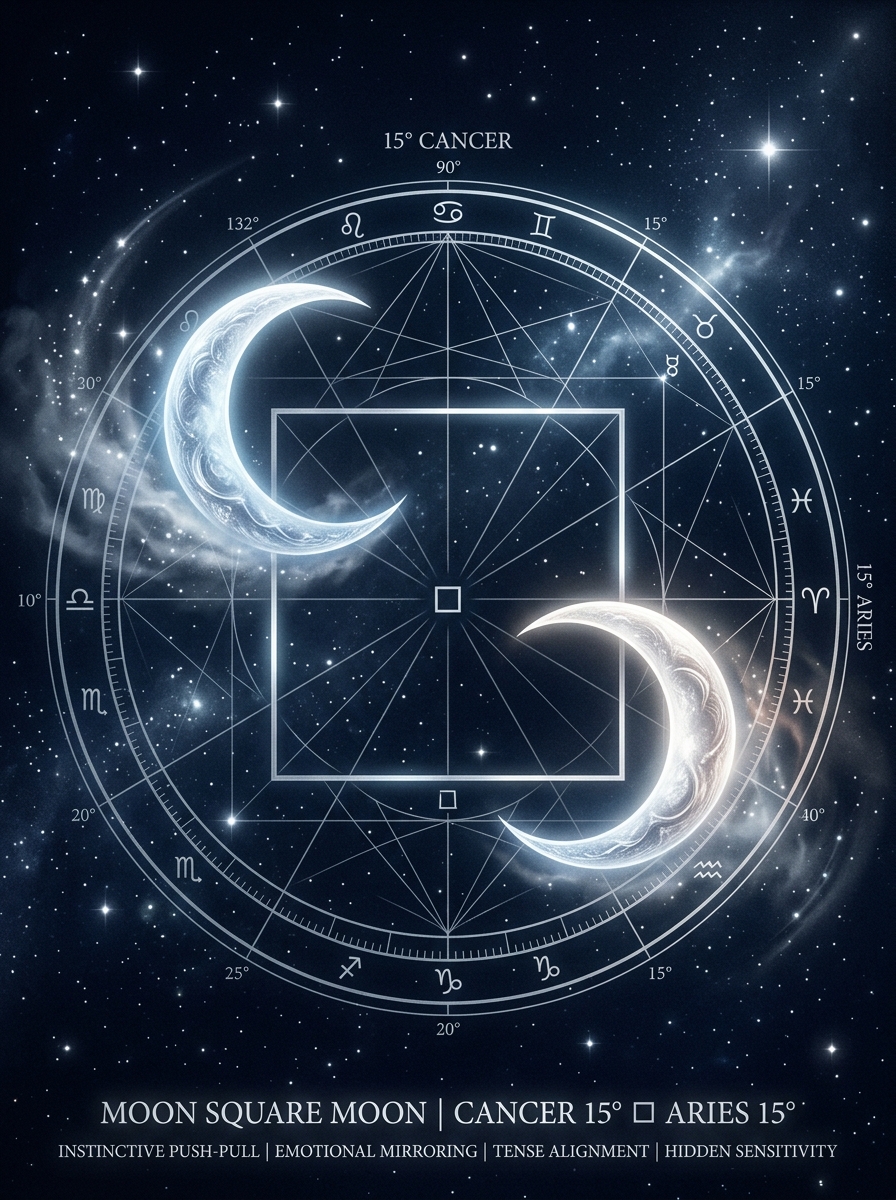
Two emotional tides meeting at a right angle
In Moon square Moon synastry, each partner does not simply feel differently—they trigger the other’s most ancient emotional reflexes before a thought can intervene. The Moon governs pre-verbal safety, bodily comfort, and the private rhythm by which a person says yes or no without speaking. A square between two Moons creates immediate, visceral recognition: each recognizes that the other is emotionally alive, but the frequency is off. One reaches for closeness when the other needs distance; one soothes by talking, the other by withdrawing. This is not a failure of love but a collision of two legitimate survival systems.
The bond is often instant because the mismatch itself feels significant. It promises that something hidden in one psyche might be unlocked by the other. But the same friction that generates chemistry also produces chronic misattunement. To understand why, it helps to see how synastry aspects work as a whole: the square is a high-pressure contact that insists on development, not harmony. Here the pressure is applied directly to the emotional core.
Why the attraction is real—and harder than it looks
People often expect a harsh aspect to feel purely unpleasant. With Moon square Moon, the attraction is real because each person senses that the other is not indifferent. The square activates a hope: this person will reach what I keep hidden. That hope is magnetic, especially when the pair also shares gentler contacts. A strong Moon-Venus synastry can soften the friction with tenderness and affection, while a Sun-Moon synastry may help identity and emotional style cooperate. But the square itself does not give sweetness—it gives activation.
The specific quality that draws them together is the very thing that later hurts. One partner’s steadiness may feel like emotional aridity; the other’s openness may feel like engulfment. Each becomes a mirror that does not flatter. The attraction is not about ease but about the promise of being completed by someone who feels like a missing limb. The trouble is that completion requires translation, and the square makes translation feel like betrayal of one’s own truth.
The daily theater of misattunement
A Moon square in synastry rarely announces itself in dramatic arguments. It lives in the micro-decisions of domestic life: who answers a text too slowly, who seems cold at the dinner table, who wants affection while the other wants silence. The content changes, but the pattern is predictable. One partner reaches for emotional rhythm, and the other is already out of step. This is the lived grammar of the square aspect—friction that keeps insisting on itself until consciousness is built around it.
The most visible difference is in comfort language. A water-sign Moon may seek merging, emotional confession, or continuous touch; an earth-sign Moon may soothe through routine, practical help, or quiet presence. Neither is wrong, but in square form each can feel that the other is missing the point of comfort itself. A partner who needs to talk to process may feel abandoned by a partner who needs to retreat. The partner who retreats may feel invaded by the need to talk. Neither is being unreasonable; they are being themselves.
Family memory also gets projected. The Moon carries early conditioning, and in synastry each person often meets the other through unfinished childhood material. One partner may experience the other as too sensitive because their own history associates sensitivity with chaos. The other may experience the first as emotionally withholding because they grew up needing overt reassurance to feel secure. The relationship becomes a stage for inherited scripts. A couple that can recognize this—that the present partner is not the parent—has a chance to turn projection into intimacy. A couple that cannot will keep punishing the living person for the crime of belonging to the past.
The work of the square: from suspicion to translation
The most useful shift a couple can make is to stop treating their own emotional reflexes as universal law. Under the Moon square Moon dynamic, each partner tends to assume the other is choosing to be difficult. One thinks the other is deliberately cold; the other thinks the first is willfully needy. But the square is not a moral failure—it is a difference in survival instincts. The work is to decode the accusation into a request.
This is where the aspect becomes psychologically potent. The square asks for emotional accountability. “I need space” is not an insult; “I need reassurance” is not manipulation. The couple must build a third language—a shared vocabulary for what each person needs and why. A strong Mercury contact can help with that translation, but the real work is internal. Each person has to learn that their own way of soothing is not the only valid one. In healthy form, the square teaches that love is not the absence of friction but the ability to stay human inside it.
When the square is part of a larger pattern like a T-square, the pressure becomes even more focused. The missing function—perspective, mediation, conscious emotional craft—must be built. The relationship itself becomes the forge. For couples who can manage this, the bond develops a peculiar loyalty: they know each other too well to idealize, and they have survived the mismatch. That is the hidden dignity of this aspect.
The wider relational ecology
A single Moon square Moon does not decide a relationship. It is a high-pressure contact, not a verdict. Its meaning depends on the rest of the synastry, the natal charts, and the current developmental stage of each person. In some couples it is the main irritant; in others it is the gritty engine that keeps the bond emotionally alive. The house overlays show where the tension will be most active—domestic life, partnership, work, or friendship. A Moon square that falls into the seventh house may feel more contractual; one in the fourth feels ancestral and domestic.
To read this aspect fairly, you must place it inside the full ecology of attraction, compatibility, and repair. A synastry step-by-step approach helps reveal whether the square is supported by grace notes or undermined by deeper incompatibilities. The couple that can metabolize pressure into intimacy will find that the square becomes a source of depth rather than a chronic wound.
In the end, Moon square Moon is love translated through different accent marks. The couple recognizes the same emotional species in each other—and still fails, repeatedly, to speak it fluently. That failure can harden into chronic disappointment, or it can become the reason the relationship acquires real texture. The deciding factor is not the aspect itself but whether both people are willing to be educated by it. A square can be a wound that never stops complaining, or a forge that shapes character. With the Moon, the forge is domestic, intimate, and nearly invisible from the outside. Inside the relationship, though, it feels unmistakable: two tides meeting at a right angle, each insisting on its own shore, each altering the other simply by refusing to disappear.
Related
- Moon Square Mercury Synastry: When Feeling and Thought Refuse Easy Peace
- Moon Square Mars in Synastry: Desire That Knows How to Wound and Warm
- Sun Square Mercury in Synastry: The Spark That Argues with Itself
- Moon Conjunct Moon Synastry: When Two Inner Tides Recognize Each Other
- Sun Square Sun in Synastry: When Two Solar Egos Strike Spark and Steel
Comments
Loading comments…