The Alchemy of Love Synastry: A Psychological and Esoteric Guide to Relationship Astrology
Introduction to Love Synastry: The Meeting of Two Psychological Ecosystems
When two people enter an intimate relationship, they are not merely exchanging pleasantries, sharing a physical space, or dividing domestic chores; they are bringing two highly complex, fully formed, and distinct psychological ecosystems into a singular, shared orbit. In the ancient and modern traditions of relationship astrology, the study of this psychic intersection is known as love synastry. Synastry operates by overlaying the natal chart of one individual directly onto the natal chart of another, mapping the precise geometric relationships—known as aspects—between their respective planets, angles, houses, and nodes. This analytical process is less about predicting whether a relationship will succeed or fail in a deterministic, fatalistic fashion, and more about mapping the unique, invisible psychic architecture that arises when these two distinct energetic fields merge and interact.
As the Swiss psychiatrist Carl Jung famously observed, the meeting of two personalities is like the contact of two chemical substances: if there is any reaction, both are transformed. In synastry, we observe the celestial blueprint of this transformation. Every planet in a birth chart represents a specific psychological function, a drive within the human psyche. When another person’s planets activate these points, they call forth dormant aspects of our own personality, activating emotional patterns that we might not even be aware of. For example, someone’s Sun falling in our Twelfth House might illuminate the hidden, unconscious recesses of our mind, bringing to light elements of what Jung termed the personal shadow. The overlay acts as a detailed map of potential triggers, growth points, and deep-seated resonances that dictate how we react to the other person.
To approach synastry with true psychological sophistication, one must abandon the simplistic checklists of "compatible" and "incompatible" zodiac signs commonly found in popular culture. The target-language literature of psychological and evolutionary astrology, championed by influential thinkers like Liz Greene and Steven Forrest, teaches us that compatibility is not a static state of effortless bliss. Instead, it is a dynamic, living process. A chart comparison reveals the specific developmental work two people have contracted to do together. The harmonious aspects show where the wind is at their backs, providing the psychological safety, comfort, and emotional replenishment necessary to sustain the bond through difficult times. The challenging aspects, conversely, represent the friction points—the crucibles of growth where projection is dismantled, egos are challenged, and consciousness is expanded. Through the lens of synastry, we learn to view our partners not as sources of ultimate fulfillment or frustration, but as mirror holders, reflecting back to us the unresolved parts of our own psychological ecosystems, prompting a deeper realization of the self.
The Core Five: Key Personal Planets and Points in Intimacy
To begin the work of synastry synthesis, we must first isolate the core components of the relational psyche. While every point in the chart has its voice, five key personal planets and points form the primary structural pillars of intimacy: the Sun, the Moon, Venus, Mars, and the Ascendant. These points represent the fundamental drives of self-expression, emotional security, relational desire, physical drive, and the interface through which we meet the outer world.
The Sun and Moon: Conscious Will meets Emotional Depth
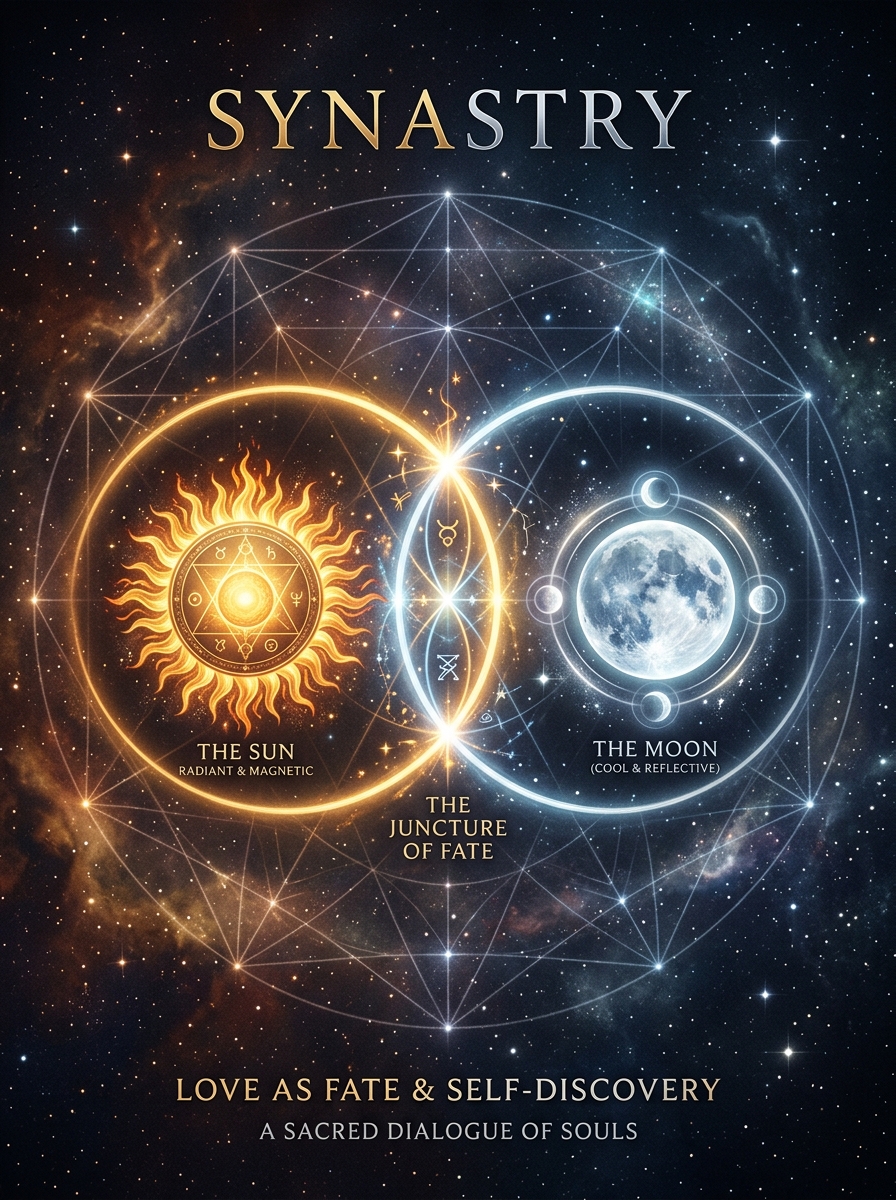
The Sun represents our core identity, our conscious purpose, and the creative spark of the ego. It is the solar center of our psychological solar system, directing our sense of vitality and purpose. In synastry, the Sun describes how we want to be seen, recognized, and validated by our partner. When one partner’s Sun aspects another’s planets, it infuses those planets with vitality, conscious awareness, and warmth. However, the Sun cannot operate in a relational vacuum; it requires the receptive, reflective energy of the Moon. The Moon represents our emotional body, our subjective needs, our conditioning, and our deep-seated feeling of home. It is the seat of the unconscious. While the Sun seeks expression and recognition, the Moon seeks safety, comfort, and belonging.
A relationship cannot achieve deep intimacy without a strong connection between the Moon and the partner's chart. When the Sun of one person conjuncts or trines the Moon of another, there is an immediate, pre-verbal understanding. The Sun feels creatively inspired and validated by the Moon’s receptive listening and emotional support, while the Moon feels safe, warm, and nurtured by the Sun's conscious presence and clear direction. This luminary connection forms the bedrock of emotional compatibility, allowing both partners to feel seen at the level of their essential identity and felt at the level of their deepest vulnerability. Without some connection between the luminaries, a relationship may feel intellectually stimulating or physically passionate, but it will ultimately lack the emotional glue necessary to build a shared life.
Venus and Mars: The Cosmic Dance of Attraction and Desire
If the Sun and Moon represent the core self, Venus and Mars represent the active machinery of relationship. Venus is the archetype of attraction, value, and aesthetic appreciation. It governs our relationship style—how we seek connection, what we value, and how we express affection. In psychological terms, Venus represents the Anima in a man's chart and the relational ideal in a woman's, acting as the psychological template of the beloved. When Venus is active in synastry, it brings a sense of pleasure, beauty, and mutual appreciation. Partners with strong Venus contacts enjoy each other's company, share similar tastes, and find harmony in their shared aesthetic and social lives.
Mars, on the other hand, represents the archetype of desire, assertiveness, and physical drive. It is the Animus in a woman's chart and the drive of pursuit in a man's. Mars is how we go after what we want, how we defend ourselves, and how we ignite our physical passions. In the dance of relationship, Venus draws in, while Mars pursues. The aspects between Venus and Mars in synastry are the primary indicators of erotic chemistry and sexual attraction. A harmonious aspect, such as a Venus-Mars trine, allows attraction to flow smoothly, blending romantic affection with physical desire in a balanced, satisfying way. A challenging aspect, like a Venus-Mars square, can create an intense, magnetic friction—a powerful sexual draw that is often accompanied by interpersonal tension, highlighting the delicate, ongoing balance between closeness and independence.
The Ascendant: The Relational Portal
The Ascendant, or rising sign, is the physical interface through which we meet the world. It represents our persona, our physical body, and the immediate impression we make on others. The Ascendant-Descendant axis is the primary relational portal of the natal chart. The Descendant represents the qualities we seek in a partner, often projecting them outward before we integrate them within ourselves. In synastry, when a partner's planet conjuncts our Ascendant or Descendant, it represents an immediate, tangible impact. A planet conjunct the Ascendant is felt physically and personally; the partner represents a living embodiment of the energies that shape our physical reality. A planet conjunct the Descendant represents the archetype of the partner we seek, bringing a sense of destiny and profound familiarity to the connection, as if we are meeting the outer manifestation of our own inner counterpart, opening the doorway to deep relational engagement.
Harmonious Aspects in Synastry: Flow, Chemistry, and Mutual Resonance
Harmonious aspects in synastry—specifically conjunctions, trines, and sextiles—act as the psychological lubrication of a relationship. They represent areas where the energies of two individuals flow together without resistance, creating a sense of ease, mutual understanding, and natural synergy. In these areas, partners do not have to explain themselves; their psychological gears mesh perfectly, allowing for a shared rhythm and cooperative interaction.
Conjunctions are the most powerful aspects in synastry, representing the blending of two planetary energies at the exact same degree of the zodiac. When one partner’s Venus is conjunct another’s Venus, for example, their values, tastes, and styles of expressing love are identical. They find pleasure in the same things, share an aesthetic language, and value the same relational dynamics. While conjunctions can sometimes lead to a lack of objectivity—where partners become so similar that they reinforce each other's blind spots and create a closed feedback loop—they provide an unparalleled sense of unity and shared identity.
Trines (120 degrees apart) and sextiles (60 degrees apart) offer a more relaxed, supportive flow. Trines bring a natural, often unconscious, alignment of elements. A trine between one partner’s Moon in Cancer and another’s Moon in Scorpio creates an immediate emotional resonance. Both speak the language of water; they navigate the emotional currents of life with the same sensitivity, depth, and intuition. They instinctively understand each other's moods and vulnerability, providing a safe harbor for emotional expression. Sextiles, meanwhile, offer opportunities for creative collaboration. A sextile between Mercury and Venus, for instance, makes communication pleasant and affectionate. The partners find it easy to speak kindly to one another, resolving misunderstandings through gentle dialogue, mutual respect, and a shared desire for harmony.
However, Liz Greene warns that a chart filled exclusively with harmonious aspects can sometimes lead to stagnation. Without the challenge of harder aspects, a relationship can become too comfortable, lacking the evolutionary drive to grow, adapt, or change. Harmonious aspects create the sanctuary, but as we will see, it is the challenging aspects that provide the fuel for the journey, ensuring the relationship remains alive and vital.
Challenging Aspects in Synastry: Friction as a Catalyst for Psychological Growth
Challenging aspects—namely squares (90 degrees) and oppositions (180 degrees)—are frequently misunderstood as indicators of incompatibility. In psychological astrology, however, these aspects are recognized as the primary engines of consciousness and growth. Without them, relationships lack the dynamic tension required to push individuals past their ego boundaries. They represent the necessary friction that sparks self-awareness, forces the withdrawal of projections, and demands psychological evolution.
Squares represent internal conflict and blockages that manifest through external interactions. When one partner’s Mars is square another’s Sun, there is a constant, grating friction. The Mars person may perceive the Sun person’s ego expression as a challenge, an overbearing command, or an obstruction, while the Sun person may feel attacked, defensive, or impatient with the Mars person’s assertive, independent drive. This aspect demands that both partners learn to negotiate boundaries, manage anger, and respect individual autonomy. The square does not mean the relationship is doomed; rather, it indicates an area where both partners must actively work to build conscious communication, transforming raw friction into productive energy.
Oppositions, on the other hand, represent the classic dynamic of the mirror. They highlight the polarization of opposites, forcing partners to confront the qualities they have repressed or projected onto the other. An opposition between one partner’s Moon and another’s Uranus can create an addictive, push-pull dynamic. The Moon partner seeks stability, emotional closeness, and predictability, while the Uranus partner craves freedom, novelty, and independence. The Moon partner projects their own unexpressed need for freedom onto the Uranus partner, viewing them as erratic, cold, or emotionally unavailable. The Uranus partner projects their own need for safety onto the Moon partner, viewing them as needy, suffocating, or overly emotional. To resolve an opposition, both partners must integrate the opposite pole within themselves, recognizing that the qualities they find frustrating in their partner are actually parts of their own psyche seeking expression.
Through the evolutionary lens of Steven Forrest, these challenging aspects are the spiritual agreements of the relationship. They are the specific lessons the two souls have chosen to master together. By engaging with the discomfort of squares and oppositions, partners engage in profound shadow work, dismantling the projections that distort their view of the other, and moving toward a more mature, realistic, and psychologically integrated love.
Saturn’s Anchor: Duty, Structure, and Long-Term Durability
While Venus and Mars ignite the initial spark of attraction, it is Saturn that determines whether that spark will endure the test of time. In the Western esoteric tradition, Saturn represents the principle of form, structure, responsibility, time, and crystallization. It is the archetype of the Senex—the wise elder, the taskmaster, and the builder of boundaries. In synastry, Saturnian aspects are the structural anchors that bind two lives together, transforming a transient romance into a committed, long-term partnership.
When Saturn makes strong aspects to another person’s personal planets or angles, it introduces a sense of weight, duty, and consequence to the relationship. For example, if one partner’s Saturn is conjunct another’s Moon, the Moon partner will feel a deep, serious commitment to the Saturn partner. There is an instinctive sense that this relationship is not a casual game. The Saturn partner often acts as a stabilizing force, providing structure, containment, and practical support to the Moon partner’s emotional life. However, this same aspect can also feel restrictive. The Moon partner may occasionally feel judged, emotionally cold-shouldered, or burdened by the Saturn partner's expectations, while the Saturn partner may feel an overwhelming sense of responsibility for the Moon partner's emotional well-being, leading to defensiveness.
The key to navigating Saturn in synastry is recognizing that its limitations are necessary for containment. Just as a river requires banks to flow without flooding, a relationship requires the containment of Saturn to survive the inevitable challenges of life. Saturn aspects represent the areas where we must grow up, take responsibility, and honor our commitments. Liz Greene notes that without Saturn aspects in a synastry comparison, a relationship often lacks the "glue" required to hold it together when the initial romance fades. Even if the aspect is a square or an opposition—such as Saturn square Venus—it indicates a profound psychological tie. The Venus partner may feel that the Saturn partner is restrictive or demanding, but the depth of the challenge forces both to examine what they truly value in love, building a resilient, realistic bond that can withstand the eroding effects of time.
Pluto’s Crucible: Power Dynamics, Passion, and Alchemical Transformation
If Saturn is the builder of the relationship’s structure, Pluto is the alchemical fire that purges and transforms it. Pluto represents the underworld, the collective unconscious, power, control, taboos, and the process of death and rebirth. When Pluto is prominent in synastry, the relationship ceases to be merely a social contract or a source of emotional comfort; it becomes a crucible of psychological transformation, drawing both partners into the deepest recesses of their personal shadows.
Plutonic aspects in synastry are characterized by an intense, almost hypnotic magnetism. When one partner’s Pluto aspects another’s personal planets—such as Pluto conjunct or opposite Venus—the attraction is immediate and overwhelming. It feels destined, inescapable, and laden with unconscious import. The Venus partner is drawn to the mysterious, intense depth of the Pluto partner, while the Pluto partner feels a profound, possessive fascination with the Venus partner. This is the realm of the alchemist, where the ego is stripped away to reveal the raw gold of the soul.
However, the shadow side of Pluto involves power struggles, manipulation, and the fear of betrayal. Because the emotional stakes are so high, partners may resort to controlling behaviors to avoid vulnerability. The Pluto partner may attempt to dominate the relationship, using emotional silence, jealousy, or psychological insights to maintain control, while the Venus partner may feel disempowered, obsessively attached, or emotionally consumed. The core lesson of Pluto in synastry is the surrender of control. The intense passion and friction are designed to break down the rigid defenses of the ego, forcing both individuals to confront their deepest fears of abandonment, loss, and powerlessness.
Through the evolutionary astrology of Steven Forrest, Pluto aspects represent areas where the soul is calling for a profound regeneration. It demands absolute honesty, vulnerability, and the dismantling of psychological games. When navigated consciously, a Plutonic relationship becomes a path of mutual healing, allowing partners to release ancient trauma, reclaim their personal power, and experience a depth of intimacy and rebirth that is only possible when one has stared directly into the abyss of the self.
Traditional Bond Indicators: Classic Alignments of Relationship Astrology
While modern psychological astrology emphasizes the developmental path of a relationship, traditional astrology provides us with specific, time-tested alignments that indicate strong relational bonds. These traditional indicators are the classic configurations that astrologers look for to identify immediate recognition, mutual attraction, and the capacity for long-term partnership.
The Luminary Connection: Sun-Moon Conjunctions and Oppositions
The alignment of the Sun and Moon across two charts is the premier indicator of partnership in traditional astrology. When one person's Sun conjuncts the other's Moon, it represents a perfect symbolic marriage of the masculine and feminine principles (Animus and Anima). The Sun person brings conscious focus, guidance, and vitalizing energy, while the Moon person provides the reflective, emotional container and support. This aspect creates an instinctive, telepathic understanding where actions and feelings align effortlessly. The opposition between the Sun and Moon, while more polarized, is equally potent. It acts as a magnetic pull of opposites, where each partner represents the missing half of the other, creating a dynamic of mutual completion that is highly favorable for marriage and long-term union, balancing conscious drive with unconscious depth.
The Chemistry Axis: Venus-Mars Contacts
Physical and romantic chemistry is traditionally mapped through the relationship between Venus and Mars. When one person’s Venus conjuncts, trines, or even squares the other’s Mars, the classic sparks of attraction are ignited. Venus represents what we find beautiful, desirable, and harmonious, while Mars represents the energy of pursuit, physical passion, and drive. When these two planets interact, the Venus partner feels desired, attractive, and appreciated, while the Mars partner feels inspired, energized, and attracted. This alignment ensures that the physical dimension of the relationship remains vibrant, providing the magnetic attraction that draws the partners together and keeps them engaged over time.
The Structural Portal: Ascendant-Descendant Conjunctions
The Ascendant-Descendant axis represents the boundary between the self and the other. In traditional synastry, when one partner’s personal planets or Ascendant conjunct the other’s Descendant, it creates a powerful sense of relational fit. The Descendant is the doorway to the seventh house of partnership; planets falling here are welcomed into the partner's life as a natural completion of their personal narrative. A conjunction between one partner’s Ascendant and the other’s Descendant (an axis swap, where one's rising sign is the other's setting sign) is one of the most binding indicators of compatibility, indicating that their ways of meeting the world are perfectly complementary, acting as mirror images of a singular relational path.
Alchemical Synthesis: Blending Harmony and Tension into a Holistic Relationship Ecosystem
The ultimate task of the astrologer is not merely to list the aspects between two charts, but to perform an alchemical synthesis—blending the diverse, often contradictory indicators into a singular, qualitative understanding of the relationship as a living ecosystem. A synastry chart cannot be read in isolation; it must be interpreted through the lens of the individual natal charts, recognizing that the dynamics that manifest between partners are always conditioned by their individual psychological maturity.
To perform a successful synthesis, we must balance the tension of the challenging aspects with the grace of the harmonious ones. A relationship with only harmonious aspects may suffer from inertia, lacking the spark to evolve. A relationship with only challenging aspects may become exhausting, collapsing under the weight of constant conflict. The ideal relational ecosystem contains a healthy balance of both: the trines and sextiles provide the safe container and emotional recovery zones, while the squares and oppositions provide the creative tension and developmental challenges that push the partners toward self-actualization and mutual maturity.
Furthermore, we must synthesize the outer planetary influences with the inner personal planets. We must look at how the structural boundaries of Saturn and the transformative fires of Pluto interact with the vulnerability of the Moon and the affection of Venus. This requires a shift in perspective from deterministic prediction to psychological exploration. We ask not, "Will this relationship last?" but rather, "What is the psychological purpose of this connection, and how can both partners support each other's individuation?"
In the words of Liz Greene, the goal of synastry is to help us understand the unique fate of the relationship. By viewing the chart comparison as a holistic ecosystem, we move away from blame and frustration, and move toward a deeper appreciation of the relationship's spiritual and psychological destiny. We begin to see the partnership as a sacred vessel—an alchemical container in which two souls have agreed to undergo the painful, beautiful process of becoming who they truly are.
Frequently Asked Questions About Love Synastry
What is the difference between Synastry and a Composite Chart?
While both are vital tools in relationship astrology, they describe different dimensions of connection. Synastry is the overlay of two individual birth charts, comparing the aspect interactions between their planets. It describes the interpersonal chemistry—how person A’s planets affect person B, and vice versa. It is the study of how two individuals interact. A Composite Chart, by contrast, is a single chart calculated using the mathematical midpoints between the two partners' planets and angles. It represents the relationship itself as a third entity—the psychological ecosystem of the couple as a collective unit. If synastry describes how they feel about each other, the composite chart describes the destiny, purpose, and public expression of the relationship itself.
Can a relationship survive with many challenging aspects (squares and oppositions)?
Yes, absolutely. In fact, many long-term, highly creative, and transformational relationships feature numerous squares and oppositions. These aspects provide the passion, attraction, and developmental friction necessary to prevent stagnation. The survival of the relationship depends not on the absence of challenging aspects, but on the psychological maturity of the individuals and their willingness to engage in shadow work. If both partners are willing to take responsibility for their own projections rather than blaming the other for their discomfort, challenging aspects can become the most rewarding, growth-promoting features of the partnership, turning conflicts into opportunities for conscious evolution.
How do Pluto aspects manifest differently from Saturn aspects in synastry?
Saturn and Pluto represent two very different archetypal forces of growth. Saturn operates through structure, boundaries, patience, and duty. It is the principle of containment, manifesting as practical responsibility, commitment, and sometimes emotional restriction. Saturn challenges us to grow through endurance, discipline, and building long-term structures. Pluto, conversely, operates through intensity, power, crisis, and transformation. It does not build structures; it burns them down to reveal what is essential. Pluto aspects manifest as magnetic attraction, power struggles, and psychological death-and-rebirth cycles. While Saturn teaches us boundary and commitment, Pluto teaches us surrender, vulnerability, and the reclamation of personal power through the purging of the ego.
Why is the Ascendant-Descendant axis so critical in relationship astrology?
The Ascendant-Descendant axis is the primary relational polar axis of the birth chart. The Ascendant (rising sign) represents the self, the physical body, and our initial orientation to life. The Descendant (the seventh house cusp) represents the "other"—the qualities we project onto partners and seek to integrate through relationship. In synastry, aspects to this axis directly impact our sense of identity and relational security. When a partner’s planets conjunct our Descendant, they activate our seventh house of committed partnership, making us feel that this person naturally embodies our relational ideals. A conjunction to the Ascendant, conversely, brings the partner directly into our personal space, affecting our self-image and physical reality.
How can Jungian concepts of Anima and Animus help us understand synastry aspects?
In Jungian psychology, the Anima represents the unconscious feminine archetype in a man’s psyche, while the Animus represents the unconscious masculine archetype in a woman’s. These inner figures are frequently projected onto potential partners, drawing us to individuals who embody these qualities. In synastry, our Anima and Animus templates are mapped by Venus (and the Moon) for the Anima, and Mars (and the Sun) for the Animus. When a partner’s planets align with these indicators in our chart, they activate our internal archetypes. For example, a man whose Venus is conjunct a woman’s Sun will project his Anima onto her, experiencing her as the living embodiment of his inner feminine ideal, initiating a deep journey of relational integration and self-discovery.
Can a relationship thrive if there are no major Venus or Mars aspects between the charts?
While Venus-Mars aspects are the classic indicators of physical chemistry and romantic attraction, their absence does not doom a relationship. A relationship can thrive on other connections, such as deep Sun-Moon emotional resonance, strong Mercury communication aspects, or Saturn-guided structural bonds. When Venus and Mars are not directly linked, the partners may find that their attraction is less about immediate physical spark and more about shared values, mental compatibility, or mutual goals. The overall relational ecosystem adapts, utilizing other planetary alignments to foster intimacy, showing that love can be built on many different astrological foundations.
Comments
Loading comments…