Synastry: Sun Conjunct Moon — When Identity Meets Instinct
The Core Exchange: Two Centers That Recognize Each Other
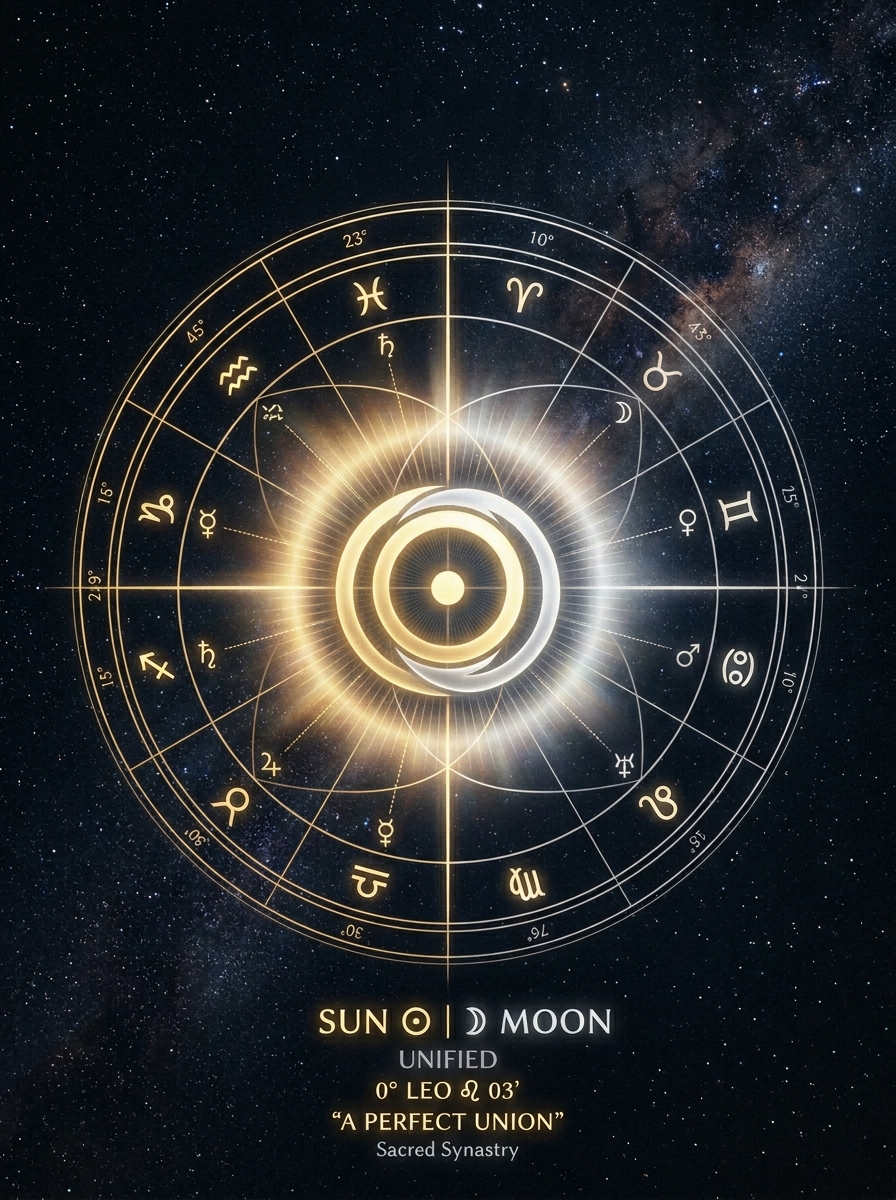
In Sun conjunct Moon synastry, one person’s conscious self meets the other person’s emotional core in the same degree. The Sun person’s identity, purpose, and will are lit by the Moon person’s instinctive weather; the Moon person feels seen by the very force that names and directs the relationship. This is not admiration at a distance—it is a sensation of inner and outer selves locking into a single magnetic frame. The bond often feels immediate because each recognizes a function the other already lives: the Sun gives direction, the Moon gives atmosphere. That complementarity is why this aspect becomes the emotional spine of so many powerful connections.
The catch is that this same closeness can erase necessary separation. The Sun may assume the Moon wants what it wants, and the Moon may organize itself around keeping the solar center stable. If neither notices the power arrangement, the bond becomes a cozy loop of projection. The aspect works best when it stays a meeting of functions, not a merger of identities.
How It Forms: The Psychological Magnetism
The Sun in any chart represents the ego’s organizing principle—the story we tell ourselves about who we are. The Moon represents the body’s memory, emotional survival strategy, and pre-verbal needs. When these two points conjoin across two charts, the relationship offers each person a chance to experience a less divided self through the other. The Sun person finds a Moon that mirrors their deepest motives before they are spoken, granting permission to act without self-justification. The Moon person finds a Sun that gives shape to formless feeling, creating emotional safety with a spine. This is the psychological root of the attraction: the other feels like the missing half of a whole, a resonance that can feel both healing and fated.
In Jungian terms, the contact can constellate anima or animus recognition—the other embodies the unconscious qualities that the self lacks. That recognition is real, but it must be integrated rather than lived through the partner. The mature pair learns that the Moon’s emotional rhythm does not need to be managed by the Sun, and the Sun’s direction does not need to be the Moon’s only compass. Sun-Moon synastry explores this broader dynamic; the conjunction simply intensifies it.
When It Matures vs. When It Goes Shadow
The highest expression of Sun conjunct Moon is mutual attunement strong enough to support difference. The Sun person learns to respect the Moon’s privacy, fluctuation, and nonverbal processing. The Moon person learns not to treat the Sun as an oracle who must always know and provide. Each becomes more whole by refusing to demand that the other perform the missing half. In practice, this means the couple can rely on one another without flattening one another—they remain deeply familiar yet still surprising.
The shadow form is fusion disguised as intimacy. Because the conjunction reduces friction between core identity and emotional response, it encourages projection: the Sun believes the Moon agrees with its direction, and the Moon believes the Sun will always meet its needs. Both are often wrong, and the wrongness only surfaces when external pressure forces differentiation. The bond may become a closed emotional system, retreating into a private world that feels complete from the inside but opaque from the outside. This is not depth; it is confinement. The couple may mistake emotional fusion for depth when depth sometimes requires disagreement, disappointment, and the ability to be separate without collapse. Synastry aspects like Saturn oppositions or Pluto squares can break this seal, forcing growth.
How It Lives in Love, Work, and Everyday Life
The same conjunction expresses differently depending on the domain. In romantic contexts, the contact creates a rare blend of tenderness and ardor: the other is not just desired but emotionally known. The pair may slip into shared routines, private language, and an automatic division of roles. Sexual chemistry is often seamless because the Moon’s receptivity answers the Sun’s initiative, but the erotic charge can fade if the relationship becomes too maternal or too paternal. Venus and Mars synastry tells you how desire enters the room; the Sun-Moon conjunction tells you why the room itself feels inhabited.
In work or creative partnerships, the Sun person often drives the vision while the Moon person provides the emotional climate that makes that vision sustainable. The Moon may sense when the Sun is pushing too hard, and the Sun may give the Moon permission to take risks. This works beautifully when both roles are conscious and flexible; it becomes a trap when the Moon is reduced to caretaker and the Sun to autocrat. In friendships, the contact produces a sense of tribal belonging—the other becomes a safe harbor, someone who understands without explanation. That safety can be profound, but it can also discourage growth if the pair never invites new perspectives.
House overlays turn the conjunction from a feeling into a stage. If the Sun falls in the Moon’s fourth house, the bond resonates as home, ancestry, and private refuge. If it lands in the seventh, the pair may feel like natural partners who instinctively orient toward each other as a unit. In the tenth, the relationship fuses affection with ambition and public identity. Synastry house overlays explain this geography in depth; the conjunction’s meaning shifts entirely depending on where it lands.
What the Conjunction Really Asks
No synastry contact should be read in isolation, and Sun conjunct Moon is especially vulnerable to overreading because it feels so foundational. The conjunction creates a strong relationship skeleton, but the flesh comes from other contacts. A supportive Venus link may express the conjunction as tenderness; a hard Saturn contact may turn it into duty or endurance. Astrological synastry as a whole provides the full map.
The aspect asks one question: can your center and your feelings consent to occupy the same room? That question is different from “Do we like being together?” It is more primal. It demands that each person remain recognizable to themselves while still becoming real to the other. When that balance holds, the bond is warm without being possessive, familiar without being predictable. That is the mature gift of the conjunction—a meeting of two whole people, not two halves pretending to be one.
Related
- Moon Conjunct Moon Synastry: When Two Inner Tides Recognize Each Other
- Synastry Sun Conjunct Sun: When Two Selves Ignite
- Sun Opposite Moon in Synastry: The Magnetic Fault Line
- Sun Square Sun in Synastry: When Two Solar Egos Strike Spark and Steel
- Synastry Sun Square Moon: Desire, Disruption, and the Emotional Fault Line
Comments
Loading comments…