Synastry Sun Trine Venus: The Easy Warmth of Being Wanted
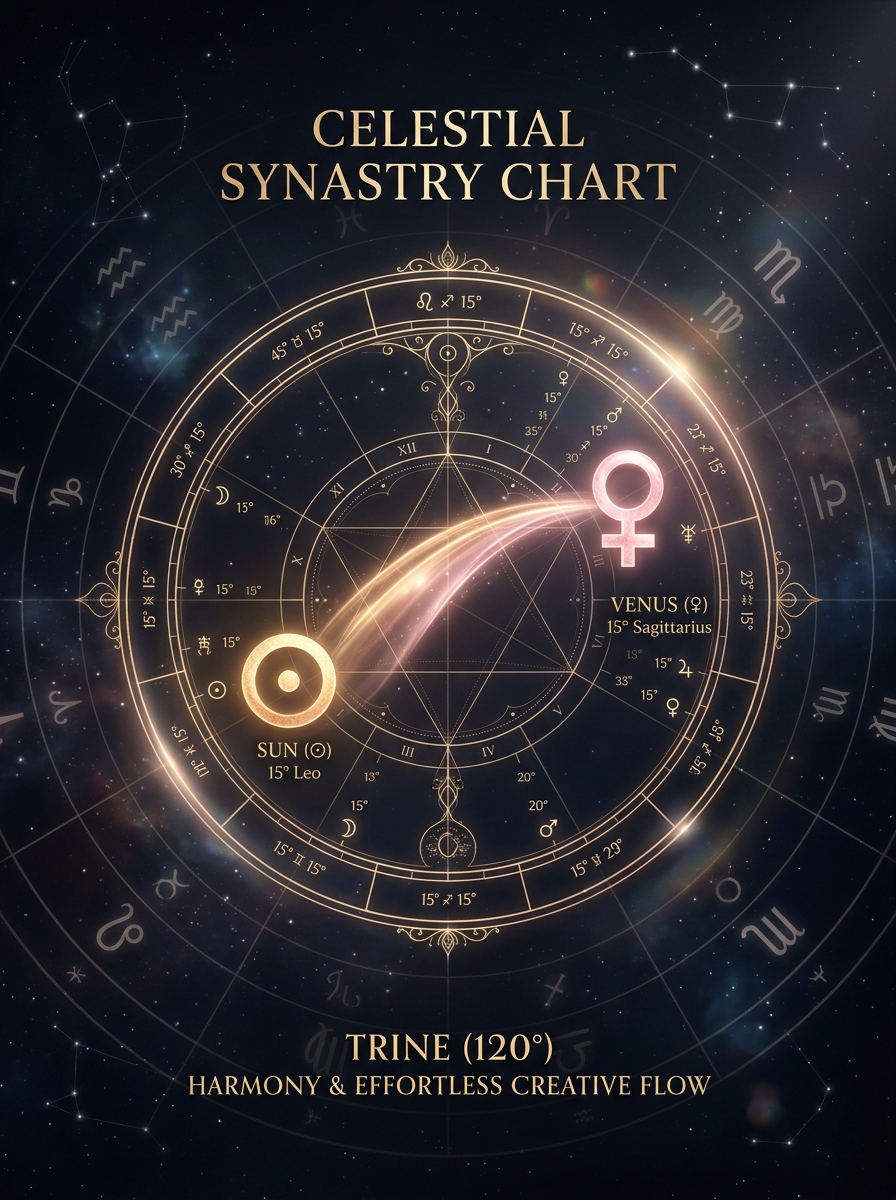
The core signature: recognition without strain
In Sun trine Venus synastry, one person’s self-expression and life force meet the other’s style of affection, pleasure, and values in a way that feels naturally favorable. The Sun person feels appreciated; the Venus person feels charmed. There is usually an instinctive social grace here, a sense that the relationship knows how to say yes to itself. The chemistry is real, but it is often quieter than the heat of Venus and Mars synastry or the emotional fusion of Sun-Moon synastry. What this aspect offers first is not drama but affirmation.
The trine is a 120-degree relationship between signs of the same element, and that elemental kinship is the whole secret. There is no need to force the connection into existence. The people often share a natural rhythm, and what one emits the other can receive without translation. If you want the larger geometry behind this ease, the logic is similar to a trine aspect more generally: flow, talent, and the danger of taking smoothness for depth. In synastry, that smoothness can be a gift, but it can also become a kind of relational autopilot.
The trine does not create attachment by pressure. It creates it by pleasure. The Sun person may feel “liked for who I am,” which is no small thing. The Venus person may feel that their preferences, aesthetic instincts, and social intelligence land exactly where they are most effective. Together they tend to generate goodwill quickly, and in many charts this is the aspect that makes a first date feel easy, a conversation feel expensive, or a relationship feel strangely familiar before intimacy has even had time to prove itself.
What the attraction actually feels like
The attraction in Sun trine Venus often arrives as warmth before it arrives as overt desire. The Sun person may notice the Venus person’s attention as flattering, softening, or beautifying; the Venus person may notice the Sun person as radiant, confident, or pleasingly alive. This is a contact that often improves posture, tone of voice, and manners. It lends social polish to the pair. You can see why it often appears in charts where people like being photographed together, hosting together, or simply being seen together.
The Sun person’s experience
The Sun person usually feels supported in selfhood. Their creativity is less likely to be met with competition and more likely to be met with appreciation. They may feel that the Venus person knows how to receive them without trying to revise them. If the Sun person is used to earning love through performance or intensity, this aspect can feel startlingly unburdened. It is one reason the Sun person may become more generous and more aesthetically aware in the relationship: being admired has a way of civilizing the solar fire.
Still, the Sun can become vain under too much Venusian admiration. If the connection never introduces friction, the Sun person may begin to equate comfort with love and applause with intimacy. That is where the charm of the aspect can shade into a blind spot. A relationship built only on being mutually pleasing can stay lovely while remaining untested.
The Venus person’s experience
The Venus person often feels chosen in a deeply reassuring way. The Sun person seems to value what Venus values, or at least to activate Venusian pleasures with little resistance. This can create a strong sense of being aesthetically and socially understood. The Venus person may become more affectionate, more open, or more visibly elegant around the Sun person, as if the relationship gives their preferences a stage.
But Venus can also over-accommodate. If the Venus person is conflict-avoidant, the trine may invite them into a role of continual softening, smoothing, and pleasing. That is not always conscious. The relationship can become beautiful by default, while inconvenient truths are deferred in the name of harmony. Compare this to the more direct pressure of Venus in Libra, where balance is an active art, not just a mood.
The sweetness hides a specific friction: complacency
The main difficulty of Sun trine Venus is not fighting. It is ease that never has to mature. The connection can become so agreeable that neither person pushes the other into necessary truth. In Jungian terms, the pair risks identifying with the persona: the polished social face, the version of themselves that knows how to be liked. That mask is not false, but it is partial. A trine can make the partial feel sufficient.
The result is usually not explosive conflict. It is underdevelopment. The relationship may look harmonious from the outside while avoiding the harder work of differentiation. The Sun person may stop stretching because they are already admired; the Venus person may stop asserting taste because the atmosphere is so pleasant without it. Over time, that can produce a subtle emotional anemia. Everyone is being nice. Nobody is being fully known.
When the trine becomes too soft
This aspect can also encourage a kind of romantic anesthesia. Because the Sun person feels valued and the Venus person feels charmed, both may unconsciously avoid whatever would disturb the tone. That can be fatal if one partner needs explicit discussion about money, commitment, sex, or long-term direction. The bond can remain affectionate while sidestepping the facts.
That is why synastry never belongs to a single aspect. A glittering Sun-Venus trine can coexist with harder contacts that test the relationship’s bones. A square or opposition elsewhere may supply the tension the trine does not. If the chart also contains a Moon-Venus synastry link, the couple may be able to soothe one another with unusual tenderness; if not, the elegance may be more social than sustaining. Harmony is not the same thing as intimacy.
How sign element and house placement change the tone
A trine between Sun and Venus is inherently easy, but the signs determine the flavor of that ease. Fire signs make the connection more overtly radiant and expressive. Earth signs make it more tactile, practical, and steady. Air signs render it conversational and stylish. Water signs make it tender, intuitive, and private. The aspect stays the same; the emotional texture changes dramatically.
This is where the chart becomes specific rather than generic. A Sun trine Venus in Aries and Leo can feel like mutual applause with real glamour. In Taurus and Virgo, it may show up as dependable care, good taste, and shared rituals. In Gemini and Libra, the relationship can revolve around banter, social intelligence, and an almost elegant mental reciprocity. In Cancer and Pisces, the bond may feel protective, sentimental, and quietly devotional.
House overlays determine where the harmony lives
House placement shows the stage on which the trine acts. If the Venus person’s Venus falls into the Sun person’s fifth house, the chemistry often becomes unmistakably romantic, playful, and creative; if it falls into the seventh, the aspect may feel more openly partnership-oriented. A fourth-house overlay can make the pair think in terms of nesting, home, and emotional shelter. A tenth-house overlay may turn the affection public, polished, and professionally useful, like two people who make each other look good in the world.
This is why synastry house overlays matter so much: the aspect tells you how the planets speak; the houses tell you where the conversation happens. The same Sun trine Venus can create a flirtation, a marriage, a creative alliance, or a quiet admiration that never fully declares itself. Context is destiny’s grammar.
What this aspect is good for, and what it cannot do alone
In synastry, Sun trine Venus is one of the most reliable indicators of immediate goodwill. It helps people enjoy one another’s company, forgive minor imperfections, and feel socially at ease together. It often supports romance, yes, but it is just as useful in friendship, collaboration, and family ties because it lowers the friction around being together. The other person tends to feel like a place where your better manners emerge naturally.
It can also be one of the most elegant indicators of mutual encouragement in creative life. The Sun person may feel emboldened to present themselves; the Venus person may know how to style, frame, or soften that presentation. Together they can make beauty without hysteria. In that sense, the aspect resembles the productive grace of Venus in the fifth house or Venus in the first house: love and selfhood stop competing and begin to decorate one another.
What it cannot do alone is guarantee depth, fidelity, or hard-earned transformation. For that, the chart needs other signatures: Saturn for durability, Pluto for intensity, the Moon for emotional belonging, Mars for erotic ignition, the seventh house for formal partnership. A trine is an instrument of flow, not proof of soul-mate status. Even the most beautiful compatibility can remain decorative if it never enters the difficult rooms of real life. The ease is real; the question is whether the ease can carry truth.
Reading the aspect in the larger relationship
The best way to interpret Sun trine Venus is to ask what kind of goodness the relationship makes possible. Does the Sun person become more confident, more generous, more aesthetically awake? Does the Venus person feel more visibly adored, more socially alive, more able to name what they like? If yes, the aspect is doing its work. If the bond is only sweet but not sustaining, then the trine is probably covering for missing structure elsewhere.
A stronger reading also considers whether the relationship has an elemental echo elsewhere. A fire-sign trine may be buoyed by synastry love dynamics that reward enthusiasm and creativity, while an earth-sign trine may rely on practical overlays and shared routines. If the relationship also contains a grand trine, the atmosphere can become especially fluent, even luxurious; the question then is whether the couple can avoid the drift toward inertia described in a grand trine or its more crystalline, self-enclosed version in The Grand Trine: Sacred Geometry, Elemental Flows, and the Trap of Harmonic Inertia. Too much harmony can become a closed ecosystem.
That is the paradox of Sun trine Venus: it is one of the gentlest aspects in synastry, and gentleness can be either blessing or evasion. At its best, it lets two people experience one another as attractive, affirming, and naturally pleasing without needing to perform for every inch of connection. At its worst, it keeps everything lovely enough that nobody notices the relationship has stopped telling the truth.
Related
- Venus Trine Venus in Synastry: Shared Taste, Easy Affection, and the Hidden Cost of Too Much Ease
- Synastry Sun Trine Moon: The Quiet Chemistry of Being Felt
- Moon Trine Venus in Synastry: The Soft Geometry of Being Easily Loved
- Venus Trine Mars in Synastry: The Ease of Mutual Desire
- Synastry Sun Sextile Venus: The Ease That Makes Desire Feel Human
Comments
Loading comments…