Venus Trine Mars in Synastry: The Ease of Mutual Desire
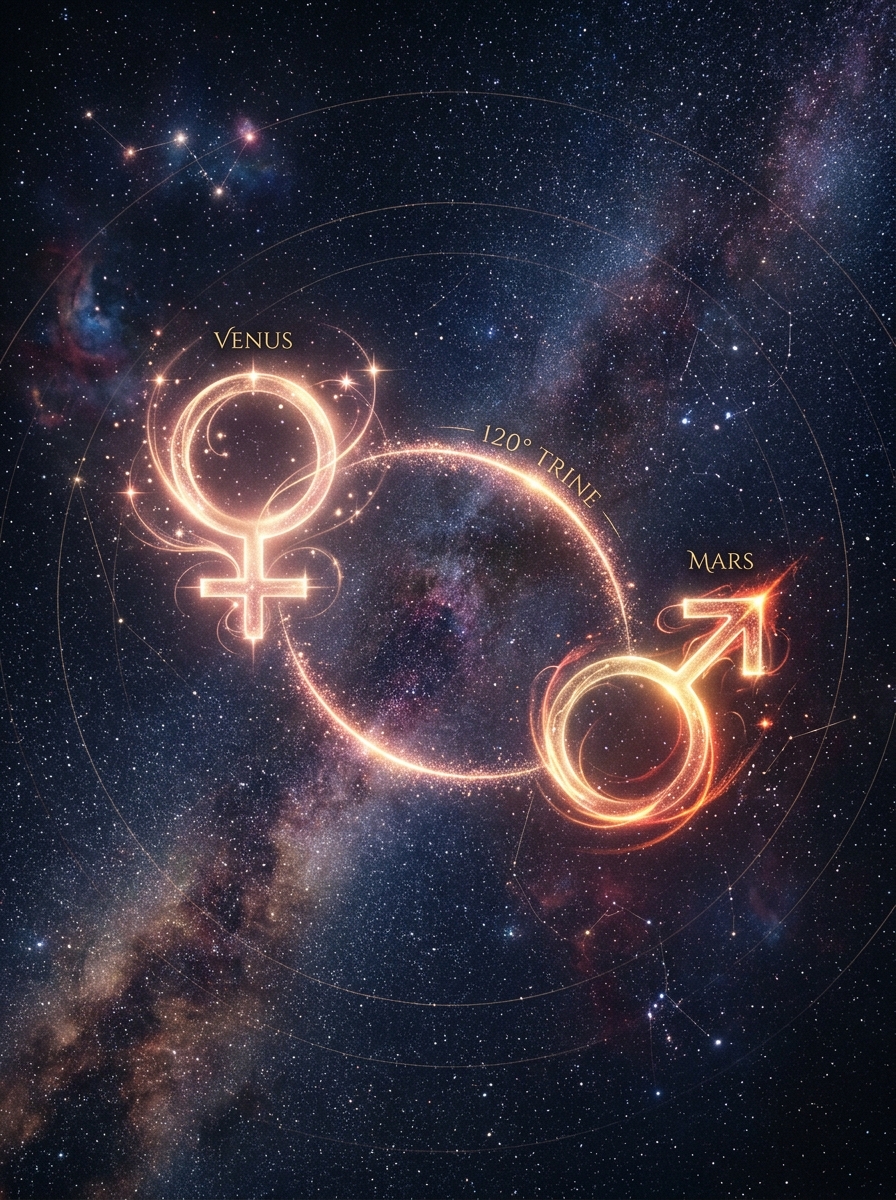
Venus trine Mars in synastry is the aspect of desire that knows its own language. One person’s Venus recognizes beauty and warmth; the other’s Mars recognizes readiness and direction. In a trine, these two functions do not negotiate — they meet, as if they had always been speaking the same dialect. The attraction is not forced, not misunderstood, not delayed by the usual static of misinterpretation. This is a bond where courtship feels natural and desire circulates without translation.
The Core Dynamic: Mutual Ease Without Translation
What makes this aspect distinct is the absence of the friction that defines most Venus-Mars contacts. In a square or opposition, Venus and Mars often pull against each other: one wants closeness while the other wants conquest, one moves slow while the other rushes, and the result is a productive but uncomfortable spark. The trine skips that struggle. Here, the Venus person’s style of being wanted fits the Mars person’s style of wanting, and the loop closes without resistance.
The circuit works like this: Venus radiates an open invitation, often unconsciously, through manner, taste, or simple presence. Mars picks up that signal not as a challenge but as a permission — a clear path forward. Because the aspect is a trine (120 degrees of harmonic flow), the response is almost reflexive. The Mars person feels encouraged to act, and the Venus person feels good about being acted upon. No one exposes themselves too far, no one retreats too fast.
This is why the aspect commonly appears in couples who describe their early connection as “easy” and who remain physically warm long after the initial rush. For a broader look at how Venus and Mars interact in synastry across all aspects, see Venus and Mars Synastry: The Astrological Alchemy of Desire and Affection.
Timing as a built-in gift
One of the most practical expressions of this ease is timing. The flirtation lands at the right moment; the kiss comes when the mood is ready. Neither partner has to force a pause or explain a boundary. The trine gives both people a kind of interpersonal grace: the ability to read each other’s readiness without a word. That grace extends beyond eros into daily life. A couple with Venus trine Mars often finds that decisions about where to eat, how to spend a weekend, or how to handle a disagreement flow with minimal drama, because the underlying energy is cooperative rather than combative.
How It Plays Out: From First Glance to Long-Term Rhythm
The earliest stage of this aspect is often marked by mutual recognition — each person feels “seen” in a way that is both flattering and safe. The Venus person feels their attractiveness is appreciated, not objectified. The Mars person feels their pursuit is welcome, not rebuffed. That mutual calibration creates a feedback loop: each advance is met with warmth, each warmth invites another advance. There is no need to test or prove.
As the relationship matures, the dynamic becomes a reliable current. In a long-term partnership, Venus trine Mars sustains what psychologists call “ongoing romantic interest”: the partners continue to find each other sexually compelling not because they work at it, but because the underlying harmonic keeps renewing itself. It is renewable heat. The body language stays open, the playful teasing continues, the flirtation never quite ends.
The social expression of the bond
Venus governs not only romance but social polish, aesthetic instinct, and the impulse to make life more beautiful. Mars governs assertion, initiative, and the courage to act. In a trine, these qualities blend in everyday settings. The couple moves well together in public — they know how to dress for each other, how to share a stage, how to handle a disagreement without humiliating the other. This social grace is not superficial; it is the outer form of an inner agreement. Partners often report feeling “on the same page” even when they disagree on details, because the underlying commitment to each other’s dignity (Venus) and agency (Mars) is never questioned.
When this aspect appears in a synastry chart, it often supports the kind of partnership that can weather ordinary life — the kind that still feels alive after years of shared breakfasts and commutes. For a deeper look at how this plays out across specific houses, see Synastry House Overlays: The Astrological Geography of Relational Resonance.
The Shadow Side: When Ease Becomes Drift
A trine’s greatest strength is also its most seductive risk. Because the attraction flows without effort, the partners may assume it will always flow on its own. This is the shadow of harmonic inertia — the danger of taking chemistry for granted until it becomes background noise. The couple may stop initiating, stop showing appreciation, stop the small gestures that feed the bond. The trine does not disappear, but it can flatten into pleasant familiarity. Desire that was once alive becomes a habit.
This is not a crisis — no affair, no betrayal — but a slow erosion. The partners still like each other, but the spark dims because no one remembers to tend it. The trine’s gift of ease becomes a liability: it never forces the couple to confront their complacency. For a more detailed exploration of how trines can trap us in comfort, read The Trine Aspect in Astrology: Celestial Geometry, Elemental Flow, and the Shadow of Complacency. A grand trine involving Venus and Mars would amplify this pattern even further, as the harmony spreads across the chart — see The Grand Trine: Navigating the Flow of Effortless Talent and Astrological Ease.
The risk of uneven investment
Sometimes one partner begins to rely on the natural flow while the other still initiates. Because the aspect feels easy, the more active partner may not notice they are carrying the load, and the more passive partner may not realize they have stopped showing up. This subtle imbalance can grow over months or years, until the person who started as the pursuer begins to feel invisible. The trine alone will not correct this; it only makes the drift feel less painful than it would under a harsher aspect. The bond requires conscious stewardship — a deliberate choice to keep the circuit alive, even when the flow is smooth.
The Chart Matters: Sign, House, and Other Aspects
A Venus trine Mars is a general promise of harmony, but its concrete expression depends on where each planet sits. The sign tells you the style: Venus in Aries approaches desire with boldness and a need for autonomy; Mars in Taurus moves with deliberate, sensuous persistence. When these two meet in a trine, the energy is still cooperative, but the execution looks very different than it would with a Venus-in-Capricorn partner (reserved, value-driven) and a Mars-in-Sagittarius partner (impatient, adventurous). The underlying circuit is the same; the flavor is not. For a detailed look at one such pairing, see Venus in Aries: Passion, Independence, and the Archetype of the Warrior Goddess.
The house overlay determines where the chemistry shows up. If Mars falls into the 5th house of the other person’s chart, the attraction manifests prominently through play, romance, and creative collaboration. If it falls into the 8th house, the bond carries an undercurrent of erotic intensity and shared transformation. If Venus touches the 1st house, the attraction is immediate and embodied — the other person’s physical presence is magnetic. If it touches the 10th house, the pair may admire each other’s professional competence and public authority as much as their personal charm.
Other aspects complicate the picture
A trine rarely exists in isolation. The same Venus or Mars may square Saturn, oppose Pluto, or form a tight conjunction with Neptune. Those tensions do not cancel the trine; they color it. A couple might have an easy Venus-Mars trine but a harsh Venus-Saturn square — the attraction is real, but commitment feels heavy and uncertain. In such cases, the trine becomes an oasis, a reliable source of felt connection that helps the partners endure the harder aspects. It is not a magic wand. The full synastry chart must be read as a whole. For a comprehensive guide to the process, see Synastry Step-by-Step: The Complete Astrological Guide to Relationship Compatibility.
Renewable Heat: How to Steward the Bond
The healthiest expression of Venus trine Mars is not constant fireworks. It is a foundation of mutual accessibility — each person knows they can reach for the other and find a response. That accessibility is what makes the bond renewable. When the trine is tended, it does not fade; it deepens. The partners learn that ease and depth are not opposites. The attraction remains alive because both people periodically remember to choose each other, even when the choice is invisible.
This stewardship can be as simple as a touch without agenda, a word of appreciation, a spontaneous plan. The aspect asks for nothing heroic — only that the partners do not assume the fire will tend itself. In this sense, Venus trine Mars parallels the gentle reliability of a Moon-Venus synastry connection, where emotional safety is given freely. The difference is that Venus-Mars animates, while Moon-Venus soothes. For that complementary dynamic, see Moon-Venus Synastry: The Sanctuary of Daily Affection and Astrological Harmony. Together, they create a relationship that is both warm and alive — and worth tending.
Related
- Venus Trine Venus in Synastry: Shared Taste, Easy Affection, and the Hidden Cost of Too Much Ease
- Moon Trine Venus in Synastry: The Soft Geometry of Being Easily Loved
- Synastry: Venus Sextile Mars — The Ease of Mutual Spark
- Moon Trine Mars Synastry: Desire, Protection, and Easy Emotional Heat
- Synastry Sun Trine Venus: The Easy Warmth of Being Wanted
Comments
Loading comments…