The Trine Aspect in Astrology: Celestial Geometry, Elemental Flow, and the Shadow of Complacency
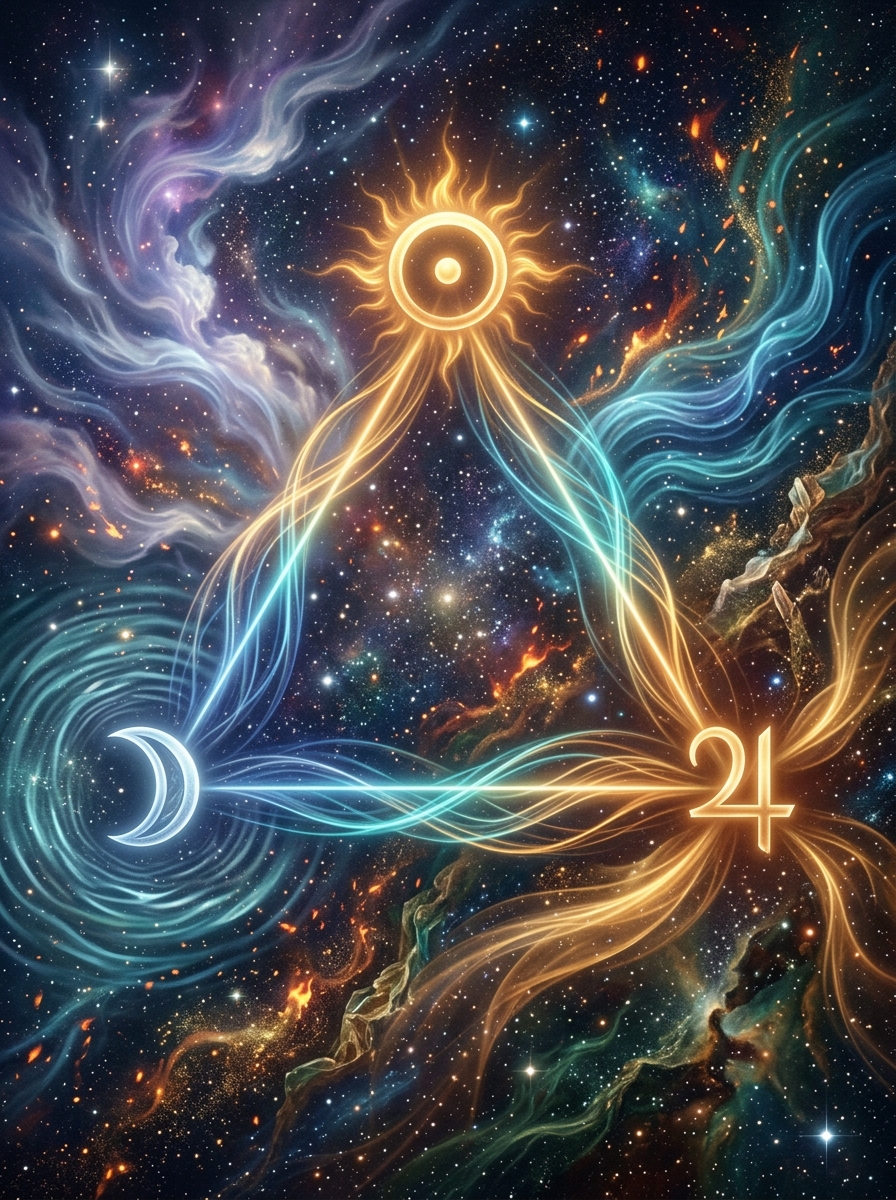
The cosmic tapestry is woven through angular relationships, geometric intersections of light and gravity that astrologers call aspects. Among these, the trine—a precise 120-degree separation between two celestial bodies—stands as the undisputed emblem of harmony, ease, and effortless flow. When two planets form a trine, they speak the same elemental language. They occupy signs of the same element (Fire, Earth, Air, or Water), creating a natural circuit of energy that operates with the fluid grace of a well-rehearsed symphony. In the birth chart, the trine points to our inherent talents, the areas of life where we experience no resistance, and the psychological channels where consciousness flows without friction.
Yet, this very ease introduces a subtle spiritual and evolutionary paradox. Because the trine represents energy that functions without effort, it often operates below the threshold of conscious awareness. It is the gift we take for granted, the talent we fail to develop, the path of least resistance that can ultimately lead to psychological stagnation. To truly understand the trine, we must look beyond the simplified interpretation of it as merely "good luck" or a "positive aspect." We must examine its sacred geometry, its esoteric symbolism, its elemental variations, and its role in the lifelong process of Jungian individuation.
The Celestial Geometry of 120 Degrees: Defining the Trine and the Sacred Triangle
To comprehend the trine, we must first look to the sky and the mathematics of the circle. A circle represents the infinite, the unbroken wholeness of the cosmos. When we divide the 360-degree wheel of the zodiac by the number three, we arrive at the angle of 120 degrees. This division creates an equilateral triangle within the circle—a shape that represents the most stable, balanced, and structurally sound configuration in geometry.
In classical astrology, particularly as articulated by Claudius Ptolemy in the Tetrabiblos, aspects were understood through the lens of planetary friendships and hostilities. The trine was classified as a major, or Ptolemaic, aspect, universally recognized as highly favorable. The reason lies in the element of the signs involved. Because the zodiac is divided into twelve signs, and those twelve signs are divided into four elements, any two signs that are 120 degrees apart will naturally belong to the same triplicity. For example, Aries, Leo, and Sagittarius are all Fire signs; Taurus, Virgo, and Capricorn are Earth signs; Gemini, Libra, and Aquarius are Air signs; and Cancer, Scorpio, and Pisces are Water signs.
When two planets are in trine, they share a fundamental temperament. They share the same dry, wet, hot, or cold qualities. There is no need for translation or negotiation between them. A planet in Aries shares the same hot, dry, active nature as a planet in Sagittarius. They naturally validate and reinforce one another, creating an open channel of communication where energy flows back and forth with zero impedance.
The Math of Harmony: Dividing the 360-Degree Circle
When we look at the division of the circle by three, we are looking at the manifestation of the Ternary. Pythagoras and his followers regarded the number three as the first true number, because it has a beginning, a middle, and an end. In Pythagorean geometry, two lines can meet but cannot enclose a space; it requires a third line to create a stable two-dimensional form—the triangle.
In terms of planetary dynamics, the trine represents an open, flowing circuit. Unlike the opposition (180°), which divides the circle by two and creates a polarized tug-of-war, or the square (90°), which divides the circle by four and creates acute friction and a need for action, the trine is self-contained and self-sustaining. The energy flows along the lines of the triangle, feeding back into itself. There is no external crisis to resolve, no internal tension demanding release.
Johannes Kepler, who revolutionized aspect theory by introducing the minor aspects based on harmonic ratios, noted that the trine (the 1:3 ratio) represents a state of natural resonance. In musical terms, it is akin to a perfect major chord. It sounds pleasing to the ear because the wave frequencies align perfectly, without the acoustic beating or dissonance of a semi-sextile or a square. In the human psyche, this translates to a cognitive or behavioral pattern that feels natural, right, and deeply comforting. We do not question our trines; we simply live them.
The Mysticism of Three: Reconciliation of Opposites and Synthesis
The number three has held a central place in the Western esoteric tradition for millennia. It is the key to understanding how the universe resolves polarity and achieves harmony. In the Kabbalah, the third Sephirah of the Tree of Life is Binah (Understanding), which acts as the mother archetype, receiving the raw, active energy of Chokhmah (Wisdom) and organizing it into form. This represents the synthesis of the primordial positive and negative forces of the cosmos.
Similarly, in the Tarot, Key 3 is the Empress. She represents fertility, abundance, nature, and the creative force. She is the manifestation of the union between the Magician (Key 1, active consciousness) and the High Priestess (Key 2, passive subconsciousness). The Empress is the trine in action: the natural, organic growth that occurs when polarities are reconciled and allowed to flourish in a supportive environment. The Empress does not struggle to create; she conceives, gestates, and births through the natural cycles of time.
In the writings of Aleister Crowley, particularly in The Book of Thoth, the number three is associated with the maternal, nurturing aspect of the universe that allows raw energy to stabilize and find its natural expression. Crowley notes that without the third term, the universe remains locked in a sterile, static duality. The trine aspect represents this stabilizing third term in astrology. It acts as a bridge, allowing the conscious mind and the unconscious mind to meet in a space of mutual understanding and creative synthesis.
Triadic Archetypes: Jung, Crowley, and the Transcendent Function
Carl Jung, the founder of analytical psychology, wrote extensively about the concept of the "transcendent function." Jung observed that when the conscious ego and the unconscious shadow are locked in conflict—a psychological state analogous to the astrological square or opposition—the tension cannot be resolved by the ego's logical faculties alone. Instead, a third factor must emerge from the depths of the psyche to unite the opposites and create a new level of consciousness.
This transcendent function is structurally identical to the astrological trine. The trine provides the psychological container within which conflict can be integrated. It represents the innate wisdom of the psyche, the natural healing mechanism that seeks balance and wholeness. When we work with a trine in our birth chart, we are tapping into this transcendent function. We are allowing the natural flow of archetypal energy to wash over our internal conflicts, dissolving the rigid boundaries of the ego and facilitating a deeper synthesis of the self.
Steven Forrest, a leading voice in evolutionary astrology, describes the trine as a "gift of grace" earned in past cycles of development. He suggests that the ease we experience with a trine is the result of hard work and conscious integration in previous lifetimes, now manifesting as a natural, instinctual talent. Whether one subscribes to the evolutionary view of karma or the psychological view of genetic and developmental inheritance, the reality remains: the trine is an area of the chart where the soul has already achieved a state of peace and synthesis.
Elemental Resonance: How Trines Manifest in Fire, Earth, Air, and Water
Because a trine always connects signs of the same element, its manifestation is deeply colored by the nature of that element. The four elements represent the four fundamental modes of human experience: intuition (Fire), sensation (Earth), intellect (Air), and feeling (Water). When planets are linked by a trine, they supercharge the element they share, creating a highly specific type of psychological flow.
Understanding these elemental variations is crucial for interpreting how a trine will behave in a birth chart. A fire trine operates with a completely different energy, speed, and visibility compared to a water or earth trine.
Fire Trines: The Flow of Inspiration and Will
The Fire trine involves Aries, Leo, and Sagittarius. Fire represents spirit, enthusiasm, vitality, and the drive for self-actualization. When planets are in a Fire trine, the individual experiences an effortless flow of creative energy, inspiration, and self-confidence.
Aries (Initiating Will) <=========> Leo (Expressive Heart)
      \                                 /
       \                               /
        \                             /
         \                           /
          \                         /
           \                       /
            Sagittarius (Expanded Vision)
In a Fire trine, there is an innate sense of destiny and personal power. The individual does not need to search for motivation; it arises spontaneously from within. They possess a natural charisma and a belief in their own abilities that can make them highly effective leaders, artists, or innovators. However, the shadow of the Fire trine is self-absorption and a lack of grounding. Because things come so easily, the individual may struggle with patience, discipline, and the mundane details of daily life, expecting the world to bend to their enthusiastic will without putting in the necessary structural work.
Earth Trines: The Flow of Materialization and Form
The Earth trine links Taurus, Virgo, and Capricorn. Earth represents the physical world, practicality, stability, and the mastery of form. When planets occupy an Earth trine, the individual has a natural affinity for the material plane.
Taurus (Sensory Resources) <=========> Virgo (Refined Craft)
       \                                   /
        \                                 /
         \                               /
          \                             /
           \                           /
            \                         /
             \                       /
             Capricorn (Structural Authority)
This configuration manifests as an innate understanding of how to build, organize, and sustain resources. These individuals are naturally grounded, pragmatic, and patient. They excel at turning abstract ideas into tangible reality, whether that means building a successful business, creating physical art, or managing complex systems. The flow here is steady, quiet, and reliable. The danger of the Earth trine is a deep-seated materialism and resistance to change. The individual can become so comfortable in their physical routines and security that they reject spiritual growth, emotional vulnerability, and the creative disruption necessary for psychological evolution.
Air Trines: The Flow of Intellect and Relationship
The Air trine connects Gemini, Libra, and Aquarius. Air represents the mind, communication, social dynamics, and abstract thought. When planets are in an Air trine, the flow occurs in the realm of ideas and social connections.
Gemini (Curious Connection) <=========> Libra (Harmonious Relation)
       \                                    /
        \                                  /
         \                                /
          \                              /
           \                            /
            \                          /
             \                        /
             Aquarius (Systemic Vision)
Individuals with Air trines possess a natural intellect, social grace, and objectivity. They learn quickly, synthesize complex information effortlessly, and communicate their thoughts with clarity and poise. They are natural mediators and thinkers, able to see multiple perspectives without getting bogged down in emotional bias. However, the trap of the Air trine is intellectual detachment and superficiality. Because they can rationalize anything with ease, they may avoid the messy, irrational depths of emotional intimacy or the hard, practical demands of physical labor, living entirely in a beautiful but sterile world of concepts and ideals.
Water Trines: The Flow of Intuition and Soul
The Water trine connects Cancer, Scorpio, and Pisces. Water represents the emotional depths, the subconscious, intuition, and the psychic dimensions of life. A Water trine creates an effortless flow of empathy, creativity, and spiritual sensitivity.
Cancer (Nurturing Sanctuary) <=========> Scorpio (Transformative Depth)
       \                                      /
        \                                    /
         \                                  /
          \                                /
           \                              /
            \                            /
             \                          /
              Pisces (Boundless Devotion)
Individuals with Water trines are deeply intuitive, often psychic, and possess a profound capacity for emotional healing. They absorb the atmosphere around them and can navigate complex psychological landscapes with natural ease. Their creative work is often rich with symbolic and emotional resonance, drawing directly from the collective unconscious. The shadow of the Water trine is emotional enmeshment, hypersensitivity, and escapism. Because the emotional boundaries are so fluid, these individuals can easily become overwhelmed by the pain of the world, retreating into passivity, fantasy, or victimhood rather than using their emotional gifts to take constructive action.
Jungian Integration: Innate Strengths and the Unconscious Flow
From a Jungian perspective, the birth chart is a map of the psyche, showing the different archetypes and complexes that make up the individual self. Within this framework, the trine aspect represents a pre-established pathway of psychological integration. It is an area of the psyche where the ego does not feel threatened by the unconscious.
For example, if an individual has a trine between Mercury (the conscious mind, communication) and Neptune (the archetype of the spiritual, the imaginative, the collective unconscious), the boundary between the ego-consciousness and the transpersonal realm is porous and friendly. The individual can easily access dreams, artistic inspiration, and spiritual insights, translating them into clear language or artistic expression. They do not experience the terror of being overwhelmed by the unconscious that a person with a Mercury-Neptune square might feel.
However, Liz Greene, in her seminal work on psychological astrology, points out that this very friendliness can prevent psychological growth. Because the trine operates so smoothly, the ego is never forced to confront its own limitations in that area. The individual may remain completely unconscious of the power and dynamics of the planets involved, viewing them as "just the way things are."
The Shadow of Easy Flow: When Integration Becomes Invisible
In Jungian psychology, the "shadow" consists of those parts of ourselves that we reject, ignore, or fail to recognize. While we usually think of the shadow as containing our dark, destructive impulses, it also contains our unlived potential and gold—talents and strengths that we have not consciously claimed.
The trine aspect can easily contribute to this "golden shadow." Because the talents of the trine require no effort, the individual may not value them. They might assume that everyone can write beautifully, organize complex budgets, or read people's emotions instantly. Consequently, they do not cultivate these abilities, leaving them in a semi-conscious, primitive state.
Furthermore, if a chart is dominated by trines and lacks tense aspects (squares and oppositions), the individual may lack the psychological drive to develop a strong, resilient ego. They may float through life, relying on their natural charm, luck, or intelligence, but never achieving true psychological maturity or individuation. They remain perpetual children—the archetype of the Puer Aeternus—never testing their limits against the hard realities of the material world.
+-------------------------------------------------------------+
|                     THE ASPECTS COMPARED                    |
+-------------------------------------------------------------+
| ASPECT     | ANGLE | DIVISION | DYNAMIC     | RESISTANCE    |
+------------+-------+----------+-------------+---------------+
| Trine      | 120°  | 3        | Flowing     | Zero / Low    |
| Sextile    | 60°   | 6        | Opportunistic| Moderate      |
| Square     | 90°   | 4        | Frictional  | High          |
| Opposition | 180°  | 2        | Polarizing  | Very High     |
+-------------------------------------------------------------+
The Stagnation Trap: Turning Potential Energy into Active Virtues
The ultimate evolutionary challenge of the trine is the transition from potential energy to kinetic energy, from passive talent to active virtue. In physics, potential energy is the energy stored within an object due to its position or configuration. It does not do any work until it is released and converted into kinetic energy.
The trine is a reservoir of potential energy. It is a gift, a natural capacity, but it is not an achievement. To turn a trine into a true virtue—something that contributes to our personal growth and the welfare of others—we must apply conscious will and discipline. This is where we must invite the structure of Saturn and the focused drive of Mars into our trines.
For example, a person with an Venus-Jupiter trine has a natural capacity for joy, generosity, and attracting abundance. They are easily liked and bring a pleasant energy to any room. However, if they do not consciously work with this energy, it can manifest as laziness, self-indulgence, and a tendency to avoid any situation that requires effort or discomfort. They may become spiritual dilettantes, seeking constant pleasure and positive reinforcement while avoiding the shadow work necessary for deep transformation.
To avoid the stagnation trap, we must treat our trines not as comfortable resting places, but as tools to help us tackle the more difficult parts of our charts. We can use the flowing energy of a trine as a resource to face our squares and oppositions.
                                  [ The Square ]
                             (Friction & Action Required)
                                         ^
                                         |
                                         | (Conscious Application)
                                         |
     [ The Trine ] ----------------------+
  (Effortless Talent,
   Resource Reservoir)
By consciously directing the ease of the trine toward the friction of the square, we create a dynamic psychological alchemy, using our innate strengths to dismantle our deepest blocks.
Astrological Comparisons: The Trine Versus the Sextile, Square, and Opposition
To truly appreciate the nature of the trine, we must place it in context with the other major aspects. Each aspect represents a different phase in the development of consciousness, and comparing them reveals the unique role the trine plays in our psychological evolution.
The Trine vs. The Sextile (60°)
Both the trine and the sextile are harmonious, flowing aspects, but they operate with different levels of intensity and awareness. While the trine (120°) connects signs of the same element, the sextile (60°) connects signs of compatible elements (Fire and Air, or Earth and Water).
The sextile represents a potential talent that requires conscious effort to activate. It is an open door, an invitation. If you do not walk through it, the energy remains dormant. The trine, on the other hand, is already active and running in the background of your life. It is not an invitation; it is a permanent state of flow. We must work to develop our sextiles, but we must work to become aware of our trines.
The Trine vs. The Square (90°)
The square represents acute internal conflict. It is the clash of two planets in different elements and modalities (Cardinal, Fixed, or Mutable) that cannot find a common language. The square demands action; it creates anxiety, crises, and obstacles that force us to grow and build character.
While the trine feels much better than the square, it is often the squares in our charts that drive our greatest achievements. The square is the engine of the chart, providing the raw power and determination to succeed. The trine, without the motivating friction of a square, can lead to a pleasant but ultimately unproductive life. A chart with a healthy balance of squares and trines is ideal: the squares provide the motivation to build, while the trines provide the ease, recovery, and internal resources to sustain the effort.
The Trine vs. The Opposition (180°)
The opposition represents a state of projection and relationship conflict. It occurs between planets in opposite signs of the zodiac, creating a polarized axis where we tend to identify with one planet and project the other onto the external world (partners, enemies, circumstances).
The challenge of the opposition is to find the middle ground, to balance the seesaw. The trine resolves this polarity by bypassing the conflict altogether. Instead of a tug-of-war, the trine offers a collaborative triangle where energy is shared and integrated. However, because the opposition forces us to engage with the "other," it often leads to profound relationship wisdom and self-awareness. The trine, being self-contained, can make us self-sufficient to the point of isolation, requiring no input from the outside world and thus missing the growth that comes from relational mirror-work.
FAQ Section: Working with Trines in the Birth Chart
What happens if my birth chart has many trines but no squares or oppositions?
A chart dominated by trines with little to no challenging aspects (squares or oppositions) can create a life of relative ease and comfort, but it also carries the risk of psychological inertia. Without the friction and drive provided by squares, there is little internal pressure to grow, change, or achieve.
Individuals with this configuration may find that opportunities come easily, but they lack the discipline, resilience, or ambition to make the most of them. They can easily fall into the stagnation trap, avoiding any situation that involves conflict, effort, or discomfort. In psychological terms, they may struggle to develop a strong ego-defense system, making them vulnerable when life inevitably presents major crises that cannot be resolved with charm or luck.
How can I identify a trine in my birth chart?
A trine occurs when two planets are approximately 120 degrees apart on the 360-degree zodiacal wheel. Astrologers typically allow an "orb of influence"—a range of deviation from the exact angle—of about 6 to 8 degrees. This means that if one planet is at 10 degrees of Aries, any planet between 2 and 18 degrees of Leo or Sagittarius is considered to be in trine to it.
Most modern birth chart generators will draw a blue line (or sometimes a green line, depending on the software settings) between the two planets to indicate a trine aspect. You can also identify them manually by checking if the planets are in signs of the same element and have similar degree numbers.
Can a trine involve planets in different elements?
Yes, this is known as a "dissociate trine" or an "out-of-sign trine." It occurs when two planets are close to the 120-degree angle, but due to their positions at the very beginning or end of their respective signs, they lie in signs of different elements.
For example, if Mars is at 29 degrees of Aries (a Fire sign) and Neptune is at 1 degree of Virgo (an Earth sign), they are 122 degrees apart, which is well within the orb of a trine. However, because they occupy Fire and Earth signs, they do not share the same elemental language. A dissociate trine does not flow as easily or unconsciously as a standard trine; it requires a bit of adjustments and conscious integration, behaving more like a hybrid between a trine and a minor challenging aspect.
What is a Grand Trine, and is it always beneficial?
A Grand Trine is a major planetary configuration that occurs when three planets in a chart form trines to one another, creating an equilateral triangle. This links all three signs of a single element (Fire, Earth, Air, or Water) in a continuous loop of flowing energy.
While a Grand Trine represents a profound reservoir of talent, creativity, and protection, it is also a highly self-contained system. The energy circulates within the triangle so effortlessly that it can be very difficult for the individual to break out of this loop and engage with the rest of the chart. It can act as a psychological "closed circuit," leading to extreme complacency, defensiveness, and resistance to any external influence that threatens the harmony of the triangle.
How do transits affect the trines in my natal chart?
When a transiting planet forms a trine to a planet in your natal chart, it temporarily opens a channel of ease, opportunity, and smooth integration. These periods are often marked by a feeling of support, where things seem to fall into place without much struggle.
If a transiting planet triggers an existing natal trine, it activates that entire circuit of talent and flow, making it an excellent time to express those natural gifts, initiate projects related to those planets, or use that positive energy to address more challenging transits occurring elsewhere in your chart. However, because transit trines lack urgency, we can easily let them pass without taking action, enjoying the temporary mood boost but failing to build anything lasting with the energy.
How do I consciously work with a trine to prevent stagnation?
To prevent a trine from becoming a source of complacency, you must apply conscious intent, discipline, and structure to it. Treat the talents indicated by the trine not as finished products, but as raw materials that need to be refined through practice and effort.
Look at the houses where the trined planets reside; these are the life areas where you can actively deploy these gifts. If you have an intellectual Air trine, commit to writing, teaching, or formal study rather than just daydreaming or chatting. If you have a Water trine, channel that emotional sensitivity into creative arts, therapy, or active service. By coupling the flowing grace of the trine with the focused discipline of Mars and Saturn, you transform passive potential into an active, conscious, and evolutionary force.
Comments
Loading comments…