Synastry Sun Sextile Venus: The Ease That Makes Desire Feel Human
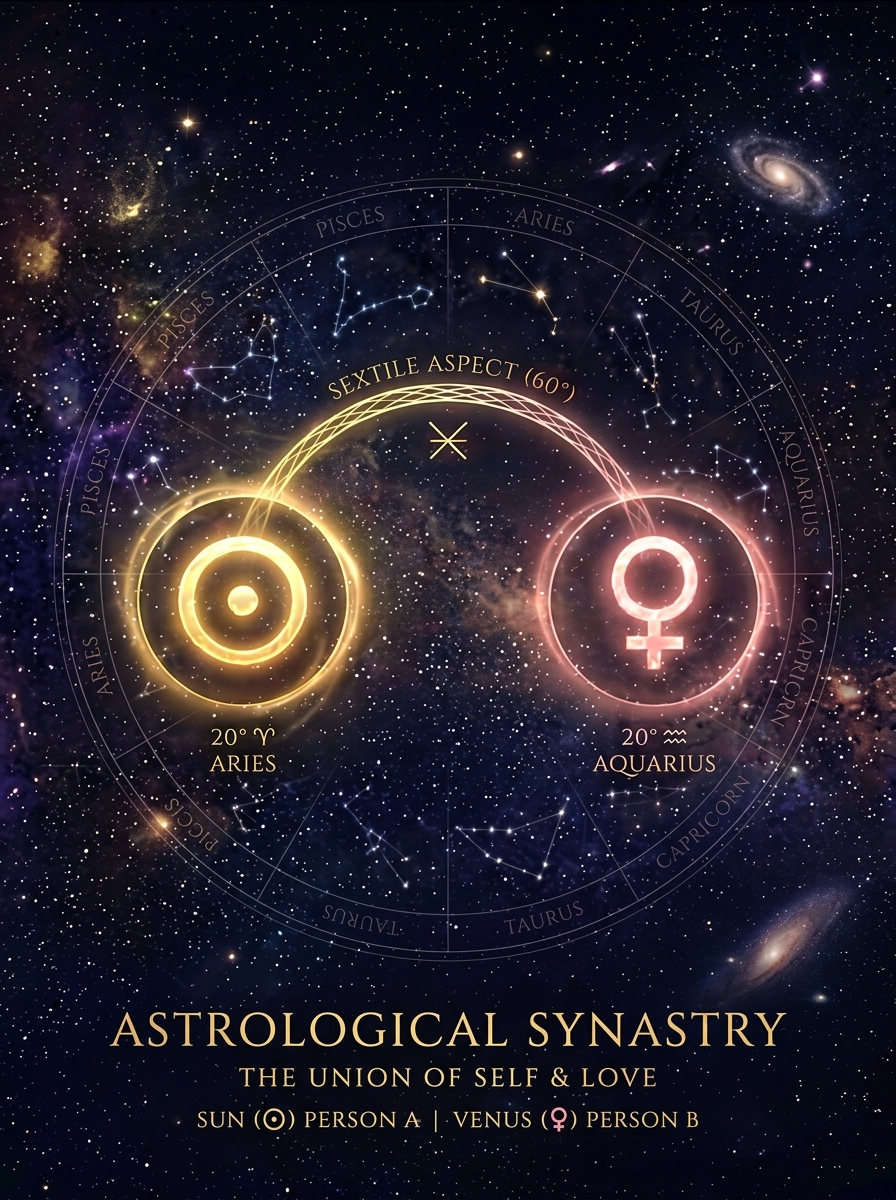
A Sun sextile Venus in synastry is the aspect equivalent of a room that makes everyone look better. It does not force connection; it opens a door between identity and value, will and affection, self-expression and receptivity. The sextile is an aspect of opportunity, not compulsion — and here the opportunity is to be liked without having to audition. The Sun person feels seen and approved of at a core level, while the Venus person feels their taste, charm, and relational instincts land with unusual grace. The attraction is not volcanic. It is better than that for the long term: it creates a social field where both people can be more themselves, with less fear of rejection and less pressure to perform. This is not the chemistry that burns hot and fast; it is the chemistry that allows two people to enjoy each other’s company, repeatedly, and to let that enjoyment deepen into something renewable.
The root of the ease: mutual activation of relational intelligence
Why does this aspect feel so clean? Because each person activates something the other is already wired to do well. The Sun person, whose core identity is on display, meets a gaze that affirms rather than competes. The Venus person receives permission to express preference, delight, and even refusal, because the Sun gives value a visible center. In Jungian terms, the Sun finds an ally for its persona without being reduced to it — the self is aesthetically welcomed, not merely admired from a distance. Venus, usually the planet of reception and valuation, gains direction and clarity.
This mutual activation shows up in behavior. The Sun person may dress better, speak with more charm, or take greater pleasure in their own creativity because Venus responds with appreciation instead of anxiety. The Venus person may become more confident in asserting what they like — in art, in food, in how to spend an evening — because the Sun provides a steady reference point. The relationship develops a kind of social intelligence: introductions go more smoothly, conflicts soften because timing matters, and affection travels through gesture rather than declaration. For a broader map of how synastry organizes these dynamics, see the overview of synastry aspects and the complete guide to relationship chart overlay.
Because the sextile is an aspect of opportunity, it does not maintain itself. It likes participation. If neither person actively feeds the ease — by showing up, offering appreciation, keeping the social field alive — the bond can grow inert. But when tended, the root becomes a foundation for something that feels both gracious and organic.
What matures and what goes shadow: the arc of this bond
Every harmonious aspect has a shadow, and Sun sextile Venus is no exception. Its strength is also its risk: the relationship can become so pleasant that it evades the harder work of intimacy. Maturation here means using the ease as a base camp for deeper explorations — naming resentment, tolerating difference, facing asymmetry in need. The aspect does not provide emotional depth or erotic tension on its own; those come from other parts of the chart. A relationship with strong Sun-Moon synastry may feel more intimately bonded, while Venus-Mars synastry supplies erotic voltage. The sextile’s job is to keep those more combustible elements civilized, to soften their edges without killing their heat.
The shadow emerges when the pair mistakes agreement for connection. The Venus person may become the keeper of mood — smoothing over friction, maintaining charm — while the Sun person stays in the spotlight, perpetually validated but insufficiently challenged. The attraction remains, but the relationship can become an attractive surface without enough inner weather. The danger is not overt conflict; it is complacency. Ease becomes a sedative.
This is why Sun sextile Venus often functions best when other contacts in the synastry provide some tension — a square, an opposition, a challenging house overlay. Those harder elements give this aspect something to refine and metabolize. Without them, the couple may be lovely but bland. The mature path is to recognize that harmony is not the same as depth, and to consciously preserve the difference between the two people. Desire needs contour. The sextile can support that contour, but it will not create it by itself.
Where the ease lands: love, work, and the influence of signs and houses
The concrete expression of Sun sextile Venus depends on which signs are involved, which houses are activated, and what else is happening in the chart. In love, this aspect typically produces courtship that is gracious, not frantic. People enjoy each other’s company in public and private; they share tastes in music, design, cuisine. The relationship feels easier than most, and that ease is often the reason it lasts. In friendships, it creates a social bond based on mutual elevation — each person makes the other more interesting, more stylish, more at ease in their own skin. In professional or collaborative settings, the aspect can give a pair a polished, confident rapport that others find attractive and trustworthy.
The sign flavor matters more than many expect. If the Sun is in a fire sign and Venus in an air sign, the chemistry tends toward playful, flirtatious, quick to spark creative ideas. If earth and water are emphasized, the same aspect expresses through care, consistency, and a patience that builds slowly. A Venus in Libra sextile a Sun in Leo may produce a luminous social partnership; a Venus in Taurus sextile a Sun in Virgo may build a relationship out of steady pleasure and shared routines. For the specific signatures of Venus in different signs, see Venus in Libra, Venus in Taurus, and the more probing version of the same ease when Venus in Scorpio is involved — charm with an undertow of depth.
House overlays tell you where the sweetness lands. If the Venus person’s planet falls into the Sun person’s fifth house, the bond expresses through romance, play, and creative self-display — the couple feels as if they are each other’s muse. In the seventh house, partnership itself becomes the center; mutual regard is the air they breathe. In the fourth house, the relationship may be primarily domestic, soothing, and private. In the tenth, the pair may support each other’s public reputation or professional polish. For a full geographic map of these placements, synastry house overlays provides the terrain. A comparison with Venus in the 7th house is especially useful: both suggest relational refinement, but the house placement makes partnership central to Venus’s expression, while the sextile makes partnership feel naturally congenial.
The lasting residue: why this aspect leaves a mark
What Sun sextile Venus leaves behind is not transformation through ordeal. It is the memory of having been treated well — of having one’s presence received with warmth and one’s taste respected. Even when the relationship ends or changes, the people involved often remember each other as someone who made life prettier, gentler, more bearable. That memory is not sentimental; it is structural. It teaches the psyche that affection can be skillful, that love does not need to arrive as crisis to be real. It can arrive as composure, mutual consideration, and the daily choice to meet another person with more charm than the situation requires.
In the larger ecosystem of synastry, this aspect belongs to the quieter angelic side. It does not promise drama or destiny. It promises the dignity of mutual favor. And that may be its deepest gift: it makes attraction feel human. For those who want to understand how this contact fits into a full relational reading, the principles in the alchemy of love synastry and the stepwise method in synastry step-by-step offer the next layer of practice.
Related
- Synastry Venus Sextile Venus: Ease, Taste, and the Art of Mutual Attraction
- Synastry Sun Conjunct Venus: Attraction, Ease, and the Point Where Admiration Becomes Appetite
- Synastry Moon Sextile Venus: The Soft Geometry of Feeling and Affection
- Synastry Sun Trine Venus: The Easy Warmth of Being Wanted
- Synastry: Venus Sextile Mars — The Ease of Mutual Spark
Comments
Loading comments…