Moon Trine Venus in Synastry: The Soft Geometry of Being Easily Loved
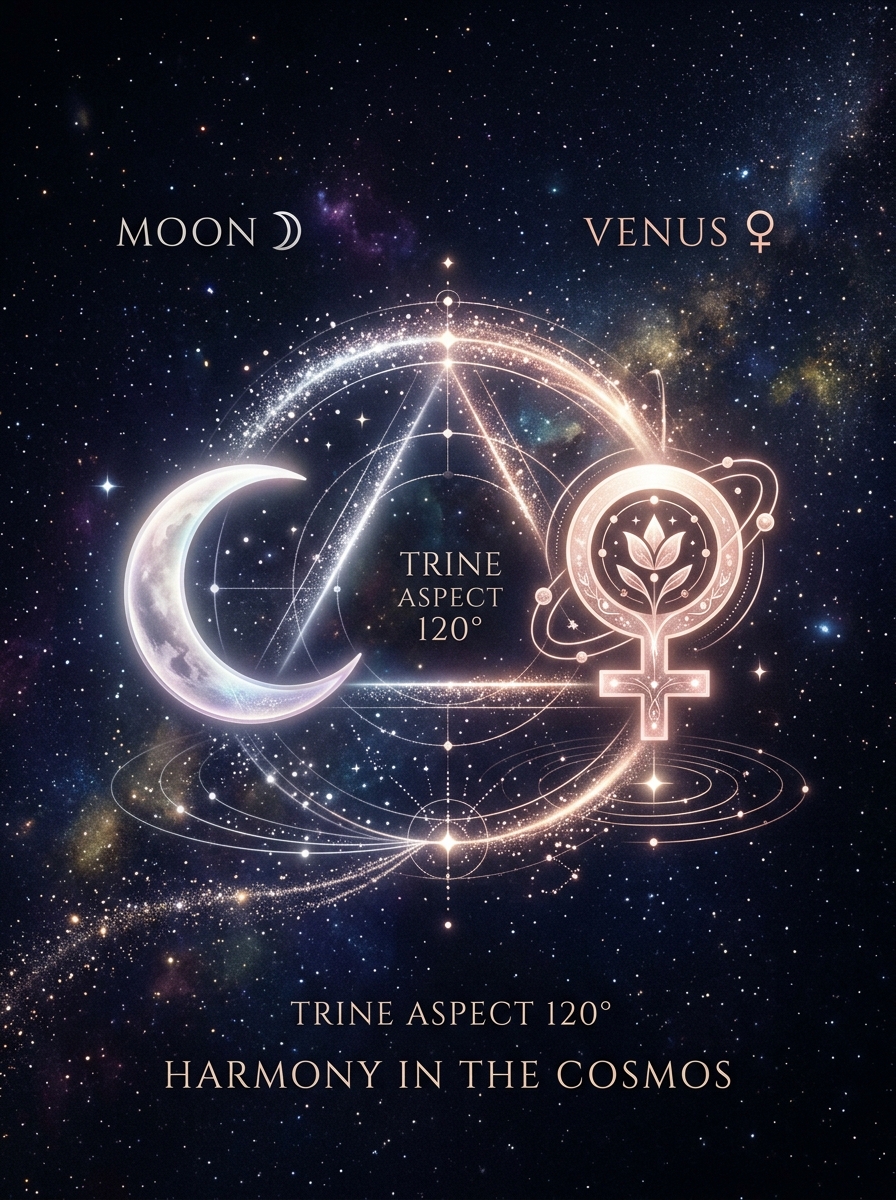
The Moon trine Venus synastry aspect is the emotional equivalent of two languages that share a root: you do not need to translate — you simply understand. The Moon person’s need for safety and the Venus person’s impulse toward pleasure meet in the same element, so affection arrives before either individual has to ask for it. This is not the fracturing intensity of hard aspects, nor the friction that forces growth. It is a geometry of recognition. The bond feels soft, familiar, almost pre-negotiated. Yet because the trine demands so little corrective effort, its hidden cost is the assumption that love will keep taking care of itself.
The Initial Gesture: Affection That Requires No Defense
The Moon operates beneath language. It knows whether a room is safe before the mind has formed a thought. Venus operates through attraction — it gravitates toward what is pleasing, beautiful, or agreeable. When these planets form a trine, the Venus person’s gestures of liking (a compliment, a shared meal, a tender touch) land directly on the Moon’s receptive surface, unfiltered by suspicion. The Moon person does not have to wonder whether the affection is genuine; it is felt as immediately true. In return, the Venus person experiences an unusual sense of emotional impact: their kindness matters, visibly, to the other’s inner world.
This creates a feedback loop of ease. Neither partner has to explain why they care; the caring is self-evident. But that very seamlessness can breed a dangerous passivity. When love feels natural enough, neither party thinks to articulate its terms. The relationship becomes a climate rather than a conversation — warm, but not necessarily deep. For a broader map of how relational aspects create such climates of effortlessness or strain, the guide to synastry aspects places this contact within the full spectrum of interplanetary dynamics.
Elemental Dialects and the Shape of Emotional Trust
Because a trine links signs of the same element, the flavor of the bond shifts with the element involved, yet the underlying grammar stays constant. What changes is the vocabulary of care.
When the trine runs through water signs (Cancer, Scorpio, Pisces), affection tends to be private, intuitive, and memory-soaked. The Moon person’s moods are absorbed rather than questioned; Venus offers tenderness that feels like shelter. The relationship may thrive on unspoken rituals — a shared pillow, a familiar meal, a silence that says more than words. The shadow here is fusion: feelings can become so intertwined that neither person knows where their own emotional boundary begins.
With earth signs (Taurus, Virgo, Capricorn), the trine manifests as material reliability. Venus shows love through consistency, sensual pleasure, and practical support. The Moon person feels held by dependability. This is the couple who remembers how the other takes their coffee, who builds a shared life around quality and routine. The risk is that stability calcifies into habit; desire fades into comfort, and the relationship becomes a well-maintained container with little live current inside.
A fire trine (Aries, Leo, Sagittarius) ignites the bond with warmth and spontaneity. Venus expresses affection through enthusiasm, play, and generous attention. The Moon person feels enlivened, even admired. This pairing can be the life of any party, radiating mutual delight. But heat is not depth. If the relationship never slows down into vulnerability, the bright flame may flicker when real hardship arrives.
An air trine (Gemini, Libra, Aquarius) runs through conversation and shared aesthetics. Venus likes the Moon’s emotional responsiveness; the Moon appreciates Venus’s tact and charm. They may have the same taste in music, the same social rhythms, the same way of smoothing over awkward moments. Elegance, however, is not intimacy. Feelings can become too quickly translated into wit or diplomacy, leaving the deeper emotional life untouched.
Understanding the trine’s elemental current helps reveal why some versions of this aspect feel more sustaining than others. The trine aspect is a current of competence, but competence alone does not guarantee emotional truth — it only guarantees that the exchange flows easily.
The Shadow of Harmony: When Ease Becomes Avoidance
The hidden friction in Moon trine Venus is not a fight; it is a silence. Because the aspect rarely produces overt conflict, both partners can drift into a state of emotional smoothing. The Moon person minimizes their own discomfort to preserve the pleasant atmosphere. The Venus person beautifies over raw truth — why risk ugliness when affection is so much nicer? Over time, the relationship may become a masterpiece of courtesy that avoids the real work.
A specific fault line emerges: the Moon often needs direct verbal reassurance, while Venus tends to believe that the ambiance of pleasure itself is enough. The Venus person might plan a lovely evening or give a thoughtful gift, assuming the gesture says everything. The Moon, meanwhile, craves explicit words: “I see you. You matter. I am here.” If both are in the same element, they may speak the same love language; if not, the mismatch can quietly erode trust. The Moon feels unseen; Venus feels unappreciated. Neither one argues about it, because arguing would break the spell of harmony.
This is the trap of harmonic inertia. In a chart where the trine is part of a larger pattern — such as a grand trine — the bond can become almost narcotically comfortable, a warm bath that sedates the impulse toward growth. The couple may stay together for decades without ever confronting the unspoken differences that are the real architecture of intimacy. The glossary on grand trine explores how such configurations can both bless and immobilize a relationship.
Living the Aspect: Where the Sweetness Lands
No synastry aspect exists in a vacuum. The Moon trine Venus bond reveals its concrete texture through house overlays and the specific condition of each planet. If Venus falls into the other’s fourth house, the affection becomes domestic: shared homes, family rituals, the quiet pleasure of nesting. In the fifth house, it spills over into romance, play, and creative collaboration. In the seventh house, it strengthens the partnership itself, making kindness a pillar of the commitment. Each overlay tells a different story about where the sweetness settles; for a full treatment of how houses shape relational dynamics, see synastry house overlays.
The signature of the Venus person’s natal chart also changes everything. Venus in Taurus will make the trine earthy, sensual, and steady. Venus in Gemini turns it into a stream of light conversation and shared curiosities. Venus in Scorpio adds a layer of psychological depth and privacy, even within the ease of the trine. To understand why Venus behaves so differently from one person to the next, a deeper look at Venus in astrology clarifies the planet’s full range.
In daily life, the bond tends to express itself through small, consistent kindnesses. The couple may cook together, remember each other’s preferences, create beautiful environments, instinctively soften each other’s rough edges. It is not the aspect of grand romantic gestures — it is the aspect of a hand on the back in a crowded room, a text that arrives just when the day was hard, a table set with attention. When supported by other contacts such as strong Mars or Saturn, the trine’s ease gains erotic pressure or enduring structure. The Moon-Venus synastry page explores this interplay in more detail, showing how the trine functions within a broader web of affection.
The Craft of Being Cherished
A mature Moon trine Venus does not mistake comfort for depth. It knows that being cherished is not a passive inheritance — it is a practiced act. The couple must learn to keep tenderness active without turning it into performance. They must speak the words the Moon needs, even when the atmosphere already feels warm. They must ask the uncomfortable questions Venus would rather sidestep.
The real gift of this aspect is not seduction or sentimentality. It is the rare experience of being emotionally welcomed by beauty itself. But that welcome must be renewed, not assumed. When the bond is conscious, the trine becomes a foundation for a love that is both gentle and alive — a love that does not fear its own ease because it has chosen to inhabit it with intention. For contrast, the Sun-Moon synastry dynamic shows a more obviously interlocked relationship between identity and emotion; Moon-Venus is softer, but softness too must be worked for.
Related
- Venus Trine Venus in Synastry: Shared Taste, Easy Affection, and the Hidden Cost of Too Much Ease
- Venus Trine Mars in Synastry: The Ease of Mutual Desire
- Synastry Sun Trine Venus: The Easy Warmth of Being Wanted
- Moon Conjunct Venus in Synastry: The Tender Current That Turns Chemistry into Care
- Synastry Sun Trine Moon: The Quiet Chemistry of Being Felt
Comments
Loading comments…