Synastry Sun Trine Mercury: When Identity Finds a Language
The core thesis: recognition before romance
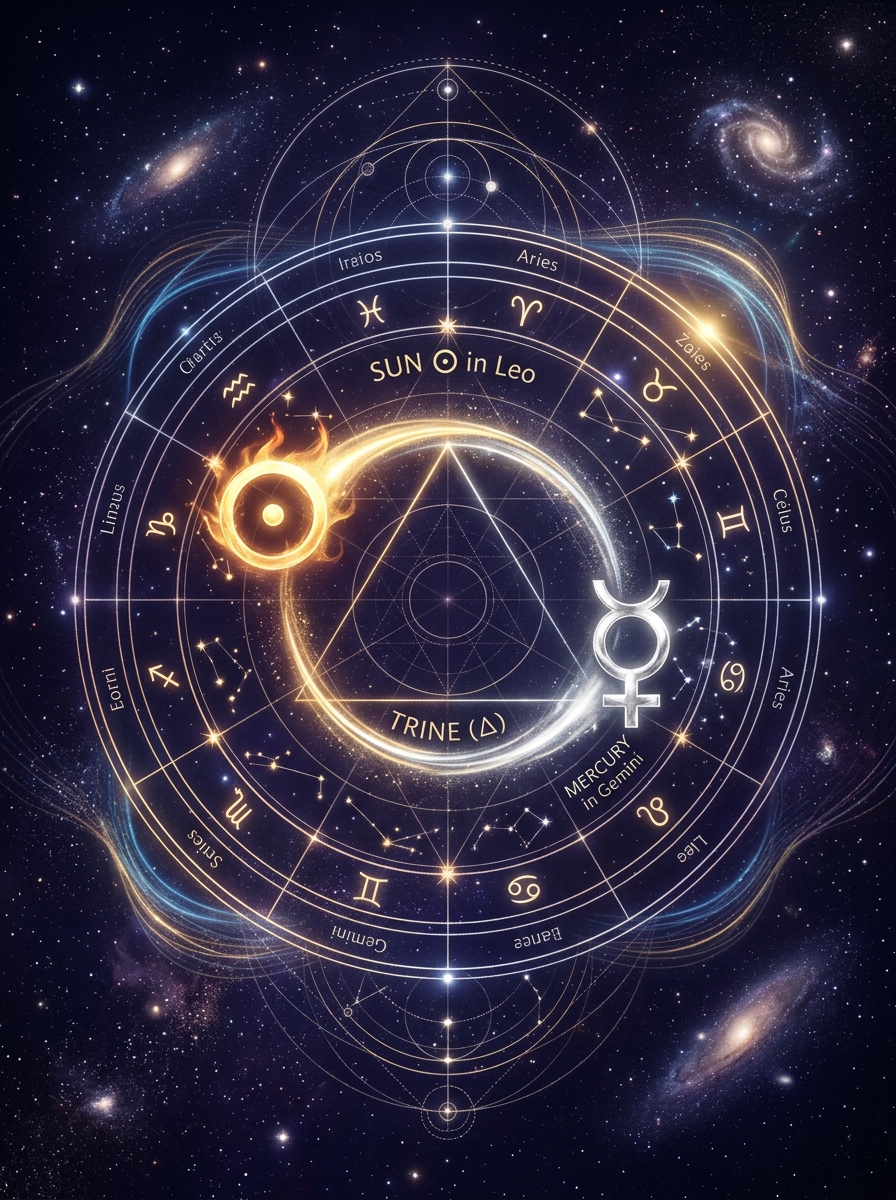
When one person’s Sun forms a trine to the other’s Mercury, identity and intelligence begin speaking in a shared register. The aspect does not guarantee love, but it creates the conditions for mutual legibility: one person feels seen, the other feels mentally engaged, and conversation becomes a bridge rather than a battleground. This is one of synastry’s clearest signatures of rapport because the trine lets Mercury interpret the Sun without strain and lets the Sun express itself without being diminished.
That ease can be erotic, but it is not primarily about heat. It is about intelligibility. The Sun person experiences the Mercury person as someone who “gets” the essence quickly; the Mercury person feels their mind is not merely tolerated but invited. Compared with more volatile contacts like Venus-Mars synastry, this is less about charge and more about orientation. The connection can be deceptively simple — which is exactly why people underestimate it until it is gone. For a broader framework of how this contact fits among other relational patterns, see synastry aspects.
Psychological architecture: the loop of interpretation
The trine operates as a cognitive feedback loop. The Mercury person articulates what the Sun person is already trying to become, while the Sun person gives Mercury a subject worth thinking around. One offers language, the other offers center. In a healthy pairing, each person leaves the exchange with more coherence than they entered with.
This is why the aspect shows up in enduring friendships, business partnerships, and romantic bonds that stay mentally alive over time. The pair can explain themselves to each other with unusual accuracy. Disagreement tends to be metabolized through dialogue rather than defensive silence. The Sun person receives the rare gift of being mentally received without distortion — Mercury knows how to ask the right question, paraphrase the unsaid, or reflect intent in sharper form. For the Mercury person, the relationship is unusually empowering: their thoughts land on fertile ground, and the Sun’s attention confers importance, sharpening Mercury’s confidence and willingness to speak plainly.
There is a psychological dimension here. Identity depends on being witnessed accurately. Sun-Moon synastry covers emotional attunement; Sun-Mercury adds cognitive attunement: “I feel known” becomes “I can say what I mean.” The archetypal function of Mercury is to name, categorize, and connect — and in trine, that function helps the Sun become articulate without turning it into performance. For the baseline archetype of this planet, read about Mercury in astrology.
The shadow of ease: when flow becomes inertia
A trine does not erase difference; it makes difference easy to live with. That is not always the same as transforming it. In Sun trine Mercury synastry, the main problem is rarely argument. It is the temptation to assume that being understood once means being understood always. People are not static, and neither are charts. If the relationship relies only on the original ease, it can become mentally elegant and emotionally underdeveloped.
This shadow resembles the pattern described in broader trine theory: flow can turn inert if never challenged. The pair may talk constantly but avoid the topics that would change them. They may use conversation to keep reality polished rather than revealed. The Mercury person can begin performing brilliance for the Sun, tailoring every idea toward approval. The Sun person may retreat into identity defense when stressed, while Mercury tries to solve what needs to be felt. Because the aspect is so fluid, the pair can miss the moment when dialogue stops being useful and begins to circle the same wound.
The healthiest version of this contact preserves a difference between admiration and surrender. The trine is an open channel, not a contract. For a deeper look at how the trine’s geometry can either mature into grace or drift into complacency, see the trine aspect.
How it lives in a relationship
In love, Sun trine Mercury often appears in couples who describe their bond with phrases like “we just get each other” or “we talk about everything.” The mental rapport can feel like a shared dialect, and it frequently outlasts the initial romantic charge. When combined with a Moon-Venus connection, the emotional climate warms; when paired with a strong Venus-Mars exchange, the mental rapport acquires sexual voltage. For the interplay of desire and affection alongside this cognitive attunement, see Venus and Mars synastry.
In friendship, this aspect is one of the most dependable signatures of long-term companionship. The pair can burn through hours of conversation without noticing time passing. They introduce each other to new ideas, correct each other’s blind spots, and trust that the other will listen before judging.
In work or creative collaboration, the trine functions as a cognitive shortcut. The Sun person’s vision and the Mercury person’s articulation become mutually reinforcing. Meetings are efficient because each side anticipates what the other needs to hear. This is especially valuable when the relationship must function under pressure — long-term partnerships, teacher-student bonds, or couples making life decisions together without mutual confusion.
For the emotional foundation that supports such contact, read about Sun-Moon synastry.
What modifies the trine
The aspect describes the relationship between planets; the signs tell you the style. Mercury in Gemini trine a Sun in Aquarius feels electric and future-facing, like two antennas catching the same signal. Mercury in Virgo trine a Sun in Capricorn is more exacting: practical, organized, attentive to usefulness. Mercury in Pisces trine a Sun in Cancer is atmospheric and emotionally permeable, with meaning arriving through tone and intuition rather than linear explanation. These distinctions matter because the same trine can express as banter, strategy, poetry, or method.
House overlays decide where the conversation lives. If Mercury falls into the other person’s 7th house, dialogue becomes the glue of partnership; in the 10th, the pair may think strategically about status or public image; in the 3rd, the relationship becomes talkative and text-heavy. For that layer of interpretation, synastry house overlays are essential.
Finally, the rest of the chart determines whether the ease matures. A Sun-Mercury trine functions best when there are enough other contacts to create depth. Add a hard Saturn aspect and the conversation gains gravity; add a strong Jupiter contact and the mental rapport expands into shared philosophy. The trine is a channel, not the whole landscape. When used to tell the truth — not merely to keep things pleasant — it becomes one of synastry’s most elegant signatures.
Related
- Moon Trine Mercury in Synastry: When Feeling Finds a Voice
- Synastry Mercury Trine Mercury: The Mind That Finds Its Mirror
- Synastry Venus Trine Mercury: When Affection Finds the Right Words
- Synastry Sun Trine Moon: The Quiet Chemistry of Being Felt
- Synastry Sun Sextile Mercury: The Easeful Spark Between Identity and Mind
Comments
Loading comments…