Synastry Sun Conjunct Venus: Attraction, Ease, and the Point Where Admiration Becomes Appetite
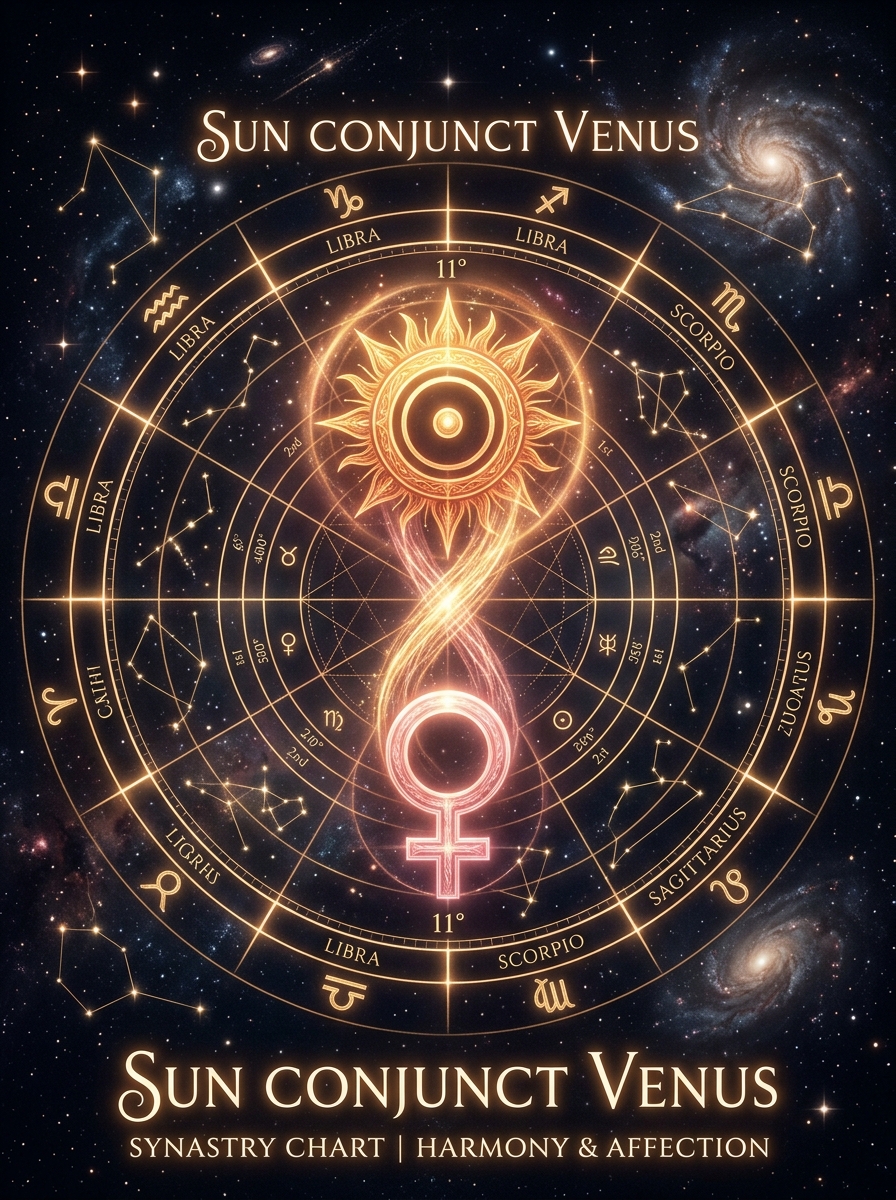
The Core Exchange: Identity Meets Preference
Sun conjunct Venus in synastry is not merely a “good aspect” for romance — it is a specific chemical event in which the Sun’s drive to express who it is collides with Venus’s instinct to harmonize, please, and value. The Sun person feels amplified, appreciated, and aesthetically validated simply by being seen by the Venus person. The Venus person feels magnetized by the Sun’s vitality, confidence, or sheer sense of self. The result is a feedback loop: admiration becomes appetite, and appetite becomes a shared style of being.
The bond appears effortless because both planets are warm and relational, but they work differently. The Sun seeks radiance and coherence; Venus seeks pleasure and relational ease. When they touch, the other person instinctively feels like “the right fit” — not necessarily in a soulmate sense, but in the way a favorite jacket fits. This is the aspect of immediate liking, not deep repair. For a fuller map of how synastry works as a whole, readers can start with astrological synastry and the technical language of synastry aspects.
The Psychological Architecture: Why This Bond Feels So Immediate
The instant chemistry of Sun conjunct Venus has a root cause that is often missed in pop astrology. The Sun person does not just enjoy the Venus person; they enjoy themselves more in the Venus person’s presence. The Venus person does not just admire the Sun person; they feel that their own capacity for affection and taste is being received as valuable, not decorative. This is the secret bargain: each person gives the other permission to be seen in a flattering light.
That dynamic rests on a psychological asymmetry. The Sun wants to be desired without having to audition for it — to feel that its essence is inherently attractive, not merely useful. The Venus person wants their affection to matter — to know that their tenderness, style, and relational intelligence carry real weight. When the conjunction works well, these desires meet and amplify each other. The relationship becomes a platform for mutual enhancement: the Sun person shines, the Venus person curates the light.
To see how this contrasts with more eros-driven bonds, compare it with Venus-Mars synastry, which is about chase and consummation rather than mutual admiration. Where Venus and Mars synastry heats, Sun-Venus warms. Similarly, Sun-Moon synastry provides emotional regulation and home-finding, while Sun-Venus provides social grace and aesthetic alignment. The two can coexist powerfully, but they are not the same vocabulary. For depth of emotional attunement, see Sun-Moon synastry.
The praise dynamic and its hidden trap
Because Sun-Venus is built on mutual approval, the pair may unconsciously avoid anything that disrupts the pleasant mirror. The Sun person may edit their rough edges to stay lovable; the Venus person may withhold critique to preserve harmony. When healthy, the bond is sweet and elegant. When it curdles, it becomes a hall of mirrors where approval is traded like currency. Flattery substitutes for contact, and the relationship stays beautiful but hollow.
The shadow emerges when one partner begins to feel reduced to a role: the Sun person the admired performer, the Venus person the pleasant backdrop. This is not a failing of the aspect itself but a warning that admiration, without reality testing, becomes projection. The couple must eventually learn to include conflict, boredom, and the ungraceful parts of human nature without withdrawing affection. That is the maturation point of this conjunction.
When the Flower Becomes the Frame: Maturing the Conjunction
At its best, Sun conjunct Venus creates relationships that are not only loving but cultivated. There is a natural instinct for beauty, hospitality, and social ease. The pair may dress well together, host well together, or simply make the ordinary feel more elegant. This is not trivial charm; it is a shared philosophy of pleasure. But a flower needs a garden. This aspect excels at attraction, affirmation, and creative collaboration — it does not automatically supply endurance, conflict capacity, or the willingness to stay when the shine fades.
The shadow of this conjunction is vanity and mutual flattery that becomes a substitute for truth. The Sun person may bask in admiration until adoration feels like pressure to perform. The Venus person may enjoy being cherished until they feel trapped inside a pleasing image. Then the relationship becomes a polite contest over who sets the standard of beauty: the Sun through its sheer presence, the Venus through selective approval. Both partners may feel quietly resentful without admitting it, because the bond has taught them to prioritize aesthetics over honesty.
Power is never absent in a Sun-Venus bond. The Sun person often assumes centrality because the Sun is identity itself; the Venus person exerts power through approval, taste, and the granting or withdrawing of warmth. Neither is inherently wrong, but the aspect matures only when both can speak openly about influence without poisoning the chemistry. The relationship becomes a dance of conscious enhancement rather than unconscious negotiation. For a deeper look at how synastry overlays shape relationship geography, see synastry house overlays.
The Sign and House Lens: No Two Conjunctions Are Alike
A Sun-Venus conjunction behaves very differently depending on the sign and house it falls in. The core dynamic of admiration remains the same, but its texture shifts. In Leo, the bond becomes playful, proud, and spectacular — the pair may perform their affection for others. In Taurus, it turns toward sensual reliability and shared pleasure — touch, scent, food, and steady devotion. In Scorpio, the sweetness is threaded with intensity and possession; admiration can feel like surveillance unless both partners are conscious of the edge. In Aquarius, affection needs room and originality — the pair may bond over ideas and social causes rather than private intimacy.
The sign matters because it determines what kind of “value” Venus is offering. A Venus in Taurus person will feel loved through physical consistency and material care; a Venus in Gemini person through conversation and mental nimbleness. The same Sun-Venus conjunction with a Taurus Venus will look radically different from one with a Gemini Venus. For detailed sign-by-sign textures, readers can explore entries like Venus in Taurus, Venus in Scorpio, or Venus in Leo.
House placement defines the stage
Equally important is the house where the conjunction falls in the overlay. If it lands in the first house, the attraction is visceral and identity-defining — the other person feels like a living extension of one's self-image. In the fifth house, the bond becomes romantic, playful, and creatively generative — lovers often become collaborators. In the seventh house, it strongly favors partnership language and commitment desire; the couple may naturally gravitate toward formal union. In the tenth house, the pair may be publicly polished, professionally aligned, or socially advantageous. For a deeper dive, see Venus in the 10th House or Venus in the Fifth House. The same conjunction in a private twelfth-house overlay will feel more secretive, devotional, and porous; in a third-house overlay it will be witty, conversational, and light.
Living the Conjunction: Applications in Love, Work, and Daily Life
Because Sun-Venus is fundamentally an aspect of mutual recognition, it shows up wherever two people must cooperate on the quality of their shared experience. In romantic relationships, it provides the easy affection that many couples spend years trying to build. There is a natural instinct to please, to soften, and to enjoy each other's company. But it rarely stands alone; it works best when supported by other contacts for depth (Saturn, Moon, Pluto) and passion (Mars). See how this fits into larger romantic patterns in the alchemy of love synastry.
In creative or professional partnerships, this conjunction is a gift. The pair can collaborate on projects that require taste, presentation, or social grace. The Sun person supplies the vision and drive; the Venus person supplies the calibration — the sense of what feels right. They can sell ideas, host events, or produce art that others find irresistible. The bond is not necessarily about competition or conflict; it is about enhancement.
In everyday life, the Sun-Venus conjunction often makes two people genuinely enjoy doing nothing together. Eating a meal, walking through a market, or sitting in silence feels rich because the presence of the other reorganizes the moment into something pleasurable. That is the core promise of this aspect: it makes life feel more civilized, more worth savoring. When the garden is tended — when admiration coexists with truth — the flower blooms again and again.
Related
- Synastry Sun Sextile Venus: The Ease That Makes Desire Feel Human
- Venus Conjunct Venus in Synastry: When Two Desire Systems Speak the Same Language
- Sun Conjunct Venus: The Radiance of Desire Made Visible
- Synastry Sun Trine Venus: The Easy Warmth of Being Wanted
- Moon Conjunct Venus in Synastry: The Tender Current That Turns Chemistry into Care
Comments
Loading comments…