Sun Conjunct Venus: The Radiance of Desire Made Visible
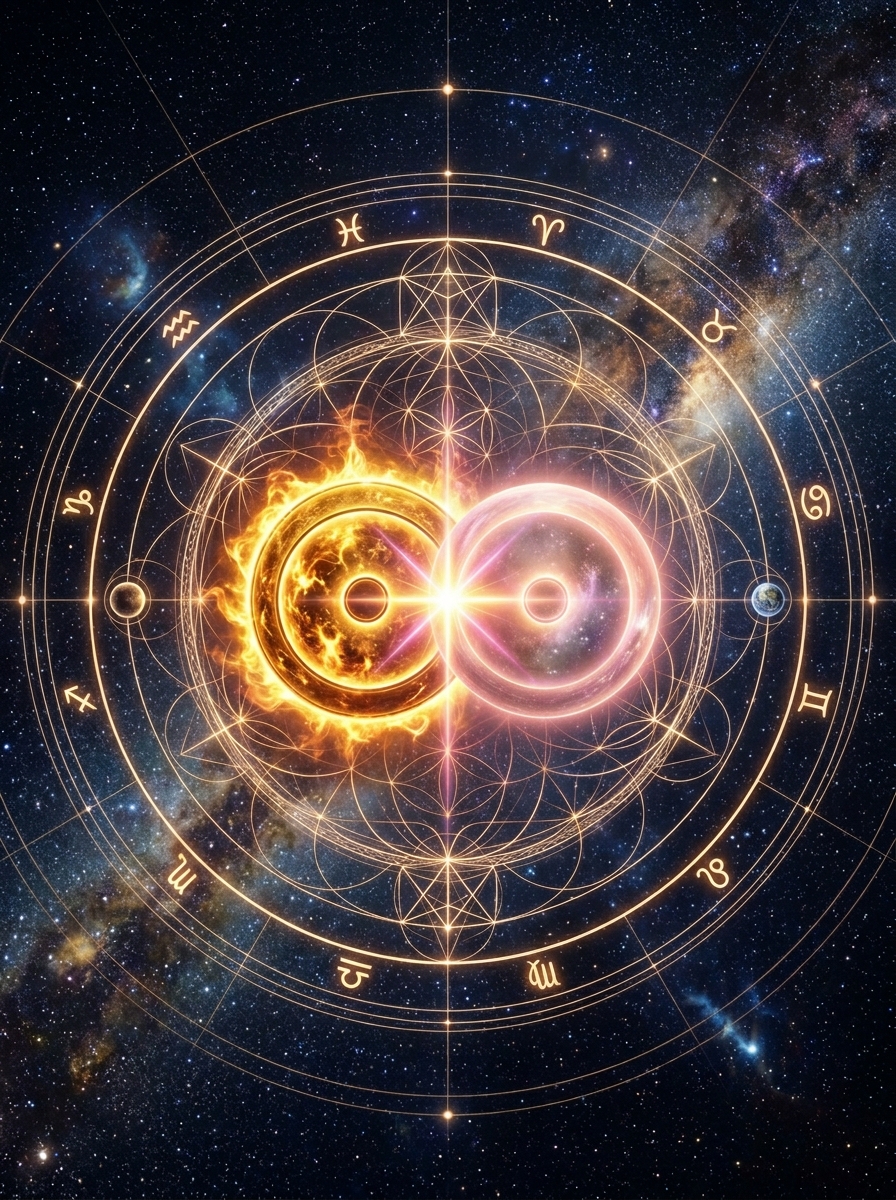
The Core Fusion: Identity and Attraction Merged
Sun conjunct Venus is not a decorative add-on to the chart. It is a fundamental alloy of the will to be and the urge to attract. The personality does not merely want to shine; it wants to shine beautifully, harmoniously, and in a way that can be loved back. The Sun supplies center, agency, and pride; Venus supplies value, receptivity, and the instinct to unite. Together they create someone whose presence feels civilizing—an instinct for proportion, social timing, and the subtle choreography of making others feel at ease.
This is a merger, not a compromise. The self is softened by the need for resonance. The native may dislike jarring environments, crude behavior, or situations where affection and dignity are separated. There is often a strong aesthetic conscience: the sense that how one appears, speaks, decorates, loves, or spends money should reflect inner value. For the full archetype of the planet at work, see Venus in Astrology.
The deeper truth: this aspect rarely wants harsh boundaries between “who I am” and “what I love.” The native is trying to become lovable through authentic expression, or authentic through what feels elegant, beautiful, and relationally alive. That can be a gift. It can also become a trap if approval starts masquerading as identity.
The Psychological Architecture: How This Aspect Forms
The conjunction means that pleasure is not peripheral—it is part of the ego’s operating system. The person is often unusually alive to music, fabric, scent, design, or gesture. A cluttered apartment, a sour relationship, or a humiliating social exchange may feel not merely unpleasant but identity-wounding. The Sun does not like to feel diminished, and Venus does not like ugliness, rupture, or overt conflict. So the psyche develops a low tolerance for disharmony and a high sensitivity to beauty.
This is why the aspect frequently shows up in artists, stylists, mediators, and socially intelligent leaders. But the same mechanism can appear in less glamorous ways: the employee who calms a room, the teenager who unconsciously becomes the peacemaker in the family, the adult who cannot tolerate relational ugliness and therefore polishes every interaction to a shine. The aesthetic conscience is not about vanity; it is about coherence. The self needs beauty to breathe, and it learns early that presence, grace, and diplomacy are the most effective tools for maintaining that coherence.
The native often has a talent for embodying value rather than talking about it. Because the Sun wants expression and Venus wants connection, the person knows how to make their individuality socially legible. They can present ideas with tact, perform with grace, or lead in a way that feels human rather than domineering. This is especially visible when the conjunction falls in angular houses; for example, Venus in the First House can show the same merging of identity and charm, though the conjunction intensifies the fusion into a single current.
The Mature Expression and Its Shadow
The highest form of Sun conjunct Venus is not prettiness. It is coherence: the person becomes someone whose values are visible, whose presence is calming without being weak, and whose love does not require self-betrayal to remain harmonious. That is a more demanding achievement than it sounds. It requires the native to risk being less universally pleasing in order to become more truthful.
Maturity arrives when the person learns that real elegance includes boundaries. A beautiful life is not one with no friction; it is one in which friction is handled with proportion. The Sun must remain sovereign, and Venus must remain sincere. Charm stops being a mask and becomes a byproduct of inner order.
The shadow, then, is dependence on being pleasing. When the aspect is under stress, the native may confuse affection with worth and attractiveness with legitimacy. If the Sun should stand for simple being, the conjunction can make being feel conditional: I am real when I am appreciated, desired, admired, or aesthetically validated. That produces a polished exterior with a surprisingly vulnerable center. One common friction point is avoidance. Because both bodies prefer ease over abrasion, the person may sidestep confrontation, postpone difficult decisions, or smooth over resentments until they become structural. A relationship can look lovely long after its emotional truth has gone stale. This is one reason the aspect can become entangled with Venus-Mars dynamics—the native may be highly attuned to attraction yet reluctant to metabolize conflict. For deeper insight into that polarity, see Venus-Mars Synastry.
The most insidious shadow is the seduction of approval. The person may cultivate a lovable persona so thoroughly that it replaces contact with the raw self. They may say yes too quickly, overextend in the name of harmony, or perform warmth while privately feeling depleted. Material indulgence can be another distortion: spending to soothe, collecting beauty to feel coherent, using romance as anesthetic. In such cases, the deeper work is not to renounce beauty but to separate pleasure from permission to exist.
How It Manifests in a Life
Once the core dynamic is understood, its expression across love, work, money, and the body becomes clear—no need to re-derive the fusion for each area.
In love, the person wants admiration and affection to be mutually reinforcing. Romance needs a sense of style: thoughtful gestures, good timing, visible appreciation, shared pleasures. Crudeness can be fatal; so can emotional stinginess. But the native must learn that intimacy sometimes requires mess, not just polish. If the partner is emotionally blunt, the Sun-Venus person may initially experience that as a lack of love when it may simply be a different style of care. Partnership can become a stage for the fusion—see Venus in the 7th House for a related placement that places this dynamic directly at the center of relationship.
In work, the person does best in environments where appearance, diplomacy, presentation, curation, or interpersonal finesse matter. They may excel in design, art, branding, hospitality, client relations, performance, or leadership roles that require soft authority. The conjunction says the person’s vocation needs to feel like an extension of identity, not a costume.
Money is often linked to taste and self-regard. The native may spend on quality, beauty, or experiences that confirm who they are. If unconscious, that can become acquisitive or image-driven. If conscious, it becomes a refined relationship to value: spending in ways that reflect genuine standards rather than insecurity.
In the body, the aspect often shows a desire to inhabit the self attractively. Grooming, posture, scent, and touch matter because the body is not experienced as a machine; it is a vessel of presence. This is one reason the conjunction can feel especially alive when linked to Venus in the Fifth House, where creative delight and display become explicit life themes.
Sign Flavor Changes the Tone
Because a conjunction is a merger rather than a specialization, the sign matters a great deal—but it does not change the essential fusion. In Venus in Taurus, the conjunction becomes sensual steadiness and deep attachment to comfort. In Venus in Gemini, it becomes witty charm and verbal sparkle. In Venus in Scorpio, the same aspect becomes far more magnetic, private, and psychologically charged. In Venus in Aquarius, it may favor original aesthetics and social independence over conventional romance. The conjunction does not erase sign nature; it gives that nature a brighter, more unified stage. The underlying truth remains: the self and its values are one fabric, and the life that honors that weave will feel like a work of art in motion.
Related
- Synastry Sun Conjunct Venus: Attraction, Ease, and the Point Where Admiration Becomes Appetite
- Venus Conjunct Venus in Synastry: When Two Desire Systems Speak the Same Language
- Venus Conjunct Mars: Desire That Knows Its Own Name
- Sun Sextile Venus: Ease, Magnetism, and the Art of Being Well-Loved
- Moon Conjunct Venus: The Heart That Seeks Comfort, Beauty, and Belonging
Comments
Loading comments…