Venus Conjunct Venus in Synastry: When Two Desire Systems Speak the Same Language
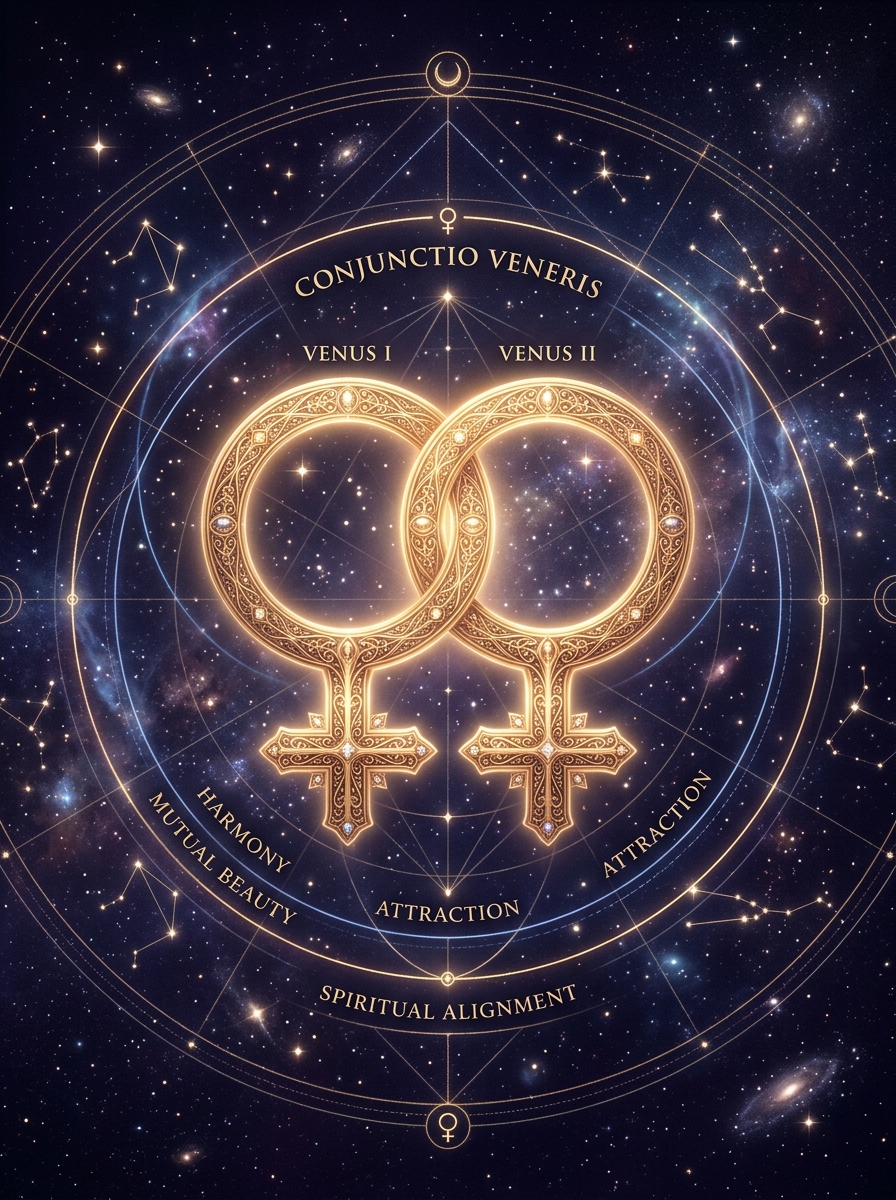
The shared dialect of desire
When one person’s Venus falls within a few degrees of another’s Venus in synastry, the two desire systems occupy the same frequency. This is not an aspect that introduces difference and asks the relationship to bridge it. It is an aspect of recognition: each person’s instinct for pleasure, beauty, social grace, and affection arrives in a dialect the other already speaks. The core thesis is that Venus conjunct Venus creates immediate affinity around taste and value, but that very similarity can mask the deeper work of intimacy.
Venus in astrology rules far more than romance. It governs attraction, aesthetics, manners, chosen values, the pace of affection, and the unspoken rules of “what feels good.” In a conjunction, those wanting systems overlap. One partner’s idea of a perfect evening — the restaurant, the dress code, the volume of conversation — tends to make intuitive sense to the other. The relationship feels easy not because there is no friction, but because friction rarely erupts over the raw materials of comfort. This fluency is often visible in the small rituals: how you gift, how you flirt, how you spend Sundays. For a deeper map of how synastry techniques work, the synastry aspects guide explains why some contacts blend and others provoke.
Yet ease has a hidden cost. A Venus–Venus conjunction can be so seamless that neither partner develops the muscle for disagreement. Both prefer harmony, so difficult conversations get postponed indefinitely. The relationship becomes a tasteful room where no one moves the furniture. This is not a failure of love; it is a failure of differentiation. The conjunction gives two people the same grammar for sweetness, but grammar alone does not write a story.
Beyond romance: Venus’s full domain
It is a mistake to read this aspect only through the lens of romantic chemistry. Venus conjunct Venus often appears in close friendships, creative partnerships, and even professional alliances where two people share an instinct for style, presentation, or relational diplomacy. The bond feels affectionate without necessarily being erotic. This is because Venus rules liking as much as wanting. In a friendship, the conjunction may produce years of easy rapport; in a creative duo, it yields a shared aesthetic that makes collaboration feel telepathic. Astrological synastry confirms that the same aspect can show up across relationship types, and the house overlay determines the arena of life where the shared taste expresses.
The subtle competition of like minds
The mirror that Venus holds up is not only flattering. Because Venus governs value — what we deem worthy of time, money, and attention — a Venus–Venus conjunction can trigger a quiet rivalry over whose taste is more refined, whose way of loving is more authentic, whose aesthetic judgment is truer. This is especially likely when the two people occupy similar social worlds or life stages. The competition is rarely explicit. It shows up in subtle jabs about décor, in a need to be the one who “introduced” a certain restaurant, or in a silent conviction that one partner’s love language is more evolved than the other’s.
This shadow grows from the conjunction’s core strength: shared preference. When two people value the same things, each can become the other’s harshest aesthetic critic. The bond can devolve into a mirror of refinement where each asks, “Do you admire me, or only the parts of me that resemble you?” This tension is most acute when one Venus is retrograde or under stress from Saturn or Pluto — conditions that make value feel precarious or overly controlled. For a fuller understanding of Venus’s archetypal range, the Venus in Astrology page traces how the planet rules both self-worth and relational style.
Collusion in harmony
The deeper risk is not rivalry but collusion. Two Venus energies can conspire to keep the relationship pleasant at the expense of truth. Neither wants to be the one who disturbs the mood. The consequence is a bond that looks graceful from the outside but feels hollow from within — all surface agreeability, no real depth. This is why a Venus–Venus conjunction, for all its charm, cannot substitute for the emotional honesty that aspects like Moon-Venus synastry or Sun-Moon synastry bring. Those contacts push the relationship to share vulnerability, not just taste.
From recognition to real intimacy
The maturation of a Venus–Venus conjunction depends on whether the two people can use their shared language to build something other than comfort. The true work is to let the bond include subtle friction — to disagree about a purchase, a plan, or a social event — and discover that disagreement does not destroy the aesthetic. A mature Venus conjunction allows both partners to say, “I see exactly why you love that, and I don’t, and that’s fine.” Differentiation, not fusion, deepens the connection.
The element grid
The sign layer of the conjunction determines whether the shared taste feels rooted, airy, fiery, or watery — and each element carries its own temptation toward stagnation. An earth-on-earth Venus can become materially comfortable but emotionally stuck; an air-on-air conjunction can stay mentally alive but avoid bodily depth; fire-on-fire can burn bright but exhaust itself; water-on-water can merge into fusion that drowns individuality. Recognizing the element pattern helps each person see where the shared appetite might turn into a blind spot. Synastry house overlays add a further layer: the same conjunction in the fourth house feels domestic and nurturing, while in the eleventh it expresses through friendship and shared ideals.
When the conjunction needs a counterweight
A Venus–Venus conjunction is often strengthened by a contrasting aspect, such as a Venus-Mars synastry contact or a Sun-Moon connection. Mars brings heat; the Sun brings purpose; the Moon brings emotional visibility. Without such counterweights, the Venus conjunction can drift into a pleasant but shallow loop of mutual appreciation. The relationship may need one partner to play the role of Saturn — holding a boundary, asking the hard question — or Uranus to introduce novelty when the shared taste becomes a rut. The most successful relationships with this aspect treat it as a foundation, not the whole house.
Where the conjunction lives in the chart
A Venus–Venus conjunction does not play out identically in every life. Its expression depends on the houses, the condition of each Venus, and the rest of the chart. But a few common patterns emerge.
Romantic and platonic expressions
In romantic partnerships, the conjunction often produces a couple that others describe as “made for each other” because they share the same eye for beauty, the same social style, the same values about money and leisure. The bond can feel like a relief from the friction of opposites. But it can also feel passionless if the only ingredient is ease. Passion needs a spark of otherness, which this conjunction does not supply. That is why exploring the alchemy of love synastry can help couples see where their shared taste might be obscuring deeper needs.
In friendships, the conjunction is a gift. Two friends with this aspect can spend hours in shared aesthetic pleasures — galleries, music, cooking — without a single misunderstanding about what matters. The friendship becomes a refuge of mutual taste. Creative collaborations thrive on the same dynamic: the joint project feels intuitive because each person’s Venus approves of the other’s choices.
Professional and creative contexts
Even in a work setting, Venus conjunct Venus can create an almost instinctive harmony around presentation, branding, and client interaction. Two colleagues may design a pitch deck that feels seamless because they instinctually agree on what looks good and what sounds gracious. The danger is that they also agree too easily and fail to pressure-test their assumptions. A third person with a different Venus sign can be invaluable for introducing perspective. For more on how Venus operates in career and public life, see Venus in the 10th House, though the house overlay in each chart remains the decisive factor.
The conjunction is never the whole story. It is the language of liking. What the relationship actually says with that language — whether it builds love, friendship, creativity, or just a beautiful room — depends on everything else in the chart. But when the language is shared, the conversation can begin without translation. That is the gift. The liability is mistaking a common tongue for a deep one.
Related
- Synastry Sun Conjunct Venus: Attraction, Ease, and the Point Where Admiration Becomes Appetite
- Synastry Venus Sextile Venus: Ease, Taste, and the Art of Mutual Attraction
- Synastry Venus Opposition Venus: The Beauty of Mismatch, the Friction of Want
- Venus Trine Venus in Synastry: Shared Taste, Easy Affection, and the Hidden Cost of Too Much Ease
- Sun Conjunct Venus: The Radiance of Desire Made Visible
Comments
Loading comments…