Mars Trine Mars Synastry: Shared Fire, Clean Friction, and the Art of Mutual Momentum
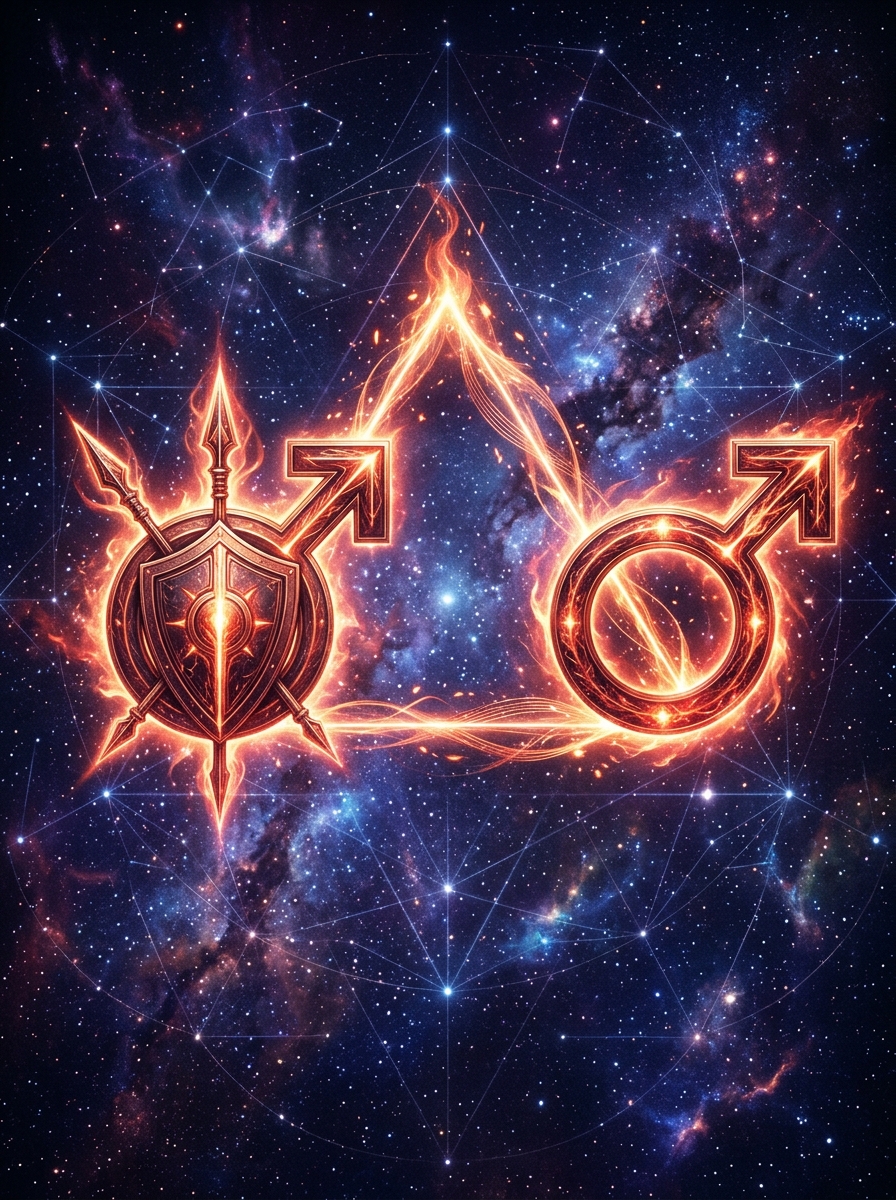
In Mars trine Mars synastry, two people meet at the level of instinct, pace, and appetite: their wants recognize each other before language arrives. The core thesis is simple and consequential—this aspect does not create heat by opposing force, but by allowing two wills to move in the same elemental current. It is often described as “easy chemistry,” yet its real gift is subtler: the couple can act, decide, compete, and desire without the constant translation work that other Mars contacts demand.
The body knows before the mind catches up
The first thing Mars trine Mars does is reduce hesitation. There is usually a quick bodily rapport: similar timing in conversation, compatible levels of directness, and a shared tolerance for speed or risk. One person’s acceleration does not feel like a threat to the other; it feels familiar, even energizing. In synastry, that matters because Mars is not sentimental. It is the part of the psyche that reaches, strikes, initiates, defends, and says no without apology.
This is one reason the aspect can feel more erotic than a softer contact: attraction here is not merely admiration but a shared kinetic language. The two people tend to read one another’s edges correctly. They know when to push, when to retreat, and when to keep going. That doesn’t mean they are identical. A trine is a 120-degree relationship, and like all trines, it belongs to the family of elemental flow—see the broader logic in the trine aspect and its shadow of ease becoming inertia. When Mars trines Mars, the “shadow” is not indifference so much as a lack of necessary tension; nothing forces the pair to refine their shared style unless they consciously do so.
Shared temperament, not just shared desire
A trine between Mars placements often shows up in practical life before it shows up in romance. The two may have similar work rhythms, sports preferences, sexual pacing, or methods for solving problems. One person wants to move; the other already lives in motion. One person acts first; the other respects that instinct. The result is not always explosive, but it is usually efficient. Compared with a square or opposition, this contact wastes less energy on internal resistance.
But “efficient” can be deceptive. The very ease that makes Mars trine Mars feel encouraging can also make it less memorable than a more volatile contact. If the relationship has no other combustible signatures, the couple may mistake compatibility for depth. That’s why synastry must be read as a whole, not in isolation; the governing map is astrological synastry, and aspects become meaningful only within the larger architecture of overlays, luminaries, and angles.
The clean friction paradox
The most elegant thing about Mars trine Mars is that it can hold friction without making friction the story. These two people can disagree and remain in motion. The argument tends to stay on topic; the energy does not have to become personal, vindictive, or dramatic. When conflict arises, it is often clean, even athletic. Each person has enough respect for the other’s will to avoid humiliating tactics. In a healthy version of the aspect, conflict becomes a means of calibration.
That said, a trine does not erase the martial impulse to compete. It only changes the style of competition. Two Mars people in trine may challenge one another through shared goals, mutual teasing, sexual sparring, or ambitious projects. The tension is not absent; it is usually productive. The risk is that both partners can unconsciously default to a “we know how to do this already” attitude and skip the deeper negotiation that makes long relationships durable.
When the aspect becomes too easy
Ease can become a sedative. If both partners prefer action over reflection, the relationship may become all momentum and no analysis. They can be excellent at starting things—travel, sex, exercise, projects, even a shared business—but less adept at pausing to ask what the motion is for. Mars needs a target; without one, it becomes irritation in search of an object. A trine between Mars placements can therefore produce a couple that functions beautifully at the level of shared impulse while avoiding vulnerability, repair, or emotional reckoning.
That’s where other synastry factors matter. A strong Venus-Mars synastry may deepen desire into tenderness and aesthetic magnetism. By contrast, Mars trine Mars alone can be all traction and no velvet. Likewise, if the emotional undercurrent is supported by Moon-Venus synastry, the pair has a softer place to land after each burst of movement. Without those balancing signatures, the relationship may feel exciting but strangely unembellished, as if it knows how to ignite but not necessarily how to rest.
The shadow: mutual reinforcement of bad habits
Every harmonious aspect can become a closed circuit. With Mars trine Mars, the danger is not obvious hostility but shared reflex. If both people are impatient, they can validate each other’s impatience. If both are avoidant, they can call it “giving space.” If both are competitive, they may encourage escalation while believing they are being admirably strong. Because the aspect feels natural, it can stabilize whatever action style is already present—good or bad.
This is one reason trines are often misunderstood. They are not automatically “better” than tense aspects; they are simply less corrective. If you want to understand the deeper symbolism of ease, the pages on the grand trine and the trap of harmonic inertia are useful companions. The same principle applies here in miniature: shared energy can create excellence, but only if it is directed.
The sign context: what kind of fire, exactly?
A Mars trine Mars aspect never exists in a vacuum. The real flavor depends on the signs involved. Mars in Aries trine Mars in Leo behaves differently from Mars in Taurus trine Mars in Virgo, even though both are harmonious. The first pair is bolder, more theatrical, more self-assertive. The second is more practical, bodily, and task-oriented. In the first, the chemistry comes from shared enthusiasm and courage. In the second, it comes from competent follow-through and mutual respect for craft.
This is where a good astrologer stops saying “there is chemistry” and starts asking what kind. Mars in fire signs tends to produce fast ignition, visible initiative, and a higher threshold for risk. Mars in earth signs tends to create durable effort, tactical patience, and a stronger instinct for material results. Air-sign Mars contacts often spark through conversation, debate, and intellectual stimulation, while water-sign contacts can channel desire through protection, loyalty, or emotional undertow. A trine between these placements can be deeply workable, but the relationship’s style will follow the element.
A note on difference within harmony
It is a mistake to assume harmonious means identical. Even in a trine, one person’s Mars may be more impulsive, while the other’s is more disciplined; one may initiate through speech, the other through action; one may act to win, the other to preserve. That variation is part of the charm. The aspect works because the two styles are compatible enough to cooperate, not because they are carbon copies. If you want a broader theory of how Mars expresses across life arenas, Mars in astrology is the foundational reference.
And if one or both people have notable natal placements such as Mars in the 1st house, Mars in the 7th house, or Mars in the 8th house, the synastry can become more visible in identity, partnership behavior, or erotic intensity. The aspect describes how the two fires cooperate; the house placement describes where each fire tends to burn.
How it behaves in real relationships: sex, teamwork, and long-term use
The most obvious manifestation of Mars trine Mars is sexual compatibility, but the deeper story is agency. This is a pair that usually knows how to get moving together. They can build a trip, launch a project, handle logistics, or take a stand without endless negotiation. In long-term relationships, that shared efficacy can become a kind of intimacy. Few things create trust faster than discovering that your partner’s instinctive move is also yours.
Sexual chemistry without drama as a requirement
In erotic terms, the aspect often produces ease in initiation. Neither person must feel they are constantly explaining desire or overperforming it. There is a mutual permission structure: both understand pursuit, both can handle being wanted, and both can tolerate directness. This can be refreshing in a culture where desire is often entangled with uncertainty or performance. The pair may not need elaborate ritual to feel alive together; a simple “yes” can be enough.
Yet the absence of drama does not mean the absence of depth. In fact, the best Mars trine Mars connections often become more erotic over time because confidence accumulates. The partners trust the other’s tempo. They know how to escalate. They know how to back off without bruising ego. That competence makes room for more honest desire, not less.
Teamwork, competition, and the best use of the aspect
As a working alliance, this aspect is excellent for entrepreneurship, shared physical activities, activism, or any domain where decisive momentum matters. The couple can be formidable when they commit to a goal together. They tend to be most successful when they have a shared battlefield—literal or symbolic. Without a mission, the same energy can leak into quarrels about whose method is correct, whose pace is better, or whose instinct should lead.
If one wants to understand the difference between desire and affection in relationship astrology, Sun-Moon synastry often explains emotional fit while Mars explains motion and appetite. The two do different work. A relationship can have superb Mars trine Mars chemistry and still lack the emotional nesting that a person needs for longevity. Conversely, it can be tender and stable without much spark. The art is not to confuse one register for the other.
What to watch for, and what to cultivate
The highest use of Mars trine Mars is not perpetual excitement; it is aligned action under pressure. This aspect shines when life gets difficult because the couple can respond without collapsing into paralysis or mutual accusation. They know how to mobilize. They know how to keep each other’s courage alive. In that sense, the aspect is less about romance than about shared nerve.
To make the most of it, the relationship needs intentional friction elsewhere: honest conversation, emotional accountability, and goals that are worthy of the fire. A trine is a gift, but gifts need form. In that spirit, the broader guidance found in synastry aspects, synastry house overlays, and synastry love helps place this contact inside a complete relational picture rather than romanticizing it in isolation.
If you want the shortest possible summary: Mars trine Mars means mutual ignition with less mutual injury. It can create erotic ease, practical partnership, and a sense that the other person “gets” your way of moving through the world. Its challenge is not conflict so much as unconscious agreement. The question it asks is whether two compatible fires will merely burn together—or actually illuminate something meaningful.
Related
- Moon Trine Mars Synastry: Desire, Protection, and Easy Emotional Heat
- Synastry Sun Trine Mars: The Ease of Mutual Charge
- Synastry: Mars Trine Mercury — The Spark of Quick Minds and Clean Friction
- Synastry Mars Sextile Mars: Shared Fire, Skilled Friction, and Mutual Momentum
- Mars Conjunct Mars in Synastry: Shared Fire, Shared Fault Lines
Comments
Loading comments…