Mars in the 7th House: The Warrior in the Mirror and the Alchemy of Relationship
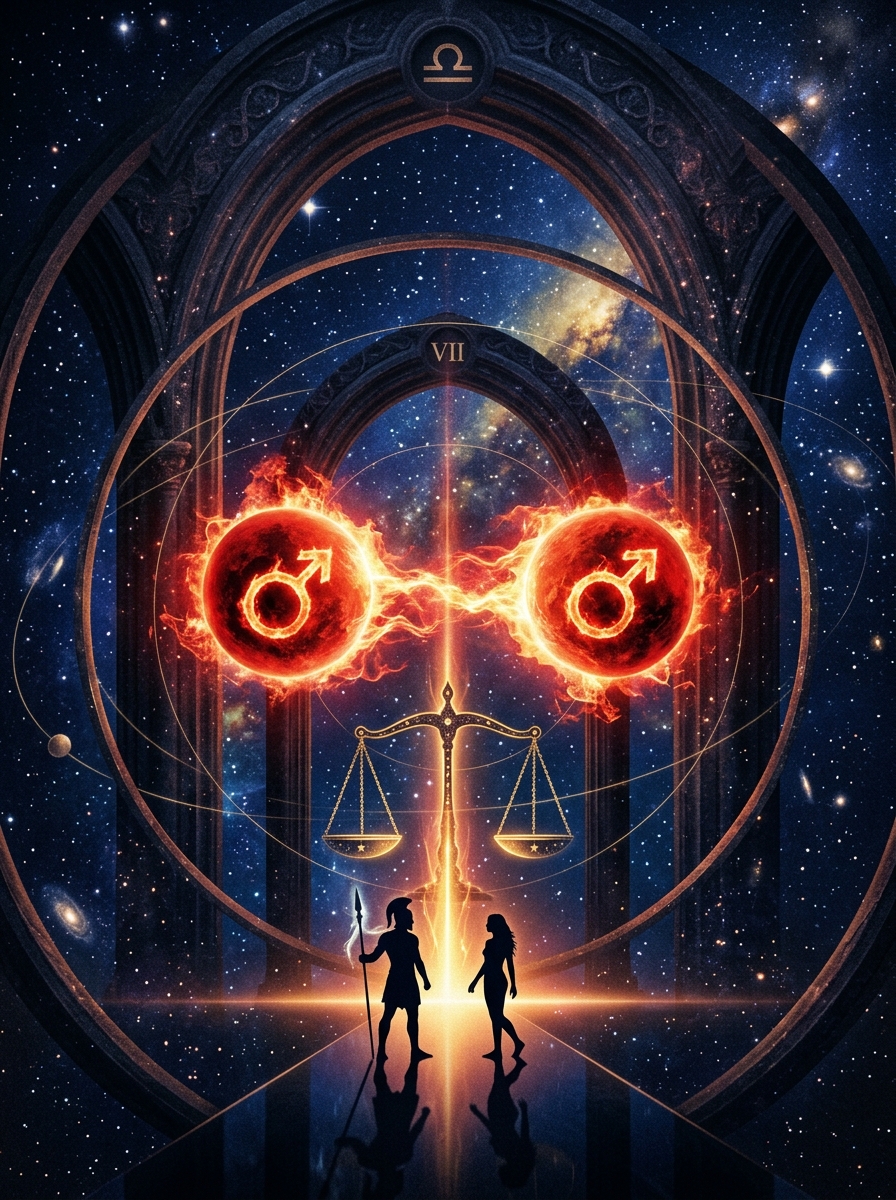
Mars in the 7th House: The Relational Exile and the Warrior in the Mirror
In the sacred and complex architecture of the natal chart, the Seventh House serves as the western horizon—the point of the Descendant where the Sun sets and where we transition from the self-referential sphere of the first six houses into the realm of the Other. It is the house of commit, marriage, business partnerships, and open adversaries. Traditionally associated with the sign of Libra and its ruling planet Venus, the Seventh House demands harmony, balance, compromise, and the delicate art of diplomacy.
When Mars, the red planet of drive, assertion, anger, libido, and survival instincts, occupies this house, it enters a state of house-based exile or detriment. Mars is naturally at home in Aries, the sign of the self, pioneering initiative, and raw individual will. When forced to operate in the house of partnership, Mars must learn to negotiate its fiery, uncompromising energy through the filter of another person. The warrior archetype, accustomed to charging forward without consensus, is suddenly asked to dance. This displacement creates a profound psychological tension: the native’s internal drive and assertiveness are frequently projected onto the external environment, transforming the relationship arena into a theater of war, passion, and evolutionary growth.
The Descendant as the Relational Gateway
Psychologically, the Descendant represents our shadow—specifically, those qualities we possess but find difficult to consciously own or integrate. As Liz Greene noted in her seminal works on psychological astrology, the Seventh House is not simply about who we marry, but about the parts of our own psyche that we disown and project onto the partner. When Mars resides on or near the Descendant, the individual may feel fundamentally un-martial. They may view themselves as peaceful, accommodating, or even passive, while constantly encountering individuals who are highly assertive, competitive, angry, or dominant.
The Descendant acts as a gateway where the disowned warrior is met face-to-face. The native projects their own latent anger, passion, and ambition onto the partner, believing these qualities belong entirely to the other. This setup is a classic Jungian mechanism: the unexpressed Mars in the native's psyche seeks expression by attracting external agents who will play out the Martian drama. Until the native recognizes that the "warrior in the mirror" is a reflection of their own internal drive, they will continue to experience relationships as battlegrounds where they are the perpetual victim of another’s aggression. This dynamic can be incredibly disorienting, as the native genuinely believes they are acting in the interest of peace, unaware of how their passive posture actively invites Martian confrontation from the outside world.
Mars in Detriment: The Challenge of the Red Planet in Libra's Realm
In classical astrology, Mars in the Seventh House shares a thematic resonance with Mars in Libra. Mars is the planet of cutting, separating, and initiating; Libra and the Seventh House are about joining, synthesizing, and maintaining peace. Therefore, Mars in the Seventh House is in a state of perpetual frustration. Every time the native tries to assert themselves, they must calculate the impact on the relationship. If they assert themselves too directly, they risk breaking the connection; if they suppress their drive to maintain peace, the Martian heat festers under the surface, eventually exploding in passive-aggressive outbursts or physical illness.
Steven Forrest’s evolutionary astrology offers a constructive lens for this placement. Rather than viewing Mars in the Seventh House as a permanent curse, evolutionary astrology sees it as a specific karmic lesson. The soul has chosen to learn about boundaries, courage, and self-assertion through the crucible of intimate relationships. The challenge is not to eliminate Mars's fire, but to refine it into a clean, conscious instrument of advocacy, boundary-setting, and passionate engagement. The native must learn that true peace is not the absence of conflict, but the ability to navigate conflict constructively. In this sense, Mars in the Seventh House is a training ground for spiritual courage, demanding that the individual find a way to honor their own truth without trampling the rights of the partner.
Magnetism and Attraction to Assertive, Mars-Type Partners
One of the most obvious manifestations of Mars in the Seventh House is a powerful, almost magnetic attraction to partners who exhibit strong Martian characteristics. The native is rarely drawn to passive, mild-mannered, or overly predictable individuals. Instead, they seek partners who possess a raw, vital energy—people who are ambitious, athletic, highly competitive, direct, and sometimes even combative. There is an unconscious craving for the heat that Mars generates; the native feels alive in the presence of someone who knows what they want and is not afraid to fight for it.
This attraction, however, is a double-edged sword. In the initial phases of a relationship, the partner’s Martian traits are highly appealing. The native may admire their partner’s decisiveness, courage, and protective nature. They feel shielded by the partner’s strength and energized by their passion. The partner becomes the surrogate warrior, fighting the battles the native feels unable or unwilling to fight. This dynamic is particularly common in individuals who were taught in childhood that anger is unacceptable or that self-assertion is dangerous. By partnering with a Martian agent, they outsourcing their own assertive needs, effectively hiring a mercenary to defend their emotional territory.
The psychological draw to these partners is rooted in the need for self-completion. By being in close proximity to someone who expresses anger cleanly and pursues goals relentlessly, the Seventh House Mars native is trying to learn how to do the same. Unfortunately, because this lesson is initially unconscious, the native often ends up feeling overwhelmed. The partner's strength begins to look like control, and their directness starts to feel like criticism. The native must realize that the partner is not there to fight their battles, but to show them that fighting is possible.
The Attraction to the Martial Archetype
As time goes on, the very traits that were once magnetic can become sources of intense frustration. The decisive partner is now seen as domineering and bossy; the courageous protector is perceived as aggressive and insensitive; the passionate lover becomes hot-tempered and demanding. The native begins to feel controlled or bullied by the partner’s strong will. This creates a cycle where the relationship alternates between intense adoration and sharp resentment, leaving both partners exhausted by the emotional volatility.
This shift occurs because the projection is starting to wear thin. The unconscious mind of the native is trying to force an integration of their own Mars. The partner’s behavior escalates in intensity to force the native to finally stand up, draw a line, and say "No." If the native refuses to develop their own Mars, they will continue to attract partners who play the role of the aggressor, trapping both individuals in a toxic cycle of pursuit and defense. The key to breaking this pattern is for the native to recognize that they do not need to marry a warrior; they need to become one in their own unique way, embodying the strength they admire in others.
High-Voltage Unions: Passion and Conflict in Marriage
When Mars resides in the Seventh House, marriage and committed long-term partnerships are rarely described as peaceful or placid. Instead, they are high-voltage unions characterized by extreme polarities of passion and conflict. The emotional climate of the home can change rapidly, shifting from deep physical intimacy and shared excitement to explosive arguments and cold wars. This is because Mars brings its primary fuel—desire and heat—directly into the marital bedroom and the shared kitchen, ensuring that the connection remains highly charged at all times.
In psychological terms, conflict in a Mars in the Seventh House relationship is often a form of intimacy. For these individuals, a good fight can feel safer and more authentic than polite distance. The friction of disagreement generates a spark that reassures both partners of their connection and vitality. When a relationship becomes too quiet, the native or the partner may unconsciously provoke a fight to restore the intensity they equate with love. This dynamic can be exhausting for partners who do not share this placement, but for the Mars in the Seventh House native, it is a familiar, if stressful, landscape that they must navigate with awareness.
To sustain a healthy marriage, the native must learn to distinguish between clean conflict and destructive hostility. Clean conflict involves expressing anger directly, setting clear boundaries, and stating needs without attempting to humiliate or destroy the partner. Destructive hostility, on the other hand, involves passive-aggression, emotional manipulation, and physical or verbal abuse. Because Mars is volatile, the temptation to hit below the belt is strong. The evolutionary task here is to use the heat of Mars to forge a stronger bond through honest confrontation, rather than burning the bridge down in a fit of rage.
Furthermore, the sexual chemistry in these marriages is often highly dependent on this tension. The cycle of fighting and making up is a classic Martian pattern. While this can sustain a relationship's passion for a time, it ultimately drains the nervous system and can lead to emotional burnout. The couple must find healthier ways to generate excitement—such as embarking on shared adventures, engaging in friendly competition, or pursuing separate, demanding goals—so that their home life does not degenerate into a constant state of combat. By consciously choosing where to direct their fire, they can keep the passion alive without destroying the peace of their home.
The Professional Calling: Litigation, Mediation, and Family Law
While Mars in the Seventh House can create significant challenges in personal relationships, it is an absolute powerhouse when directed into professional channels. The Seventh House is not only the house of marriage; it is also the house of public relations, contracts, and the law. When the warrior energy of Mars is channeled into these arenas, the native becomes an exceptionally skilled advocate, negotiator, and defender of others. They possess an instinctual understanding of interpersonal dynamics and are not intimidated by conflict; indeed, they thrive in adversarial environments.
This placement is frequently found in the charts of successful trial lawyers, litigators, mediators, and family law specialists. In these professions, the native is paid to fight on behalf of a partner or client. They can project their Mars onto the legal opponent, engaging in fierce intellectual and strategic battles without damaging their personal life. The adversarial nature of the courtroom provides a healthy, structured outlet for Mars’s competitive drive. The native can be aggressive, sharp-tongued, and relentless, knowing that their behavior is governed by professional rules and serves a constructive purpose.
Beyond the legal profession, Mars in the Seventh House excels in mediation and conflict resolution. Because they understand the mechanics of tension and projection so well, they can step into highly charged situations—such as corporate disputes, labor negotiations, or family crises—and help both sides express their anger constructively. They do not run away from the heat; instead, they act as lightning rods, grounding the emotional current and finding a path forward. By acting as a champion for others, the native fulfills the highest potential of Mars in the Seventh House: using personal strength to restore balance and justice.
In public relations and crisis management, this placement is equally formidable. When a client faces public opposition or a reputation-threatening crisis, the Seventh House Mars native steps in as the ultimate defender. They design strategies to counter attacks, manage public relations battles, and navigate hostile media landscapes. The key to their success is their ability to remain objective and strategic under fire, transforming raw anger into a calculated, effective defense that shields their clients from harm.
Vibrant but Tense Business Partnerships
In the realm of business, Mars in the Seventh House indicates that partnerships are essential for the native’s success, but they are unlikely to run smoothly without conscious effort. The native works best when they have a sounding board—a partner to bounce ideas off of, compete with, and collaborate with. A solitary business model often feels dry or uninspiring to them; they need the psychological friction of another mind to spark their own creativity and drive.
However, business partnerships under this placement are prone to power struggles, creative disagreements, and intense competition. The native may find themselves constantly vying for control, arguing over financial decisions, or feeling that their partner is taking credit for their work. There can be a lack of clarity regarding roles and boundaries, leading to resentment and sudden, explosive breakups. The partnership can easily become a battle of egos where winning the argument becomes more important than the success of the enterprise, ultimately threatening the viability of the business.
To prevent these issues, business partnerships must be built on a foundation of absolute transparency and clearly defined boundaries. Written contracts, explicit divisions of labor, and regular check-ins are crucial. The native must also learn to view their business partner not as a competitor to be defeated, but as an ally with different strengths. When aligned, a Mars in the Seventh House business partnership can be incredibly productive, combining the native's drive with the partner’s resources to achieve goals that neither could accomplish alone.
It is also important for the native to recognize when a business partnership has run its course. Because Mars is associated with endings and severing ties, these partnerships may end abruptly. If a partnership becomes toxic or stagnant, the native should use the clean, decisive energy of Mars to terminate the agreement professionally, rather than dragging out the conflict and damaging the business. A clean break is always preferable to a prolonged war of attrition that drains resources and morale.
Facing Open Enemies and Public Adversaries
In traditional astrology, the Seventh House was known as the house of "open enemies" (inimici)—in contrast to the Twelfth House of "hidden enemies." Open enemies are those who oppose us openly, directly, and without disguise. With Mars in the Seventh House, the native is highly likely to encounter open opposition, public criticism, or direct rivalry throughout their life. They may find themselves targeted by competitors, sued in court, or forced to defend their reputation against public attacks.
This phenomenon can be understood psychologically as another manifestation of projection. When we refuse to acknowledge our own competitive, aggressive, or ambitious urges, we project them onto the world, and the world obliges by presenting us with adversaries who embody those very qualities. The native may believe they are simply trying to do their job or live their life, yet they inexplicably attract people who want to fight them. This external opposition can feel unjust, but it is often the universe's way of demanding that the native wake up to their own latent power.
However, there is also an evolutionary purpose to these confrontations. Facing open enemies forces the native to develop courage, resilience, and tactical intelligence. They cannot hide behind a facade of politeness or hope the problem will go away. They must stand up, look the adversary in the eye, and defend themselves. Through these public battles, the native learns the limits of compromise and the necessity of self-defense. They discover that conflict is not a sign of failure, but a natural part of life that can be handled with dignity and strength.
Ultimately, these open confrontations act as a mirror, showing the native exactly how much power they possess. Every time they successfully stand up to an opponent, they reclaim a piece of their disowned Mars. Over time, the need for external enemies diminishes as the native becomes more comfortable with their own strength, competition, and power. They begin to see their adversaries not as threats to their survival, but as catalysts for their own self-actualization and development.
The Shadow of Mars: Volatility, Projection, and Relationship Battles
The shadow of Mars in the Seventh House lies in its capacity for volatility and relational projection. When the native does not own their Mars, the energy operates in the unconscious, creating destructive patterns that erode the foundation of their relationships. One of the most common shadow behaviors is passive-aggression. The native, fearing that direct anger will destroy the relationship, suppresses their annoyance. However, because Mars cannot be fully contained, it leaks out in the form of sarcasm, chronic lateness, withholding affection, or subtle sabotage. The partner, sensing this unexpressed anger, becomes irritated and acts out, allowing the native to say, "See? They are the angry one, not me."
Another aspect of the shadow is the tendency to turn every relationship into a win-lose battle. When Mars dominates the Seventh House, the native may view compromise not as a mutual agreement, but as a personal defeat. Every minor disagreement—from where to eat dinner to how to manage finances—becomes a test of will. The native feels that if they yield to the partner, they are losing their independence and self-respect. This constant state of defensiveness makes it impossible to build true intimacy, which requires vulnerability and the willingness to let down one's guard.
Projecting the Red Planet: The Shadow of the Unlived Drive
To heal this shadow, the native must undergo the difficult process of reclaiming their projected Mars. This requires honest self-examination. When they feel angry at their partner's aggression or selfishness, they must ask themselves: Where am I being aggressive? Where am I neglecting my own needs to play the martyr? Where am I refusing to state my desires directly?
As Liz Greene points out, the shadow only remains destructive as long as it remains unconscious. By acknowledging that they too possess a warrior, a competitor, and a desiring self, the native can stop demanding that the partner carry these energies for them. This relieves the partner of a heavy psychological burden and allows the relationship to stabilize.
It is also vital to recognize the role of jealousy and possessiveness in this shadow. Mars is a highly possessive planet, and when placed in the house of relationships, it can manifest as an intense fear of losing the partner to a rival. This fear can lead to controlling behavior, constant monitoring, and unfounded accusations, which often drive the partner away—creating a self-fulfilling prophecy. Reclaiming Mars means developing self-confidence and realizing that one's value does not depend on the partner's constant presence, but on one's own internal sense of worth and security.
Mature Integration: Reclaiming Personal Agency and Active Diplomacy
Mature integration of Mars in the Seventh House requires a synthesis of Mars (courage, action, assertion) and Venus/Libra (harmony, relationship, diplomacy). This is the path of "active diplomacy"—a state where the native is strong enough to stand in their own truth while remaining open and receptive to the partner. It is the realization that a healthy relationship is not one without conflict, but one where conflict is used as a vehicle for mutual growth and deeper understanding.
The first step in this integration is reclaiming personal agency. The native must learn to assert themselves directly, cleanly, and without apology. They must learn to say "No" when their boundaries are crossed, to express their anger when it arises, and to pursue their personal goals independently of the relationship. When the native owns their drive, they no longer need to attract aggressive partners to feel alive. They can choose partners based on mutual respect and shared values, rather than unconscious psychological needs.
Additionally, active diplomacy means learning how to fight fairly. The native must understand that conflict can be a creative force. Instead of trying to win the argument or force the partner into submission, they can use the tension to uncover underlying needs and find creative compromises. This requires deep emotional maturity and the ability to hold one's ground without attacking the other, turning potential arguments into constructive dialogues.
Transforming Friction into Fuel: Practical Steps for Integration
To practice active diplomacy, the native can implement several practical strategies:
- Direct Communication: Avoid hints, manipulation, or passive-aggressive silence. State desires and boundaries clearly using "I" statements rather than accusatory "You" statements.
- Physical Outlets: Channel excess Martian energy through regular physical exercise, competitive sports, or demanding hobbies. This prevents the build-up of physical tension that can spill over into relationship arguments.
- Professional Outlets: Commit to a career that involves advocacy, debate, problem-solving, or physical challenge, allowing Mars to be expressed productively during the work day.
- Conscious Conflict Resolution: Set aside dedicated times to discuss relationship tensions, ensuring both partners can speak without interruption and that the goal remains resolution, not victory.
By integrating Mars, the native transforms the "warrior in the mirror" into an inner guardian. They become capable of defending their relationships against external threats, advocating for those they love, and bringing a vibrant, creative passion to their commitments. They learn that the greatest battle is not against the partner, but against the fear of their own power, transforming friction into the ultimate fuel for evolutionary growth.
Frequently Asked Questions
Why do I always attract angry or aggressive partners?
With Mars in the Seventh House, you are highly susceptible to projecting your own disowned assertiveness, drive, and anger onto the Descendant—the relational mirror. Because you may consciously identify as a peaceful or non-confrontational person, your unconscious mind seeks out partners who will express the Martian energy you suppress. These partners act out the anger and assertiveness you have not integrated. To break this cycle, you must learn to express your own boundaries and desires directly, claiming your inner warrior rather than asking others to play the role for you.
Can a marriage survive when Mars is in the Seventh House?
Absolutely. While this placement indicates that your marriage will likely experience its share of conflict and high-intensity emotions, it does not doom the relationship to failure. In fact, when handled constructively, the heat of Mars provides the passion, sexual chemistry, and drive needed to keep a long-term union vibrant and alive. The key to survival is transitioning from destructive conflict (blaming, yelling, passive-aggression) to clean conflict (establishing boundaries, honest confrontation, and active diplomacy).
How can I channel my Mars in the 7th House constructively in my career?
This is one of the most beneficial placements for careers that involve advocacy, negotiation, conflict resolution, and public representation. You can channel this energy by becoming a litigator, divorce attorney, mediator, sports agent, public relations crisis manager, or union representative. In these fields, you are effectively paid to use your Martian drive and competitive nature on behalf of others, allowing you to express your warrior archetype in a structured, professional setting while keeping your personal relationships peaceful.
Does Mars in the 7th House mean I will get divorced?
No, it does not guarantee divorce. However, it does suggest that your committed partnerships will face significant tests regarding power dynamics, anger management, and personal boundaries. If you or your partner refuse to do the psychological work of integrating Mars, the resulting volatility can lead to sudden separations or legal battles. By consciously working on projection, learning to manage conflict, and maintaining individual independence within the relationship, you can build a stable, lifelong partnership.
What is the difference between Mars in the 7th House and Mars in Aries?
Mars in Aries is in its domicile, meaning the planet of action and drive operates in its purest, most direct form. The assertiveness is self-centered, independent, and focused on individual survival and victory. Mars in the Seventh House, on the other hand, operates in the domain of Libra—a position of exile. Here, the Martian drive cannot act in isolation; it must negotiate its desires through the needs and reactions of a partner. This makes the expression of Mars more complex, relational, and prone to projection, shifting the focus from "What do I want?" to "How do we navigate what we both want?"
How does shadow work help someone with Mars in the 7th House?
Shadow work is essential for this placement because it addresses the core issue of projection. By exploring the parts of your psyche that you have rejected—such as your anger, competitiveness, and drive for power—you begin to understand why you attract difficult relational dynamics. Shadow work allows you to acknowledge and integrate these traits, reducing the need to experience them through a hostile partner or open enemies. It gives you the choice to act consciously rather than reacting defensively, paving the way for deeper intimacy and personal empowerment.
Comments
Loading comments…