Mars in the 8th House: The Warrior in the Underworld
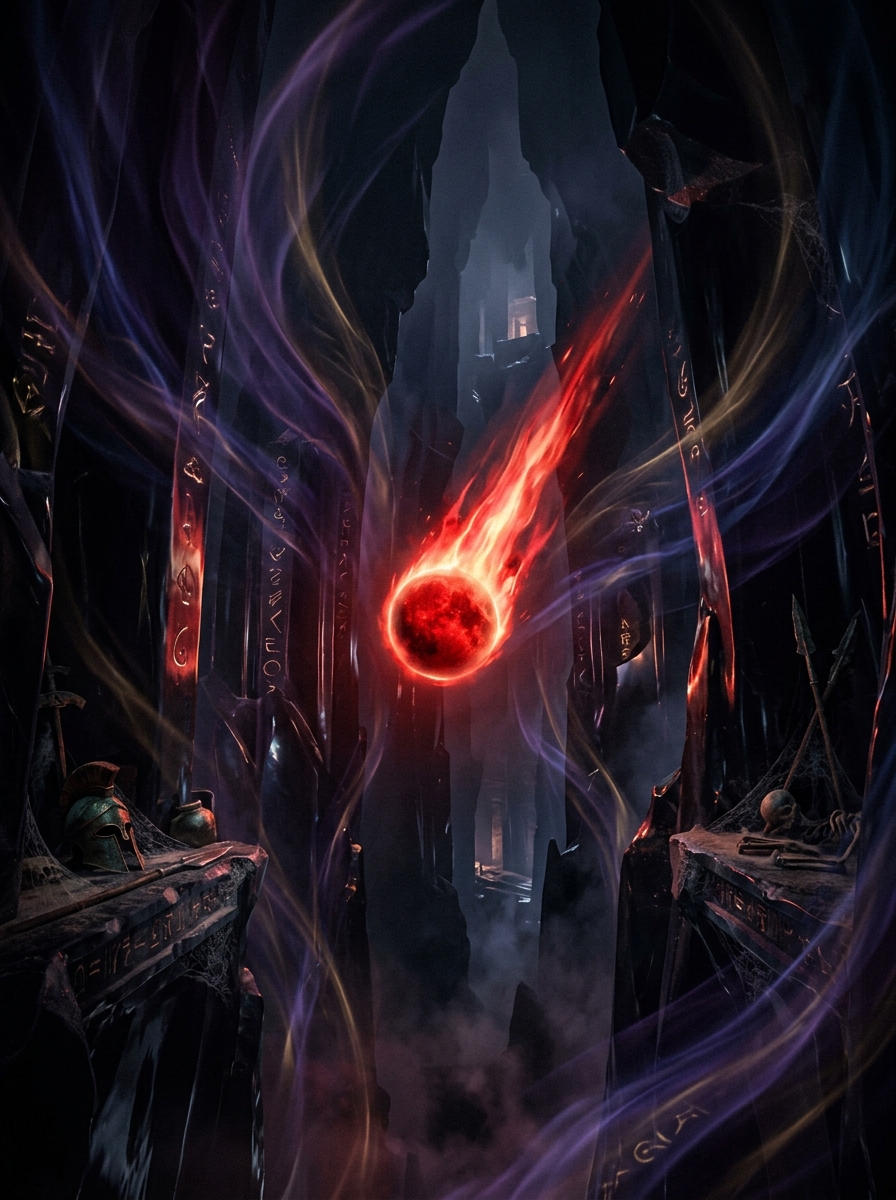
There is a particular quality of fire that burns underground. It does not announce itself with sparks or the crackle of dry wood. It moves through seams of coal and pockets of gas, invisible, pressurized, and devastating in its patience. Mars in the 8th House is that fire. It is desire that goes deep rather than wide, will that compels through psychological intensity rather than open aggression, and courage that is tested not on a battlefield but in the shadowed chambers of the self.
In the long tradition of Western astrology, Scorpio was considered the nocturnal domicile of Mars — the sign in which the red planet operated in its shadow register, trading the hot impulsiveness of Aries for something slower, more deliberate, and infinitely more dangerous. The 8th House is Scorpio's natural home in the natural wheel, and when Mars occupies this territory in the natal chart, the individual carries that ancient equation at the center of their psyche: the warrior who has learned to fight in the dark.
What follows is not a surface reading. Mars in the 8th House does not reward surface reading. This is an invitation to go down.
Mars as Traditional Lord of Scorpio: The Ancient Inheritance
Before Pluto was discovered in 1930, Mars ruled both Aries and Scorpio. Understanding Mars in the 8th House without acknowledging this dual rulership is like reading Hamlet without knowing he is the prince of Denmark — you will miss everything that matters about why he behaves the way he does.
Aries-Mars is the warrior who charges. Scorpio-Mars is the warrior who waits, watches, and strikes precisely when the moment is right. The two expressions are not contradictory; they are two faces of the same martial archetype. In Aries, Mars expresses through initiative and assertion. In Scorpio — and by extension, in the 8th House — Mars expresses through endurance, investigation, and the willingness to descend.
The Underworld Journey as Mythic Template
The mythological parallel that Liz Greene and other psychologically oriented astrologers return to again and again is the descent motif: Inanna into the underworld, Orpheus after Eurydice, Persephone seized by Hades. These myths share a structure: the hero or goddess goes down, is stripped of their former identity, confronts powers they cannot overcome by force alone, and returns — changed, deepened, sometimes wounded, but fundamentally transformed.
Mars in the 8th House people live this myth not as metaphor but as lived experience. Their descent is enacted through crisis, through loss, through encounters with the shadow dimensions of human nature. They are not exempt from fear; they are simply compelled forward by something stronger than fear. The Jungian concept of the shadow — those disowned aspects of the psyche that accumulate power in the dark — is almost literally descriptive of this placement. The 8th House is the shadow shelf of the chart.
Why This Placement Is Rarely Comfortable — and Why That Is the Point
Comfort is not the purpose of Mars in the 8th House. Steven Forrest, in his work on evolutionary astrology, consistently emphasizes that houses in the lower half of the chart are developmental crucibles — they are where soul work actually happens. The 8th House in particular is associated with what he calls "the knife-edge between life and death," not necessarily in the literal sense, but in the existential sense: the moments when who you were before can no longer survive intact.
For people with Mars here, intensity is not sought for its own sake. It arrives. And over time, they learn — if they do the work — that they have an extraordinary capacity to metabolize what would dissolve someone else.
Erotic Magnetism and the Psychology of Intimate Union
No placement in the natal chart is more directly linked to the erotic than Mars in the 8th House. But it is important to be precise about what "erotic" means in this context. It does not simply mean a strong libido, though that is often present. The erotic quality of this Mars is fundamentally psychological. It is the experience of union as transformation — of being genuinely altered by contact with another person.
For the 8th House Mars native, casual sex is almost structurally impossible. Not because of moral squeamishness, but because the mechanism does not turn on without depth. There must be something at stake. There must be a sense that the encounter is touching something real in the other person — something hidden, something that the world does not usually get to see. When that element is present, the intensity can be extraordinary.
The Pull Toward Hidden Selves
The erotic draw of Mars in the 8th House is often specifically toward what other people conceal. This is not predatory in origin; it is investigative. The native wants to know what lives behind the facade. They can read subtext with unnerving accuracy, sense when someone is performing rather than being, and remain patient with another person's complexity in a way that many partners find both disarming and deeply attractive.
This is, in Jungian terms, an orientation toward the shadow of the other. And because we are most attracted to what mirrors back something of our own interior life, the partners these individuals draw tend to be intense, complex, and often carrying significant psychological material of their own.
Death and Rebirth Through Relationship
Aleister Crowley's concept of the Great Work — the alchemical process of transforming base matter into gold, lead into the philosopher's stone — has a direct erotic analog in this placement. The profound intimate bonds that Mars in the 8th House forges are alchemical in the sense that they require both parties to be broken open. This is not the relationship astrology of Venus in Libra, where partnership is about balance and aesthetic harmony. This is the relationship astrology of the transformative encounter, where both people are fundamentally changed by what passes between them.
Not all of these relationships are long-lasting. Some of the most significant ones — the ones that reshape a person's entire psychic landscape — may be relatively brief. Duration is not the measure. Depth is.
Crisis, Resilience, and the Gift of Psychological Regeneration
If you want to know who has Mars in the 8th House, look at who shows up during a catastrophe. These individuals often discover their most essential competence in conditions that would send others into paralysis. There is something about genuine crisis — the kind that strips away social pleasantries and demands that you act from instinct — that this Mars thrives in.
This is not bravado. It is a kind of practical relationship with mortality, limitation, and the irreversible. Where some people freeze when faced with situations they cannot control, Mars in the 8th House has, usually through repeated experience, developed a working relationship with uncontrollability. They have been to the bottom before. They know — not intellectually, but viscerally — that there is a floor.
Symbolic Deaths as Developmental Milestones
The biographical arc of someone with Mars here frequently contains clear before-and-after moments: a period of illness, a loss that rewired the psyche, a collapse of a former identity that felt like annihilation at the time but was, in retrospect, the necessary demolition that made way for something more authentic. Steven Forrest would call these "the south node coming due" — the clearing of old karma through direct confrontation with what must end.
These transitions can look from the outside like destruction. The person may appear, during the crisis, to be unraveling. The 8th House process is almost always invisible to observers. The transformation happens underground. What surfaces is the phoenix — the person who came through.
Resilience as a Practiced Art, Not a Natural State
It would be misleading to suggest that Mars in the 8th House people are simply built tougher than others. Many of them suffer deeply during their periods of crisis. The capacity for regeneration is not immunity to pain; it is the ability to metabolize pain — to extract meaning from it, to use it as fuel rather than letting it become a wound that simply festers.
This is why therapy, depth psychology, and serious inner work often become central to the native's life. They are not seeking comfort in these contexts; they are seeking understanding. They want to know the mechanics of their own transformation. Jung's own chart and his deep engagement with the shadow, the collective unconscious, and the process of individuation represent, in many ways, the highest expression of this placement.
Financial Friction, Shared Resources, and the Battle Over What Is Ours
The 8th House governs shared money — inheritances, joint finances, a partner's income, taxes, insurance settlements, and the financial dimensions of merger and dissolution. Mars here means this territory is charged, contested, and often dramatic.
This is not simply about greed or financial aggression, though those shadows exist. At a deeper level, the tension around shared money is a proxy for the deeper question the 8th House always poses: What is mine? What is yours? What are we willing to surrender, and what must we hold?
Inheritance and Legacy: More Than Money
For Mars in the 8th House, the inheritance is rarely just financial. There is frequently a psychological inheritance that accompanies it — family secrets, ancestral wounds, unresolved grief, or a lineage of emotional suppression. The work of this placement, in the financial domain, often involves untangling the psychological from the monetary: understanding that the anger around the will, the dispute about who gets what, is almost never truly about the money.
This placement can produce gifted financial strategists — people who understand leverage, risk, and the mechanics of hidden value with the same intuitive ease that others apply to simpler tasks. But it can also produce financial paralysis born from the terror of merger: the fear that if I share my resources with you, I will lose myself.
Taxes, Debt, and the Hidden Economy
Mars here often has a particular relationship with the parts of the financial world that operate in shadow: debt management, tax strategy, the recovery of assets from messy endings. There can be strong skill in navigating these arenas — and equally strong temptation to use financial control as a power mechanism in relationships. The mature expression of this Mars separates skill from shadow: using financial acuity in service of genuine transformation (for oneself, for others) rather than as a weapon.
The Occult, the Forbidden, and the Pull Toward What Hides
Mars in the 8th House is almost constitutionally drawn toward what society places behind closed doors. This can manifest as a formal interest in occult study — ceremonial magic, depth psychology as a form of esoteric practice, tarot as a psychological mirror (the tradition that A.E. Waite encoded into the Rider-Waite-Smith deck is deeply compatible with this placement's sensibility), or the Hermetic arts in any of their forms.
But it can also manifest less formally: an obsession with true crime, a compulsive need to understand the worst that human beings are capable of, a fascination with death and dying that is neither morbid nor pathological but genuinely philosophical.
Depth Psychology as a Living Practice
There is a reason why some of the most significant contributors to the field of depth psychology — from Freud's excavations of the unconscious to Jung's cartography of the collective depths — have had strong 8th House placements or Scorpionic signatures. The territory interests them not as an intellectual exercise but as a matter of personal survival. You do not survive repeated underworld descents without developing a theory of what the underworld is. That theory, refined over a lifetime, can become a genuine contribution to human understanding.
For Mars in the 8th House, the study of the occult or the psychological is rarely purely academic. It is applied. These people want to know how it works because they need to use it.
Sexuality as a Spiritual Practice
The tradition of sexual magic — from Tantric systems to Crowley's approach in Thelema — is predicated on the idea that sexual energy is fundamentally transformative, and that its conscious direction can be a path of genuine spiritual development. Mars in the 8th House individuals often intuit this long before they encounter it in any formal tradition. The experience of intense erotic union as something that is not merely pleasurable but actually consciousness-altering — that it can dissolve the boundary between self and other in a way that feels genuinely transcendent — is not unusual for this placement.
This is not an endorsement of any particular practice. It is an acknowledgment that the energy these individuals carry in the domain of sexuality is not ordinary, and that it deserves to be approached with an appropriate degree of intentionality.
Aligned Vocations: Where This Energy Does Its Best Work
The question of career for Mars in the 8th House is best approached through the lens of what environments allow this energy to be deployed constructively. The common thread is that the work must involve genuine stakes, real depth, and the possibility of meaningful transformation.
Medicine and Crisis Care
Surgery stands out as almost a perfect vocational match. The surgeon enters the body — the most intimate boundary of another person — with skill, focus, and the consciousness that every moment matters. Trauma medicine and emergency care have the same quality: high stakes, irreversible decisions, the presence of mortality as a constant backdrop. These environments do not overwhelm Mars in the 8th House; they focus it.
Hospice work, while it might seem counterintuitive, is another powerful expression of this placement. The capacity to sit with someone in their dying process — to be genuinely present to the most profound transition a human being undergoes — requires exactly the relationship with mortality that this Mars develops over a lifetime.
Investigation, Research, and Strategic Intelligence
Criminal investigation — particularly the forensic, psychological dimensions: profiling, behavioral analysis, the reconstruction of events from fragmentary evidence — is well-suited to this Mars. The ability to think from within hidden frameworks, to understand motivated concealment, and to sustain attention over a long, grinding investigation without losing the thread is a hallmark of the placement.
Strategic intelligence — in the corporate, political, or literal (government) sense — draws on the same capacities: pattern recognition under conditions of deliberate obscurity, comfort with incomplete information, and the willingness to sit with uncertainty rather than forcing premature conclusions.
Depth Psychotherapy and Transformational Coaching
The psychotherapist's consulting room is, in the best sense, an 8th House environment: a sealed space where hidden material is brought into consciousness, where the therapeutic relationship itself becomes the laboratory of transformation. Analysts working in the Jungian tradition, trauma therapists, EMDR practitioners, and others who engage with the deepest levels of psychological material often have strong 8th House placements. Mars here provides the drive to go into those depths without flinching, and the instinct to know when to press and when to hold back.
Financial Strategy and Transformative Investment
Hedge fund management, private equity, distressed asset investment — the parts of the financial world that involve taking positions in situations of maximum uncertainty and opacity — are natural habitats for a well-developed Mars in the 8th House. The capacity to do due diligence into hidden liabilities, to understand how concealed information affects value, and to maintain conviction through the discomfort of illiquidity is very much the financial expression of this Mars.
The Shadow Side: Obsession, Control, and Destructive Intensity
Every placement has a shadow, and the shadow of Mars in the 8th House is serious. Because the energy is so powerful and so psychologically loaded, its distorted expressions can be genuinely destructive — to the native, to their relationships, and in extreme cases, to others.
The Control Compulsion
The deepest fear of Mars in the 8th House is vulnerability — specifically, the vulnerability of genuine merger. If you let someone truly in, they can devastate you. This is not paranoia; this placement has usually been devastated before. The shadow response to that fear is the compulsion to control: to manage access, to withhold, to maintain an asymmetry of power in relationships so that the native always has the escape route, always holds the leverage.
This control can be overt — domineering behavior, jealousy, possessiveness — or it can be extremely subtle: the passive withholding of emotional availability, the strategic deployment of intimacy as a reward and its withdrawal as a punishment. Either way, it is the antithesis of what this placement is actually reaching toward, which is genuine transformative union.
Financial Paranoia and Power Plays
In the financial domain, the shadow can manifest as a paranoid secretiveness about money — treating financial information as a power asset to be hoarded rather than a practical tool. There can be a tendency to use financial control to dominate partners or to punish them for perceived betrayals: hiding assets, manipulating shared finances, or simply refusing to engage with the financial dimensions of a relationship in any transparent way.
The obsession with power that can develop — particularly if the early experiences of this Mars were ones of genuine powerlessness — can become genuinely corrosive. Power sought for its own sake, as protection from vulnerability, is a closed loop. It does not actually provide the safety it promises.
Compulsive Behavior and Addictive Patterns
The intensity of this placement, when it has no conscious channel, can organize itself around compulsive behaviors. The 8th House governs addictive patterns in some traditional readings, and Mars here can bring an addictive quality to anything it attaches to: substances, sex, control, crisis itself. The adrenaline of crisis can become its own dependency — unconsciously generating drama in order to feel the clarity and aliveness that genuine existential stakes produce.
Recognizing this pattern is half the battle. The other half is developing deliberate, intentional channels for the intensity — practices and environments that produce genuine depth without the collateral damage.
Integration and Mature Expression: The 2nd House Axis and the Path Forward
No house stands alone in a chart. The 8th House is always in conversation with the 2nd, its opposite: the house of personal resources, self-worth, earned income, and the body as a home. The developmental challenge of Mars in the 8th House, viewed through the lens of this axis, is the cultivation of genuine self-sufficiency alongside the capacity for deep merger.
The 2nd House as Counterbalance
The 2nd House question is: What is mine, truly? Not in a legal or financial sense, but in the sense of what I have actually earned — what I have built from the ground up, from my own labor, my own skill, my own intrinsic value. Mars in the 8th House, particularly in its shadow expressions, can become so oriented toward shared and hidden resources that it neglects this foundation. The person who can only access their power through another person's money, or through the intensity of merger, has not yet fully integrated the axis.
The integration work involves developing the 2nd House: building a relationship with one's own material resources, one's own body, one's own sensory experience of being alive — separate from the charge of intensity and depth. This is not a retreat from the 8th House's gifts. It is the grounding that makes those gifts sustainable.
Channeling Mars Consciously
The mature expression of Mars in the 8th House is a person who can move between registers: who can enter the deep waters of psychological transformation — their own or another's — with full presence and skill, and then return to ordinary life with that experience integrated rather than discharged in crisis or compulsion.
Practices that support this include: depth therapy (not as a luxury but as a genuine form of training), physical practices that connect the native to their body's wisdom rather than its intensity (yoga, somatic work, martial arts with a philosophical dimension), and creative work that provides a container for the volcanic material this Mars generates.
The magician who works with power consciously is the archetype that best describes the highest expression of this placement. Crowley's famous injunction — "Do what thou wilt shall be the whole of the Law" — is often misread as permission for indulgence. In its properly understood form, it is a demand for absolute self-knowledge and self-direction. Mars in the 8th House, at its best, embodies that demand.
Frequently Asked Questions
What does it mean to have Mars in the 8th House in my natal chart?
Mars in the 8th House is one of the most psychologically intense natal placements in Western astrology. It means that your drive, desire, and will are oriented toward the hidden, the transformative, and the profound rather than toward surface-level achievement. You are likely to experience your most significant growth through crisis, loss, intense relationships, and deep psychological work. You carry an instinctive relationship with power, mortality, and the hidden dimensions of human experience. This is not an easy placement, but it is an extraordinarily powerful one for anyone willing to engage with it consciously.
Is Mars in the 8th House good for relationships?
Mars in the 8th House brings extraordinary depth, loyalty, and transformative potential to relationships — but it also brings intensity, possessiveness, and the shadow of control. The relationships this placement forges can be the most profound experiences of another person's life. They can also be overwhelmingly intense if the native has not done the work of understanding their own shadow motivations. The key is developing the capacity for genuine vulnerability alongside the instinct for power. Relationships that survive — and thrive — with Mars in the 8th House are ones built on radical honesty and mutual willingness to be transformed.
How does Mars in the 8th House affect finances?
This placement creates a strong, often complicated relationship with shared money: inheritances, joint finances, debt, taxes, and a partner's income. There can be genuine skill in navigating financial complexity, distressed assets, and hidden value — alongside a shadow tendency to use financial control as a power mechanism. The most productive use of this energy in the financial domain is strategic: using the native's natural instinct for uncovering what is hidden and managing risk under uncertainty. Transparency with partners, even when it feels threatening, is essential for financial health.
What careers are best for Mars in the 8th House?
The most aligned vocations are those that involve genuine stakes, hidden information, and the possibility of meaningful transformation. Surgery and trauma medicine, depth psychotherapy and analysis, criminal investigation and forensic work, strategic investment and distressed asset management, hospice care, crisis management, and serious occult or esoteric practice all provide natural channels for this energy. The common denominator is work that most people find too intense, too dark, or too close to the edge — which is precisely where Mars in the 8th House functions best.
What is the shadow of Mars in the 8th House?
The principal shadows are: the compulsion to control (particularly in intimate relationships), financial paranoia and power plays around shared resources, obsessive or addictive patterns (especially around intensity and crisis itself), and a destructive jealousy that can poison even the deepest partnerships. Underneath all of these is the core wound: the terror of genuine vulnerability, and the conviction — usually based on real experience — that total openness leads to total devastation. The work is not to eliminate the protections but to choose them consciously rather than deploying them automatically.
How can I work with Mars in the 8th House constructively?
The most important step is developing a deliberate relationship with intensity rather than being driven by it unconsciously. Depth therapy — particularly modalities rooted in Jungian, somatic, or trauma-informed frameworks — provides an invaluable container. Physical practices that connect you to your body's strength and groundedness (rather than its adrenaline capacity) help develop the 2nd House axis. Creative work — writing, visual art, music that engages your darkest and most powerful material — gives form to what would otherwise circulate as compulsion or crisis. And the ongoing cultivation of radical honesty in your most intimate relationships, even when it feels dangerous, is the direct path to the transformation this placement is always reaching toward.
Related
- Mars in the Eighth House: Desire at the Threshold
- Mars in the 7th House: The Warrior in the Mirror and the Alchemy of Relationship
- Mars in the 12th House: The Veiled Warrior
- Mars in the 9th House: The Passionate Quest for Truth, Belief, and Adventure
- Mars in the 4th House: The Warrior in the Sanctuary
Comments
Loading comments…