Synastry Mars Sextile Mars: Shared Fire, Skilled Friction, and Mutual Momentum
The Core Dynamic: Usable Fire, Not Volcano
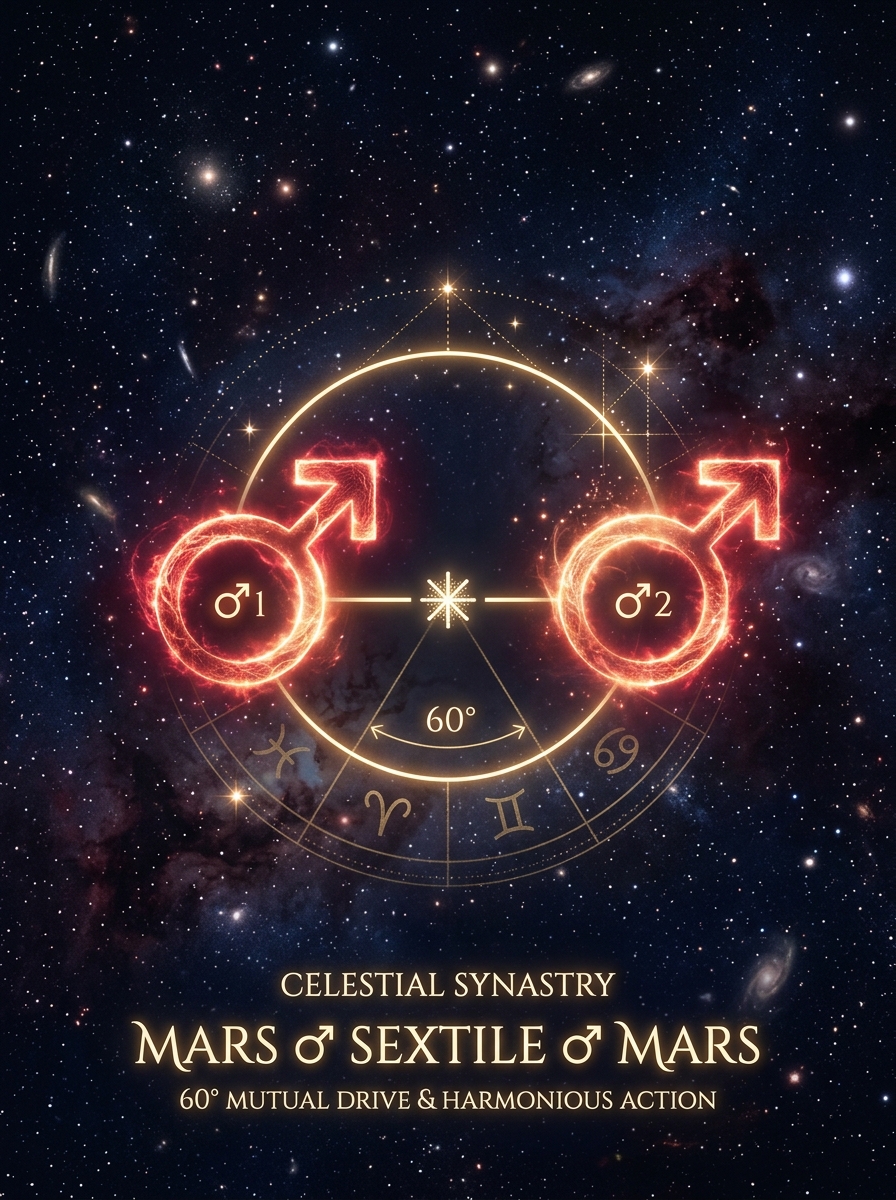
Mars sextile Mars in synastry is the aspect of coordinated initiative — fire that does not need to burn everything down to prove it is alive. The contact is a sextile, an aspect of opportunity rather than automatic harmony. Two people with this placement find that their wills move in complementary rhythms. One may act first, the other strategize; one pushes hard, the other paces. Neither style feels alien or threatening. The attraction registers not through dramatic friction but through a subtle, kinetic recognition: this person moves in a way I understand deep in my bones.
This matters because Mars is the planet of directed life-force — assertion, pursuit, competition, and the raw nerve of desire. In astrological synastry, when one person’s Mars responds to the other’s via sextile, the instinctual self does not brace for a fight. It finds an ally, or at least a sparring partner whose hits land cleanly. The chemistry is real but unforced; it behaves less like lightning and more like a well-balanced blade.
Why It Forms: The Kinetics of Recognition
The psychological root of this aspect runs deep. A sextile between Mars placements implies that each person’s style of assertion — the way they handle resistance, express anger, or chase what they want — resembles a dialect someone already speaks. It is not identical (that would be a conjunction), nor is it opposite (an opposition). It is a shared grammar with different vocabularies.
For example, a Mars in Leo person may perform desire with theatrical flair, while a Mars in Sagittarius person charges straight into experience. These two energies are not the same, but they recognize each other as fire. Neither needs to translate its heat for the other. In practice, this recognition often surfaces through activity: the couple meets while hiking, playing a sport, building something, or arguing passionately about a shared cause. The body says yes before the mind has a chance to rationalize.
Because the sextile is not a frictionless flow — it is a door left unlocked — the relationship requires both parties to walk through it. Without shared projects or challenges, the energy can scatter into separate routines. That is why this aspect often feels most alive when there is a mutual task, a goal larger than the bond itself. For the deeper mechanics of the sextile as a dynamic, see the astrology of the sextile aspect.
How It Matures — and Where It Stalls
The Mature Expression: Functional Friction
When consciously worked, Mars sextile Mars teaches two people how to disagree without damaging the bond. Because both instinctively trust the other’s motives (even when they disagree), conflict becomes a form of training. The couple can argue, compete, interrupt, and test each other, but the friction rarely turns toxic. Instead, it sharpens both individuals. One learns to be more direct; the other learns to be more patient. The relationship becomes a forge, not a trap.
This capacity for functional conflict is one of the mature gifts of the aspect. It supports long-term partnership because the couple can handle real-world pressure — moving, financial stress, parenting, career transitions — without collapsing into blame. They know how to mobilize. For a broader map of how Mars interacts with other relationship factors, Venus and Mars synastry offers the complementary picture of desire and affection braiding together.
The Shadow: Motion as Avoidance
Yet every gift has a shadow. The very ease of this sextile can become a trap. Because the couple works well together, they may mistake competence for intimacy. They solve, fix, and execute, but they may never stop to ask what they are actually solving. Action becomes a substitute for vulnerability. The relationship hums along efficiently, yet something essential remains unspoken — the wounds that cannot be addressed through a to-do list.
In Jungian terms, this is the shadow of the puer figure: the will that moves but never roots. If the couple never learns to sit in stillness together, the dynamic can become a high-functioning avoidance. The semi-sextile, by contrast, demands awkward integration — see the semi-sextile in astrology for how that friction forces growth where the sextile may glide past.
Expression Across Life Domains
Love and Attraction
In romantic settings, Mars sextile Mars often produces a desire that is physical and straightforward. The couple may not need elaborate courtship rituals; they simply do things together and find that the doing is erotic. Their sexual energy is usually uncomplicated — not because there are no shadows, but because the basic channel of initiative and response is clean. One partner’s advance rarely hits a wall of resistance. Instead, it meets a response that says, yes, I was already moving that way.
When combined with strong Venusian ties, the attraction becomes both tender and active. Moon-Venus synastry adds the ingredient of emotional softness, making the fire more nurturing without losing its edge.
Work and Collaboration
This aspect shines most in shared endeavours. The couple can co-create a business, manage a household under deadline, or support each other’s careers with rare efficiency. One may be the initiator, the other the organizer; both trust the other’s judgment under pressure. House placements color this greatly. For example, a Mars in the 10th house sextile a partner’s Mars in the 6th points to professional synergy — career ambition supported by daily discipline. For more on that configuration, see Mars in the 10th house.
Conflict and Competition
Competition between them is rarely personal. They may play games, race to complete tasks, or argue about tactics, but the rivalry energizes rather than wounds. If one person has Mars in Aries and the other Mars in Libra, the contest becomes an exercise in balancing speed with strategy — each learning from the other’s style. That kind of growth is the aspect’s deepest value. For a detailed look at Mars in Libra as a placement, Mars in Libra can deepen the interpretation.
The Deeper Significance: A Relationship That Knows How to Move
At its core, Mars sextile Mars produces a bond that restores agency. After time together, each person feels more capable, more decisive, less trapped in hesitation. That is a sacred function of Mars in relationship astrology: not merely desire, but courage transmitted through contact. The couple becomes a small engine of mutual momentum.
This initiatory quality matters because life will test them. When the predictable does not hold, they will not freeze. They will move — because they have built the habit of moving together. The relationship is less a shelter from the world and more a base camp for engaging it. If you are building a full synastry reading, synastry step-by-step provides the method for integrating this aspect with others.
Mars sextile Mars never means “soulmates” in the soft sense. It means two people whose wills speak the same language. They may not always agree, but they will rarely mistake each other. And in a world that demands constant negotiation between separate selves, that clarity is a form of grace.
Related
- Sun Sextile Mars in Synastry: The Ease of Shared Fire
- Moon Sextile Mars Synastry: The Warmth That Knows How to Move
- Mars Trine Mars Synastry: Shared Fire, Clean Friction, and the Art of Mutual Momentum
- Synastry Mars Sextile Mercury: The Spark of Quick Minds and Clean Friction
- Sun Sextile Mars: The Seam Between Purpose and Force
Comments
Loading comments…