Synastry Sun Trine Mars: The Ease of Mutual Charge
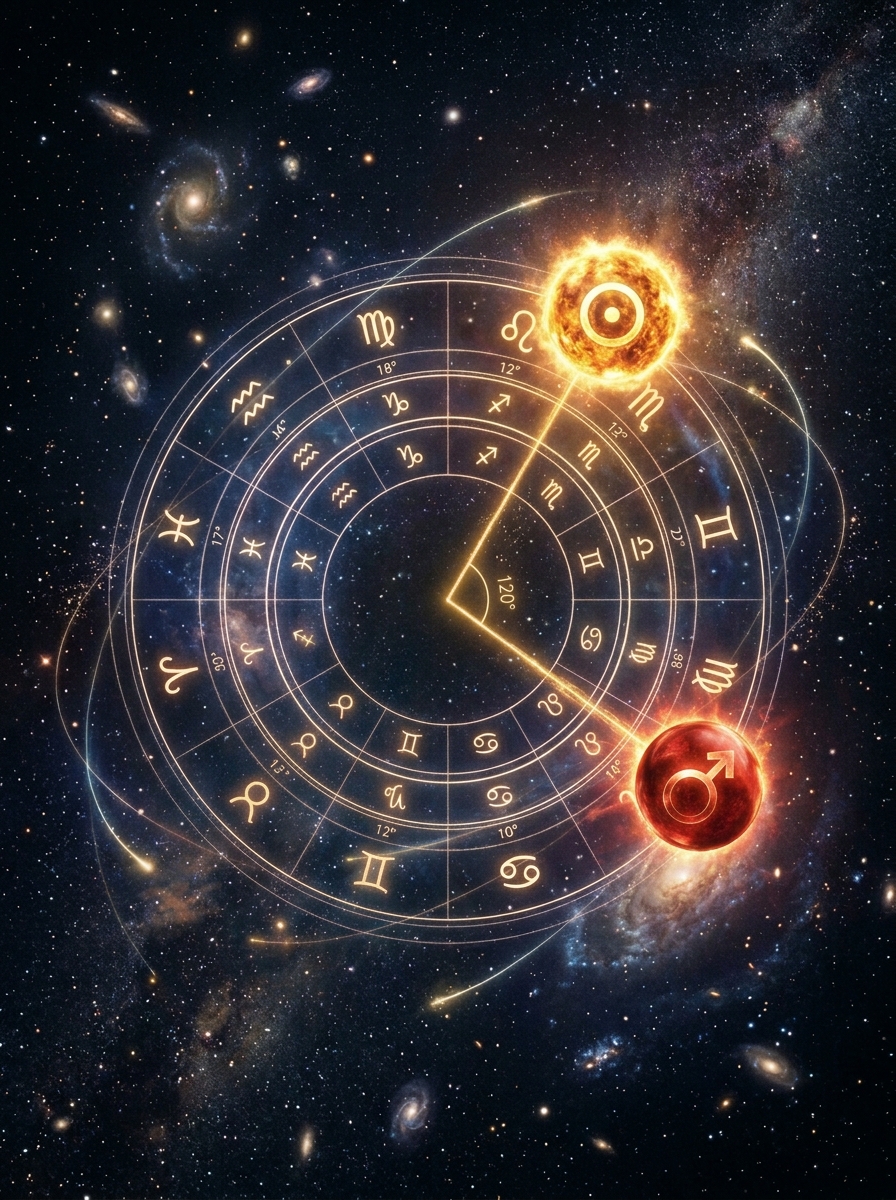
Sun trine Mars is the synastry contact that makes two people feel mutually awakened without feeling endangered. The Sun person experiences the Mars person as energizing, brave, and responsive; the Mars person feels seen, approved, and given something worth acting on. This is not the smoldering uncertainty of a square or the pressure of an opposition. It is cleaner, quicker, and often more literal: one person shines, the other moves. The trine is an ease-making geometry, and here that ease becomes behavioral—desire does not spend itself overcoming resistance. The connection tends to say yes to life before it says yes to each other, which is why the bond often feels active rather than merely romantic. For a wider map of how relationship aspects function as a system, synastry aspects show why even a single harmonious contact is still only one instrument in the orchestra.
The Nature of the Contact: What It Actually Does
A trine is a 120-degree arc that lets energy flow without friction. In synastry, that means the two planets involved are naturally sympathetic—they do not need to translate one another’s language. With Sun trine Mars, identity and will agree. The Sun person’s core self and the Mars person’s drive speak the same dialect, so the relationship spools out without the usual static of misinterpretation. Plans get made, bodies move, decisions sharpen. The couple stimulates one another into motion not because they are trying to, but because being together feels like permission to act.
This is one reason the aspect appears so often in couples who work well as a team. One person initiates, the other clarifies purpose; then the roles reverse. The relationship gains a pulse. If the broader chart also supports emotional attunement, Sun-Moon synastry may reveal whether the chemistry has a shelter beneath it, not just momentum.
The Sun Feels Fortified, Not Chased
The Sun person usually feels amplified rather than pursued. Mars does not flatter them with softness; instead, Mars gives the Sun a stage, a field, or a challenge. That matters because the Sun wants to express identity outward, and Mars answers with action. In healthy form, the Mars person says: I see who you are, and I can meet it. This can feel like being accompanied by someone who does not dim the light but helps carry the lamp. The dynamic is reciprocal but not equal in kind—the Sun provides purpose, and Mars provides power.
Mars Gets Useful Material to Act On
The Mars person is rarely bored here. The Sun gives Mars a target, and Mars likes targets. Whether the target is a person, a project, a shared goal, or simply the pleasure of mutual engagement, Mars tends to feel legitimized. That is different from being controlled. The trine allows action to feel purposeful rather than compulsive, which is why this aspect can support real-world building: moving, making, training, creating, competing, organizing. The lightness of the trine is not trivial—it is the difference between having to fight for oxygen and breathing freely. To understand why that ease can also become a trap, consider the broader lesson of the trine aspect, which warns that frictionless flow can lead to unexamined entitlement.
The Circuit of Identity and Action: Psychological Root
This contact works because it resolves a fundamental tension that other synastry aspects leave raw: the question of whether I can be myself and still be met by your will. In a square or opposition, the Sun person often feels that the Mars person’s drive threatens or competes with their identity; the Mars person feels blocked or dominated. With the trine, no such conflict arises. The two functions—being and doing—are aligned. Psychologically, this creates a rare permission: the Sun can assert without fear of overpowering, and Mars can act without fear of extinguishing.
The result is a bond that feels both safe and alive. Neither person has to shrink. The Sun does not need to dramatize vulnerability to be wanted; the Mars does not need to dominate to feel potent. That makes the contact unusually efficient at handling directness. People can say what they want, negotiate, compete without mutiny. The relationship becomes a circuit for shared will.
This clean exchange also has a shadow, which we will examine next. But first, note that the circuit depends on difference: the Sun remains solar, not merely reactive; Mars remains martial, not merely helpful. If either person collapses into dependency or passivity, the vitality fades. For a look at how this circuit interacts with softer planetary dynamics, Moon-Venus synastry often explains whether the bond has the emotional depth to match its drive.
When Ease Becomes a Shadow
No aspect is free, and the Sun trine Mars shadow is subtle because it feels so good. The trine can become an unexamined entitlement: the connection works well enough that no one notices when they start taking it for granted. The couple moves so efficiently that they skip the inner work of checking whether the pace is mutual, the goal shared, or the method truly consensual.
The Risk of Complacency
Because the energy flows without friction, both people may assume it will always be available. The trine can produce a polished sort of self-interest: each person likes how the other makes them feel strong, and the relationship risks revolving around performance instead of intimacy. In a chart that already contains a lot of easy-fire harmony—especially a grand trine—the grace can become inertia. The couple does not fight, but they also do not grow.
Power Imbalances Disguised as Harmony
Because Mars is the planet of assertion and Sun of identity, this aspect can become lopsided if one person is naturally more charismatic and the other more impulsive. The trine smooths over rough edges, which is helpful until it prevents a necessary confrontation. Sometimes the Mars person ends up doing all the initiating while the Sun receives the benefits; sometimes the Sun sets the tone while Mars supplies the fuel. If both like the arrangement, fine. If not, resentment can stay invisible for a long time. House overlays and angular emphasis can clarify where the energy lands—a Mars person whose planet falls in the partner’s 7th house, for example, behaves very differently than one activating the 12th or 8th. For that larger terrain, synastry house overlays reveal where the action actually unfolds.
Avoidance Through Action
When conflict does arise, this aspect often pushes the couple toward doing something rather than interpreting everything. That can be a gift—tension may resolve by walking, working, cleaning, or returning to a shared task. But the shadow is avoidance. If both people use activity to outrun feeling, the trine becomes a beautiful distraction. The energetic harmony remains, but the psyche’s deeper material goes unspoken. Healthy friction—the kind that brings buried assumptions to light—is the price of aliveness.
The Elemental and House Context
No synastry aspect lives in isolation, and Sun trine Mars is especially sensitive to sign, house, and the rest of the chart’s martial and solar ecology. A trine is a relationship style, not a final verdict. The aspect tells you how energy moves; the rest of the chart tells you what it is moving toward.
Elemental Tone
A Fire trine between Sun and Mars feels incandescent: fast attraction, shared daring, quick recovery from conflict. Earth trine manifests as practical competence, sexual reliability, and the satisfaction of getting things done together. Air trine makes the chemistry verbal, witty, mentally activating. Water trine can become protective and emotionally motivating, though sometimes less visibly aggressive. The Sun sign and Mars sign matter enormously. A Sun in Leo trine Mars in Aries is not the same as a Sun in Taurus trine Mars in Virgo, even though both are harmonious. One pair burns; the other builds. To understand how Mars itself expresses across different signs, consult the full profile of Mars in astrology, which treats Mars as will, not merely libido.
Retrograde and House
A Mars retrograde person may experience the trine less as external assertion and more as internal reorganization. The energy still flows, but it arrives through revision, delayed action, or a quieter confidence that needs time to reveal itself. By contrast, Mars in the 1st, 5th, 7th, or 10th house often broadcasts more openly. Mars in the 7th house orients toward partnership and confrontation; Mars in the 5th turns the contact playful and romantic; Mars in the 10th can make the pair formidable in public or professional spaces. If Mars is strongly placed, the trine feels like a standing invitation to action rather than a gentle nudge.
How It Lives in Relationship
In lived relationships, Sun trine Mars often looks like momentum with mutual respect. The couple may be unusually good at starting things together: moving apartments, training for a race, launching a project, traveling, redecorating, or simply keeping each other from stagnating. The attraction is not just sexual; it is existential. Being around the other person makes it easier to inhabit one’s own force.
In Romance
This aspect sustains desire over time because it is not dependent on mystery. The Sun continues to admire the Mars person’s initiative; the Mars continues to feel enlivened by the Sun’s radiance. Even in a settled routine, there is often a background charge of readiness. They do not merely coexist; they prepare one another for movement. For a comparison of desire versus affection, Venus and Mars synastry distinguishes the two currents—Sun trine Mars is less about languid sweetness than about energized mutuality.
At Work and in Shared Projects
The same dynamic scales to tasks. Sun trine Mars couples collaborate with unusual efficiency: one provides direction, the other supplies push, and then they swap. The energy is not competitive in a destructive sense, but it is competitive enough to keep both sharp. They can debate without feeling threatened, disagree without withdrawing support. This is why the aspect appears in creative partnerships, athletic duos, and co-founded businesses. The bond works because it validates both parties’ need to act.
In Difficult Moments
When trouble hits, this aspect prefers action over rumination. The couple will likely resolve conflict by walking, working out, cleaning, or returning to a shared task. That is a gift—but it requires honesty about what is being powered, what is being protected, and what is being postponed. The trine offers no automatic depth; it provides a clean channel for shared will. Whether that channel carries love or merely momentum depends on the maturity of both individuals.
Sun trine Mars is one of synastry’s most workable contacts because it joins identity to action without forcing either to apologize. It produces attraction, healthy competitiveness, shared ambition, and a rare sense that two people make each other more alive. Its limit is also its virtue: because it flows so easily, it must be consciously inhabited. Used well, it is not merely chemistry—it is a joint propulsion system.
Related
- Mars Trine Mars Synastry: Shared Fire, Clean Friction, and the Art of Mutual Momentum
- Moon Trine Mars Synastry: Desire, Protection, and Easy Emotional Heat
- Sun Sextile Mars in Synastry: The Ease of Shared Fire
- Synastry: Mars Trine Mercury — The Spark of Quick Minds and Clean Friction
- Synastry Sun Conjunct Mars: Attraction That Strikes the Match
Comments
Loading comments…