October Birthstone: Opal and the Art of Living in Color
The Stone That Refuses to Hold Still
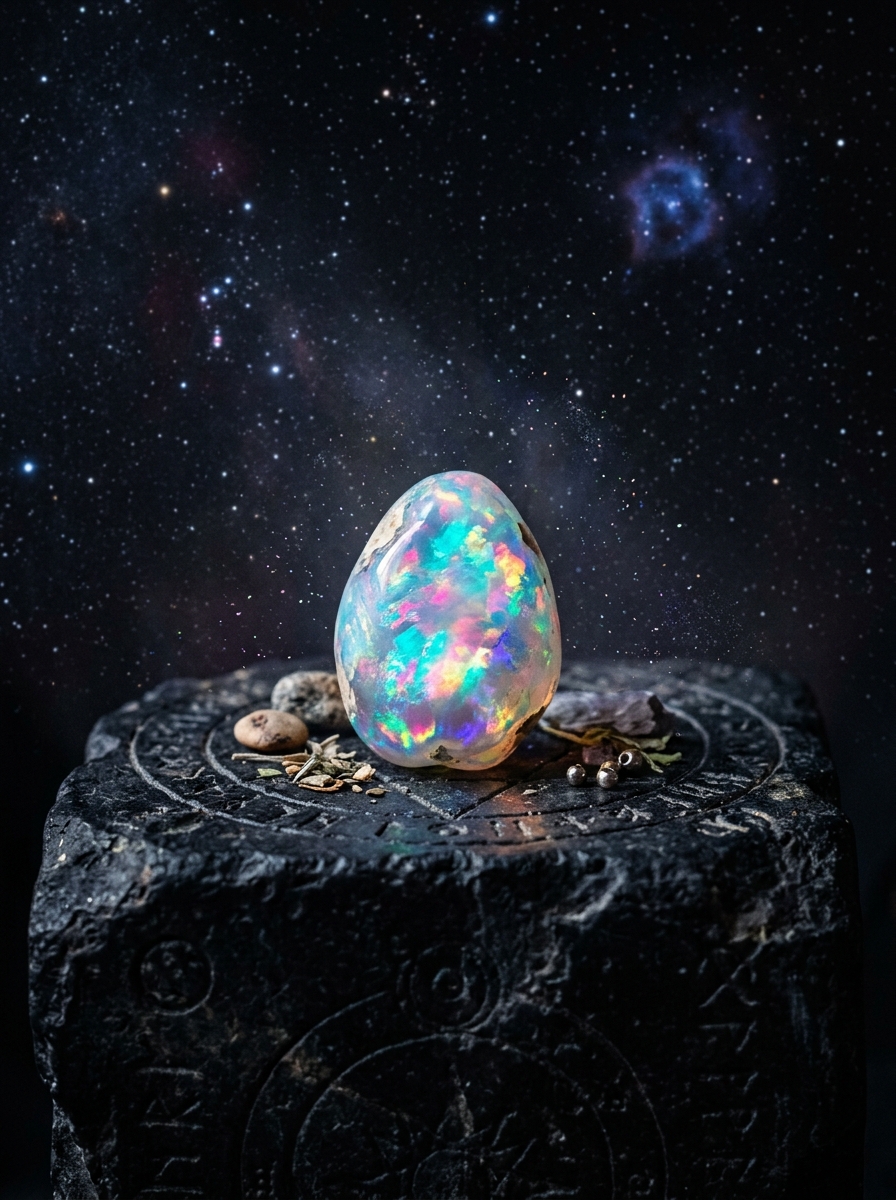
Opal is not a gem that delivers a single message. Its signature play-of-color — those drifting flashes of green, blue, red, and gold that appear to move across the stone as you turn it — makes it look less like a mineral than a weather system caught in quartz. That instability is not a flaw. It is the point. As October’s birthstone, opal symbolizes perception: changeable, refractive, emotionally alive, and impossible to flatten into one story.
Where most gems promise hardness and certainty, opal offers the opposite. It teaches that depth appears when light moves through matter, and that truth is not always identical to fixity. The stone has long been linked to intuition, imagination, and the volatile beauty of being human. It belongs to a month already charged with thresholds — when the year tilts toward shadow and the psyche becomes more porous to symbol. To wear opal is to carry a reminder that the self is not a locked shape but a living pattern.
Why opal feels lunar without being cold
Opal is often described as moonlike, and the comparison is apt if you understand the Moon not as sentimentality but as receptivity. Opal gathers and returns light; it does not generate blaze the way a ruby or diamond seems to. It reveals hidden spectra already present in the field. Psychologically, that makes it a stone of inner mirroring. It is associated with self-recognition, but not the flattering kind. Opal can show the mask and the face beneath it in the same glance.
That is why it has been adored by mystics, artists, and lovers of ambiguity. It does not resolve tension; it renders tension luminous. In a culture that often mistakes clarity for truth, opal suggests a subtler wisdom: some realities only disclose themselves when they are seen obliquely.
A History of Desire, Superstition, and Projection
Opal’s reputation has always swung between reverence and suspicion. In antiquity, it was prized for containing several gemstone virtues at once: the red of garnet, the green of emerald, the blue of sapphire, all apparently united in one body. That visual abundance made it a symbol of totality, abundance, and unpredictable fortune. Later centuries complicated that glamour with fear.
The superstitions are historically revealing. A gem that changes in the light can look innocent one moment and uncanny the next, and human beings have always had mixed feelings about things that won’t stay legible. In the Roman world, opal was admired as a treasure of rare synthesis — a stone that could not be easily categorized made perfect aristocratic sense. By the Victorian period, that same volatility became a canvas for dread. Popular fiction and changing tastes in gemstone symbolism painted opal as a stone of bad luck, loved for its singularity and blamed for its capacity to unsettle expectations.
How Australia changed the modern story
Modern opal history cannot be told without Australia, now the source of much of the world’s finest opal. The discovery and commercialization of major deposits transformed opal from a rare curiosity into a globally recognized birthstone. Australian opal — white, crystal, black, boulder — expanded the gem’s visual vocabulary and gave it a new geological authority. It was no longer merely the jewel of courtly taste or folklore; it was a modern stone with deep earth credentials.
This matters symbolically. Opal’s standing today is not based on old superstition alone, but on a recognizable material reality: silica spheres arranged in microstructures that diffract light. In other words, opal’s magic is not the denial of science; it is science behaving in a way that still feels enchanted. The stone has shed its bad-luck reputation precisely because we now understand the physics of its beauty — and because we have learned to value complexity over simple associations.
What Opal Symbolizes: Identity Under Transformation
Opal’s core symbolism is not “mystery” in the generic sense. It is identity under transformation. Where some stones symbolize strength through consistency, opal symbolizes truth through changeability. The stone’s color-shifting quality is crucial here. Opal does not present one fixed hue; it reveals a range that depends on angle, motion, and light source. That is an elegant metaphor for inner life. We are not singular objects viewed from a distance; we are relational beings whose meaning changes with context.
In metaphysical traditions, opal is often associated with heightened feeling, dreams, and the permeability of the emotional field. That association makes sense because the stone seems to externalize sensitivity. It can feel intimate, almost skin-like. This is not the stern architecture of a talisman meant to repel; it is a resonant surface meant to register subtle shifts. Opal is frequently linked with tenderness, desire, grief, and creative vulnerability. It is the gemstone equivalent of a nervous system that notices too much — and, at its best, turns that sensitivity into art or discernment.
Opal and the shadow
There is also a Jungian angle worth naming. Opal belongs to the family of symbols that expose the shadow not as evil, but as what the conscious personality has not yet integrated. The stone’s shifting fire can suggest the movement of the unconscious — brief illuminations, surprises, contradictions, the self as more than its public profile. Opal does not demand confession; it invites revelation. That is why it often speaks to people who are learning to tolerate ambiguity in themselves. If you are trying to become more authentic, opal is not about arriving at one polished identity. It is about making peace with the fact that the psyche is stratified, and that wholeness may look less like uniformity than coherence among differences.
The vulnerability that mirrors meaning
Opal is not a hard, indestructible gem in the psychological fantasy sense. It is relatively soft and sensitive to care, heat, and dehydration. That fragility is not incidental; it echoes its meaning. A stone that looks like trapped light must be handled with respect. The metaphor is almost too perfect: what is most alive is often most delicate. This is one reason opal is so compelling as a birthstone. It refuses the old moral equation that toughness equals value. Instead, it suggests that responsiveness, nuance, and permeability are forms of strength too. The stone’s care requirements become part of its spiritual logic: to love opal is to accept maintenance, attention, and patience as part of beauty.
The Season That Demands Adaptation
October is a month of thresholds. The air changes, light shortens, and the emotional atmosphere often becomes more introspective. That seasonal context helps explain why opal feels so exact as October’s birthstone. It suits a month in which surfaces thin out and the world begins to look symbolic again. Opal does not belong to the blunt certainties of midsummer; it belongs to the reflective intelligence of autumn.
In practical terms, opal comes in several important varieties, each with a distinct visual and symbolic character. White opal tends to read as airy, soft, and diffuse. Black opal — among the most prized — creates a dramatic contrast that intensifies the color play and can feel more nocturnal, more uncompromising. Crystal opal offers translucence and depth. Boulder opal incorporates matrix rock, giving the gem a more grounded, earthy presence. These are not merely market categories; they are different expressions of the same archetypal principle: light revealing itself through matter under different conditions.
How it plays out in a life
Opal’s symbolism shows up in love as a demand for emotional honesty rather than fixed roles — relationships with opal energy require the willingness to see your partner anew each day. At work, it favors roles that reward intuition and creative adaptation over rigid procedure. A person drawn to opal may find themselves in careers that involve translation, art, counseling, or any field where nuance matters more than rulebooks. The stone does not promise stability; it promises depth. That can be disorienting for someone who craves predictability, but liberating for someone ready to trust their own perceptions.
The stone’s influence is especially potent during periods of reorientation — revising an identity, grieving a lost form of certainty, trying to trust perception again after disillusionment. Opal says that shift itself is not failure; it may be the place where meaning enters. October, with its descending light, embodies the idea that descent is not diminution. Autumn light is lower, but it is also stranger, and sometimes more revealing. Opal belongs to that hour.
Why Opal Still Matters Now
Modern life is full of surfaces that are technically polished and spiritually flat. Opal interrupts that flattening. It offers depth that changes with the angle of attention — exactly what contemporary consciousness often lacks. The stone has become especially resonant in an age that values personal branding, because branding tries to fix identity while opal insists on its evolution.
That makes opal more than a pretty talisman. It is a reminder that opacity and transparency are not opposites. We can be legible and mysterious at once. We can change and remain ourselves. We can hold contradiction without becoming incoherent. As a gemstone, opal does what good symbols do: it makes a difficult truth visible without simplifying it.
For October, that truth is seasonal as well as psychic. The month does not ask for mastery; it asks for adaptation. Opal answers with iridescence instead of certainty, and in doing so it gives October its most fitting jewel: a stone that shines because it moves.
Related
- Topaz in November: Meaning, History, and the Fire Beneath the Calm
- August Birthstone Peridot: Meaning, History, and Symbolism
- Amethyst in February: The Violet Stone of Clarity, Devotion, and Night Vision
- June Birthstone: Pearl Meaning, History, and Symbolism
- Peridot Meaning: The Green Fire of Renewal
Comments
Loading comments…