June Birthstone: Pearl Meaning, History, and Symbolism
What the Pearl Is — and What It Is Not
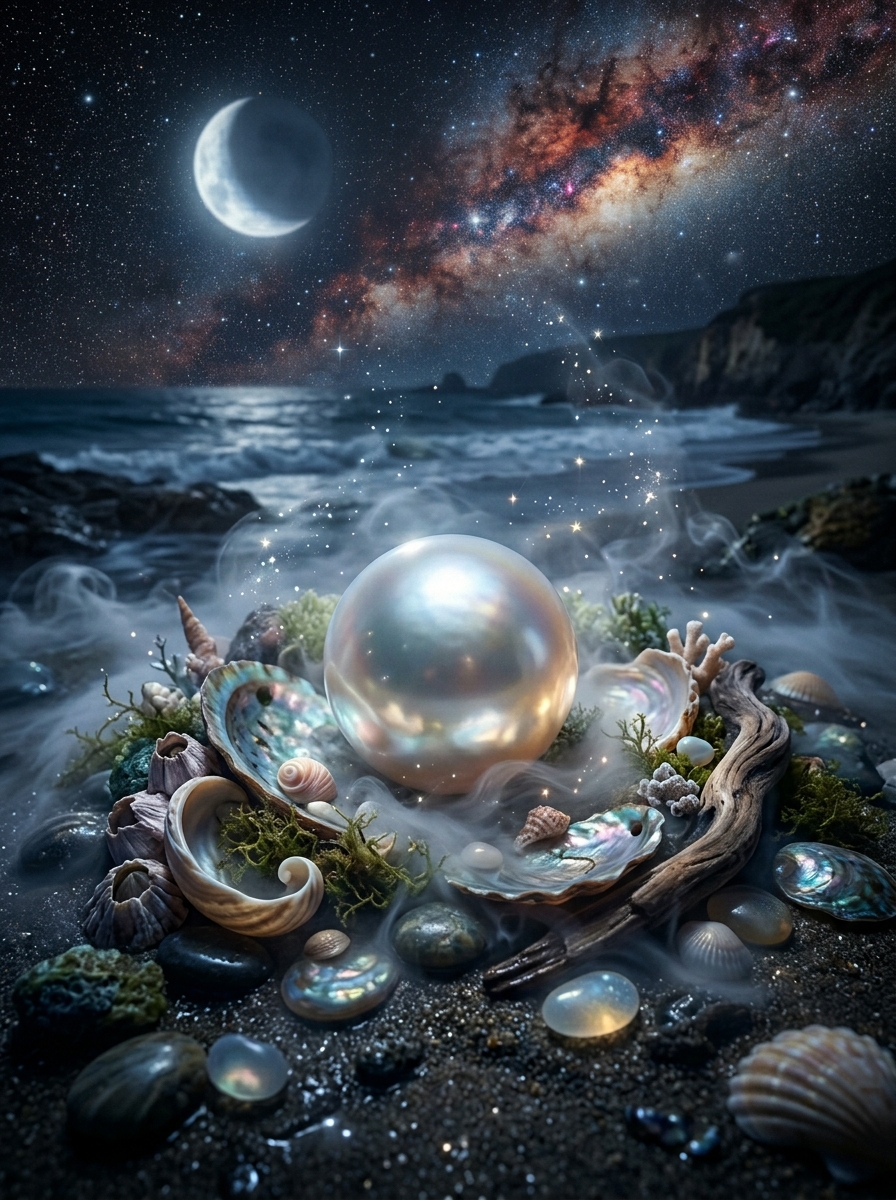
The June birthstone, pearl, is not mined, cut, or coerced into brilliance. It is grown. That fact is the entire origin of its symbolic weight. Where other gems are born from pressure in deep geological time, the pearl is born from a living organism’s response to intrusion — a slow, concentric layering of nacre around an irritant that could not be expelled. The result is not a mineral but an organic secretion, luminous and closed. The pearl does not advertise power like a diamond; it suggests power that has learned composure.
This is why the pearl has always belonged to the Moon family: reflective, receptive, sealed, and quiet. For readers who track the lunar influence in astrology, the pearl behaves like a perfect emblem of the receptive principle — not passive, but responsive in a way that builds structure from vulnerability. Its lesson is not the crude cliché that pain makes beauty. The more exact lesson is that tenderness can become form without losing its sensitivity. That is a distinct kind of intelligence, one the Cancer sign (which rules the June solstice) embodies instinctively: protective, memory-rich, emotionally tidal. The pearl fits that field perfectly. It is the feeling body that does not harden into armor but does develop shape.
The Core Dynamic: Inward Luxury
A pearl holds light inside its own rounded depths rather than throwing it outward through faceted geometry. That optical behavior mirrors its psychological signature: the person drawn to the pearl is not seeking external validation or conquest. They are seeking coherence — the kind that comes when outer presentation finally matches inner life. This is why the pearl endures as a birthstone in an age of flash. It offers an alternative to conspicuous brilliance, a reminder that some of the most precious things in a psyche are the ones that took time, patience, and the right kind of containment to form.
How the Pearl Becomes What It Is — and Why That Matters
The formation process is the key to the pearl’s meaning, not a decorative origin story. Inside a mollusk, layers of nacre accumulate around an irritant — a grain of sand, a parasite, a fragment of shell. The creature cannot eject the intruder, so it coats it, again and again, until the once-hostile particle is transformed into a smooth sphere of iridescent light. This is not endurance; it is metabolism. The pearl does not simply tolerate the irritant; it integrates it.
That distinction is crucial for anyone working with pearl as a symbol of emotional maturity. Many gems are born from pressure — diamonds from carbon crushed under the earth’s crust, rubies from aluminum oxide baked in metamorphic rock. The pearl is born from a different kind of pressure: not geological but biological, relational. It is wound tissue made luminous. In psychological terms, the pearl represents the ability to receive an intrusion — a loss, a betrayal, a wound — and, over time, organize around it into something beautiful without erasing the scar. Emotional containment is the technical name for this capacity, and it is the pearl’s true gift.
Natural vs. Cultured: The Collaboration
Historically, natural pearls were so rare that they ranked among the most valuable objects on earth. Today most pearls are cultured — a nucleus is introduced deliberately, and the mollusk does the rest. This is not “fake”; it is a human-assisted version of the same biological process. The symbolic implication is worth sitting with: beauty can be invited, not only found. The pearl does not require a story of brutal accident to be meaningful. It requires conditions, time, and the correct kind of containment. That makes it a more generous symbol than the romance of suffering suggests. As explored in our guide to emotional boundaries, the healthiest response to an irritant is not to pretend it doesn’t hurt but to begin the slow work of nacre — to layer understanding around the wound until it becomes part of the self’s luster.
The Pearl’s Historical and Elemental Lineage
Pearls have been prized for millennia because they are so difficult to produce and so immediately recognizable. Before cultivation, they were gathered at real risk — deep dives, unpredictable currents, the constant threat of drowning. Their scarcity made them royal treasure, diplomatic gift, and portable wealth. In antiquity, pearls were associated with the sea’s volatility, with fertility, with Moon phases, and with the kind of divine favor that comes from the unseen depths. They sat at the crossroads of elegance and restraint: luminous, but never loud.
In European history, pearls became especially tied to courts, chastity, and inheritance — a visual code that still signals polish and formal self-command. Yet their older symbolism is more nuanced than mere refinement. Pearls have also been connected with tears and mourning. A strand of pearls can feel celebratory, but it can also feel like grief made wearable. This dual valence — joy and sorrow, celebration and remembrance — comes straight from the pearl’s oceanic origin. The sea is depth, concealment, fecundity, and danger. The pearl, emerging from that domain, carries the paradox of something secret becoming visible without losing its secrecy.
Lunar and Cancerian Affinities
The Moon governs tides, dream states, emotional memory, and the invisible rhythms that shape the inner life. The pearl, born in water, is the Moon’s material echo. This is why pearl lore so often overlaps with themes of hidden treasure, virginity, and wisdom — not as outdated clichés but as metaphors for protected depth. For readers familiar with our feature on Cancer’s emotional memory, the connection sharpens. Cancer is the sign of shelter, lineage, and the feeling body; the pearl is its perfect birthstone because both are shaped by what they can bear while remaining intact. The pearl does not deny vulnerability. It organizes around it.
The Shadow Side and the Mature Expression
Every symbol casts a shadow, and the pearl’s shadow is idealization. Because pearls are associated with purity, elegance, and softness, they are easily pressed into service for projections — especially expectations around compliance, innocence, or polished femininity. That is a distortion. The pearl is not passive; it is the residue of a defense and a negotiation. The creature that made it did not submit; it responded.
There is also literal fragility here. Pearls are softer than many gems, susceptible to acids, abrasion, and neglect. Symbolically, that matters too. The pearl reminds us that sensitivity is not weakness, but it does require care. A life organized around exquisite feeling cannot be handled carelessly and remain luminous. The shadow of the pearl is the temptation to present a flawless surface while concealing the work of nacre — the grit that never disappeared, only got layered over. The mature expression, by contrast, is emotional containment without repression: the ability to hold tension internally without turning it into noise, to let experience leave a mark without letting it become a wound only.
How Pearl Plays Out in a Life
Because the pearl’s dynamic is relational rather than conquering, it is especially suited to threshold moments — weddings, funerals, rites of passage, any transition where something vulnerable needs to be acknowledged without being overexposed. In jewelry, pearls sit close to the skin, creating a small field of lunar light on the body. That proximity makes them powerful for ceremony and for daily reminders of one’s own inner work.
In relationships, the pearl archetype asks: can you hold another person’s irritant — their pain, their shadow — without becoming hard? Can you let it coat you over time into something more beautiful rather than something more armored? In career and creative life, the pearl favors slow integrity over quick results. It is not a stone for hustle culture. It is a stone for anyone who knows that the most important formations happen in stillness, under pressure, over years.
For metaphysical use, treat the pearl as a meditation on boundaries. Place it on the throat or heart; hold it during reflection on a persistent irritant — a relationship dynamic, a grief, a creative block — and invite the nacre process. Not to erase the pain, but to see what it might become if you let yourself sit with it long enough.
Color, Luster, and Variation
White pearls carry the classic meanings of clarity and formal grace. Black pearls feel more sovereign and internally complex, often associated with mystery and hidden depth. Gold pearls suggest a marriage of solar and lunar energy — abundance balanced with receptivity. Pink pearls lean softer, more affectionate, emotionally intimate. What unites all of them is luster: the way light seems to move within the pearl rather than bouncing off its surface. That shifting quality makes pearl unusually good for work with self-perception. It says identity is not static. It is layered. You do not become yourself by hardening into a single color; you become yourself by learning how to hold light differently.
The June birthstone endures because it captures a paradox people still need: how to become more beautiful without becoming less protected; how to transform irritation without romanticizing pain; how to let experience leave a mark without letting it become a wound only. The pearl does not promise a life without intrusion. It offers a more interesting possibility — that what enters the self can, in time, be made into something that shines.
Related
- October Birthstone: Opal and the Art of Living in Color
- Emerald for May: The Birthstone of Green Fire, Love, and Clear Seeing
- Amethyst in February: The Violet Stone of Clarity, Devotion, and Night Vision
- August Birthstone Peridot: Meaning, History, and Symbolism
- March Birthstone Aquamarine: Meaning, History, and Symbolism
Comments
Loading comments…