Emerald for May: The Birthstone of Green Fire, Love, and Clear Seeing
The Living Paradox
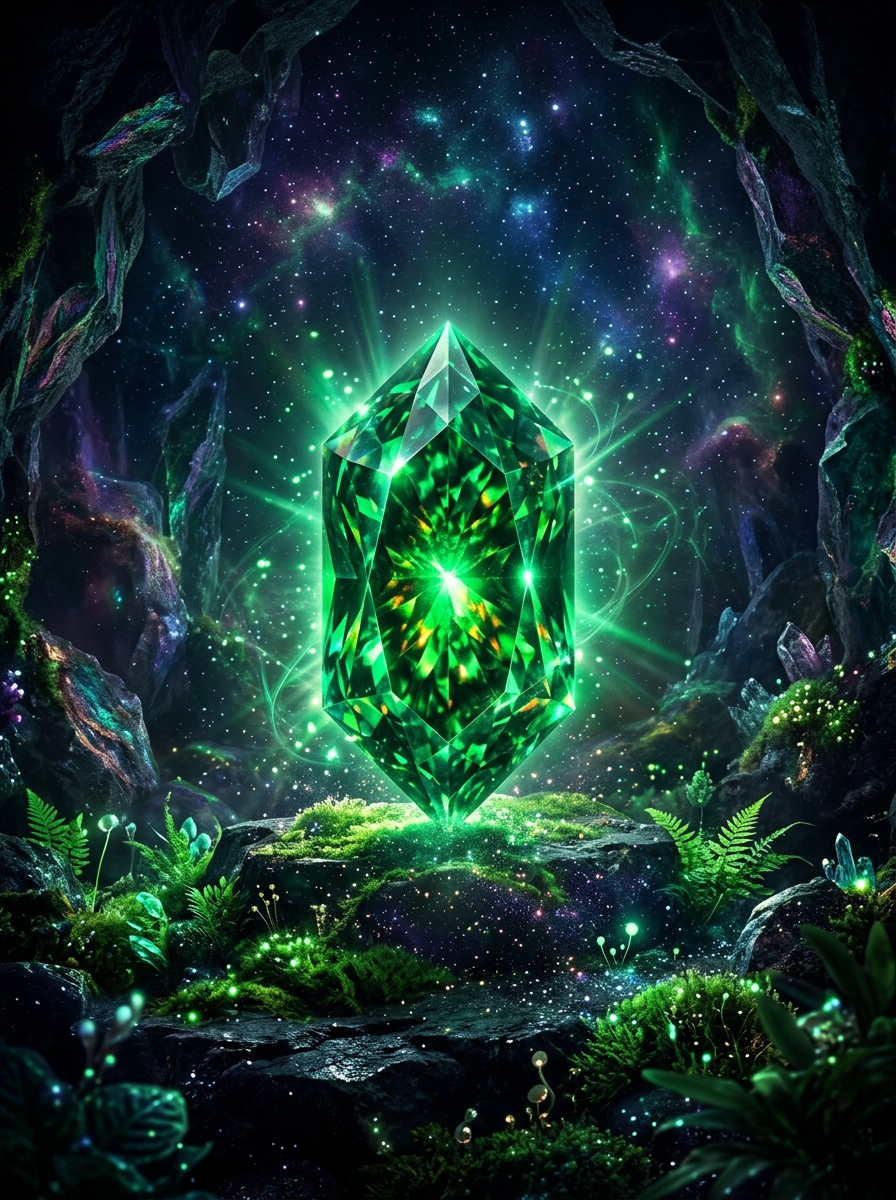
Emerald is May’s birthstone not because it is green, but because its green comes with a built-in contradiction. The stone looks like a compressed leaf, as if the earth had crystallized chlorophyll into a mineral that still remembers how to grow. Yet that lushness is paired with an exacting demand: see clearly. Love without illusion. Prosper without grasping. The paradox is its power. Emerald belongs to the threshold month when spring tips into fullness but has not yet surrendered to summer’s excess—a season of expansion that still requires structure.
The core thesis of this gem is simple but easily sentimentalized: Emerald is a stone of love that refuses to be blind. It does not ask you to love more; it asks you to love with open eyes. That is a harder discipline than it sounds, and it is the reason the stone has survived as a talisman for thousands of years. The human heart tends to conflate intensity with truth. Emerald separates them.
The Ancient Inheritance
The ancient world prized Emerald not for rarity alone—though that helped—but because green stones seem alive. The human eye is wired to respond to green as the color of vegetative life, and Emerald capitalizes on that biological reflex. But the civilizations that first mined and wore it quickly layered on meanings that went deeper than biology.
In Egypt, Emerald was linked to fertility, rebirth, and the royal line. Cleopatra’s famous collection was less about adornment than about symbolizing sovereignty over desire and renewal. The stone was understood as a tool of the ruler who could see through deceptions, both political and personal. That tradition of Emerald as a stone of truth-telling and foresight carried into the Greco-Roman world and then into medieval lapidaries. By the Renaissance, Emerald was prescribed for improving memory, detecting betrayal, and even protecting chastity—a curious assignment for a gem so often associated with passion. The contradiction is instructive: the stone’s green fire was never about indulgence. It was about desire kept honest.
What changed over time was not the gem’s meaning but its audience. The modern birthstone system democratized Emerald, turning it from a regal emblem into a personal one. Yet the underlying logic remains: to wear Emerald in May is to inherit a tradition that refuses to let love or prosperity become naive. The stone is a filter for self-deception.
The Psychology of Clear-Seeing Love
The reason Emerald resonates so strongly with modern metaphysics is that it addresses a psychological wound that most gemstones ignore. People who love deeply often struggle to distinguish devotion from delusion. The heart chakra is not a diffuse openness; it is a calibrated center that must hold both vulnerability and boundary. Emerald is the stone that makes that calibration tangible.
The Venusian Logic
Classical astrology places Emerald under Venus, which is often flattened into prettiness. In fact, Venus governs attraction, value, reciprocity, and the capacity to discern what is worth keeping. As discussed in the Venus article on Aurora Arcana, this planet does not ask whether something is appealing; it asks whether it is truly valuable to you. Emerald crystallizes that question. It is a stone for people who need to know whether their love is real or projected, whether their prosperity is earned or borrowed, whether their growth is rooted or hollow.
The Heart Chakra in Practice
When we say Emerald is a heart-chakra stone, we mean something specific. The heart chakra is the midline between the lower instinctual centers and the upper conceptual ones. It translates raw desire into informed commitment. Emerald supports that translation by making the user feel the weight of their choices. It does not facilitate easy flow; it facilitates honest flow. For a detailed look at how this works with other green stones, the heart chakra page explores the spectrum from rose quartz to emerald.
The shadow side of this dynamic is equally important. Emerald can amplify the tendency to overidealize a partner or a project if the wearer is not ready to face what they see. The stone’s clarity is not gentle; it reveals the difference between what is alive and what is merely green. That is why Emerald is sometimes avoided by those who prefer fantasy to discernment. The stone is not cruel, but it is exacting.
Emerald in a Life
The real test of any symbolic stone is whether it changes how you navigate actual situations. Emerald has practical applications that flow directly from its paradoxical nature.
Relationship Discernment
In partnerships, Emerald asks a single question: Can you love this person without editing their reality? The stone undermines the fantasy of the perfect partner. It prefers the flawed, loyal, complicated bond that has been tested over time. This is why Emerald has historically been used in wedding jewelry—not to bless romance but to bless commitment. If you are choosing a ring for a May-born partner, consider whether the relationship can survive clear seeing. If it can, the gem will support it.
Self-Worth and Stewardship
Emerald also governs how you treat your own resources. Its green signals fertility, but not infinite abundance. In the Taurus archetype, the earth’s slowness respects growth that takes time. Emerald encourages stewardship—protecting what you have built rather than constantly expanding. That applies to money, energy, emotional reserves, and even creative output. The stone’s lesson: do not confuse flourishing with overextension.
The Shadow: Rotten Green
Every symbol has a shadow, and Emerald’s is the refusal to change when change is necessary. The stone’s love of structure can curdle into rigidity. A relationship that no longer serves may be held together because clear seeing has become seeing only the flaws. Emerald in its shadow form is the partner who analyzes every miscue instead of feeling the connection. It is the business owner who clings to a failing venture because it should work. The antidote is the gem’s own message: clarity without compassion is as distorting as love without sight.
The Symbolic Constellation
Emerald does not sit alone. Its meaning deepens when placed alongside other symbolic structures.
The Astrological Resonance
Beyond Venus, Emerald has a natural affinity with Libra and Taurus. Taurus grounds the stone’s materiality and patience; Libra refines its aesthetic and relational intelligence. For May-born individuals who also have strong Libra or Taurus placements, the stone acts as a kind of anchor—keeping the scales balanced without losing pleasure. The Libra profile elaborates on that need for harmony that is neither weak nor vacillating.
The Tarot Kin
In tarot, Emerald aligns most closely with The Empress, who embodies creativity, fertility, and the kind of abundance that comes from tending. The Empress does not control growth; she nourishes it. Emerald supports that same posture. It also harmonizes with the Two of Cups, where mutual recognition replaces projection. Both cards teach the same lesson: love is a craft, not a surrender.
The numerology of May—the fifth month—adds another layer. Five is the number of movement, change, and experiential learning. Emerald counterbalances that restlessness with rootedness. The month asks you to expand; the stone asks you to expand with integrity.
Choosing Emerald Now
To wear Emerald today is to participate in an argument about what beauty means. The finest emeralds are never flawless; they contain inclusions that gemologists call jardin—French for “garden.” Those internal marks are not defects; they are evidence of the stone’s formation under pressure. Emerald’s message is that imperfection is not the opposite of worth. Vitality, depth, and coherence matter more than a surface that has been polished into transparency.
For anyone born in May, or for anyone drawn to the stone, Emerald is a reminder that love and discernment are the same muscle used differently. The heart that sees clearly is not a cold heart. It is a heart that has learned to keep its fire under discipline—green, alive, and unwilling to lie about what sustains life.
Comments
Loading comments…