August Birthstone Peridot: Meaning, History, and Symbolism
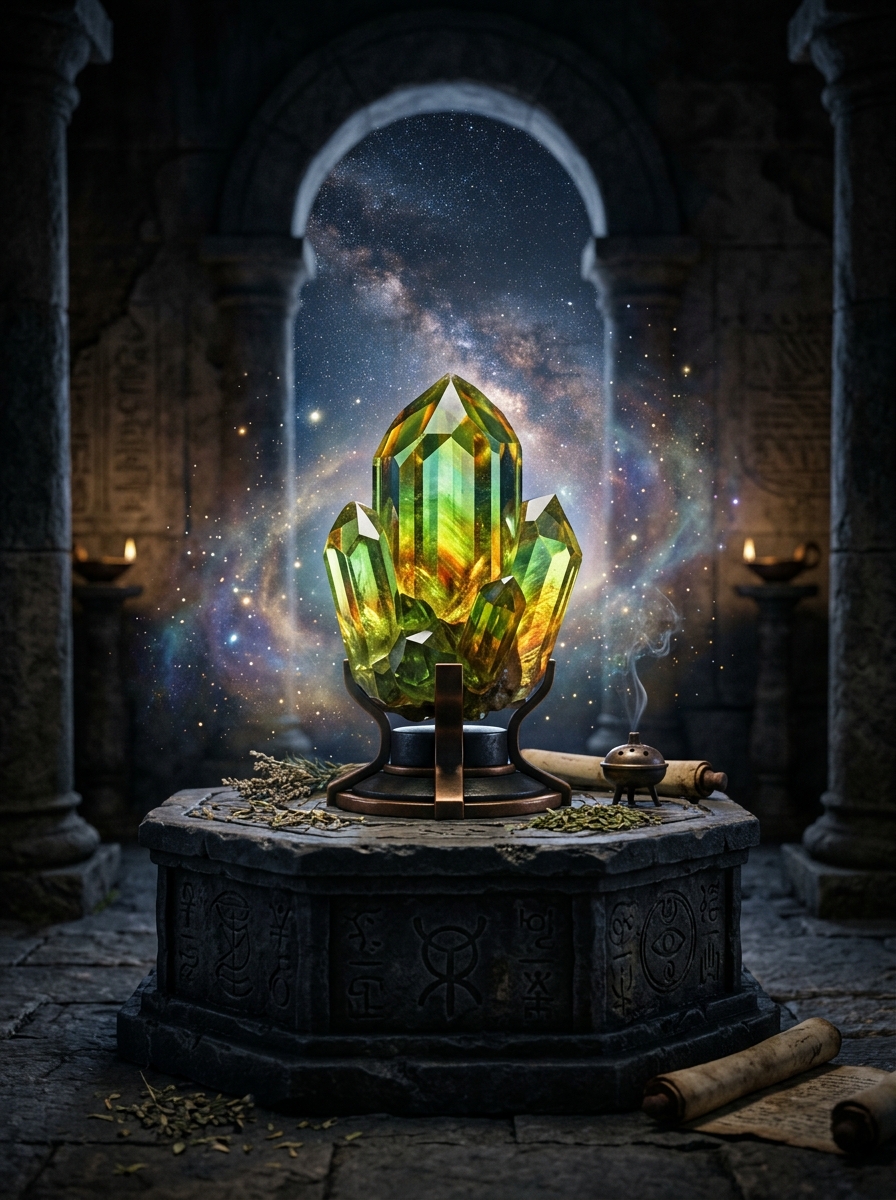
Peridot is August’s birthstone because it holds the month’s central paradox: late-summer brilliance without the weight of summer’s heat. Its green is not deep, forested, or moody; it is lucid, sunlit, and slightly volatile, as if color itself had been caught mid-transformation. That quality explains its old reputation. Across cultures, peridot has been treated less as a decoration than as a stone of release — of haze, envy, fear, and the static that clings to the psyche when life has become too enclosed.
The Core Dynamic: Calm Radiance
The essential meaning of peridot is clarity that remains alive. Unlike stones whose symbolism leans toward solemnity or depth, this gem suggests an active, outward-facing intelligence. It does not invite withdrawal; it sharpens attention. The ancient association with the sun is not accidental. Peridot has a brightness that seems to originate from within the crystal structure itself, so the stone reads as energized rather than merely colored.
That matters symbolically. Green is often associated with growth, healing, and the heart, but peridot is a more specific kind of green: it is the green of a leaf caught in direct light, the green of late season abundance, the green of something healthy enough to let go. In a psychological reading, that makes the stone a good emblem for separating what is vital from what is simply familiar. Peridot does not represent possession; it represents circulation.
A green that does not hide
The color is crucial. Many green stones feel dense, secretive, or subterranean. Peridot is transparent enough that light participates in its meaning. That transparency has made it a traditional symbol of protection against spiritual fog, jealousy, and confusion. In modern terms, one could say peridot favors clean perception: the ability to see an attachment, a habit, or a self-deception without immediately colluding with it.
This is why the stone often feels emotionally refreshing rather than merely beautiful. Its symbolism is not about sentimental comfort. It is about restoring a person to themselves. If the heart is the organ of attachment, peridot is the mineral of discernment inside attachment — the part of love that knows the difference between devotion and dependency.
The August temperament
August is not a soft month. It carries the fullness of summer, but also the first inward tilt toward harvest and the end of the season’s excess. Peridot fits that threshold perfectly. Its lightness is not naïve; it is the lightness of something that has survived intensity and come back lucid. That is why the stone feels relevant to people born in August even beyond custom. It speaks to warmth with boundaries, generosity without depletion, and vitality that has learned how to cool itself.
How It Forms: Volcanic Origins and Royal Confusion
The history of peridot is unusually rich because the gem was valued long before mineral science gave it a stable identity. For centuries, people used different names for green stones, and peridot was often confused with emerald or topaz. That confusion does not diminish its history; it reveals how powerfully the stone was perceived. It was important enough to be mistaken for rarer gems and luminous enough to attract myth before taxonomy.
One of the most famous historical sources of peridot was the volcanic island of Zabargad in the Red Sea, known in antiquity for producing the gem. Egyptian miners extracted stones from an unforgiving landscape, which only deepened the aura around them. The gem’s origin in harsh terrain became part of its meaning: beauty emerging from a place that seems almost designed to deny it. That contrast still shapes how peridot reads symbolically. It is not a passive gift of paradise; it is a brightness wrested from stone, heat, and pressure.
Cleopatra’s stone, or so the story goes
Peridot is often linked to Cleopatra, though historical certainty is thinner than the legend. The association persisted because the gem’s green glow naturally invited a regal, solar mythology. Whether or not Cleopatra wore peridot, the stone’s reputation aligns with the kind of authority ancient queens and priestly elites were said to command: radiant, protective, and not easily crossed. That is part of the gem’s enduring appeal. It implies not just beauty, but sovereignty.
The medieval imagination extended that lineage. Peridot was sometimes set into church objects and ritual regalia, where it was believed to ward off evil spirits and night terrors. Its luminous quality made it feel like a captured fragment of daylight, and daylight was not merely visual; it was moral. To possess peridot was, in a symbolic sense, to keep darkness from settling too deeply.
Confusion, correction, and the gem’s real identity
For centuries, many famous “emeralds” in religious and royal collections were later identified as peridot. That misidentification is more than a footnote. It says something about the stone’s emotional grammar: peridot can masquerade as more aristocratic gems, but it retains a different spirit. Emerald carries depth, secrecy, and the green of forests after rain. Peridot is cleaner, brighter, and more airborne. It belongs to a different symbolic family — one associated with airless sunlight, not shaded abundance.
When jewelers and collectors eventually separated peridot from lookalike stones, they did not strip it of mystery. They clarified its distinctness. That distinction is important because the stone’s power does not depend on being mistaken for something else. Its own identity is strong enough: a gem of the sun, but not fire; a green stone, but not earthbound; a protective talisman, but not a heavy one.
What It Protects: The Psychology of Clean Perception
If the first layer of peridot is historical and the second is aesthetic, the third is psychological. The stone’s symbolism has always clustered around emotional purification, but “purification” here does not mean perfection. It means making emotional life more permeable to truth. Peridot is associated with dissolving resentment, cooling possessiveness, and loosening the internal grip of self-criticism. Its green does not promise innocence; it proposes recovery.
This is where the stone becomes especially relevant in a contemporary spiritual vocabulary. Many people do not need more intensity. They need less congestion. Peridot symbolizes the kind of change that happens when a person stops trying to wrestle their feelings into obedience and instead lets the atmosphere clear. In that sense, it belongs to the ethics of honesty. It encourages clean self-regard: not inflated, not punitive, just accurate.
Protection without paranoia
One reason peridot has been used as a protective stone is that it seems to shield by clarification rather than by hardening. That makes it psychologically elegant. A brittle defensive system can keep harm out, but it also keeps life out. Peridot implies another model: remain open, but remain lucid. The protection it symbolizes is the ability to notice what drains you before you consent to it.
This distinction matters in any reading of the stone. Its power is not aggressive. It does not function like a barricade. It functions like eyesight. If you think of peridot as a lens, not a wall, its traditional uses make more sense. It has long been linked to banishing the “evil eye,” but on a symbolic level that can be read as resisting envy, projection, and the sticky social emotions that distort perception. Peridot helps a person return to their own center instead of living under someone else’s gaze.
Love, jealousy, and emotional hygiene
Because peridot is green, it inevitably brushes against the symbolism of the heart. But unlike stones that romanticize devotion, peridot asks for emotional hygiene. It is especially apt for the places where love becomes entangled with insecurity: jealousy, comparison, and the fear of not being chosen. The stone’s message is subtle but practical: love works better when it is not suffocating itself with surveillance.
That is why peridot often feels less like a charm for romance than a charm for relational maturity. It does not promise that every attachment will be easy. It offers the more useful skill of staying clear while attached. In a world of noisy feelings, that is a real spiritual discipline.
August and Leo: Solar Energy with an Earthy Body
As August’s birthstone, peridot is naturally linked with Leo season, and the fit is striking. Leo is ruled by the Sun, the center of identity, will, and creative radiance. Peridot echoes that solar force, but it tempers it. If Leo can sometimes lean toward performance, pride, or the need to be seen, peridot suggests the healthier version of solar power: confidence without inflation, visibility without vanity.
This is one reason the stone feels astrologically correct for August. Its color harmonizes with the season’s fullness, but its energy is not brash. It supports a Leo’s best gifts — generosity, warmth, creative courage — while quietly correcting the distortions that can accompany them. The Sun wants to shine; peridot reminds it to illuminate rather than dominate.
Solar energy with an earthy body
Although its symbolism is solar, peridot is not disembodied. It has the grounded mineral presence that keeps the image from becoming abstract. This gives the stone a useful duality: it is bright enough to carry solar associations, but solid enough to anchor them. In practice, that makes peridot feel appropriate for anyone who needs confidence that remains connected to reality.
Astrologically, that balance is more interesting than simple “luck.” The stone does not merely attract good outcomes. It sharpens the relationship between inner radiance and outer action. For a Leo, that means expressing selfhood with less drama and more authority. For anyone else, it means borrowing a little solar steadiness without becoming theatrically self-centered.
A quiet fit for fire signs
The strongest astrological correspondence is often stated too bluntly: peridot for Leo, full stop. But the deeper truth is that the stone’s medicine can matter to any fire sign facing burnout, impatience, or overexposure. Its green cools without extinguishing. That cooling is not a rejection of vitality. It is what allows vitality to last.
What Peridot Still Offers Now
The enduring appeal of peridot is that it answers a modern problem with an ancient image: how to stay bright without becoming brittle. Its history reaches from desert mining to royal legend; its symbolism moves from protection to emotional release; its astrological home in Leo season places it at the center of solar identity. Yet the stone never collapses into a single meaning. That complexity is part of its charm.
Peridot is, finally, a stone of useful radiance. It suggests that clarity can be warm, that protection can be light, and that the heart does not have to become darker in order to become wise. For August, that is exactly the right lesson: summer’s brilliance does not end in exhaustion if it learns how to breathe.
Related
- Peridot Meaning: The Green Fire of Renewal
- Emerald for May: The Birthstone of Green Fire, Love, and Clear Seeing
- October Birthstone: Opal and the Art of Living in Color
- Topaz in November: Meaning, History, and the Fire Beneath the Calm
- Ruby in July: The Birthstone of Fire, Blood, and Unblinking Desire
Comments
Loading comments…