Ruby in July: The Birthstone of Fire, Blood, and Unblinking Desire
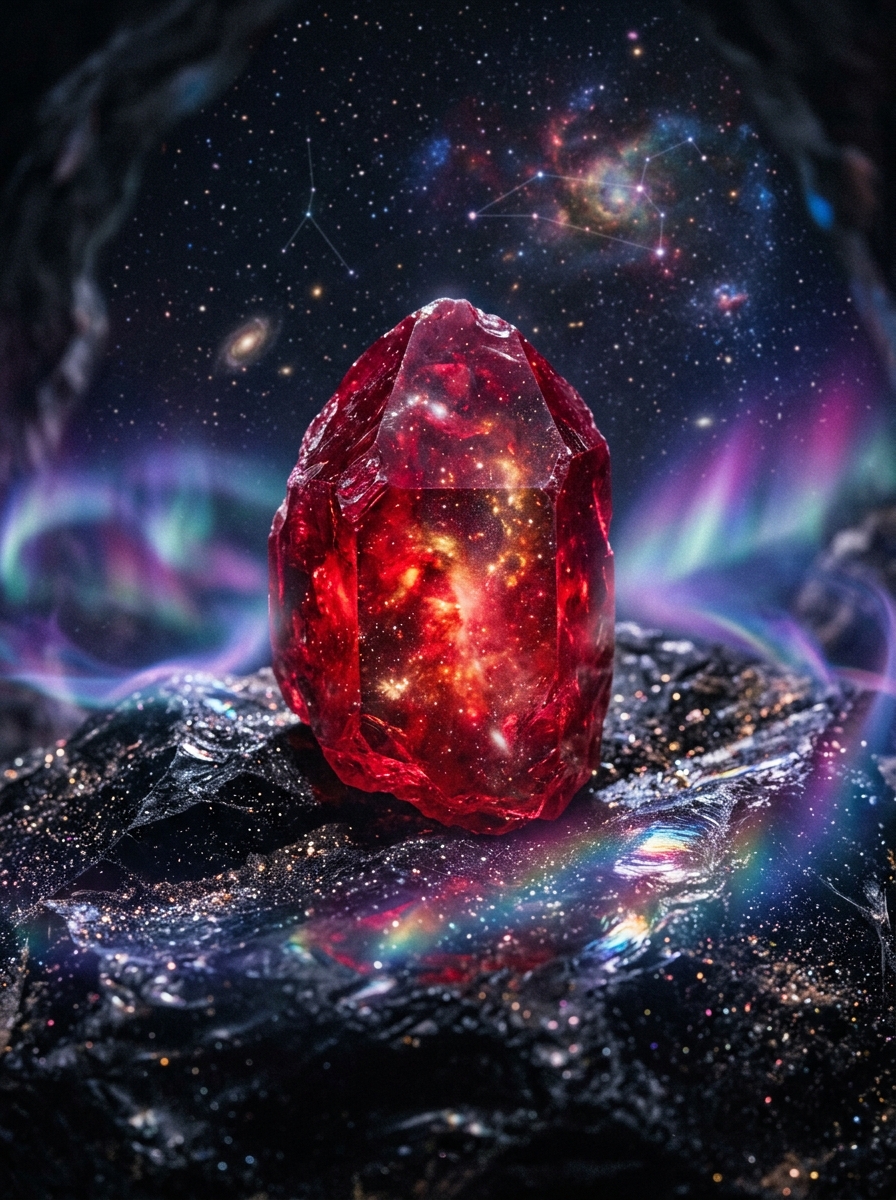
July Birthstone: Ruby
Ruby is July’s birthstone because it embodies the month’s central paradox: abundance sharpened into a single point of heat. Mid-summer is not a gentle season — it is the sun halted at its zenith, the air thick with ripeness and the threat of lightning. Ruby answers that energy directly. It is the gemstone of life force under pressure, of the heart that refuses to cool, of a will that has learned to burn cleanly rather than scatter. That is why it has been prized not as ornament but as omen: a stone that declares rather than suggests.
The core dynamic: heat that holds itself together
What makes ruby distinct from every other red stone is not merely its color but the way the color behaves. True ruby — the red variety of corundum — often exhibits fluorescence, a subtle inner glow that makes the stone seem self-illuminated. This is not a trick of the light; it is a property of the crystal structure under chromium. Symbolically, that self-generated radiance matters more than any gemological fact. It tells us that ruby’s authority comes from inside, not from reflected circumstance.
That is the core dynamic of the July birthstone: it is heat that does not consume itself. The stone is impossibly hard — 9 on the Mohs scale, second only to diamond — and that hardness is not incidental. It means the heat is contained, disciplined, durable. Ruby stands for vitality that has been forged rather than borrowed. It is the difference between a fever that destroys and a fire that sustains.
In symbolic terms, ruby belongs to the same psychic family as the heart, the royal seal, and the flame at the center of the hearth. It does not whisper. It does not negotiate. It demands to be seen, and it expects to last.
Why red is never neutral
Red is the color of consequence. It signals blood, life, danger, appetite, mating, battle, feast, and sacred rite — all at once. Ruby condenses that entire spectrum into a single object you can hold. In ancient and medieval worlds, red stones were often confused with one another — spinel, garnet, ruby — but that confusion did not weaken their symbolic power. It enlarged it. Red gems clustered in the imagination as stones of bloodline, nobility, and sacred force.
Kings wanted ruby because it looked sovereign. A ruby set into a crown or ring announced rank in a visual language everyone could read: the red suggested lifeblood, but also restraint over lifeblood — a ruler’s command, a warrior’s discipline, a priest’s burden. The stone was not merely admired; it was enlisted. In European and Asian courts alike, it acquired a reputation as a talisman for protection and success, associated with the health of kingdoms and the well-being of rulers.
That logic runs deeper than luxury. When a culture invests red with authority, it is usually because red concentrates what the culture fears and desires most — passion, danger, fertility, violence, and legitimacy. Ruby sits at that crossroads with unusual clarity. It does not soften the message.
The psychological architecture of ruby
Astrologically, ruby is linked to the Sun, and that correspondence is exact. The Sun signifies vitality, identity, radiance, purpose — the capacity to stand at the center of one’s own life. Ruby expresses those themes not through calm dignity but through concentrated brilliance. If the Sun is the principle of life itself, ruby is the moment life realizes it must be visible.
Solar organization, not ego inflation
The solar quality of ruby is often misunderstood as mere confidence or ambition. But the Sun does not merely inflate the ego; it organizes the psyche around a central truth. Ruby can symbolize that same organizing function. It gathers scattered energy and returns it to the core. That is why the stone has historically been carried by people who need to recover courage, clarity, or a stronger sense of self-possession — but it does not flatter identity. It tests whether identity is real.
A person aligned with the Sun is not performing brightness; they are inhabiting it honestly. Ruby provokes that honesty. It can awaken confidence, but it can also expose where confidence has been built on denial. In that sense, the stone has a corrective function. It does not approve; it illuminates.
The heart under pressure
Metaphysically, ruby connects to the heart — not the soft heart of sentiment, but the heart as the seat of courage, vitality, and moral choice. This is the organ that keeps beating when fear, grief, or fatigue would prefer otherwise. Ruby stands for love that does not dissolve under strain, for willingness to be vulnerable without surrendering one’s center.
That is why the stone has been used as a symbol of protection in battle and in affairs of the heart alike. It is not a charm for safety from harm; it is a charm for the stamina to meet harm and remain intact. The heart under pressure is the heart that has learned to burn steadily, not flare and gutter.
How ruby matures vs. how it goes shadow
Like any real symbol, ruby has a spectrum of expression. When integrated well, its energy manifests as vital presence, clear self-assertion, and the ability to love intensely without possessiveness. The person who carries ruby’s lesson can stand at the center of their own life without needing to dominate others. Their heat is contained; they do not scorch.
When the energy goes shadow, ruby becomes the stone of tyranny disguised as passion. The same insistence that should organize the psyche instead consumes it. Love becomes obsession. Confidence becomes arrogance. Protection becomes paranoia. The fire that was meant to sustain turns to ash.
The difference lies in whether the heat is held or scattered. A ruby’s hardness is a metaphor for that discipline: it is possible to be fierce without being cruel, to burn without burning out. The shadow ruby forgets the hardness; it mistakes heat for rightness. The integrated ruby remembers that containment is the price of endurance.
How the dynamic plays out in a life
Ruby’s energy is not abstract. It finds expression in specific domains — love, work, identity — but always through the same lens: heat that is either disciplined or destructive.
Love as a crucible
In relationships, ruby favors intensity over comfort. It is not the stone of easy affection; it is the stone of bonds that survive fire. Those drawn to ruby often find themselves in partnerships that demand full presence — no half measures, no emotional hedging. The danger is possessiveness; the gift is devotion that has been tested and proven.
Work as a proving ground
Professionally, ruby resonates with roles that require focused visibility — leadership, performance, advocacy, or any work where one’s vitality is the primary resource. The stone does not support passive careers. It insists on taking up space, on having a center that others can orient to. The shadow risk is burnout through over-identification with the role; the mature expression is sustainable authority.
Identity as a claim
Finally, ruby speaks to the act of becoming oneself. Every person has a core that must be claimed, often at the cost of comfort. The July birthstone symbolizes that claiming — the moment when life force stops hiding and starts declaring. It is not a gentle process, but it is an honest one.
Ruby is one of the few gemstones that appears to carry its own weather. It does not need to be polished into bland perfection; natural inclusions testify to its authenticity, and the stone is valued not for being flawless but for being convincingly itself. As a birthstone, it offers July-born people an anchor for their season’s intensity — but its appeal is broader. Ruby belongs to anyone who needs to remember that vitality is not a mood. It is a disciplined form of presence, the red center that stays intact.
Related
- August Birthstone Peridot: Meaning, History, and Symbolism
- October Birthstone: Opal and the Art of Living in Color
- Topaz in November: Meaning, History, and the Fire Beneath the Calm
- Garnet Meaning & Healing Properties: The Stone of Blood, Will, and Return
- Emerald for May: The Birthstone of Green Fire, Love, and Clear Seeing
Comments
Loading comments…