April Birthstone: Diamond Meaning, History, and Symbolism
The core dynamic: pressure made visible
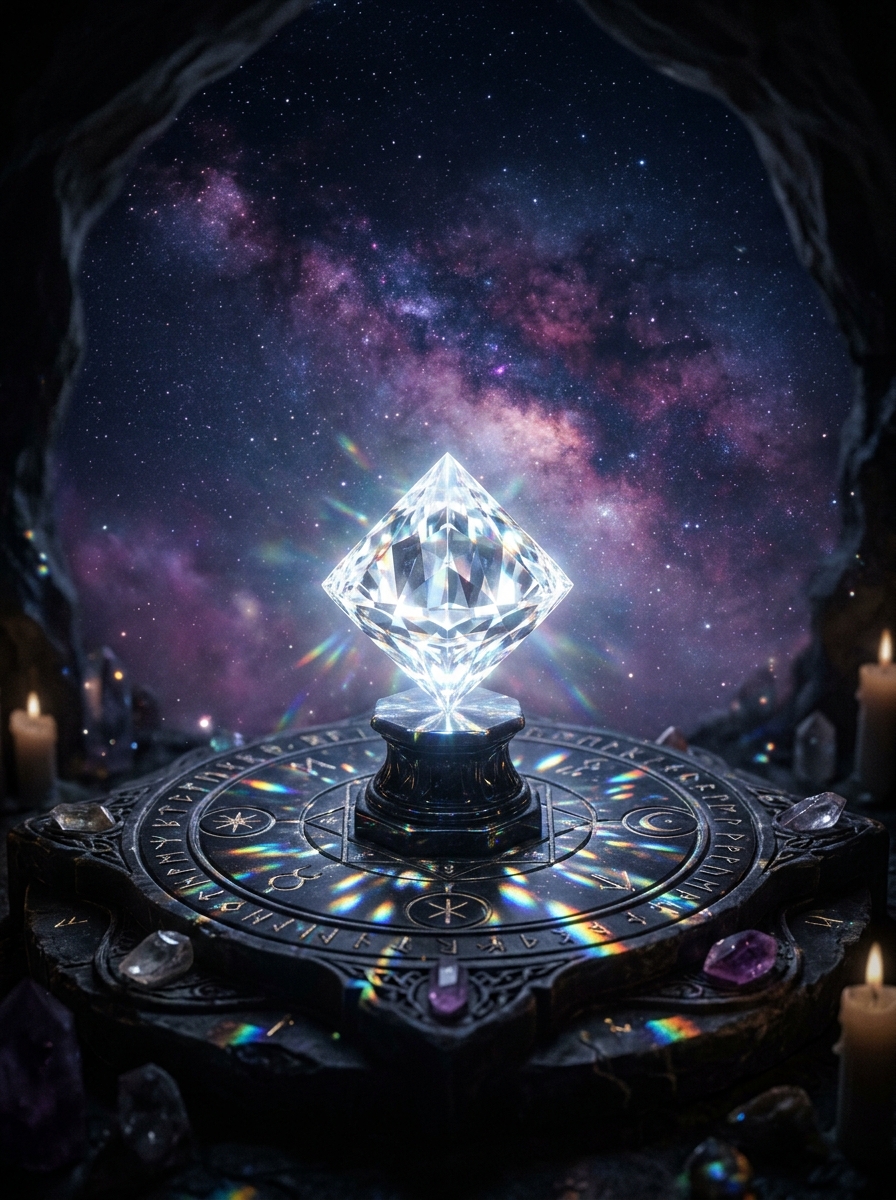
The Diamond is April’s birthstone because it embodies a single, exacting paradox: the hardest natural substance on Earth is also the clearest. This is not a decorative fact; it is the stone’s entire symbolic signature. Where other gems imply softness, mystery, or emotional depth, Diamond insists on structure that transmits light without dissolving. It does not soothe; it sharpens. That makes it the natural emblem for April, a month that sits at the threshold between winter’s residual cold and spring’s forceful emergence. The stone asks a question the season itself asks: what remains of a self when everything nonessential has been stripped away?
The answer is not comfort. It is precision. A Diamond under compression does not crack; it organizes carbon into a lattice that can bend light. Psychologically, that is an image of consciousness under strain — the mind that does not go opaque or scattered but instead becomes more lucid. April’s birthstone is therefore an archetype of earned brilliance. It does not promise ease. It promises that pressure can be metabolized into form.
How diamond forms: a geological metaphor for crystallization
The process that creates a natural Diamond is almost absurdly violent. Carbon atoms, buried more than a hundred miles beneath the Earth’s surface, are subjected to temperatures above 2,000 degrees Fahrenheit and pressures that would crush any weaker material. Over billions of years, that relentless environment forces carbon into its densest arrangement — a crystal so stable that it cannot be altered by ordinary heat or acid. Then, a volcanic eruption carries the stone upward, sometimes through miles of rock, before it cools into a deposit that humans can mine.
This formation story is the stone’s deepest symbolic layer. It tells us that Diamond is not a surface phenomenon. It originates in the kind of hidden extremity that most people never see, and it arrives in the visible world only after a catastrophic journey. The psychological parallel is exact: the traits we value most — integrity, clarity, resilience — rarely develop in comfortable conditions. They crystallize under the weight of what we cannot avoid.
Unlike many birthstones that are valued for color or rarity, Diamond is prized for its internal order. The rough stone looks ordinary, even dull, but once cut, its facets organize light into something almost mathematical. That is why the stone’s meaning is not about passion or sentiment. It is about alignment. The April-born person who feels drawn to Diamond is often someone who has learned to make adversity structural — to let pressure produce discipline rather than fracture.
Diamond in cultural history: from invincibility to vow
The word Diamond descends from the ancient Greek adamas, meaning “unconquerable” or “untamed.” That etymology preserves the oldest human intuition about the stone: it seemed to resist every attempt to damage it. Before modern gemology, Diamond was admired not only for beauty but for what looked like material invulnerability. Roman soldiers wore it into battle, believing it hardened courage. Medieval healers ground it into powders, hoping its indestructibility would transfer to the body. These beliefs were not random; they were symbolic extrapolations from physical fact. A substance that survives force becomes a metaphor for the self that wants to survive force too.
The stone’s cultural meaning shifted dramatically in the fifteenth century, when European lapidaries learned to cut Diamond with its own powder. For the first time, the rough crystal could be transformed into a symmetrical object of light. This technical breakthrough changed the stone from a symbol of raw endurance into a symbol of disciplined brilliance. The Diamond was no longer just undefeated; it was refined. That nuance matters because it introduced a new moral dimension: resilience alone is not enough. The resilient self must also be willing to be shaped, cut, and polished — to let its facets be made intentional.
The modern association with engagement and marriage is culturally recent but logically coherent. A Diamond ring marks a commitment that intends to survive time, scrutiny, and strain. It does not represent soft emotion; it represents a promise that will hold its shape under testing. That same logic makes it the perfect birthstone for April. The month is not gentle. It is the season of hard-earned growth. The Diamond says that value is not measured by ease but by what can endure clarity.
Why April and Aries belong with diamond
April is dominated by Aries, the zodiac sign of initiation, directness, and the first push. Aries does not hesitate; it strikes. Diamond shares that quality of immediate definition — but adds a corrective: the stone refuses to be scattered. Aries can burn too hot, rush into action without structure, and dissipate its force. Diamond introduces a counterbalancing discipline. It says: channel fire into form. The April birthstone is is not the gem of passive waiting. It is the gem of directed will.
The astrological relationship is not accidental. Aries rules the head, and Diamond is associated with the crown chakra in some metaphysical traditions — the center of higher awareness and self-command. The stone’s clarity mirrors the sign’s need for truth, but it insists that truth must be structured to last. An Aries personality without Diamond’s influence may be brilliant but brittle. With it, the drive becomes architectonic: the first move is followed by a shape that holds.
In elemental terms, Diamond behaves like an extreme of air and light — it transmits, refracts, flashes. Yet its origin is deep in the Earth, under crushing dark. That paradox is the heart of its appeal for April. The month’s emergence is not innocent; it is weathered. The brightness comes from a place that has known compression. The April-born person, like the stone, is not meant to remain hidden. The journey upward is part of the meaning.
How to read diamond now: wearing the archetype
Working with Diamond symbolically is not about accumulating sparkle. It is about accepting a demanding standard. The stone’s authority lies in its refusal to blur edges. If you wear Diamond — as jewelry, as a talisman, or simply as a focus for contemplation — you are not asking for softness. You are asking for definition. That can feel severe, especially in a culture that prefers comfort to clarity. But the stone’s gift is the opposite of comfort: it strengthens the part of you that can bear to be seen exactly.
Practically, Diamond works best at thresholds. Milestone birthdays, career transitions, the end of a long recovery, the start of a bond that requires true durability. In relationships, it is a stone of fidelity not because it is sentimental but because it does not bend. In work, it is a stone of integrity: the refusal to cut corners even when pressure mounts. In personal growth, it is the stone of uncompromising self-recognition — the willingness to let light expose what you prefer to keep in shadow.
The April birthstone does not teach escape from pressure. It teaches transformation under pressure. That is the lasting insight. The stone is not a luxury object first; it is a model of character. It says that what is most luminous may come from the most hidden place, and that real radiance has structure. If April is your month, Diamond offers a concise archetypal gift: be bright without being scattered, be strong without being opaque, and let your beauty come from what you have survived.
Related
- Ruby in July: The Birthstone of Fire, Blood, and Unblinking Desire
- Topaz in November: Meaning, History, and the Fire Beneath the Calm
- Emerald for May: The Birthstone of Green Fire, Love, and Clear Seeing
- October Birthstone: Opal and the Art of Living in Color
- January Birthstone Garnet: Meaning, History, and Symbolism
Comments
Loading comments…