Peridot Meaning: The Green Fire of Renewal
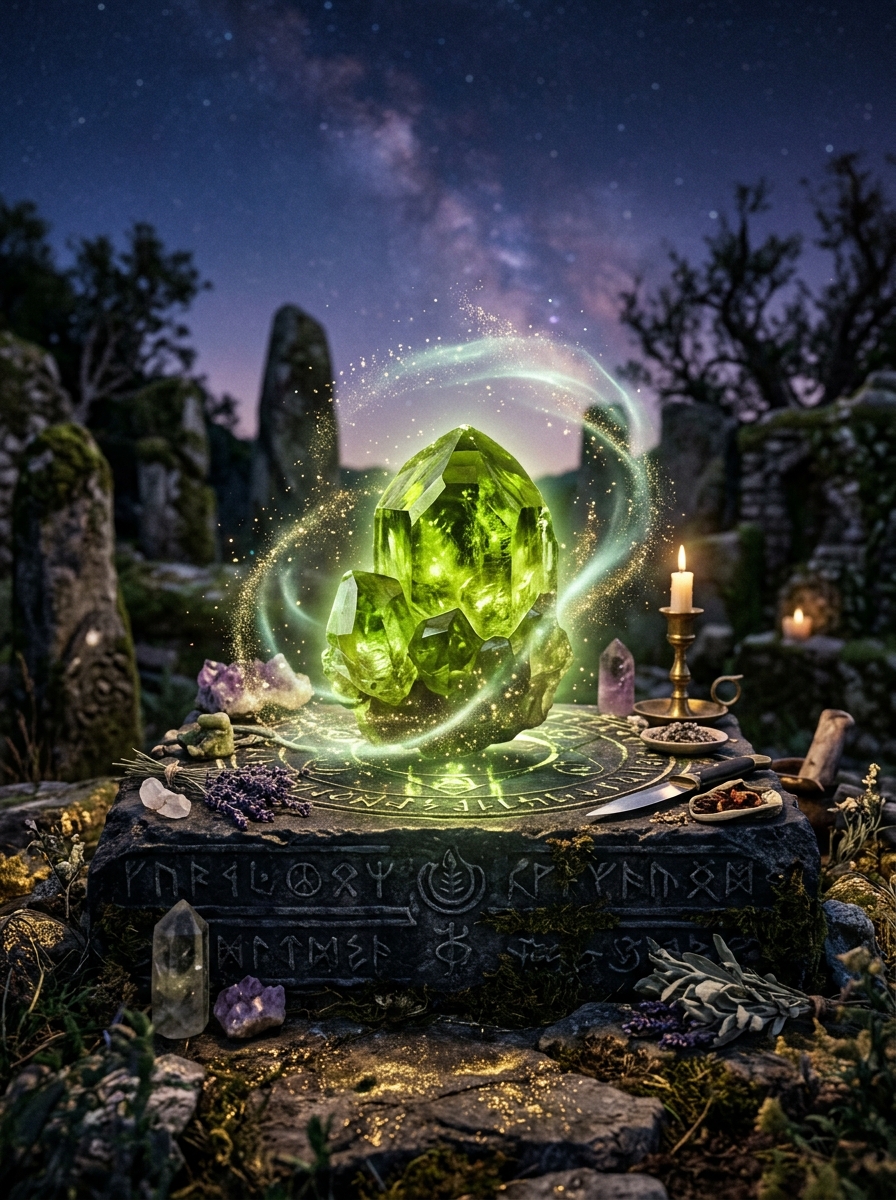
Peridot is a stone of clean release: it lightens what has calcified in the heart, clears resentment without erasing discernment, and restores a workable sense of personal worth. Metaphysically, it belongs to the bright green current of renewal—less about dreamy healing than about metabolizing the past so the future can actually enter. Its signature is solar-green, a color that says growth is not a vague promise but a disciplined act of reorientation.
The core meaning of peridot: green light after emotional congestion
Peridot’s meaning is not “good vibes” in the abstract. It is the energetic intelligence of renewal after depletion. This stone is often read as a cleanser of emotional residue: jealousy, bitterness, self-judgment, and the subtle fatigue that comes from living too long in defensive posture. In symbolic terms, it helps the psyche move from reactive protection into receptive vitality.
What makes peridot distinct among green stones is its brightness. Emerald can feel royal and deep; aventurine can feel easy and diffuse. Peridot is sharper, more immediate, as if the heart itself had been polished to catch light. That quality matters psychologically. A person working with peridot is usually not trying to become softer in the sense of becoming weaker. They are trying to become less encumbered, less entangled in old emotional weather.
This is also why peridot is associated with the restoration of self-trust. Many crystals for the heart emphasize compassion outward. Peridot emphasizes the more difficult middle step: clearing the internal court where your own judgment has been prosecuting you. It asks, What if shame is not a personality trait but a pattern that can be released?
For readers drawn to the larger symbolic map, this kind of inner reorientation belongs to the same family of meaning as the Sun’s individuation journey and the development of a coherent life direction. If you want that framework in astrological language, the page on the Astrological Sun Sign expands the idea of the solar core in a useful way.
The emotional medicine: jealousy, exhaustion, and wounded receptivity
Peridot has long been linked with the cooling of envy and the softening of possessiveness. That association is not trivial folklore; envy often masks a wound in perceived sufficiency. Peridot does not shame that wound. It reveals it. The stone’s green clarity can make comparison feel less like destiny and more like a habit of attention.
It is also a good stone for emotional depletion. Not every exhaustion is physical. Some of it comes from carrying ambient tension: other people’s expectations, inherited family roles, the pressure to be agreeable. Peridot’s message is not withdrawal but internal housekeeping. It helps separate what is yours from what has been lingering on your field.
Chakra and elemental associations: where peridot actually works in the body of symbols
Peridot is most commonly associated with the heart chakra, and that is accurate—not because it automatically produces romance or sentimental warmth, but because it helps the heart function as a regulating center. A balanced heart chakra is capable of attachment without fusion, generosity without self-erasure, and grief without collapse. Peridot supports that middle ground.
The stone can also be used in connection with the solar plexus, especially when the issue is self-worth, agency, or the ability to say yes and no without apology. The solar plexus governs personal power; the heart governs relational truth. Peridot bridges them elegantly. It says, in effect, that real kindness requires a stable self, not a self in perpetual negotiation.
From an elemental perspective, peridot resonates strongly with Earth because it grounds growth in actual embodiment. Green stones often get described as “healing,” but peridot’s healing is practical: restoring appetite, focus, and the willingness to act. It is a stone of life force entering form. It doesn’t dissolve structure; it makes structure livable.
Why the heart and solar plexus pairing matters
When the heart chakra is overactive without support from the solar plexus, a person may become overly porous, compassionate to the point of depletion. When the solar plexus is inflated without heart integration, confidence can curdle into defensiveness. Peridot helps mediate between these centers. That makes it especially relevant for people learning how to be open without becoming available to everything.
This is one reason peridot pairs well with astrological work around aspect patterns and activation. A supportive connection can be a sextile: not a dramatic overhaul, but a usable channel. If you want a deeper astrological explanation of that kind of productive linkage, see the sextile aspect. Peridot’s energy often feels exactly like that—an opening, not a takeover.
Zodiac and planetary correspondences: who peridot speaks to most clearly
The strongest traditional zodiac association for peridot is Leo, with secondary resonance in Virgo. Leo makes sense because the stone carries solar brightness, confidence, and the courage to be seen without collapsing into performance. Yet peridot is not merely “Leo’s stone” in a decorative sense. It supports the higher function of Leo: warm authority, generous heart, and creative self-possession rather than vanity.
Virgo is the other useful correspondence because peridot has a purifying quality. Virgo seeks refinement through discernment, and peridot helps distinguish healthy correction from self-criticism. For Virgos or strong Virgo placements, it can soften the internal editor while preserving precision. That balance is rare and valuable.
Planetarily, peridot is most naturally aligned with the Sun. The Sun in astrology symbolizes vitality, coherence, and the will to become oneself. Peridot does not inflate the ego; it clarifies the solar principle so it can shine without distortion. If you are working with your broader astrological identity, the meaning of the zodiac can help situate these correspondences inside the larger symbolic structure.
How peridot behaves in chart-conscious terms
Peridot is particularly supportive when the chart suggests a need for solar restoration: a challenged Sun, a crowded identity axis, or periods when vitality feels split between duty and desire. It can also be useful when the chart contains a strong stellium that has created a psychological complex around one life area—too much concentrated energy, not enough circulation. In that context, peridot acts like a green current of redistribution. For a more technical astrological lens on concentrated planetary clusters, stelliums are worth understanding.
For people exploring life direction, peridot can also be paired symbolically with the North Node, especially when the task is to move toward a more self-respecting future rather than repeat inherited patterns. If that language speaks to you, the page on North Node meaning offers the right framework.
Healing properties and practical use: how to work with peridot without flattening its intelligence
Peridot is often marketed as a money stone, and while abundance can be part of its field, that reduces it too quickly. Its true healing property is receptivity that has been cleaned of panic. Money, opportunity, love, and creative momentum all require that kind of receptivity. Peridot does not “attract” in a simplistic way; it removes the internal interference that keeps you from recognizing what is already trying to reach you.
In crystal healing practice, peridot is frequently used for the energetic support of digestion, detoxification, and emotional release. Those correspondences are symbolic and experiential rather than medical claims, but they are coherent: the stone is associated with helping the body-mind system process what it no longer needs. In that sense, it belongs to the broader family of stones used for clearing stagnation and restoring flow.
Best ways to use peridot
Wear peridot close to the skin when you need steady heart support and a reminder of your own value. Rings and pendants are especially effective because they keep the stone in the field throughout the day, where it can interact with reactive moments rather than only meditative ones.
Use it during journaling if you are excavating resentment, comparison, or old relational wounds. Peridot works well with questions that are specific and unsentimental: What am I still blaming myself for? Where am I mistaking vigilance for wisdom? What would self-respect require if I stopped bargaining with my own needs?
Place it on the chest in meditation if your focus is the heart chakra, or just above the navel if you are working with agency and self-definition. Some practitioners pair it with breathwork because the stone’s energetic tone is brisk, almost clarifying. It does not ask you to sink endlessly into emotion; it asks you to circulate through it.
For ritual use, peridot is especially good at the threshold moments: new jobs, post-breakup recovery, recovery from burnout, or any season when a person is relearning how to want things without apology. In those moments, it can be helpful to place it alongside an image or symbol of authority that feels benevolent rather than controlling. The archetypal relationship between sovereignty and radiance is explored beautifully in The Emperor and The Sun Tarot Card Meaning, where structure and life force are not opposites but allies.
Cleansing, charging, and choosing quality
Because peridot is a bright, responsive stone, it benefits from regular energetic clearing. Short moonlight exposure is gentle; smoke cleansing or resting it on selenite is also common. Avoid harsh treatment and store it carefully, since the stone’s physical presence matters as much as its symbolic one.
Quality matters with peridot. Look for color that feels lively rather than muddy, with a clean green-to-yellow-green tone. Stones that are too dark can lose the quality that makes peridot distinct: the sense of light entering matter. That brightness is part of the meaning.
What peridot teaches in the long run: self-respect as a form of light
The deepest lesson of peridot is that healing is not only about comfort. It is about recovering enough inner clarity to stop identifying with what has drained you. This stone is for the person who is done romanticizing suffering and ready to treat vitality as a spiritual responsibility. That may sound severe, but peridot is not harsh. It is lucid.
When used well, peridot helps a person become less emotionally possessive of old stories and more available to the next truthful thing. It is good for renewed love, renewed purpose, renewed appetite for life. It supports the part of the psyche that wants to participate fully without begging for permission. In Jungian terms, it belongs to the movement toward wholeness: not perfection, but integration.
If you are mapping your life through symbols, peridot makes a strong companion to the larger astrology of identity and timing. It resonates with solar clarity, benefic activation, and the ongoing task of becoming more yourself without theatricality. For a wider interpretive frame, you can also explore astrological houses to see where renewal is likely to land in lived experience, or revisit the broader language of the zodiac when you want the whole map rather than one stone’s bright signal.
Peridot does not ask for devotion through mystery. It asks for honesty, release, and a willingness to let green light back into the heart.
Related
- August Birthstone Peridot: Meaning, History, and Symbolism
- Opal Meaning & Healing Properties: The Stone of Shifting Light
- Rose Quartz Meaning: The Soft Power of the Heart Stone
- Sunstone Meaning and Healing Properties: Solar Courage, Joy, and Clean Power
- Topaz Meaning & Healing Properties: Clarity, Fire, and Steady Power
Comments
Loading comments…