Topaz in November: Meaning, History, and the Fire Beneath the Calm
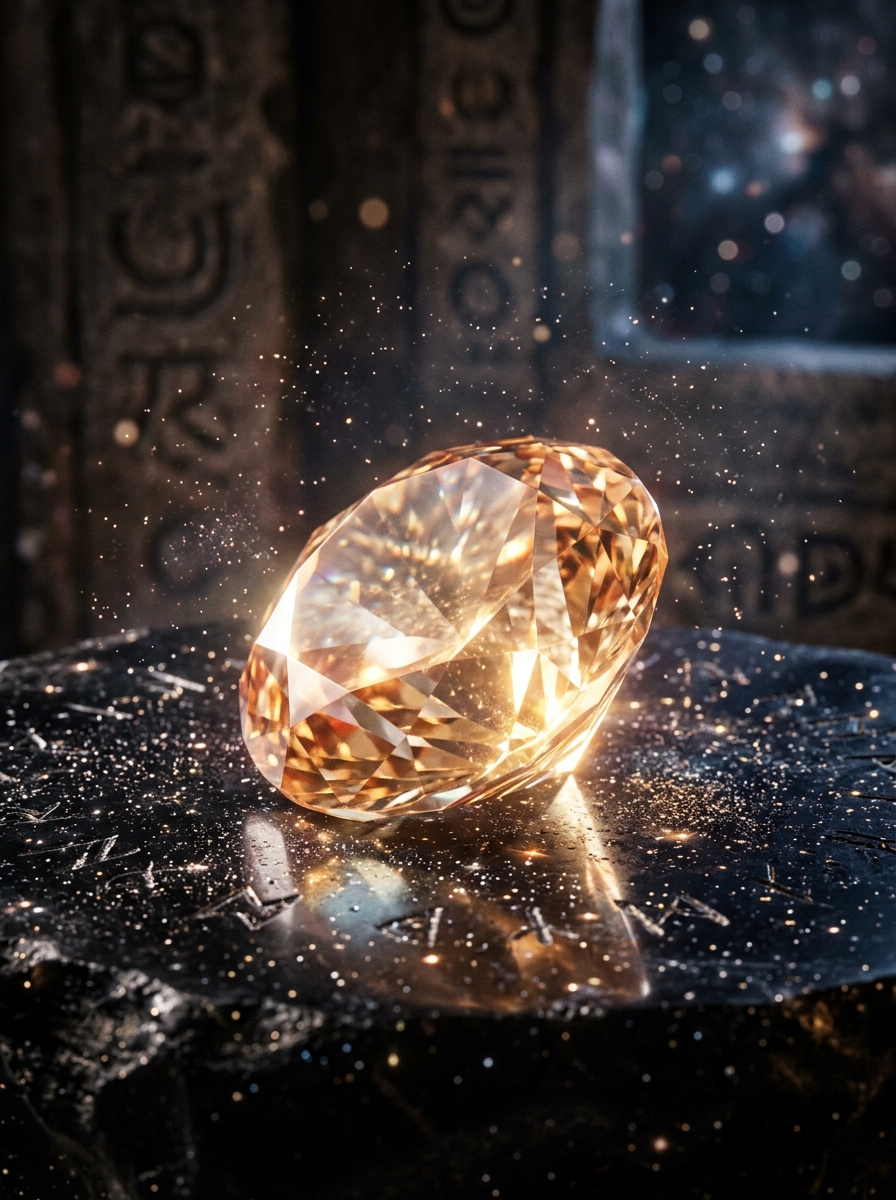
Topaz Is November’s Stone Because It Earns Its Light
Topaz belongs to November because winter arrives, the leaves finish dropping, and the kind of warmth that remains is not the soft ambient kind. It is a focused warmth, disciplined. That is what this gemstone offers: not comfort that lulls but clarity that steadies. The November-born person, or anyone who resonates with this month’s atmosphere, needs a symbol that does not promise endless bloom. They need a stone that has been pressed into form, that can hold a sharp edge and still let light through. That is Topaz — a mineral of precision, irreducible to a single color but always legible as truth-telling.
Its most durable meaning is discernment. Not cold analysis, but the ability to sort what matters from what merely shines. November strips the year down; Topaz does the same for the psyche. It supports a person in exiting the theater of performance and entering the room where substance is the only currency. Every other facet of this gem’s symbolism — its history, its color psychology, its role in modern life — grows from that root.
What Topaz Actually Is, and Why Its Geology Matters
Topaz is a silicate mineral, not a quartz. That distinction is not technical trivia; it shapes how the stone behaves under pressure and how we read it symbolically. It ranks eight on the Mohs scale — hard enough for daily wear, but with a perfect basal cleavage that makes it temperamental if struck at the wrong angle. This tension between durability and vulnerability gives the stone a psychological texture: it can endure much, but it demands respect for its internal grain.
Color is the language of meaning
The range of Topaz colors is misunderstood by those who only know the golden-toned birthstone jewelry. The mineral naturally appears in honey, sherry, peach, pink, blue, and champagne. Golden topaz dominates the November association because it carries solar confidence, abundance that does not need to show off, and the warmth of a lamp rather than a bonfire. Blue topaz, often produced by treatment, shifts the symbolism toward articulate thought and clean expression — useful, but less autumnal. Imperial topaz, the rare pink-orange variety prized by collectors, reads more internally lit, closer to self-worth than to outer radiance.
Each color changes the emotional territory, but all share a common discipline: Topaz does not glow softly. It catches light and returns it in defined beams. That is why it feels architectural. It arranges brightness rather than spilling it.
The History of Topaz: Misidentification That Reveals How We See
The word Topaz comes from the Greek topazos, a name likely applied to a yellow-green stone that may have been peridot or a variety of chrysolite. Ancient writers had fluid nomenclature; they named by color and origin, not by mineral chemistry. This means the “topaz” of Pliny or the Old Testament was almost certainly not the Topaz we know today. Yet this confusion is not a weakness in the story; it is a feature. It shows that human beings have always looked at certain stones and felt the same quality — brightness that does not scatter, light that organizes.
From fluid tradition to fixed birthstone
The modern birthstone list that links Topaz to November emerged in the early twentieth century, standardized by jewelry industry associations. Before that, gem calendars varied by region and era. Once Topaz settled into November, its symbolism deepened around autumnal themes: maturity, gratitude, grounded wealth, and the kind of radiance that survives after the easy colors are gone. Crucially, this placement distinguished Topaz from citrine, a quartz that shares a golden palette but behaves differently. Citrine feels buoyant, quick, like sunlight in motion. Topaz feels deliberate, architectural — sunlight held in a structure.
Old mythologies of protection and truth
Across cultures, Topaz was carried as a talisman against deceit, a stone that revealed the truth of a person or situation. In psychological terms, that myth points to an ancient intuition: some objects help us organize our attention. Topaz became a stone for discernment because it visually performs discernment — it lets light in and returns it in a disciplined way. That is a small miracle, and the human imagination has always been sensitive to it.
The Psychological Work of Topaz: Confidence Without Inflation
If the November birthstone had a single psychological job, it would be this: Topaz supports the self when the self must become more exact. Not harder, not colder — exact. That is a subtler achievement than it sounds. November does not ask for performance; it asks for substance. Topaz answers that request by embodying a mature version of confidence: the confidence that does not need to fill the room.
Coherent identity and the boundary of warmth
In a Jungian frame, Topaz aligns with ego consolidation — not crude self-esteem, but a coherent sense of what belongs to the self and what does not. The person who resonates with Topaz is often sorting out where energy leaks into unnecessary drama, where kindness becomes softness, where openness becomes vulnerability. Topaz does not romanticize this process. It makes it legible. That is why it supports truth-telling and self-respect.
Color psychology sharpens the picture. Golden topaz offers generosity, optimism, and abundance that includes discernment. It is the difference between a lamp and a bonfire: the lamp gives directed illumination; the bonfire consumes everything equally. Topaz belongs to the lamp. That distinction makes the stone a natural symbol for boundaries. Good boundaries are not walls; they are the conditions under which warmth can remain usable. Topaz implies that kind of boundary: intact enough to hold shape, clear enough to let light pass.
How it plays out in life
In love, Topaz does not push romantic fantasy. It asks partners to see each other clearly — and to choose each other anyway. In work, it favors roles that require honest evaluation, where the task is to sort the necessary from the noisy. In relationships of all kinds, it helps the person speak the hard truth without cruelty, because it has already made that truth legible to the self. The stone does not promise easy harmony; it promises integrity that can withstand friction.
How Topaz Is Carried in Modern Life
Topaz remains popular because it is visually accessible and symbolically layered. People choose it for birthdays, milestones, and self-given markers of change because it feels clean without being sterile. It can be celebratory without becoming flashy, which is one reason it fits November so naturally.
The setting changes the message
In jewelry, a Topaz solitaire in gold reads differently from the same stone in silver or platinum. Warm metals amplify its solar side, making it feel more abundant and openly autumnal. Cooler settings sharpen its edges and emphasize clarity, composure, modern restraint. This is why Topaz works across style types: it is not locked into a single mood. The setting decides whether it speaks like a hearth or like a line of thought. For the person who wants a November birthstone that does not vanish in the room, Topaz is ideal because it is elegant without fragility, bright without glare.
As a gift, it says something specific
A Topaz gift is not a generic token of affection. It implies respect for the recipient’s inner architecture. It says: I see your strength, and I do not imagine that strength as hardness. That makes Topaz especially appropriate for transitions — new jobs, birthdays near the end of the year, recoveries, hard-won beginnings. In spiritual practice, some use Topaz as a focus stone for honest speech and disciplined intention. Whether one treats that literally or symbolically, the function is similar: the stone becomes a concentrate for attention. You look at it and are reminded that light can be gathered, not only received.
The November lesson it keeps repeating
Topaz endures as the November birthstone because it understands a difficult truth about human life: warmth is most convincing when it has weather in it. The stone does not promise endless glow. It promises discernment, steadiness, and the kind of radiance that survives after the easy colors are gone. In that sense, it belongs to November not because it is cheerful, but because it is earned.
Related
- October Birthstone: Opal and the Art of Living in Color
- December Birthstone Turquoise: Meaning, History, and Symbolism
- Amethyst in February: The Violet Stone of Clarity, Devotion, and Night Vision
- Ruby in July: The Birthstone of Fire, Blood, and Unblinking Desire
- January Birthstone Garnet: Meaning, History, and Symbolism
Comments
Loading comments…