Amethyst in February: The Violet Stone of Clarity, Devotion, and Night Vision
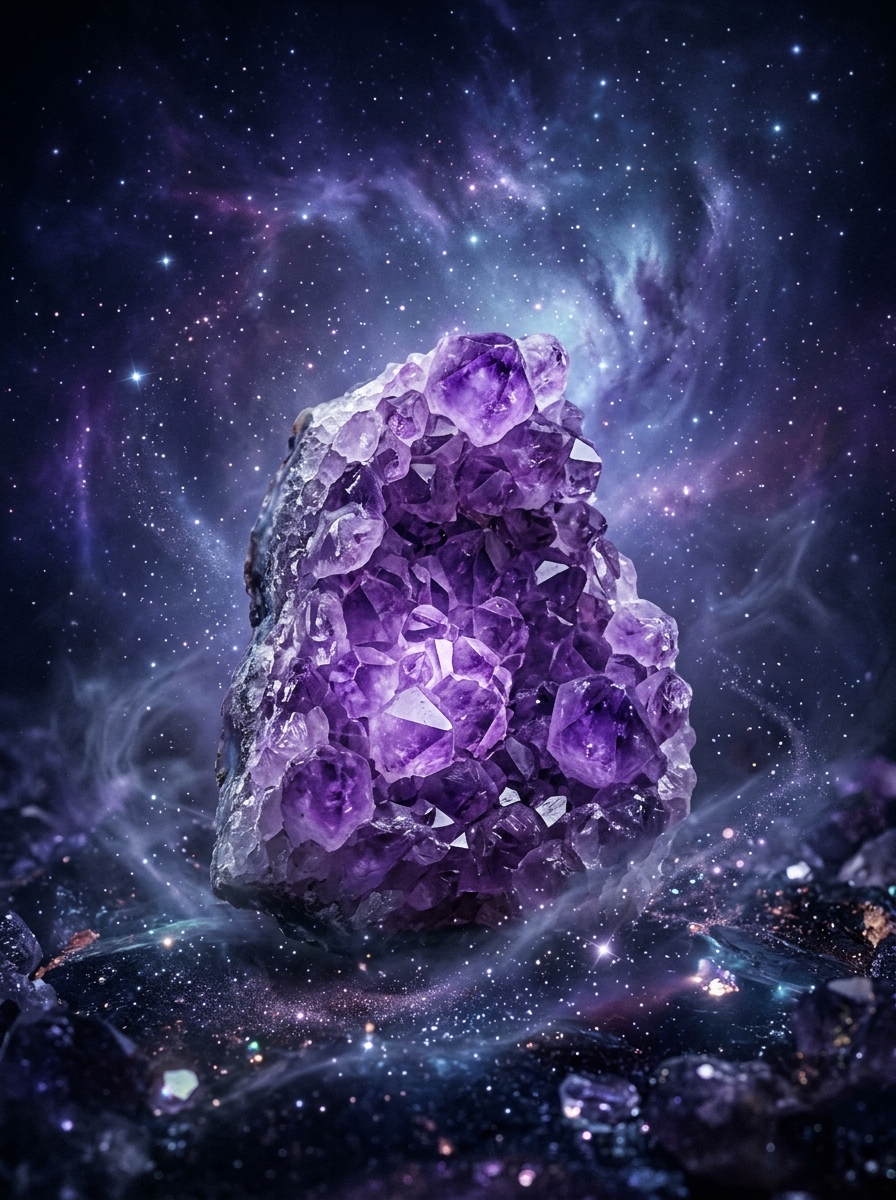
The Stone That Sees in the Dark
Amethyst is February’s birthstone because it does what winter asks of a person: it stays clear when light is scarce. The stone’s meaning is not vague calm—it is precise, historical, and psychological. At its core lies an idea that has survived for millennia: the capacity to remain inwardly composed when the outer world is emotionally noisy or dim. That makes amethyst less a decoration and more a tool for maintaining shape under pressure.
Geologically, it is a purple variety of quartz, colored by iron and natural irradiation. Symbolically, quartz amplifies; the violet note adds intuition, contemplation, and the borderlands between visible fact and inner knowing. As a birthstone for February, amethyst does not announce exuberance. It refines perception. It belongs to the part of the psyche that can hold a strong feeling without immediately becoming it. In a month governed by cold, reduced light, and the psychological turn inward, that function is not ornamental—it is necessary.
A Geology of Sobriety: What the Name Actually Means
The Greek word amethystos means “not drunk.” In classical thought, the stone was believed to guard against intoxication—or, more precisely, against the loss of self-command that intoxication represents. Early cultures did not wear amethyst as a mere amulet; they set it into cups and carried it as a talisman for sober judgment. That etymology is not a charming superstition. It reveals how the stone was understood from the start: as an emblem of the mind’s ability to stay composed when desire, pleasure, or grief threaten to scatter it.
Medieval Christian tradition deepened that association. Bishops wore amethyst in their rings, not as a display of power but as a reminder of spiritual authority ordered toward conscience. The stone’s purple resonated with penance, fidelity, and liturgical dignity. Its authority was contemplative, not imperial. This is one reason amethyst remains psychologically compelling today. Modern life produces a surplus of stimulation and a deficit of pause. The stone’s old link to sobriety now reads as clarity, attention, and the refusal to be captured by every passing appetite. The history did not go stale; it became newly legible.
Violet Between Two Blues: The Color’s Psychological Action
Amethyst’s meaning is inseparable from its color. Violet sits between red and blue—between impulse and distance, appetite and reflection. That threshold position is what gives the stone its peculiar symbolic weight. It is not the raw force of red, not the absolute cool of blue, but the psyche moving between instinct and contemplation. Jung would have recognized this immediately: violet is the color of threshold states, of moments when the unconscious stirs without overwhelming the ego. Amethyst does not soothe by numbness; it soothes by making emotion legible.
This is why the stone is so often recommended for meditation, dreams, and psychic hygiene. Each of those practices asks for a particular kind of attention: stabilized, receptive, capable of distinguishing your own material from what is projected onto you. Amethyst supports that discernment. It does not promise escape from shadow; it offers enough composure to face shadow without surrendering to it. That is a more serious symbolism than the usual crystal-shop language of “positive vibes.” The stone’s power lies in its capacity to create a small interior chamber where emotion can become legible without becoming overwhelming.
Color depth and emotional temperature
The shade of violet matters. A pale lavender amethyst feels airy and devotional, opening toward gentleness. A deep, saturated specimen feels more anchored, more ecclesiastical, almost nocturnal. The same mineral expresses different tonalities of the same psychic function—lightness for receptive openness, darkness for concentrated inwardness. Neither is better; both are amethyst. The range reminds us that clarity does not always look the same.
How the Stone Works in Practice: Protection, Dreamwork, Boundary
The practical uses of amethyst follow logically from its nature. It is not a stone of conquest or dramatic transformation. It is a stone of inner order, and its strength is most felt in quiet practices. People who work with crystals in a spiritual context often reach for amethyst when they need to set intentions, clear emotional residue, or prepare for sleep. But the word “calming” is too soft unless paired with another truth: amethyst does not relax the mind so much as help the mind sort itself.
Dreamwork and the nocturnal mind
Because amethyst is associated with the borderlands of consciousness, it has a long history of use in dream incubation and lucid dreaming. Placing a stone on the nightstand or under the pillow is a ritual gesture that signals the psyche: we are entering a state of permeable awareness. The stone’s violet frequency is thought to harmonize with the third-eye and crown chakras, though that language is less important than the actual effect. Many people report that amethyst helps them remember dreams without the anxiety that often accompanies intense dream recall. It holds the line between sleeping and waking.
Psychic hygiene and boundaries
In metaphysical practice, psychic hygiene means knowing what is yours and what belongs to the environment. Amethyst is useful here because it does not repel energy aggressively—it clarifies the atmosphere. Some stones push; amethyst clarifies. That makes it especially good for those who absorb other people’s moods easily. It does not build a wall; it builds a filter. The stone’s historical association with fidelity and devotion also translates into relationship work: it helps distinguish genuine connection from emotional overdraft.
Meditation as sustained attention
In meditation, amethyst serves as a focus object for the eyes or a tactile anchor in the hand. Its color naturally draws the gaze into a soft, unfocused stare—the ideal condition for insight meditation. The stone does not force concentration; it invites it. This is why it appears in so many contemplative contexts across traditions. It is the stone of the Hermit tarot card, of the solitary lamp that illuminates without glare.
February’s Alchemical Season: Why This Stone Fits This Month
February is a strange month. It opens with Aquarius season—cool, intelligent, airy—and closes with Pisces season—dissolving, intuitive, oceanic. The month lives between those two currents, and amethyst mirrors that tension. Its violet blends the mental clarity of Aquarius with the emotional depth of Pisces. It is the stone for someone who needs to think clearly while feeling deeply.
As a birthstone, amethyst does not describe a personality; it describes a temperamental resource. For people born in February, it often resonates as a visual portrait of inner weather: observant rather than performative, intelligent without needing to dominate, emotionally deep but not always eager to display that depth on demand. The stone’s best use is not as a cosmic guarantee but as a prompt. Where do I need more discernment? Where am I confusing intensity with truth? Where do I need a clean edge around my energy?
The gift that carries intention
Because amethyst is so closely tied to sobriety and devotion, it makes an especially resonant gift for rites of passage. It suits a birthday not because it is “pretty” but because it carries intention. When given as jewelry, it can imply steadiness, trust, and protection. When inherited, it feels like a memory condensed into mineral form—not sentimental, but durable. Amethyst is quartz, which gives it practical hardness for everyday wear. Its beauty is not fragile. Symbolically, that supports its reputation for resilient calm.
The stone’s own character
Amethyst endures because it is both beautiful and morally intelligible. It offers a color, a history, and a temperament all at once. In a season of austerity that can become wisdom, in a dark month that can still generate light, it stands for clarity as a kind of grace. It does not shout. It sees in the dark.
Related
- March Birthstone Aquamarine: Meaning, History, and Symbolism
- October Birthstone: Opal and the Art of Living in Color
- Rose Quartz Meaning: The Soft Power of the Heart Stone
- Amazonite Meaning & Healing Properties: The Stone of Clear Boundaries
- Topaz in November: Meaning, History, and the Fire Beneath the Calm
Comments
Loading comments…