Moon Trine Mercury in Synastry: When Feeling Finds a Voice
The Core Dynamic: Feeling Finds Its Syntax
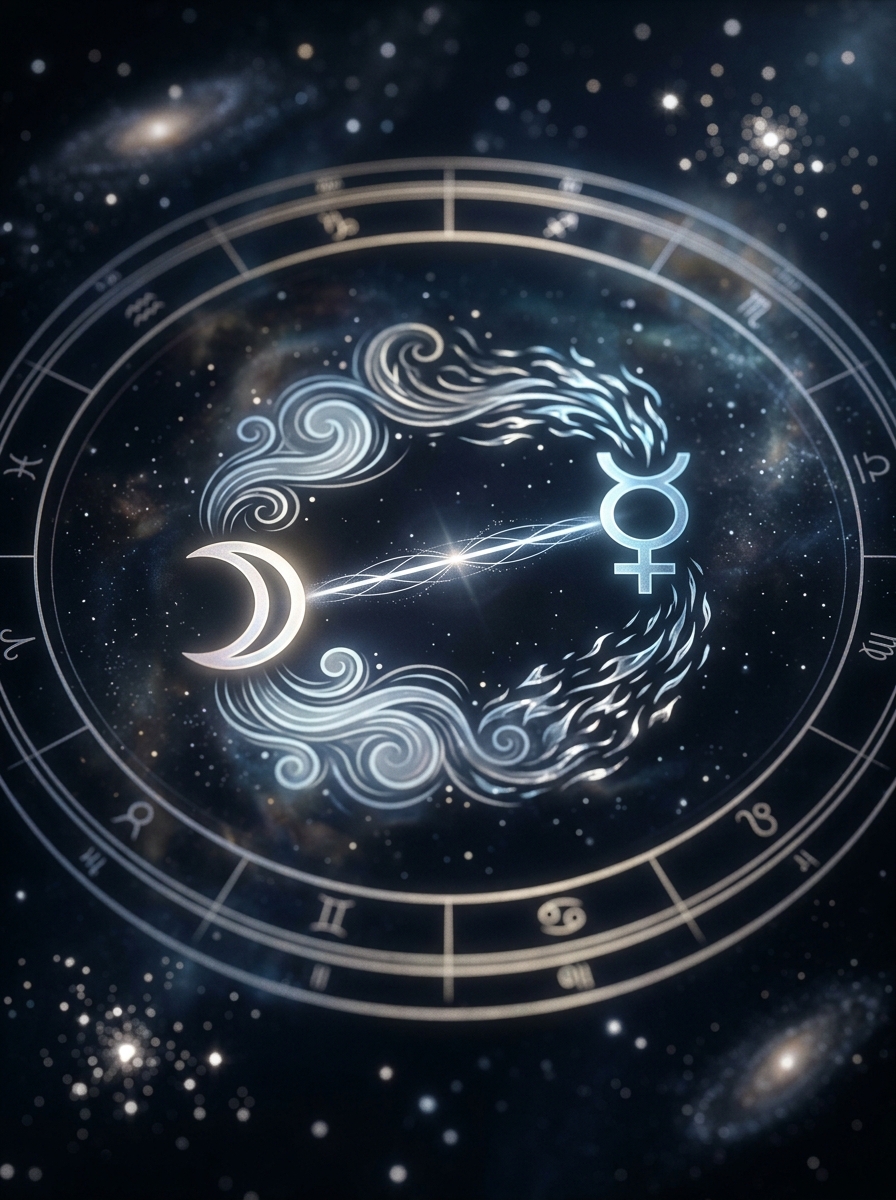
Moon trine Mercury in synastry is not merely “good communication.” It is an arrangement in which the pre-verbal life of the Moon — attachment, memory, appetite, the body’s verdict on safety — meets the naming function of Mercury and finds it trustworthy. The trine connects signs of the same element, so no translation between incompatible rhythms is necessary. Emotion gets syntax without distortion.
What the couple experiences is mutual intelligibility. One person’s inner weather becomes legible to the other without labor; the other’s words are received as intended, not as something to be decoded or defended against. This is why the aspect often produces an early sense of homecoming. It lowers the nervous system’s guard. Conversation feels less like explanation and more like recognition.
The trine is an easy-flow aspect, so it does not generate drama by itself. It creates fluency. The Moon supplies instinct, mood, and need; Mercury supplies naming, perspective, and sequence. In a strong synastry chart that fluency becomes a cherished dialect — a shared language for metabolizing experience. This aspect frequently appears in couples who “just get” each other’s tone, in friends who can talk through a crisis without escalating it, and in family members who know how to say the right thing at the right time. But ease is not the same as depth; a trine can make empathy look effortless while hiding how much unconscious compatibility is doing the work. That is why this contact is best understood alongside the larger relational map: synastry aspects show the full weather system, and synastry step-by-step helps determine whether this harmony is central or merely one graceful thread.
How the Trine Forms: From Instinct to Shared Idiom
The psychological roots of Moon trine Mercury lie in the Moon’s need for safe containment and Mercury’s desire to understand. The Moon, before it learns language, knows safety through rhythm, touch, and familiarity. Mercury, the swift messenger, lives to name, connect, and sort. A trine between them means these two modes work in the same direction: the Moon trusts Mercury to handle its material without ridicule, and Mercury trusts the Moon to provide honest raw data.
This mutual trust creates an attraction that is cerebral on the surface and visceral underneath. The Moon feels emotionally seen; Mercury feels mentally invited in. The chemistry is rarely theatrical, but it can be deeply adhesive. Eroticism, when it arises, comes through attunement rather than conquest. A small remark about a childhood memory becomes a door into private chambers of history. The mind is turned on by access; the feelings are turned on by being intelligible. Over time, this makes the bond more durable than hotter aspects: the couple can narrate, repair, and remember together. Repair is the unsung engine of attachment, and Moon trine Mercury oils that engine.
If the synastry also contains a strong Sun-Moon connection, the relationship can feel both comprehensible and fated in the most ordinary sense — daily life fits. See Sun-Moon synastry for that deeper emotional architecture. And when comparing to Moon-Venus synastry, the difference is instructive: Venus softens and desires harmony; Mercury understands and replies. This is less about charm than about mutual intelligibility.
The Shadow of Effortless Understanding
Ease has a shadow. Moon trine Mercury can become so efficient that it bypasses the work of differentiation. People may mistake shared emotional style for shared values. They become skilled at soothing each other while avoiding the harder business of disagreement. A trine does not eliminate friction; it can simply make friction polite.
The primary risk is assumption. Because the exchange feels cooperative, one person may stop checking whether they were actually understood. The Moon may begin to expect mind-reading. Mercury may assume that a clear explanation equals resolution, even when the emotional wound is deeper than language can reach. The couple can talk beautifully about a problem while leaving the hurt untouched. If Mercury is in a sign that prefers analysis over vulnerability — say, Virgo or Capricorn — the dialogue becomes elegant but emotionally evasive. If the Moon belongs to someone with strong cardinal or fixed needs, they may eventually feel talked around instead of felt.
This is where the trine aspect and the astrological trine matter as psychological principles, not just geometry. The trine’s gift is flow; its risk is drift. In synastry, that can look like a relationship that is easy to narrate but hard to deepen if neither person names the unsaid. If the broader chart contains a Grand Trine, this easy communication may be part of a larger pattern of grace — which can be a blessing or a trap. The chapter on the Grand Trine and its glossary entry make clear that harmonious charts can become self-satisfied. Moon trine Mercury may smooth the conversation enough that nobody notices what remains unchallenged.
Another shadow: talking instead of touching. A Moon-Mercury trine can make feelings highly discussable while leaving bodily or instinctual tensions untouched. The couple may be excellent at processing but less skilled at inhabiting silence, uncertainty, or raw need. They can explain their pain beautifully and still not let it change them. If the native Mercury is retrograde, the dynamic can become even more layered — revisiting and revising can deepen reflection, but also create loops of re-explanation. The question is whether the talking opens feeling or merely circles it.
Where the Conversation Lives: House Overlays and Sign Tones
The aspect gives the relationship its syntax; house overlays and Mercury’s sign give it location and accent. Two charts can contain the same Moon trine Mercury and feel completely different because the dialogue happens in different rooms of the psyche.
If Mercury falls in the other person’s 4th house, the conversation tends toward the intimate, familial, and memory-rich. Words carry the scent of childhood and private habit. That placement — Mercury in the Fourth House — makes emotional exchange feel rooted in domestic space. In the 3rd house, exchange is frequent, immediate, and kinetic: texts, errands, jokes, quick emotional check-ins. For that, see Mercury in the Third House. If Mercury overlays the 8th house, the trine can turn into psychological X-ray vision — the conversation goes deeper, faster, and less politely than expected. Mercury in the 8th House captures the detective quality that surfaces. In the 12th house, communication becomes dreamlike, telepathic, hard to pin down; Mercury in the 12th House describes that submerged style.
Mercury’s sign changes the flavor of empathy. A trine does not erase temperament. Mercury in Gemini brings speed, wit, and multiplex awareness — see Mercury in Gemini. Mercury in Cancer wraps feelings in story and protective phrasing — Mercury in Cancer. Mercury in Virgo is precise, discerning, service-oriented — Mercury in Virgo. Mercury in Libra softens conflict with fairness and relational tact — Mercury in Libra. The trine does not standardize communication; it makes the style easier to inhabit. Likewise, the Moon’s sign colors what the receiving person needs: a Cancer Moon hears comfort differently than a Sagittarius Moon, a Taurus Moon wants steadiness, a Pisces Moon wants resonance.
Reading the Aspect in the Full Chart
The real question is not whether Moon trine Mercury is “good.” It is good at a particular job: making emotional reality speakable. But synastry is never just one contact. It is a choreography of permission and resistance. A graceful aspect can support love, friendship, and long-term companionship, yet it cannot on its own determine intimacy’s outcome.
Before overcrediting the trine, ask three things. First, is the aspect mutual in feeling or only in exchange? One person may do most of the talking while the other simply feels relieved to be included. Second, is the dialogue emotionally honest or merely frictionless? Third, what complicates the story? Hard aspects to Moon or Mercury, Saturn contacts that test patience, Neptune contacts that blur clarity — a chart with both ease and challenge often has more staying power than one with only verbal grace. For the wider architecture of relationship astrology, astrological synastry gives the map, and synastry house overlays tells you where the map becomes embodied.
In the end, this aspect is one of synastry’s quiet luxuries: a mind that can hear the heart, a heart that can trust the mind. When it works well, the relationship develops a private idiom — almost a small language of its own. That language may not prevent conflict, but it gives conflict a place to land. And in the best cases, that is what keeps two people from becoming strangers inside the same story.
Related
- Synastry Sun Trine Mercury: When Identity Finds a Language
- Synastry Venus Trine Mercury: When Affection Finds the Right Words
- Synastry Mercury Trine Mercury: The Mind That Finds Its Mirror
- Synastry Moon Sextile Mercury: When Feeling Finds a Voice
- Synastry Moon Trine Moon: The Quiet River of Emotional Compatibility
Comments
Loading comments…