Moon Square Venus in Synastry: Sweetness Under Strain
The chemistry that keeps missing its mark
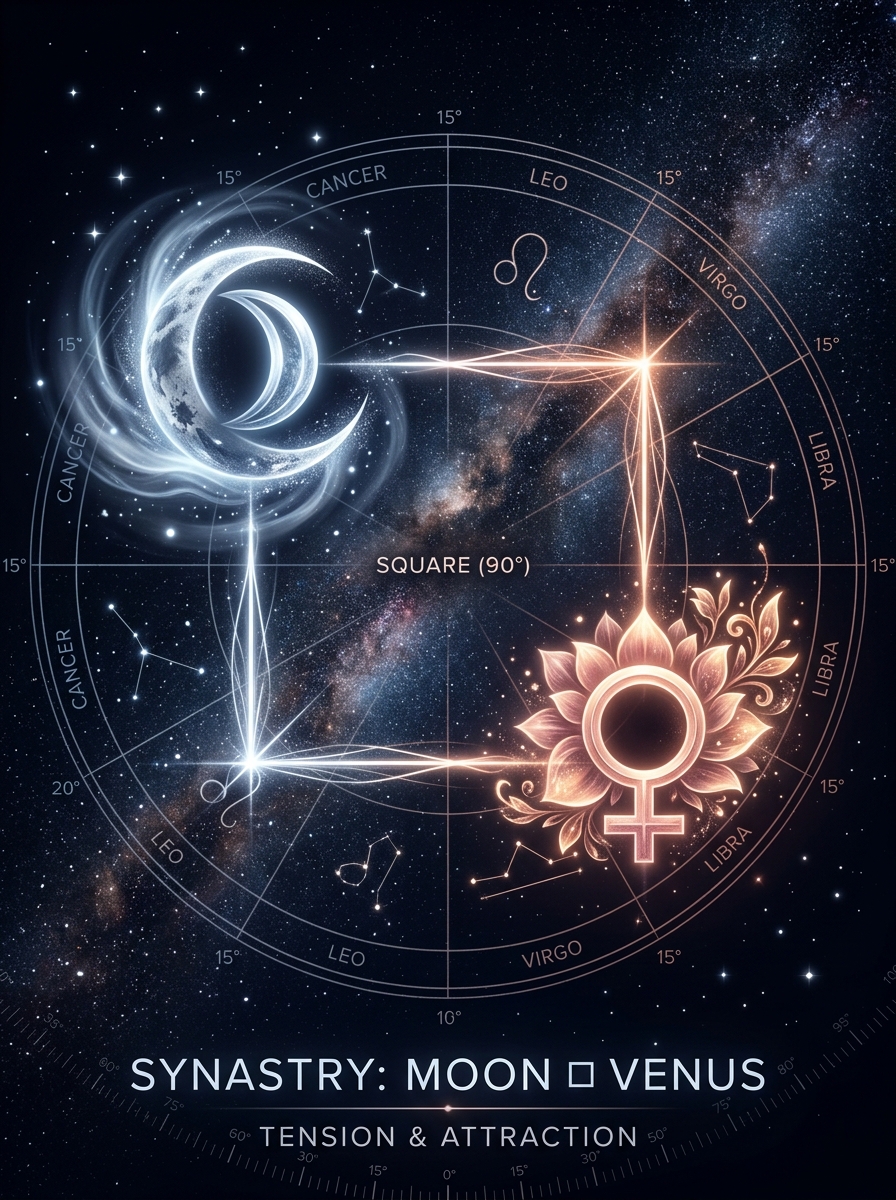
Moon square Venus in synastry creates a bond that feels intimate before it feels coherent. The Moon person reaches for emotional attunement—instinctive care, shared mood, the raw language of need. The Venus person offers charm, harmony, and the desire to make things beautiful. The square forces these two currents to meet at cross-purposes. The result is not indifference but mismatch: one is asking to be held in a certain emotional dialect, while the other is loving in a style that does not quite translate.
This is not a rejection aspect; it is an aspect of tension that generates real attraction. Each person stimulates a need the other activates vividly—the Moon person feels seen by Venus’s warmth, even when misunderstood; the Venus person finds the Moon’s needfulness compelling because it gives gravity to her charm. Yet the square keeps the connection from settling into easy flow. The signature of this aspect is a peculiar ache: affection feels almost right, then not quite. Compared to gentler Moon-Venus contacts, such as the conjunction or trine described in Moon-Venus Synastry, this placement never lets the couple forget that love requires translation, not just resonance.
The bond is tender, but the tenderness has to be earned. And the earning happens through friction. The square aspect in synastry is a catalyst for differentiation; here, it forces both people to recognize that their ways of caring are not the same, and that “almost right” is not the same as wrong.
Why the same gesture feels like love to one and a miss to the other
The psychological root of the friction lies in the difference between comfort and ease. The Moon wants comfort: messy, repetitive, emotionally honest, responsive to unspoken signals. The Venus person wants ease: grace, proportion, pleasant atmosphere, the kind of affection that smooths rather than disturbs. These ideals overlap, but not enough to prevent collision.
Consider a small scene: after a stressful day, the Moon person wants to sit in shared silence, to be held without words. The Venus person, feeling the tension, brings home flowers and offers a compliment, hoping to lift the mood. The Moon person feels unseen—the flowers are beautiful but miss the point. The Venus person feels unappreciated—the gesture was meant as love, and it was rejected. Neither is wrong, but the square makes each hypersensitive to the how rather than the what.
This dynamic often plays out as a subtle critique of emotional style. The Moon person may accuse Venus of being superficial; Venus may experience the Moon as needy or hard to satisfy. But the real issue is not depth versus shallowness—it is that each person’s native love language triggers the other’s blind spot. For the Moon, the Venus person’s charm can feel like a polite barrier. For Venus, the Moon’s raw need can feel like an unmanageable demand. The square asks both to learn a foreign dialect.
To understand why the attraction remains real despite the friction, it helps to see how each planet functions in astrological synastry overall. The Moon represents the part of us that asks, “Do you get my mood, my memory, my vulnerability?” Venus asks, “Do you appreciate my beauty, my taste, my way of giving pleasure?” The square is a collision of these two questions—they are both legitimate, but they cannot be answered with the same language.
From correction to translation
If the couple does not consciously work with the square, the relationship can devolve into a culture of correction. The Moon person corrects the Venus person’s emotional timing or taste; Venus polishes, refines, and feels increasingly managed. Or the roles reverse: Venus becomes the critic, deciding which feelings are reasonable and which are too messy. In either direction, love starts to feel like an evaluation.
The shadow of Moon-Venus square is chronic disappointment—a sense that the other is almost right but not quite, and that the gap can be closed by more effort from the other person. That is the trap.
The maturation of this aspect requires both people to stop demanding that the other mirror their own style and instead learn the other’s native syntax. The Moon person must recognize that a planned gesture, a carefully chosen gift, a moment of polished grace—these are also acts of love, even if they are not the instinctive holding the Moon craves. The Venus person must accept that emotional truth sometimes arrives without polish, that raw need is not a criticism, and that sitting in a messy feeling is a form of intimacy.
Over time, the square can ripen into what might be called relational craftsmanship. The couple learns to calibrate their love—not to eliminate friction, but to speak across it. This is the deeper gift of the aspect: it refuses the fantasy that love should always be intuitive. Instead, it makes intimacy an art that is practiced, revised, and deepened through mutual effort.
For a broader understanding of how different synastry aspects shape this learning curve, it is useful to compare the square to smoother aspects. A trine or sextile grants natural flow; a conjunction can feel enveloping. The square leaves an imprint by forcing a choice: stay in the friction and translate, or drift apart.
Where the friction lives: houses, signs, and the rest of the chart
The square itself is the dynamic, but house overlays and sign tones give it a specific address. The synastry house overlays reveal where the mismatch becomes concrete in daily life. If the Moon person’s Moon falls into the other’s fourth house, the emotional charge centers on home, privacy, and domestic habits—arguing about where to put the couch or how to spend a quiet evening becomes a coded battle over care. If Venus lands in the other’s tenth house, the friction may erupt around public image, career, or how affection is expressed in front of others. Each house stages the core dynamic in a different arena.
The signs, meanwhile, give the square its costume. A Moon square Venus in fire signs (e.g., Venus in Aries square Moon in Cancer) will play out as impulsive charm clashing with protective emotional memory. In earth signs, the struggle may be between sensual stability (Venus in Taurus) and duty (Moon in Capricorn) versus a need for routine that feels controlling. In air signs, the split can be between intellectual harmony (Venus in Libra) and emotional detachment (Moon in Aquarius). In water signs, the square can blur boundaries, with Venus in Pisces offering unconditional acceptance that the Moon in Scorpio finds too diffuse. Understanding the sign clarifies the dialect: it turns an abstract mismatch into a recognizable conversation.
Other aspects in the chart can alter the square’s intensity. A flowing Sun-Moon synastry link (see Sun-Moon Synastry) provides core emotional compatibility that helps the couple repair the friction. Strong Venus-Mars chemistry (see Venus and Mars Synastry) can override the complaint pattern with desire, but may also confuse sexual tension with emotional ease. If the square participates in a larger hard configuration like a T-square, the friction becomes a recurrent theme rather than a manageable irritation—then the relationship has a curriculum, not just a quirk.
The tender work of lasting affection
Moon square Venus is not asking for perfect compatibility. It is asking for emotional translation. The first phase of the relationship often involves idealization followed by a bruise: “You seemed to be exactly what I wanted, and then you weren’t.” If the couple survives that disappointment, the bond can deepen into something more human than easy harmony.
What develops is not the effortless comfort of a trine, but the earned tenderness of two people who have learned to love beyond their preferred style. The Moon person learns that affection may arrive in forms that are not immediately soothing—a careful gift, a considered choice—and that this does not mean the love is absent. The Venus person learns that emotional truth may come without polish and still deserve reverence. Each stops demanding that the other become a mirror and begins learning the other’s native syntax.
This is the square’s gift: it refuses the fantasy that love should always be intuitive. Instead, it teaches that intimacy is partly an art of calibration. The relationship deepens when the couple can say: your way of caring is not mine, but it reaches me when I stop trying to make it resemble my own.
In that sense, Moon square Venus is a beautiful problem. It can produce insecurity, sweetness, irritation, and longing, sometimes in the same hour. But if both people are willing to stay curious, the contact becomes less about winning and more about becoming fluent in another soul’s appetite. That is the work that turns friction into tenderness—and tenderness into something earned.
Related
- Synastry Moon Square Moon: When Two Weather Systems Share a Sky
- Moon Square Venus: When Need and Pleasure Refuse to Agree
- Sun Square Venus in Synastry: Attraction, Friction, and the Price of Chemistry
- Moon Square Mercury Synastry: When Feeling and Thought Refuse Easy Peace
- Venus Square Mercury in Synastry: Desire Meets Debate
Comments
Loading comments…