Synastry Moon Sextile Venus: The Soft Geometry of Feeling and Affection
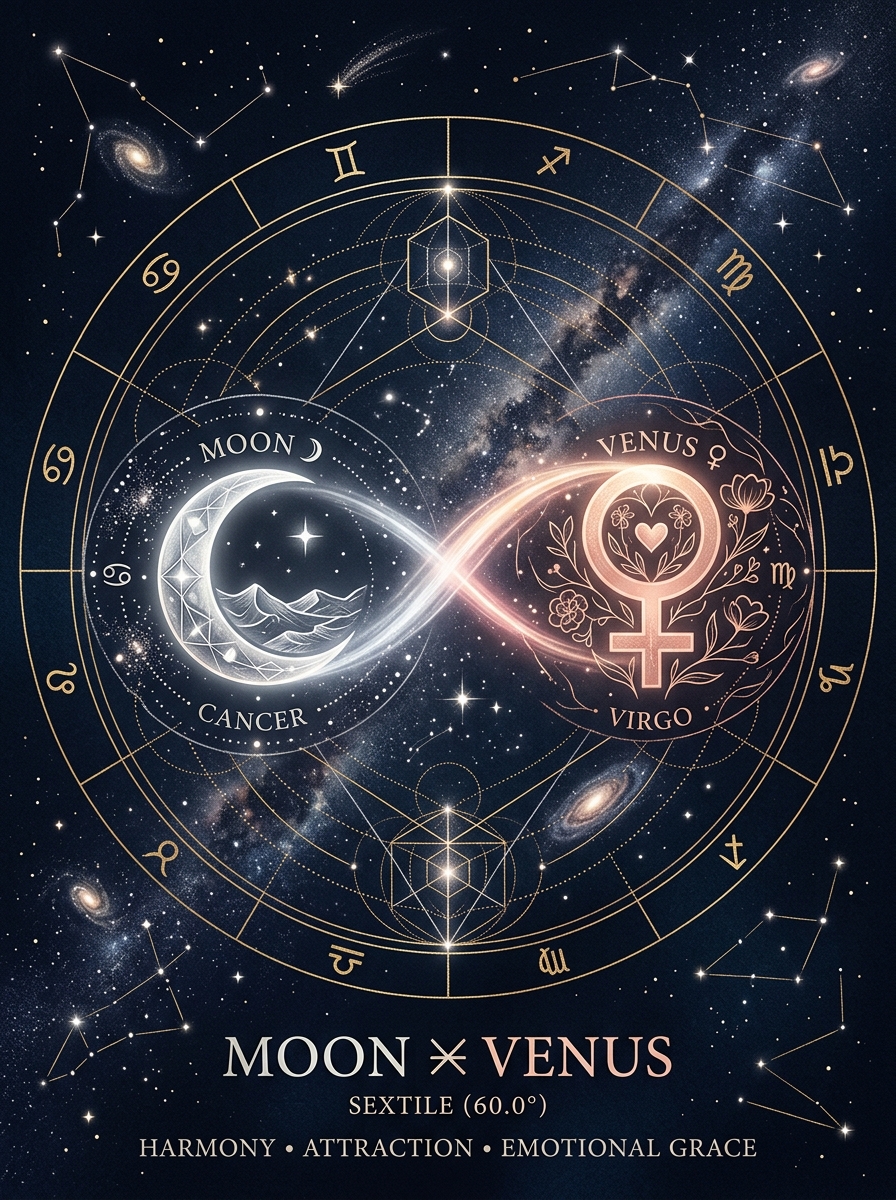
Moon sextile Venus in synastry is not the signature of instant obsession; it is the subtler miracle of being pleasantly, instinctively received. One person’s need for emotional safety and nourishment meets the other’s style of affection, pleasure, and relational tact, and the two are angled toward cooperation rather than collision. The core thesis is simple: this aspect creates an easy channel for comfort, liking, and reciprocity, but its real power lies in how naturally it turns feeling into kindness and attraction into daily habit.
The Core Dynamic: What This Aspect Actually Is
A sextile is an aspect of opportunity, not compulsion. It does not force fusion the way a conjunction can, and it does not create the high-voltage fascination of a square or opposition. Instead, the Moon and Venus recognize one another as compatible functions of human attachment: one seeks emotional safety, the other seeks delight, beauty, and mutual regard. In practice, that often feels like being able to breathe around each other. The Moon person tends to feel soothed, and the Venus person feels appreciated rather than consumed.
This is one reason the contact can be mistaken for “nothing special” by people who only notice drama. But synastry is not always loud before it is lasting. Moon-Venus sextile often shows up as the partner who remembers your favorite tea, the one whose tone is gentle when you are raw, the person whose touch somehow lands exactly right. It is sensual in the broad sense: the body relaxes, the nervous system softens, the face changes. For a broader frame on this family of contacts, the article on Moon-Venus synastry names the wider sanctuary these two planets build together.
Psychological Roots: Why This Ease Forms
The sextile works because there is no inherent friction between the Moon’s instinct and Venus’s value system. The Moon wants to be received in its raw emotional state; Venus wants to offer a form of appreciation that preserves dignity and choice. When these two desires link by a 60-degree angle, they do not compete for the same relational territory. Instead, each validates the other: Venus gives affection that the Moon does not have to earn, and the Moon gives emotional attention that Venus does not have to coax.
This is psychologically important. Many synastry aspects force one partner to adapt to the other’s emotional language under pressure. Here, the adaptation is almost unconscious. The Venus person tends to express care in a way that feels natural because the Moon person’s receptivity is so transparent. The Moon person tends to open emotionally because the Venus person’s style of affection never feels invasive. That reciprocal ease is what makes the bond feel clean and unpressured. The sextile aspect meaning page explains why this geometry works by invitation rather than force—a dynamic that is central to understanding this pairing’s psychological architecture.
How It Matures vs. How It Goes Shadow
The maturation of Moon-Venus sextile is often invisible to outsiders but deeply felt by the couple. Over time, attraction becomes habit: a shared laugh, a preferred meal, a certain hour of the day that belongs only to them. The relationship develops an aesthetic of intimacy—small rituals that feel private and almost ceremonial. This is not about grand gestures; it is about the consistency of goodwill. The pair tends to age together like a well-loved room, each knowing exactly how to adjust the light for the other.
But the shadow of this aspect is not conflict; it is complacency. Because the sextile is so smooth, the couple can unconsciously protect harmony at the expense of depth. They may become experts in pleasantness while avoiding the harder work of differentiation. The relationship then remains charming but slightly under-oxygenated. No one is pushed enough to reveal the full contour of their need, and no one is asked to risk disappointment. This is a subtle danger because the connection usually feels good even when it is not growing. Sextiles are cooperative by nature, but cooperation still requires activation. If the pair relies only on mood and mutual liking, they may circle the same emotional territory for years. The bond becomes habit without revelation. The remedy is not conflict for its own sake; it is deliberate intimacy—the willingness to speak the less polished truth before sweetness hardens into avoidance. For a more exacting contrast, the Sun-Moon synastry page shows what happens when identity and feeling produce either union or existential pressure; that pressure is something this sextile sidesteps, sometimes to its own detriment.
The Venus side of the trap
The Venus person may be tempted to keep things aesthetically balanced rather than emotionally real. If the atmosphere stays lovely, Venus can imagine the work is done. But Moon-Venus sextile needs emotional honesty beneath the charm. The Moon person’s needs are not always “romantic”; they may be messy, repetitive, or inconvenient. When those needs are continually prettified, the intimacy gradually thins.
The Moon side of the trap
The Moon person can also collude with ease by becoming quietly dependent on being soothed. If Venus is always available in just the right way, the Moon may stop asking itself what it truly wants beyond comfort. That creates a relationship of pleasant anesthesia: lovely, intimate, and oddly unfinished. The Moon person may feel loved, but not necessarily met at the edge of vulnerability. The sextile’s opportunity quality matters here—it opens a door, but someone has to walk through it.
How It Plays Out in a Life: Love, Friendship, Work
Because the dynamic is already established, we can turn to its concrete expressions without re-deriving the core. In love, Moon-Venus sextile often produces couples who are easy to imagine in domestic settings. They may not have the highest passion in the room, but they have the most usable tenderness. Shared errands become sweet exchanges; a rough day is softened by someone who knows exactly how to offer comfort without overdoing it. The relationship tends to improve social grace between partners—they are easy to introduce to family, easy to bring into a room. This is one reason the contact can support long-term pairing even when it is not the most erotic aspect in the chart. Where other contacts demand constant renegotiation, this one offers a baseline of goodwill.
In friendship, the aspect fosters a bond that feels both affectionate and unpressured. The Venus person appreciates the Moon person’s emotional availability; the Moon person feels seen by the Venus person’s tact. They may become each other’s confidants not because of shared intensity but because the channel is so open. In work, this dynamic can translate into collaborative harmony—a manager who knows how to praise without overvaluing, a colleague whose emotional instincts align with the team’s aesthetic. The synastry aspects page situates this softness among stronger signatures, showing how it contributes to the overall relationship picture.
The Long Arc: Why It Often Lasts
Moon sextile Venus is one of those synastry contacts that ages well when it is respected. It may not produce the dramatic narrative of “we fought, we transformed, we survived,” but it can produce something harder to counterfeit: affection that remains usable. Years into a relationship, the pair often still knows how to soften each other. That is not a small thing. Many bonds can ignite; fewer can keep the emotional weather livable.
The aspect is also beautiful for friendship inside love, or love that never loses friendship. Venus wants to like the person she loves; the Moon wants to feel safe with the person who matters. When these two desires are linked by sextile, the relationship can preserve tenderness under pressure. Even when life becomes difficult, the couple often has access to a shared language of care. That language may not solve everything, but it keeps the door open.
For readers building a fuller synastry picture, the astrological synastry guide and the love synastry guide place this aspect in its larger relational ecology. For a step-by-step method that reads Moon-Venus sextile alongside other contacts, the synastry step-by-step page offers a complete framework. And if you want to compare this soft compatibility with a more explicitly erotic pairing, Venus-Mars synastry shows what happens when desire is asked to carry more heat than comfort.
In the end, Moon sextile Venus is the geometry of being received well. It does not promise ecstasy every day, but it offers something many charts envy: the sense that affection and feeling know how to meet without argument. That is the quiet basis of trust, and trust is often where love becomes durable.
Related
- Moon Sextile Neptune: The Compassionate Current
- Moon Conjunct Venus in Synastry: The Tender Current That Turns Chemistry into Care
- Moon Sextile Venus: The Quiet Accord of Feeling and Grace
- Synastry Sun Sextile Venus: The Ease That Makes Desire Feel Human
- Moon Sextile Moon in Synastry: The Quiet Ease of Shared Weather
- Moon Trine Venus in Synastry: The Soft Geometry of Being Easily Loved
Comments
Loading comments…