Sun Square Venus in Synastry: Attraction, Friction, and the Price of Chemistry
The Core Dynamic: A Mismatch That Catches
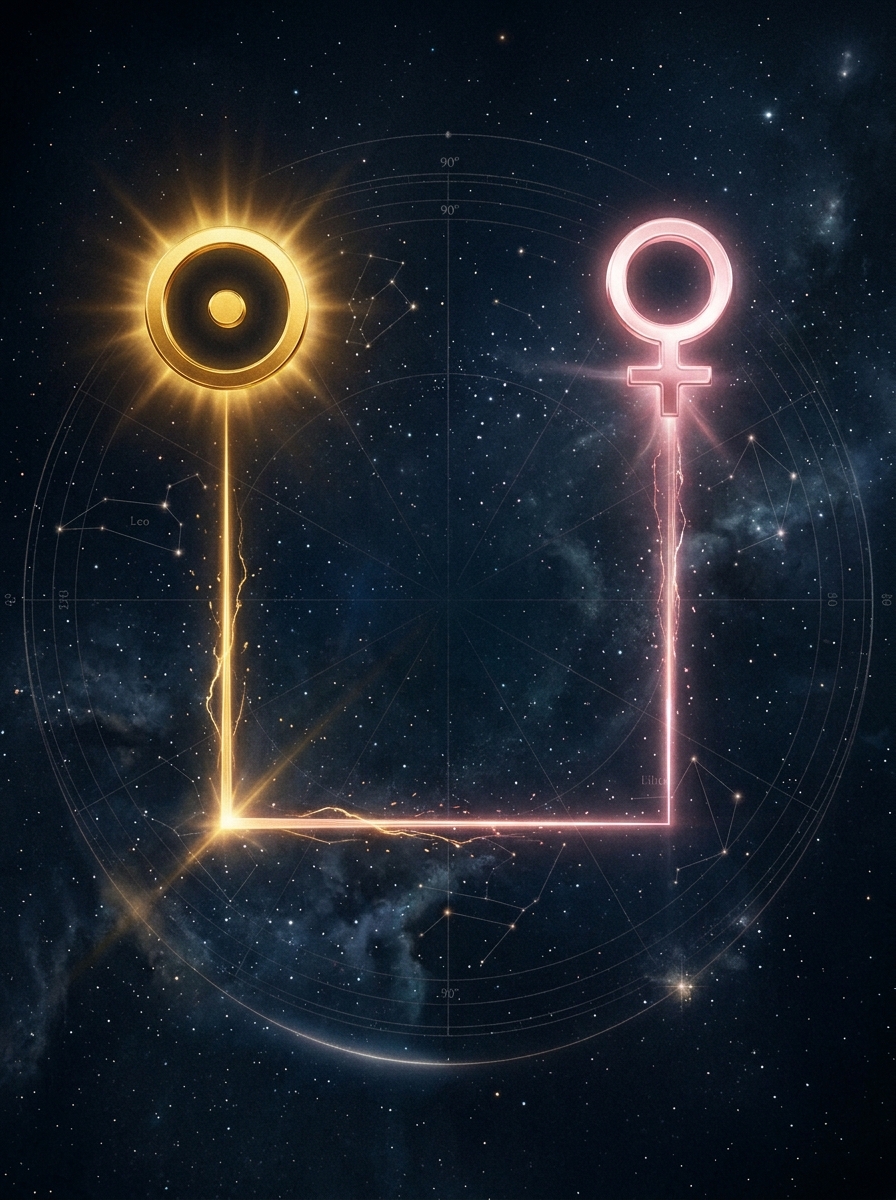
Sun square Venus in synastry is not a gentle meeting. The Sun — the ego’s need to shine, to be seen as central, to express identity without apology — encounters Venus, that part of us which seeks harmony, pleasure, aesthetic agreement, and the graceful giving of affection. The square aspect (90°) does not repel these two energies; it locks them together in a relationship that feels magnetic and irritable at the same time. The attraction is real, but the rhythm is wrong.
In the broader language of synastry aspects, squares force contact through tension. Here, the tension lives in the gap between how one person wants to be loved and how the other naturally loves. The Sun person may feel adored, then subtly corrected. The Venus person feels charmed, then overruled on matters of taste. Neither is wrong, and neither can pretend the other doesn’t matter. That is the signature of this aspect: an inescapable, consequential chemistry that refuses to settle into ease. For more on how squares work as catalysts across all chart comparisons, see the astrology of the square aspect.
The Psychological Architecture: Why Wanting Meets Resistance
Every square in synastry carries a projection. The Sun projects onto the Venus person a fantasy of perfect admiration: someone who will reflect the Sun’s brilliance without filter. But Venus is not a mirror; she is a curator. She evaluates, selects, and withholds. The Sun feels this as withholding — a critique masked as preference. The Venus person, meanwhile, projects onto the Sun a hope of effortless reciprocity: someone who will align with their sense of beauty and social grace. Instead, the Sun asserts its own style, and Venus feels unappreciated.
This is not a battle of adversaries but of two people signaling love in opposite languages. The Sun expresses love by being vibrantly itself; the Venus person expresses love by refining the shared environment. Each expects the other to meet them on their terrain, and each is disappointed. The disappointment is not indifference — it is the sharper pain of caring while being misunderstood.
The dynamic traces back to the self-worth issue each partner brings. The Sun person may have a core need to be chosen without condition; the Venus person may need to feel that their taste is valued, not overridden. When these needs collide, the relationship becomes a stage for old wounds about approval, vanity, and the fear of being unloved for one’s true self. This psychological depth is why the square deserves reading within the full frame of astrological synastry, where the entire chart reveals how each partner’s history of love plays out.
Where the Friction Lives: Taste, Ego, and the Social Stage
The friction of Sun square Venus rarely erupts in dramatic arguments. It shows up in the small, repeated misfires: a comment on an outfit that lands as a judgment, a preference for a restaurant that feels like a rejection of the other’s choice, a public moment where one person’s exuberance clashes with the other’s need for composure. These are not superficial quarrels; they are the arena where identity and affection wrestle.
Venus cares about the aesthetic container of the relationship — how it looks, feels, and harmonizes with social life. The Sun cares about being able to express itself without curating its edges. In synastry house overlays, the friction becomes concrete: if the square falls across the 5th and 8th houses, the tension may involve romance and sexuality; across the 2nd and 11th, values and friendships. The house placements tell you where the mismatch lives, but the aspect itself tells you how it will feel: like two people who keep standing in each other’s light.
The Venus person’s natal sign colors how the friction expresses. A Venus in Leo may want the Sun to perform its brilliance, then complain that it’s too much. A Venus in Virgo may offer corrective care that reads as nitpicking. A Venus in Libra may smooth over conflict until the square erupts in passive tension. The same is true for the Sun: a Sun in Aries will charge at the friction head-on; a Sun in Pisces may absorb the chalkiness and internalize it. For a deeper look at how Venus manifests in specific signs, see Venus in Leo or Venus in Virgo as typical examples.
Maturation and Shadow: How the Square Either Forges or Fractures
The shadow of Sun square Venus is vanity – a mutual obsession with how the other sees them, which degrades into performance on one side and judgment on the other. The Sun becomes louder to win approval; Venus becomes quieter to protect its standards. The relationship hollows out into a series of silent negotiations about who gets to define “good enough.”
But the square also carries an evolutionary function. When both partners recognize that the friction is not personal — it is structural — they can stop blaming each other and start translating. The Sun learns that being adored is not the same as being loved; it must let Venus keep its own aesthetic autonomy. The Venus person learns that love does not require harmony of style; it requires respect for the other’s right to exist unedited.
In practice, this means learning to say: “I need you to let me be myself even when it doesn’t match your taste,” and “I need you to value my refinement as an expression of care, not as a correction.” The relationship becomes a workshop in self-differentiation — the Jungian capacity to stay connected without fusing. This is especially potent if the synastry includes a T-square pattern, where the square to Venus becomes the pressure point for growth in other chart areas.
A mature Sun square Venus relationship does not eliminate the tension; it re-frames it. The couple learns to enjoy the spark of difference rather than try to smother it. They stop asking each other to be easier and start asking how to be clearer. The love that results is not the love of two people who fit — it is the love of two people who chose each other despite the strain, and who keep choosing.
The Gift of the Mismatch
At its highest expression, Sun square Venus teaches that attraction does not guarantee alignment, and that misalignment does not ruin desire. The relationship stays alive because each partner remains a little foreign, a little resistant, a little worth the trouble. That is not failure; it is the price of real intimacy, which always includes the other’s irreducible strangeness.
The aspect asks a final question: can you love someone whose style of love does not mirror your own? If yes, you gain a relationship that is not a refuge from growth but a crucible for it. This is love as the alchemist’s labor — and the result, when it holds, is a bond that glows with something rarer than ease: truth.
For more on how this aspect integrates into the larger story of a relationship, see the guide on the alchemy of love synastry.
Related
- Synastry Sun Opposition Venus: Attraction at the Edge of Friction
- The Beautiful Friction of Sun Square Venus
- Moon Square Venus in Synastry: Sweetness Under Strain
- Sun Square Sun in Synastry: When Two Solar Egos Strike Spark and Steel
- Synastry Venus Opposition Venus: The Beauty of Mismatch, the Friction of Want
Comments
Loading comments…