Moon Sextile Neptune: The Compassionate Current
The Core Dynamic: A Steady Tide Between Feeling and Vision
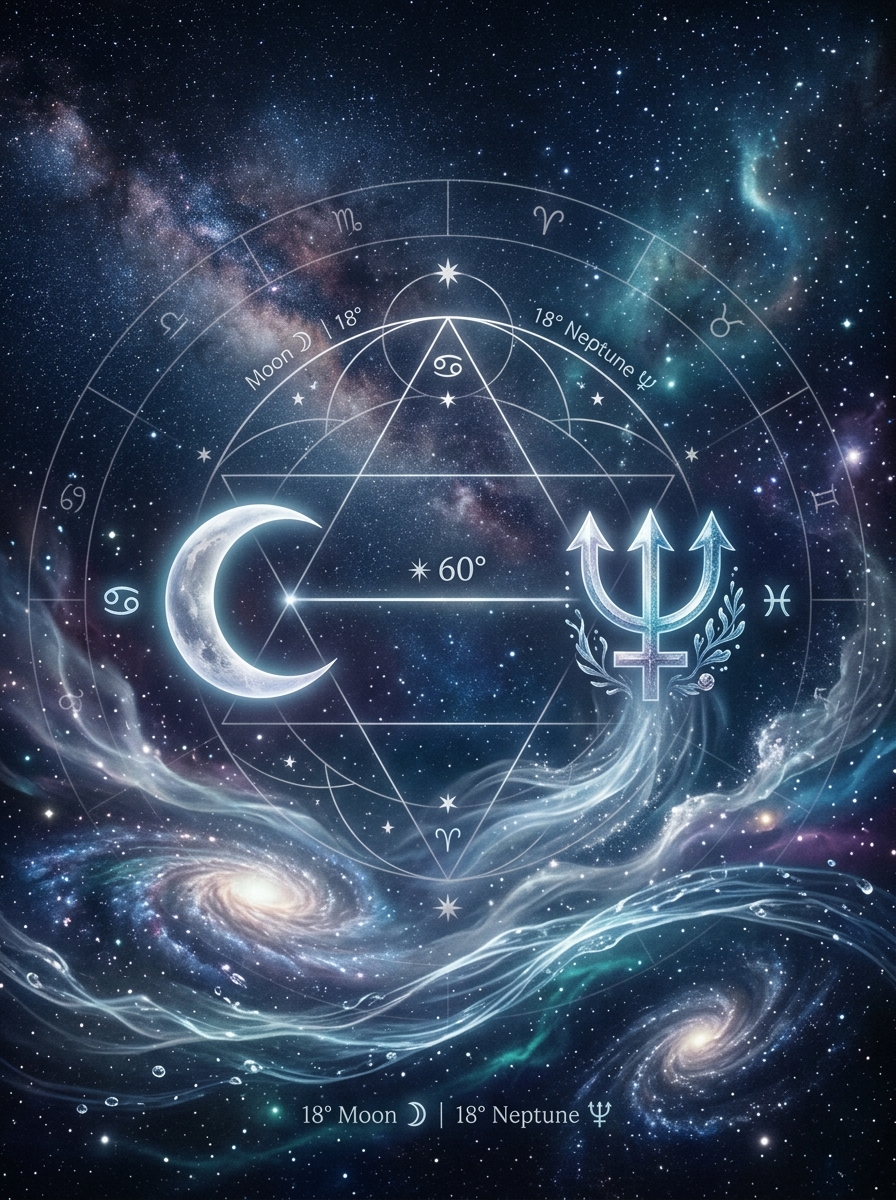
Moon sextile Neptune describes a psyche that can feel the room and the dream at the same time. The Moon holds instinct, memory, attachment, and the body’s private weather; Neptune dissolves boundaries, opens imagination, and hears what is unspoken. In a sextile, these two do not merge into chaos or conflict. They cooperate. The result is often an emotionally permeable person with a gift for intuition, empathy, imagination, and symbolic thinking—someone who can sense mood before language arrives.
This is not the hard glamour of a square or the fusion of a conjunction. It is a usable current, a talent that becomes stronger through participation. The sextile wants activation, and the sextile aspect is one of astrology’s clearest signatures of latent capability that responds to conscious choice. With Moon sextile Neptune, the feeling life does not merely register facts; it translates them into atmosphere, image, and meaning. That translation can be healing, artistic, or devotional. It can also be evasive if the native uses sensitivity to escape direct contact with pain. The aspect’s promise is not absence of distress but a refined way of metabolizing it.
How It Forms: Emotional Memory Meets the Imaginal World
The origins of this aspect often lie in a childhood where emotional truth was carried in the air rather than spoken. The native may have grown up in a family atmosphere shaped by secrecy, sacrifice, artistic sensitivity, religious devotion, or unspoken grief. They learned to read what was not said—a parent’s fatigue, a household’s hidden mood, the gap between words and feeling. That training in subtext becomes the raw material of the sextile.
The Moon’s need for safety encounters Neptune’s gift for diffusion. Instead of withdrawing from uncertainty, the child finds refuge in imagination. Music, stories, fantasy, and private ritual become containers for feelings that otherwise have no name. This is not escapism in the degraded sense; it is a survival strategy that, over time, becomes a perceptual skill. The person often remembers not only what happened but how the light felt in the room during a difficult conversation. They carry an archive of emotional atmospheres.
This developmental path means the sextile is not a mystical inoculation against pain. It is a coping mechanism that, if recognized, can be transformed into a refined instrument. The raw receptivity is always there; the question is whether the person learns to use it deliberately or stays a passive receiver of everyone else’s weather. That choice is what separates the gift from the wound.
The Gift and the Shadow: Two Sides of Porousness
At its best, Moon sextile Neptune produces compassion without self-congratulation. The person understands vulnerability from the inside and can hold another’s grief or confusion without needing to fix it. They often have a private moral code less about rules than about not betraying tenderness. In creative work, this aspect shows up as an ability to translate feeling into symbol—music, poetry, image, gesture—so that what is inchoate finds form. The imagination becomes a place where emotions can live in metaphors instead of wounds.
But the same porousness that enables empathy can also lead to idealization. Because the sextile is harmonious, the native may trust emotional impressions too readily, especially in intimacy. They can fall in love with a possibility, a projection, or a person’s wounded potential rather than their real behavior. This is where the aspect can resemble the more devotional side of Neptune in the 7th House, where the beloved becomes a mirror for longing rather than a separate human. The difference is that the sextile usually brings less tragedy and more subtle drift: promises are not broken, they simply never quite anchor.
Neptune does not only inspire. It also anesthetizes. A person with this aspect may use sleep, fantasy, media, substances, or spiritual idealism to drift away from emotional discomfort. If the Moon is already stressed by other chart factors, the native can become exquisitely attuned to others while losing contact with their own needs. The remedy is specificity: naming feelings in plain language, checking impressions against evidence, and tolerating the banality of facts. Routine and structure—especially when the chart has heavier water or mutable emphasis—strengthen the aspect by giving it a vessel. The more grounded expressions of Neptune, such as Neptune in Taurus or Neptune in the 6th House, remind us that inspiration requires a container.
The mature form of the aspect is not innocence but refined receptivity. The person learns that empathy is not fusion, that imagination is not denial, and that softness is strongest when it knows where the shore is. They can welcome ambiguity without surrendering discernment. They can feel the ache in a room and still tell the truth about it. That capacity—to hold grief, beauty, longing, and hope in the same hand without letting go of reality—is the central achievement.
How It Lives: Love, Work, and Inner Practice
In relationships, the native may long for soulful connection and telepathic understanding. They are often generous, forgiving, and deeply moved by emotional sincerity. But they must guard against over-merging. The sextile feels so giving that they may postpone asking for clarity until confusion has hardened into pattern. They do best with partners who value emotional honesty over performance and who bring enough earth to keep the dream from evaporating. This dynamic resonates with other configurations where feeling and vision already have an articulate home, such as Cancer Sun, Leo Moon or Aquarius Sun, Pisces Moon.
Professionally, this aspect suits work that requires listening between the lines: counseling, healing arts, film, photography, music, design, nonprofit service, hospice, spiritual guidance—any role where emotional atmosphere matters. The native often does best in environments that value nuance over aggression. If the chart also carries earth, the gift can become highly functional: a talent for making beauty useful, or for bringing humane intelligence into systems that are otherwise dry.
In spirituality, Neptune is naturally devotional, but with the Moon sextile, practice is usually felt rather than theorized. The native may be drawn to ritual, meditation, dream recall, ocean imagery, or forms of worship that honor feeling as a valid mode of knowing. The soul does not need an ideology here so much as a rhythm. That is why transits to this aspect can be so meaningful: Neptune transits can reveal when the current intensifies, clarifies, or dissolves old emotional structures. The natal sextile means the person already has some skill at swimming in that current—but the current still demands conscious navigation.
When the aspect is fully owned, the native becomes someone who can see clearly without losing the music. They keep the heart open without letting it go vague. Moon supplies the body’s truth; Neptune supplies the image that gives truth a soul. Between the two, the psyche learns to listen until confusion turns into meaning.
Comments
Loading comments…