Chinese Zodiac: The Ox and the Intelligence of Endurance
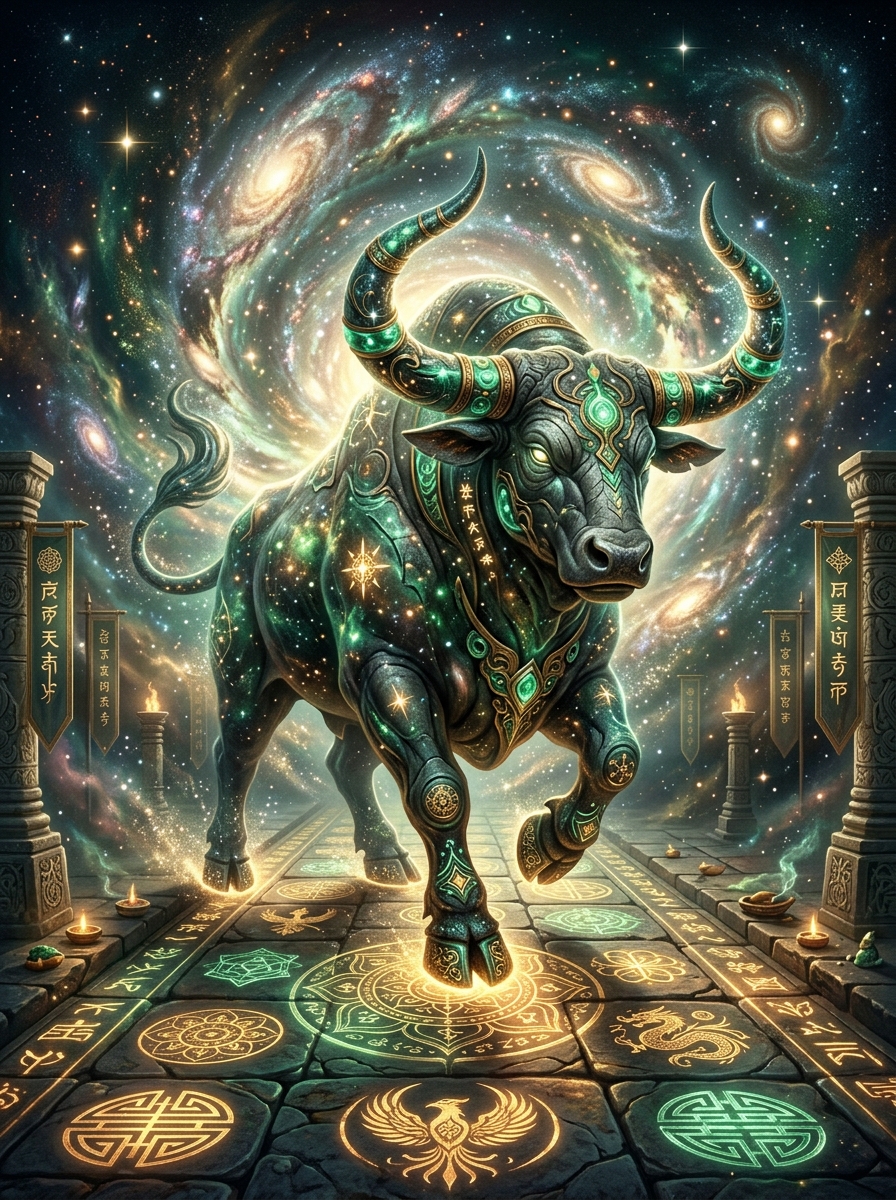
The Ox is not a personality type. It is a way of organizing energy: slow, dense, and almost geological in its patience. In the Chinese zodiac, the Ox carries the weight that other signs only gesture toward. To understand it is to recognize that endurance is not a fallback virtue—it is a form of intelligence, one that reads the world in terms of load and time rather than flash and moment. This sign does not react; it accumulates.
The Ox as a force, not a type
Every animal sign in the Chinese zodiac encodes a seasonal rhythm, and the Ox belongs to deep winter—the time of consolidation, storage, and waiting for the thaw. That seasonal root explains why the Ox is often misunderstood as passive or stolid. In fact, it is highly active internally, metabolizing experience into a private code of discipline and expectation. Where other signs chase novelty, the Ox tests for what will hold. Where others improvise, the Ox repeats until competence becomes instinct.
This is not conservatism for its own sake. The Ox operates on a principle of economy: energy is finite, so it must be spent on what has proven its weight. That makes the Ox unusually good at long projects, institutional memory, and any task that requires sustained attention without degradation of quality. Its caution is not fear—it is a measurement of friction. To understand how this fits into the larger symbolic grammar, the mechanics and meaning of the zodiac provide the frame: every sign is a seasonal force, not a static label.
The private standard
What others see as stubbornness is often the Ox’s loyalty to an internal ledger. It trusts what has been tested by repetition. A promise must match a pattern; a person’s words must align with their actions over months, not minutes. This can make the Ox appear skeptical or reserved, but the deeper truth is that it values dignity—especially the dignity of work done correctly. It bonds slowly, yet once bonded, it offers a field of safety that is almost architectural. The Ox does not need to be liked. It needs to be relied upon.
The mechanics of Ox energy: pressure, patience, and the private code
The Ox builds its sense of self through resistance. Not resistance to others, but to chaos, to waste, to the entropy of unexamined choices. This is why many Ox people seem to have an unusually high tolerance for boredom: they are not bored—they are filtering sensation through a grid of relevance. What looks like emotional flatness is often a deep concentration on what matters.
Psychologically, the Ox matures early in one specific way: it knows that life is won by accumulation, not by flashes of brilliance. It does not confuse intensity with importance. This makes it excellent in roles that demand reliability under pressure, but it also creates a shadow. The same grid that filters out noise can also filter out surprise. When the Ox becomes rigid, it mistakes its own caution for wisdom and endurance for virtue in itself. The Jungian dimension is clear: the Ox can embody the ego’s need for structure so completely that it becomes defensive against the unconscious, which is by nature fluid and symbolic. The task is not to become less solid, but to allow life to move through the structure without destroying it.
The Ox belongs to the earth element in the Chinese elemental cycle—not the Western fixed earth of Taurus, but an earth that is about containment and materialization. On the zodiac wheel, the Ox occupies a position that emphasizes foundation-building. It is the sign that turns intention into form, but only if the intention is tested and true.
What the Ox notices first
The Ox notices what will last. It sees load-bearing facts: whether a team has real cohesion, whether a relationship has structural integrity, whether an investment is sound. This is not pessimism; it is a form of foresight that prizes sustainability over excitement. In a culture that rewards speed, the Ox restores proportion. It is the part of the psyche that asks what remains true after the applause ends.
Mature expression and the shadow of inertia
When the Ox is in its healthiest form, it becomes a source of sustainable force. It does not merely keep going; it keeps going without degrading the quality of what it is doing. This is the sign that preserves institutions, protects families, and builds trust over decades. The mature Ox learns that structure is meant to shelter life, not replace it. It can allow softness without losing stability—warmth without collapse.
The shadow of the Ox is not cruelty; it is inertia. When threatened, it can become rigid, territorial, or emotionally withholding. It may confuse constancy with control, mistaking the absence of motion for safety. Conflict with an Ox person is rarely theatrical at first—it contains, compresses, and stores the charge. That makes it formidable when it finally speaks, because the reaction has had time to become dense. The remedy is not pressure, but clarity. The Ox respects plain speech, especially when it is grounded in fact and free of manipulation.
This archetype can also fall into a trap of moralizing endurance: treating hardship as inherently virtuous, even when the hardship is unnecessary. The mature Ox learns to distinguish between the kind of patience that builds and the kind that merely tolerates. The first is wisdom; the second is self-betrayal.
Relationships: who can meet the Ox without flattening it
In love, friendship, and work alike, the Ox does not bond through rhetoric. It bonds through demonstration. The most seductive thing to an Ox is someone who shows up, remembers details, and builds a life with patience. Grand declarations are pleasant but carry no metaphysical weight next to a pattern of reliability. The Ox offers loyalty that is almost ceremonial—but it expects the same.
Compatibility for the Ox is less about chemistry in the glittering sense and more about whether another sign can respect its tempo. The Ox does not thrive when rushed, theatrically tested, or emotionally cornered. For the psychological logic behind sign pairing, the guide to zodiac sign compatibility explores how these dynamics work across the full chart.
Ally patterns
The Rat often pairs well with the Ox because the Rat’s mental agility complements the Ox’s grounded execution. The Rat invents; the Ox stabilizes. That can become a powerful partnership if neither tries to dominate the other’s method. The Snake is another natural ally: perceptive, strategic, and comfortable with depth rather than display. Together, they can create a relationship built on quiet intelligence and mutual respect. The Rooster also resonates: both value competence, order, and practical results. The Rooster brings precision and articulation; the Ox brings patience and force. These pairings often work because the other sign does not try to convert the Ox into something flashy.
The Tiger can provoke the Ox because both carry force, but they express it differently: the Tiger wants freedom and dramatic assertion, while the Ox wants order and controlled power. In the healthiest version, these tensions become complementary—but it requires genuine respect on both sides. The Horse may challenge the Ox with a preference for speed and autonomy. Where the Horse seeks horizon, the Ox seeks foundation. The point is not to sentimentalize conflict; the Ox needs partners who can admire its steadiness without mistaking it for dullness.
The Ox in time: elements, directions, and the life path
The Ox prospers when supported by conditions that stabilize effort and reduce friction. Traditional correspondences are not superstition—they are a symbolic language for how this energy works best. The most favorable element is Earth, which mirrors its natural temperament: grounded, slow-building, durable. Lucky colors include white for clarity, yellow for confidence, and green for renewal. The numbers 1 and 4 evoke initiation and structure; the directions northeast and north suggest grounded ascent.
But not every Ox year feels identical. The animal is filtered through the cycle of the Five Elements, giving each Ox a different accent. An Earth Ox is especially stable and pragmatic; a Metal Ox can become even more disciplined and sharp; a Water Ox tends to be more psychologically receptive; a Wood Ox is principled and growth-oriented; a Fire Ox brings visible force, sometimes at the cost of its usual patience. These variations matter because they explain why one Ox may appear reserved and another formidable—they are not the same sign in the same season.
The life lesson of the Ox is hard and useful: what is worth having is often worth becoming strong enough to carry. This sign does not seduce with ease. It instructs through resistance, labor, and fidelity to reality. In a culture obsessed with speed, the Ox restores proportion. It is the part of the psyche that remembers what remains after the applause ends—and that is why it endures. For the larger system that gives the Ox its meaning, the zodiac as a compass and the zodiac wheel offer the map. The Ox simply walks it, step by step, until the path is solid beneath everyone who follows.
Related
- Chinese Zodiac: The Pig and the Art of Generous Fortune
- Chinese Zodiac: The Dog and the Ethics of Loyalty
- Chinese Zodiac Goat: The Graceful Soul, the Quiet Strategist, and the Art of Soft Power
- Chinese Zodiac: The Dragon — Power, Magnetism, and the Art of Command
- Chinese Zodiac: The Rabbit and the Art of Quiet Power
Comments
Loading comments…