Chinese Zodiac: The Horse and the Fire That Refuses a Fence
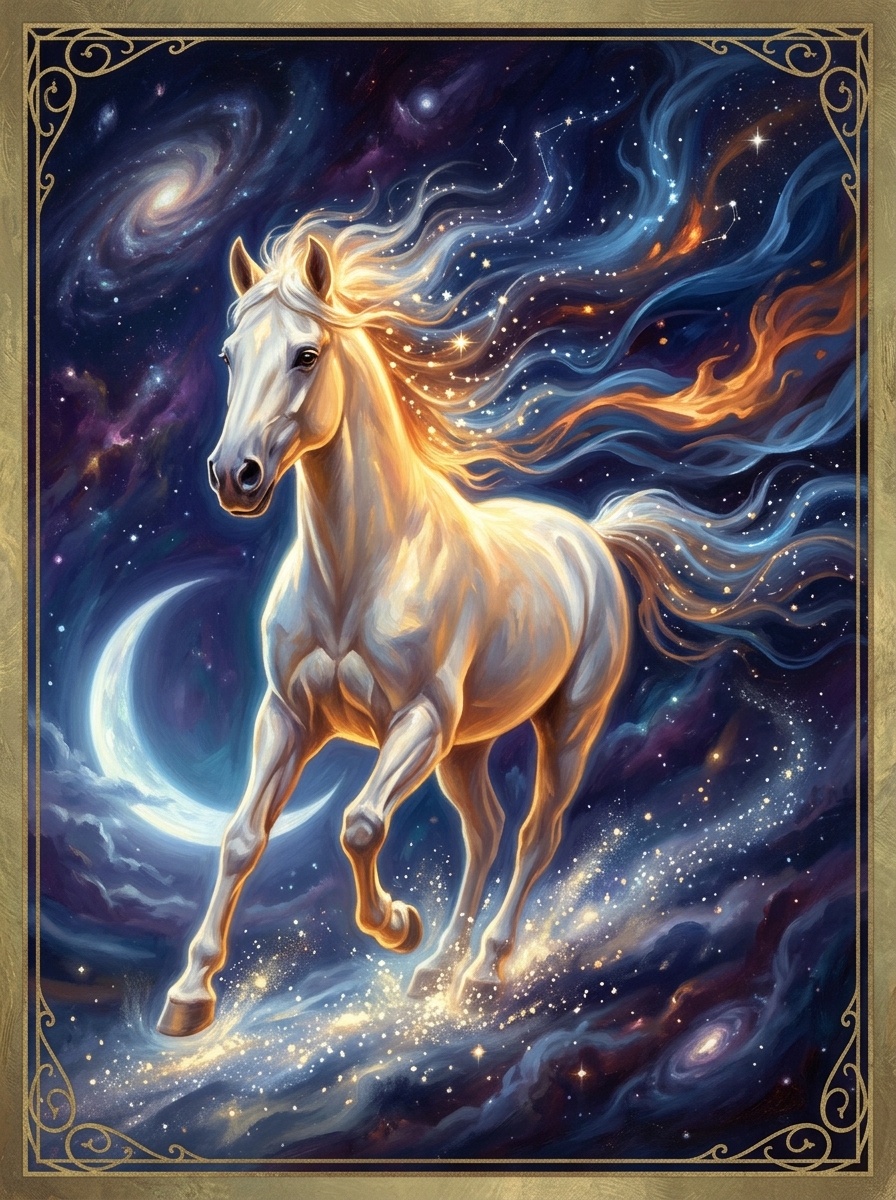
The Horse is the Chinese zodiac’s cleanest expression of motion: alert, self-propelled, hard to contain, and most alive when it has room to move. Its core thesis is simple and non-negotiable — this archetype needs freedom the way other temperaments need certainty, security, or routine. When that need is honored, the Horse becomes magnetic, spirited, persuasive, and surprisingly loyal. When it is cornered, it turns restless, evasive, or abruptly gone. The system that houses this symbolism, the Chinese zodiac, is a cyclic map of temperament rather than a fixed sentence, much like the framework explained in The Celestial Compass, and the Horse occupies one of its most unmistakable positions.
The Core Thesis — Motion as Identity
The Horse is associated with vitality, speed, charisma, and a mind that prefers direct experience over abstraction. In the inner life, its energy feels like an engine already idling at the curb: ready, impatient, alive to possibility. This is not merely “high energy” in the generic sense. Horse energy is directional. It wants a horizon, a challenge, a road, a race, a cause, a romance, a stage. Left without a target, it becomes scattered; given one, it can look almost miraculous in its stamina.
That makes the Horse one of the zodiac’s most socially legible archetypes. People feel its presence before they analyze it. The Horse speaks quickly, decides quickly, and moves quickly, and others experience that as charisma or as pressure depending on their own pace. There is an unmistakable Solar quality here: like Leo — explored in depth on the Leo archetype page — the Horse does not want to hide its life force. It wants to be seen in motion. But where Leo radiates pride and the need for recognition, the Horse radiates propulsion and the need for a path. The difference matters. Pride can be satiated with applause; propulsion requires a direction.
This directional instinct is the Horse’s genius and its vulnerability in the same breath. It knows how to initiate, inspire, and take off. It is far less interested in systems, maintenance, or slow consolidation. In a culture that rewards hustle, the Horse can over-identify with velocity and mistake motion for progress. Yet when this sign matures, it learns that real freedom is not frantic. It is chosen movement, not compulsion. That distinction becomes the central task of the Horse’s psychological development.
What Drives the Horse — and What Derails It
Psychologically, the Horse often protects a vulnerable center with competence, speed, and self-direction. Many Horse natives would rather carry their own load than wait for help that may arrive too late. This can look admirable, and often it is, but it can also conceal an old fear of being constrained, evaluated, or emotionally pinned down. The Horse does not merely like independence; it may experience dependence as a loss of identity. The archetype’s relationship to autonomy is so deep that it functions almost as a survival instinct.
This is where the Horse’s brilliance and its blind spot share the same root. The same engine that lets the Horse initiate, inspire, and accelerate also makes it prone to flight as a primary defense. When hurt, embarrassed, or controlled, Horse energy tends to vanish into busyness, flirtation, travel, ambition, or a new obsession. It becomes allergic to anything that feels heavy, recursive, or emotionally sticky. That is why the Horse sometimes disappoints people who confuse intensity with reliability — it may be passionately present in the beginning and then retreat when the demands of continuity arrive. For a broader map of how such temperamental patterns interact across the full zodiac, the Zodiac Wheel offers a useful structural lens.
The Shadow Pattern — Flight as Defense
The shadow of the Horse is not malice; it is escape. A second shadow pattern is pride. The Horse prefers to preserve dignity through self-sufficiency, but when that hardens, it refuses help even when help would strengthen its life. It may also underestimate quieter forms of intelligence: patience, repetition, timing, and the slow building of trust. The Horse does not naturally worship process. It has to learn that some victories are won by pacing, not galloping. The Aries archetype, with its similar impatience and appetite for the new, shares this tendency toward initiation without follow-through, as detailed on the Aries sign page.
Maturation — Velocity with Fidelity
The mature Horse learns to unite velocity with fidelity — to keep moving without abandoning what matters. This is not a contradiction but a refinement. Real freedom, the Horse discovers, is not the absence of constraint but the capacity to choose one’s commitments and honor them without feeling trapped. The Horse that reaches this stage becomes unusually effective: it still moves fast, but it moves in arcs that return to what it loves. That is the difference between a wild horse and a horse that has found its rider — not submission, but partnership.
The Horse in Relationship, Work, and World
Once the core dynamic is established, everything else follows as application. The Horse does not change its nature in love versus work; it expresses the same drive for freedom, direction, and vitality across every domain. The key is understanding how that drive manifests in different contexts without treating each context as a separate personality.
Love Language — Freedom as the Foundation
In relationship, the Horse is attracted to vitality, humor, and self-possession. It wants a partner, not a cage; a co-adventurer, not a supervisor. Romance thrives when the bond offers freedom, admiration, and movement. The Horse dislikes emotional interrogation, possessiveness, and clinginess. It fares best with people who can stand beside it without trying to become its bridle. But the Horse is not incapable of deep attachment. Once it chooses, it can be fiercely loyal. The crucial condition is that loyalty must remain voluntary. The Horse rarely responds to guilt. It responds to respect. When loved well, it becomes playful, protective, and intensely motivating to those in its orbit. It is one of the signs most capable of making life feel larger.
Compatibility — Who Can Share the Path
The Horse is most compatible with signs that understand movement without trying to dominate it. In classic Chinese zodiac patterning, the Tiger and Dog are natural partners because they match the Horse’s courage and respect its autonomy. The Tiger brings shared momentum and an appetite for the authentic life; the Dog brings loyalty, moral steadiness, and enough realism to keep the Horse from outrunning its own responsibilities. These pairings work because they do not force the Horse to become smaller. They give it a worthy field.
There can be friction with more controlling or structurally rigid temperaments. A Horse paired with a personality that equates love with supervision will quickly feel caged. Capricorn, with its preference for structure and long-term consolidation, can create productive tension with the Horse — but only if both parties respect what the other brings, as discussed on the Capricorn archetype page. The same logic extends across the wider zodiac: people do better together when their rhythms complement rather than compete, a principle explored in the zodiac sign compatibility guide.
Work and Vocation — The Need for a Horizon
In work, the Horse brings initiative, a live-wire intelligence, and an ability to sense what must be done and move before paralysis sets in. It is not a contemplative archetype, but it is often an excellent one for decisive moments. The Horse thrives in environments that reward initiative and quick adaptation — sales, performance, entrepreneurship, athletics, organizing, social catalysis. It works best when projects are broken into visible milestones and when the environment has space, light, and movement. The Horse does not flourish in stagnant ambiguity. It wants to know where it stands and where it is going. Without a horizon, it becomes scattered; with one, it becomes masterful.
Conditions That Let the Horse Thrive
The Horse is traditionally linked with Fire energy in the Chinese zodiac, and that correspondence makes intuitive sense: both are bright, mobile, and difficult to contain. Fire gives the Horse courage, visibility, and spark. It also explains why the Horse often thrives in conditions that reward initiative and penalize hesitation. But too much fire can burn the nervous system. The Horse needs fuel, yes, but also rhythm and rest.
Traditional lucky elements for the Horse include wood and fire, which are thought to strengthen its natural flow. Among lucky colors, green, yellow, and purple appear frequently in folk tradition, each in a different register: green for renewal and movement, yellow for confidence and vitality, purple for dignity and intuitive force. These are not talismans with mechanical effect; they are symbolic supports that help the Horse feel more aligned with its own nature. The same logic applies to the midday hour, the Horse’s traditional time association — when the sun is highest and the world is brightest, clarity, exposure, and action are at their peak.
The Horse also benefits from activities that discharge excess speed without numbing the self: dancing, running, traveling, teaching, performance, or any discipline that turns velocity into form. The point is not to exhaust the Horse. It is to give its fire a shape. Without that shape, the archetype becomes anxious or impulsive; with it, the same energy becomes mastery. The Horse that understands its conditions does not need to be tamed. It only needs to be aimed.
Related
- Dream About Horse: Power, Instinct, and the Life Force Riding Through the Night
- Chinese Zodiac: The Ox and the Intelligence of Endurance
- The Five Elements of Chinese Astrology: How Wood, Fire, Earth, Metal, and Water Shape the Zodiac
- Chinese Zodiac: The Dragon — Power, Magnetism, and the Art of Command
- Aries Sun, Leo Moon: The Double Fire Sovereign
Comments
Loading comments…