The Five Elements of Chinese Astrology: How Wood, Fire, Earth, Metal, and Water Shape the Zodiac
The Element as Grammar, Not Adjective
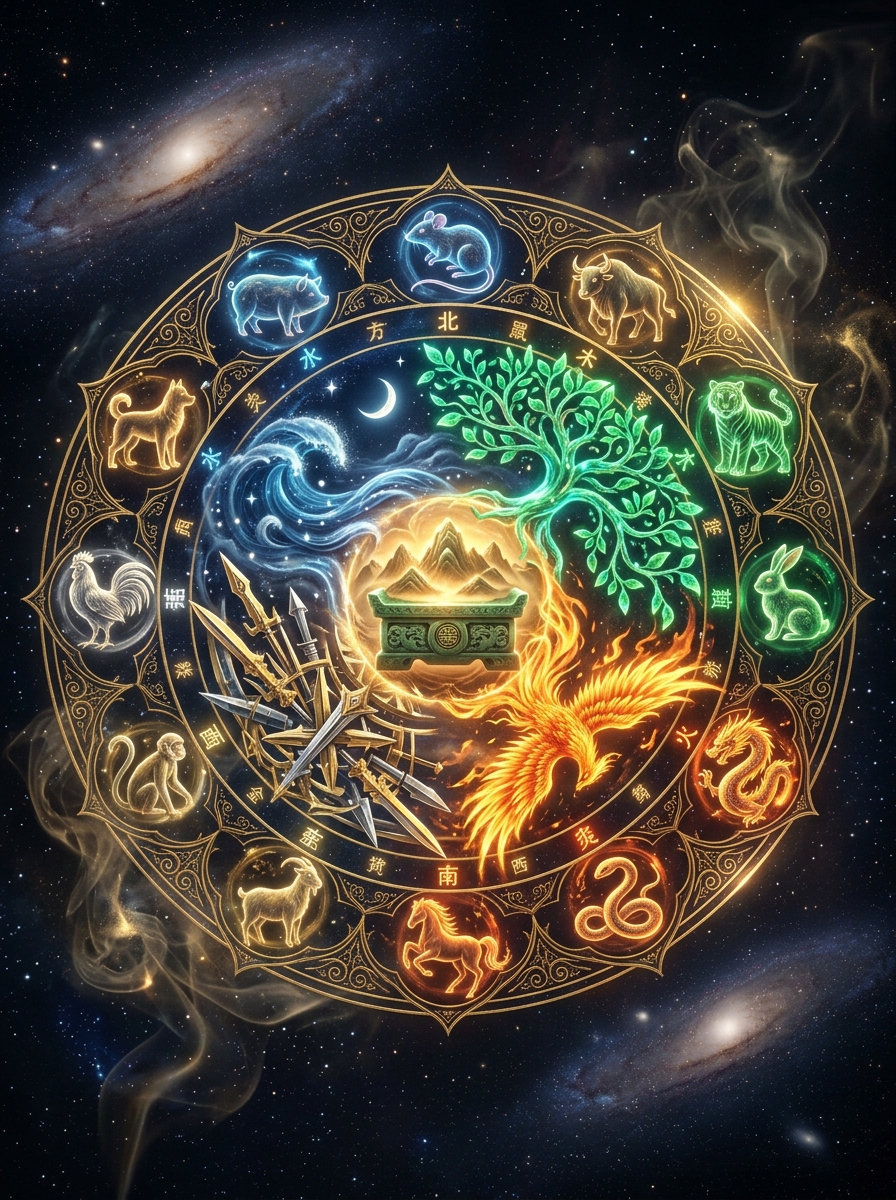
In Chinese astrology, the zodiac animal names the pattern; the five elements determine how that pattern moves through the world. The animal is the mythic body—a Dragon, a Tiger, a Rabbit. The element is the temperature, texture, and method: whether that Dragon builds, burns, steadies, cuts, or flows. A Dragon is never just a Dragon. It is a Wood Dragon’s visionary builder, a Fire Dragon’s accelerant, an Earth Dragon’s stabilizer, a Metal Dragon’s blade, or a Water Dragon’s strategist.
This distinction transforms the zodiac from a fixed set of personality boxes into a combinatorial language. If Western astrology maps temperament through the astrological elements (fire, earth, air, water), Chinese astrology adds another layer: not just what you are, but how your nature generates, restrains, or redirects itself. The animal says “I am this archetype.” The element says “This is how I will move through the world to express it.”
The Five Modes of Motion
Each element describes a distinct psychological strategy. None is better or worse; each has a light side and a shadow, a way of expanding and a way of contracting.
Wood: The Vertical Ascent
Wood is organic, upward, and future-oriented. It wants room to root and rise, and it carries a built-in moral compass—the sense that growth should serve something larger than the self. A Wood Rat is more inventor than scavenger; its intelligence builds systems rather than exploiting loopholes. A Wood Tiger is principled and expansive, driven by causes that outlast its own life. Wood’s shadow emerges when growth is blocked: frustration, brittleness, and the feeling of being trapped in a stunted field.
Fire: The Catalytic Burst
Fire is immediate, radiant, and consumptive. It does not wait for consensus; it ignites. A Fire Tiger does not merely roar—it sets the forest ablaze with purpose, both exhilarating and dangerous. A Fire Monkey becomes theatrical, daring, and quicker to improvise under pressure. Fire needs fuel, and without it burns hot then thin. Its shadow is visibility without substance, charisma that exhausts itself. The friction of Fire can resemble the chaotic energy of the Five of Wands, but in Chinese astrology Fire is not only conflict; it is also courage, presence, and the refusal to remain dim.
Earth: The Keeper of Form
Earth consolidates, shelters, and mediates. It is the element of stewardship and sober realism, asking “What will sustain this?” An Earth Dragon becomes less mythically chaotic and more practical—able to warehouse power, assign tasks, make something usable. An Earth Ox is sturdier and more patient, but also more conservative. Earth’s shadow is stagnation, the tendency to let security become a cage. Where Fire says “Now,” Earth says “Enough”—and that restraint is what lets a thing become real rather than merely exciting.
Metal: The Edge of Discernment
Metal defines boundaries, extracts value, and cuts away excess. It sharpens. A Metal Rooster is exacting, articulate, often uncompromising about standards. A Metal Rabbit may still crave peace, but it will want peace with rules, not vague reassurance. Metal’s highest expression produces clarity and justice; its shadow is judgment and severity, the need to win that can destroy the very bond being defended—a dynamic akin to the hollow victory of the Five of Swords. Metal asks instinct to become craft, and that discipline is its gift.
Water: The Adaptive Depths
Water moves around obstacles, preserves memory, and carries emotion without announcing itself. It is the element of timing: it knows when to wait and when to yield. A Water Rat reads currents before others recognize they exist; a Water Dragon’s force is oceanic rather than volcanic. Water often provides emotional intelligence, but that phrase is too shallow. Water stores what the conscious mind would rather forget, returns it in symbols and moods. Its shadow is drift, evasion, and emotional flooding. Yet when balanced, Water gives deep psychic continuity—the capacity to survive by yielding, not by force.
The 60-Year Cycle: How Animal and Element Interlock
Chinese astrology does not simply pair twelve animals with five elements in a static list. Instead, the 60-year cycle arises from combining the twelve zodiac animals with the ten heavenly stems, which pair the five elements in yin and yang forms. Every animal appears as Wood, Fire, Earth, Metal, and Water in alternating yin/yang expressions across the cycle. A person born in a Dragon year is not “just a Dragon”; they are a Dragon in a specific elemental season.
This is where the system becomes psychologically rich. Element and animal can cooperate or contradict. A Water Horse is less straightforward than a Fire Horse—it wanders, yes, but it also senses when to pull back and preserve energy. A Metal Horse may feel disciplined where a Fire Horse is impulsive. The element does not cancel the animal’s archetype; it changes the behavioral grammar. Two people may share the same zodiac animal and still behave almost oppositely because their elements differ. Conversely, two apparently different animals may share an elemental tempo that makes them easier to understand than expected. This combinatorial logic is part of what makes the zodiac a living map; for a deeper look at how the wheel itself works, see The Celestial Compass and The Zodiac Wheel.
Reading Element Through Life’s Arenas
Once you know the element, you can see how a person will likely approach love, work, and challenge—without re-describing the element every time. In relationships, a Wood person builds slowly and needs purpose; a Fire person demands visibility and risks charisma-burnout. A Metal person requires clarity and may inadvertently sever bonds when the line feels too blurred. In work, Earth stabilizes projects, Metal refines processes, Water adapts to shifting conditions. The element reveals not only what a person wants, but the method they will use to get it—and where that method becomes problematic. Pairing elements across two charts often explains the hidden choreography of attraction and friction. For a broader view of how signs and elements interact in Western terms, The Alchemy of Connection offers a complementary lens.
Shadow and Maturation
Every element has a shadow: Wood suffers when its growth is blocked, turning from idealism to frustration. Fire burns out or burns others when it has no container. Earth stagnates into inertia, mistaking comfort for safety. Metal cuts too deep, severing relationships in the name of precision. Water drowns itself in avoidance, losing form. Maturation comes not by rejecting the element but by balancing it—Wood needs Earth’s steadiness, Fire needs Water’s timing, Earth needs Wood’s momentum, Metal needs Fire’s warmth, Water needs Metal’s boundaries. The five elements are not isolated forces; they are a system. They show how your nature changes shape under pressure, love, ambition, and time—and that is why Chinese astrology, read correctly, feels less like a fortune cookie and more like a mirror.
Related
- The Four Astrological Elements: Fire, Earth, Air, and Water Explained
- The Dominant Element in Your Birth Chart: A Depth Psychological Guide to Elemental Astrology
- The Alchemy of Connection: A Psychological Guide to Zodiac Sign Compatibility
- Aries Moon, Pisces Rising: The Heart That Charges and the Mask That Melts
- The Celestial Compass: Understanding the Zodiac's Mechanics and Meaning
Comments
Loading comments…