The Zodiac Wheel: A Complete Guide to Astrology's Foundational Map
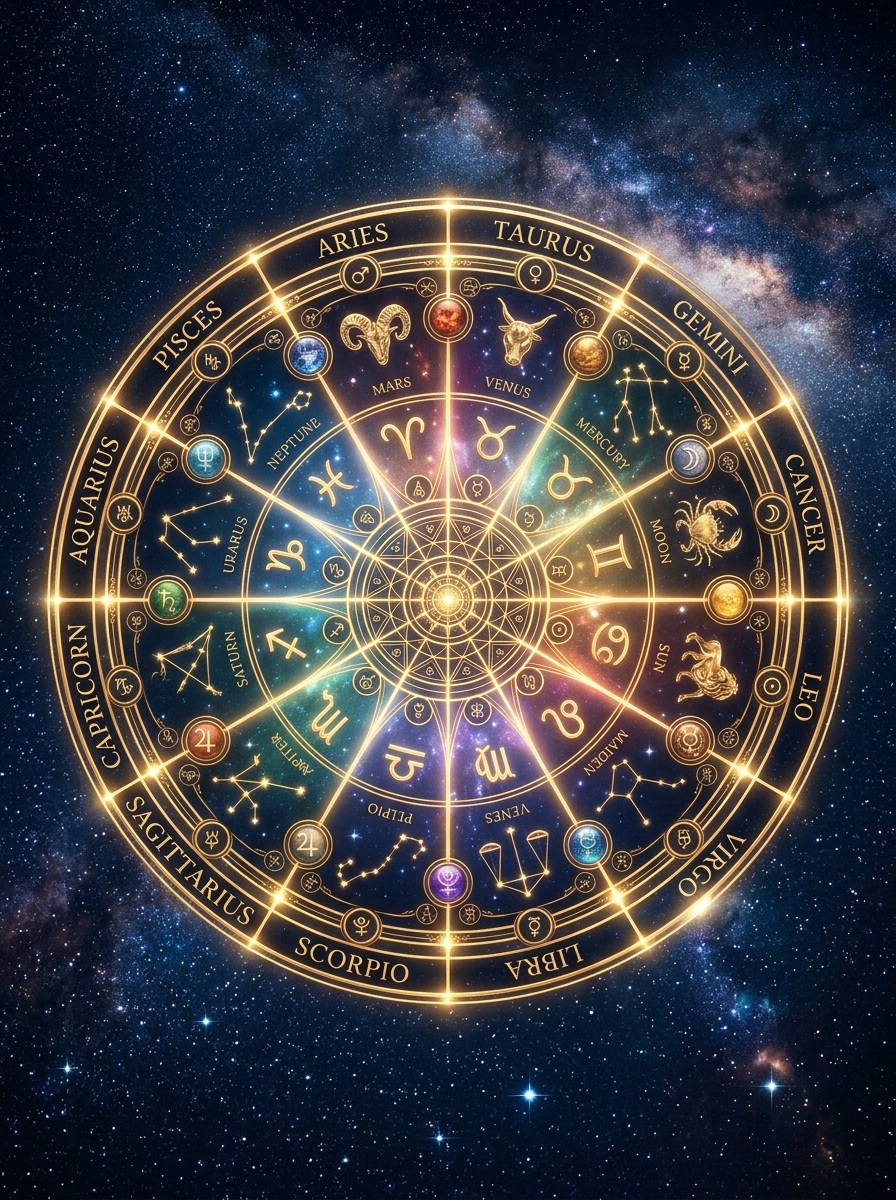
The Architecture of the Sky: Visual Anatomy of the Zodiac Wheel
Hold a natal chart in your hands for the first time and what you are looking at is a snapshot — a freeze-frame of the solar system as seen from one specific point on Earth's surface at one specific moment in time. The circle that frames the whole image is not decorative. It represents the 360-degree sweep of the ecliptic, the apparent path the sun traces through the sky over the course of a year. Every planet in our solar system travels within a few degrees of this same path, which is why a two-dimensional circle can represent the positions of all of them simultaneously.
The Twelve Signs: Divisions of the Ecliptic
The outer ring of the wheel is divided into twelve equal arcs of 30 degrees each, and these are the zodiac signs. Their order is always the same — Aries, Taurus, Gemini, Cancer, Leo, Virgo, Libra, Scorpio, Sagittarius, Capricorn, Aquarius, Pisces — proceeding counter-clockwise around the wheel. Each sign is a distinct archetypal container, a flavor of energy with its own elemental quality, its own modality, and its own ruling planet. The signs on the outer rim are, in a sense, the vocabulary of the sky: they describe how energy expresses itself. The sun moving through Aries expresses solar energy in a bold, initiating, fiery manner. The same sun in Virgo expresses solar energy through precision, discernment, and service.
The symbols — called glyphs — that represent each sign are a condensed visual language. Aries's ram's horns suggest forward thrust. Scorpio's M with an upward-pointing sting at the end hints at transformation and danger. Aquarius's two wavy lines look like water but actually represent electrical current or radio waves — a fitting image for the sign most associated with collective transmission and innovation. Learning to read these glyphs fluently is the first step toward being able to glance at a chart and immediately orient yourself.
The Twelve Houses: Sectors of the Local Sky
Nested inside the sign ring is the house system. While signs describe qualities, houses describe territories — the twelve areas of life through which planetary energy expresses itself in daily, embodied experience. The First House covers the self and physical appearance. The Second governs resources, material security, and personal values. The Third rules communication, siblings, and local travel. The Fourth anchors home, roots, and family of origin. The Fifth rules creativity, romance, and children. The Sixth covers health, work routines, and service. The Seventh governs committed partnerships. The Eighth rules shared resources, sexuality, and psychological transformation. The Ninth covers philosophy, higher education, and long-distance travel. The Tenth describes vocation and public reputation. The Eleventh rules friendships, communities, and collective ideals. The Twelfth governs solitude, the unconscious, and what lies beyond the ego's reach.
Unlike the twelve equal signs, house boundaries — called cusps — vary depending on the birth time and location. Different house systems (Placidus, Whole Sign, Koch, Campanus) calculate these cusps differently, but all of them divide the sky into sectors anchored by the same four cardinal points: the Ascendant, the Descendant, the Midheaven, and the Imum Coeli.
Planetary Symbols: The Characters Onstage
Inside the wheel, scattered across various houses and sign positions, are the planetary glyphs. The sun (a circle with a central dot) represents the core identity, the conscious will, and the life force. The moon (a crescent) describes emotional patterning, instinctual responses, and the relationship with the maternal. Mercury (a circle with horns and a cross below) governs thought and communication. Venus (the mirror of Aphrodite — circle over cross) rules attraction and relational values. Mars (the shield and spear of Ares — circle with an upward-right arrow) drives assertion and desire. Jupiter (an elaborate "4" shape) expands, blesses, and inflates. Saturn (a cross-topped scythe) contracts, disciplines, and demands maturity.
Beyond these classical seven lie the modern additions: Uranus, the awakener; Neptune, the dissolver; and Pluto, the transformer. Each carries a glyph encoding its mythological nature, and each represents a layer of experience — from the personal and immediate (sun, moon, Mercury) to the generational and collective (Uranus, Neptune, Pluto).
How to Read a Chart Wheel: Orientation and the Art of Visual Navigation
The zodiac wheel has a specific orientation that trips up virtually every beginner, and understanding it is the single most important technical skill you will develop. It requires you to override the instinct formed by looking at conventional geographic maps.
The 9 O'Clock Position: The Ascendant and the Eastern Horizon
On a geographic map, east is to the right. On an astrological chart, east is to the left — at the 9 o'clock position. This is because the chart is drawn as if you are standing at its center, facing south (toward the sun's path in the northern hemisphere). When you face south, east is to your left. This leftmost point of the chart marks the exact degree of the zodiac that was rising above the eastern horizon at your birth moment, and it is called the Ascendant or Rising Sign.
The degree directly opposite — at the 3 o'clock position, where the sun sets — is the Descendant, marking the western horizon and the cusp of the Seventh House of partnerships. At the top of the chart (12 o'clock) is the Midheaven, the highest point of the sun's arc on your birth day, associated with your vocation and public life. At the bottom (6 o'clock) is the Imum Coeli, the nadir, representing your private foundation.
Reading Counter-Clockwise: The Flow of the Chart
Once you have located the Ascendant, you read the houses in counter-clockwise order. The First House begins at the Ascendant and sweeps downward (toward the bottom of the chart) in a counter-clockwise direction. The Second House follows, then the Third, continuing around until the Twelfth House, which sits just above the Ascendant on the upper-left portion of the wheel.
This counter-clockwise movement mirrors the apparent motion of the sky from our perspective on Earth. The sun rises in the east (Ascendant), climbs toward the south (Midheaven), descends to the west (Descendant), and passes below the horizon through the night (Imum Coeli). The houses track this diurnal cycle, which is why the chart feels alive once you understand it — it is literally mapping the wheel of the day.
Aspect Lines: The Geometry of Relationship
The interior of the wheel is typically crisscrossed with colored lines connecting the planet positions. These lines represent aspects — the angular relationships between planets — and they are among the most psychologically significant features of any chart. A trine (120°) connects planets in signs of the same element and is usually rendered in blue; it suggests an area of relative ease and natural flow. A square (90°) connects planets in signs of the same modality — Cardinal to Cardinal, Fixed to Fixed, Mutable to Mutable — and appears in red; it indicates friction, pressure, and the kind of productive tension that forces growth. An opposition (180°) runs straight across the wheel's diameter and highlights polarity: two energies that are simultaneously pulling in opposite directions, demanding integration rather than dominance. A conjunction (0°) stacks two planets nearly on top of each other, intensifying and merging their energies.
Learning to read these lines is learning to see the chart not as a collection of isolated symbols but as a living web — a system of interlocking tensions and harmonies that, taken together, describe the specific psychological architecture of an individual life.
The Mandala of the Psyche: Jungian Symbolism of the Circular Form
Carl Jung spent decades studying mandalas — circular, geometrically organized images that appear spontaneously in the dreams, visions, and artwork of individuals undergoing periods of psychological crisis and integration. In his 1959 introduction to Mandala Symbolism, Jung noted that these circular patterns emerge not from cultural instruction but from a deeper layer of the psyche, what he called the collective unconscious. They represent, in his framework, the archetype of the Self: the totality of the personality, including both the conscious ego and everything that lies beyond it in shadow, complexity, and potential.
The Self and the Wheel of Wholeness
The zodiac wheel shares this structural logic with the mandala in ways that cannot be accidental. It is circular, symmetrical around multiple axes, divided into meaningful quadrants and sectors, and it contains all the major archetypes of the Western tradition — the warrior, the lover, the sage, the mystic, the sovereign, the servant — distributed across its twelve signs and ten planets. Jung himself maintained an active interest in astrology, corresponding with astrologers and noting that chart transits appeared to correlate with moments of psychological significance in his patients' lives. He was careful to frame this not as a claim about planetary causation but as an instance of synchronicity — his term for meaningful coincidence, for events that cluster together in time not because one causes the other but because both are expressions of the same underlying pattern.
Synchronicity and the Unus Mundus
The philosophical underpinning of astrology is precisely this Jungian concept of the Unus Mundus — the "one world," the idea that matter and psyche are not two separate substances but two faces of a single underlying reality. When a planet stations retrograde and simultaneously something significant shifts in your inner life or your external circumstances, the astrological interpretation does not require the planet to have sent a signal to your brain. It requires only that the cosmos and the psyche are expressions of the same ordering principle, that they rhyme.
The zodiac wheel makes this visible. When you look at your natal chart, you are not looking at a diagram of external forces acting upon you. You are looking at a symbolic map of your own psyche's structure — the specific proportion of fire and earth, the specific relationship between your Venus and your Saturn, the specific house that your sun occupied at birth — rendered in the language of a sky that, on the morning of your birth, wore the exact same geometry as your inner world.
The Integration of Opposites
One of the most powerful structural features of the wheel — one that is unmistakably Jungian in its implications — is the system of polarities. Every sign has an opposite across the wheel's diameter: Aries-Libra, Taurus-Scorpio, Gemini-Sagittarius, Cancer-Capricorn, Leo-Aquarius, Virgo-Pisces. These are not enemies but complements. Aries without Libra is pure aggression without relational awareness. Libra without Aries is pure accommodation without self-assertion. The opposition axis in a natal chart, which looks like a source of conflict, is actually an invitation: integrate these two poles, and you achieve something neither extreme could reach alone. This is the transcendent function Jung described — the capacity to hold tension without collapsing into one side — rendered in circular geometry.
Elemental and Modal Foundations: The Wheel's Inner Grammar
Before you can interpret a planet in a sign, you need to understand the two-dimensional grid that organizes all twelve signs: the elements and the modalities. Together, they form what astrologers call the elemental and modal structure of the wheel, and they distribute energy across the chart in a way that feels, once you understand it, almost mathematically elegant.
The Four Elements: The Basic Temperaments
The twelve signs are divided into four elemental groups of three signs each. Fire signs — Aries, Leo, Sagittarius — carry enthusiasm, inspiration, and the impulse toward meaning. They reach outward, ignite, and lead. Earth signs — Taurus, Virgo, Capricorn — ground energy in material reality, in the sensory world, in what can be built, grown, or measured. Air signs — Gemini, Libra, Aquarius — operate in the realm of thought, language, relationship, and the exchange of ideas. Water signs — Cancer, Scorpio, Pisces — navigate through feeling, intuition, empathy, and the depths of the emotional unconscious.
When a natal chart has a strong elemental emphasis — say, six or seven planets in earth signs — the native tends to be oriented toward material security, practical accomplishment, and sensory experience. A chart heavy in water may describe someone who lives primarily through feeling and intuition, who is deeply empathic and potentially overwhelmed by the emotional environment. An imbalanced chart — one with almost no planets in a particular element — often represents that element as a compensatory challenge, something the person must consciously develop across a lifetime.
The Three Modalities: Modes of Action
Crossing the elemental division is a second organizing principle: the three modalities, each grouping four signs (one from each element). Cardinal signs — Aries, Cancer, Libra, Capricorn — initiate. They launch new cycles, push into new territory, and occupy the four angular houses in a chart. Fixed signs — Taurus, Leo, Scorpio, Aquarius — sustain. They consolidate what the Cardinal signs begin, holding form, maintaining commitment, and resisting change until resistance is no longer possible. Mutable signs — Gemini, Virgo, Sagittarius, Pisces — adapt. They dissolve the structures built by Fixed signs, distribute their materials, and prepare the ground for the next Cardinal initiation.
The Modal-Elemental Grid: Twelve Unique Combinations
Because each sign combines one element with one modality, no two signs occupy the same coordinate on this grid. Aries is Cardinal Fire — initiating, pioneering, impulsive. Leo is Fixed Fire — sustaining, dramatic, loyal. Sagittarius is Mutable Fire — adapting, exploring, philosophizing. Taurus is Fixed Earth, Virgo is Mutable Earth, Capricorn is Cardinal Earth. Each combination produces a genuinely distinct temperament, which is why "sun sign" descriptions that lump all fire signs or all fixed signs together miss the specificity that makes astrology precise. The wheel's geometry — the way signs of the same modality always form a cross (a square or opposition) and signs of the same element always form a triangle (a trine) — is not coincidental. It is the structural skeleton beneath the symbolic flesh.
The Axes of Orientation: Horizon and Meridian
If the twelve signs and twelve houses form the wheel's outer and inner rings, the four angles — Ascendant, Descendant, Midheaven, Imum Coeli — form its spine. These four points are more sensitive than any planet position in the chart, because they are derived not from planetary motion but from Earth's own rotation. They change degree approximately every four minutes of clock time, which is why a birth time accurate to within five minutes matters enormously.
The Ascendant-Descendant Axis: The Horizon of Self and Other
The Ascendant-Descendant axis is the chart's horizontal diameter — the physical horizon line at the moment of birth. The Ascendant, as noted, describes the mask, the immediate self-presentation, the instinctive approach to new experience. Liz Greene, in The Astrologer, the Counsellor and the Priest, describes the Ascendant as the mythic character the individual adopts as their primary vehicle in this lifetime — a role chosen not arbitrarily but because it fits the soul's particular developmental task.
The Descendant, at the 3 o'clock position, is the cusp of the Seventh House and describes the qualities you project outward onto significant others — partners, close friends, open enemies. Planets near the Descendant often describe people you attract rather than qualities you immediately recognize in yourself. This is projection in the Jungian sense: what is unintegrated in the self gets cast onto the screen of the other. A Scorpio Descendant may repeatedly draw intense, transformative, sometimes controlling partners into life — until the native integrates the Scorpionic qualities (emotional depth, resilience, ruthlessness in facing truth) as their own.
The Midheaven-Imum Coeli Axis: Vocation and Root
The vertical diameter of the chart — the meridian axis — carries a different kind of psychological weight. The Midheaven (MC) describes the peak of the sun's arc on your birth day, the highest point of visibility. Accordingly, it governs what you become known for, the public role you grow into, and the ambitions that pull you upward across a lifetime. Steven Forrest, in The Inner Sky, frames the Midheaven as your evolutionary destination in social terms — not simply your job, but your calling, the work that feels like an expression of your deepest self when it is going well.
The Imum Coeli (IC) anchors the base of the chart at the 6 o'clock position. It represents what lies beneath: the private self that the public persona rests upon, the family inheritance (psychological as much as material), and the emotional foundation — nourishing or limiting — laid in childhood. Planets near the IC describe the inner life you protect from public view, and they often surface through the Fourth House themes of home, ancestry, and belonging. The IC is where you retreat to reconstitute yourself. Whatever sign occupies it describes the quality of the ground you need underfoot to stand tall enough to reach your MC.
The Hermetic Foundation: As Above, So Below
Every serious student of Western astrology eventually encounters the axiom attributed to Hermes Trismegistus: "As above, so below; as within, so without." This phrase, drawn from the Emerald Tablet — a text whose influence stretches from medieval alchemy through the Renaissance occultists and into the modern esoteric revival — is the philosophical premise that makes the zodiac wheel meaningful rather than merely decorative.
Correspondence, Not Causation
The Hermetic worldview does not claim that Jupiter physically makes you optimistic or that Saturn's rings somehow shrink your bank account. It claims something subtler and more interesting: that the macrocosm (the cosmos) and the microcosm (the human being) are structured by the same archetypal principles, and that their correspondences are readable if you know the language. The zodiac wheel is that language — a map of the sky at a specific moment that also functions, through correspondence, as a map of the psyche that came into being at that same moment.
The Planets as Living Archetypes
Aleister Crowley, in Liber 777, elaborated an exhaustive system of planetary correspondences — linking each planet not only to mythological figures but to colors, numbers, metals, plants, and psychological states. While Crowley's system is more ceremonially oriented than psychologically nuanced, it shares the underlying premise with Jung's analytical psychology: the planets are not rocks in space but symbols, and symbols are the native language of the unconscious. When you look at Saturn in your natal chart, you are looking at the principle of limitation, time, structure, fear, and hard-won mastery wherever that planet is placed — not because a distant gas giant is sending instructions, but because your psyche contains all these archetypes and Saturn names one of them.
The Chart as a Complete System
This is the deepest implication of the wheel's circular form: it is whole. Every archetype is present. Every element is present. Every modality is present. The question is not whether you contain Scorpionic depths or Aquarian detachment — you do, because every human psyche does — but where these energies are emphasized, how they relate to each other, and which of them have been brought into consciousness and which remain in shadow. The natal chart does not tell you what you will do; it tells you what you are working with. The wheel's geometry holds all of it simultaneously, without hierarchy — which is, in the end, the most radical thing about it.
The Living Chart: Transits, Progressions, and the Wheel in Motion
A natal chart is not a static document. It is a baseline — a seed pattern — against which the ongoing movement of the sky is measured. Astrologers use two primary techniques for tracking how this pattern unfolds across time: transits and progressions.
Transits: The Sky Meets Your Chart
A transit occurs when a currently moving planet reaches a degree that matches, or forms an exact aspect to, a planet or angle in your natal chart. When transiting Saturn crosses your natal Ascendant, for example, you are entering a period of approximately one to two years during which Saturnian themes — seriousness, limitation, structural reassessment, increased responsibility — will concentrate specifically around your identity, physical body, and the way you present yourself to the world. The zodiac wheel makes this visual: you overlay the current planetary positions on the outer rim of your natal chart and look for the connections.
Steven Forrest compares transits to weather systems passing over a landscape. The landscape (your natal chart) does not change; the weather (the transiting planets) brings varying conditions. A trine from transiting Jupiter to your natal Mercury may bring a period of intellectual excitement and expansive communication. A square from transiting Pluto to your natal Moon describes a time of psychological excavation — the old emotional patterns, the inherited feelings, the unexamined ancestral material — rising to the surface to be confronted and transformed.
Secondary Progressions: The Chart Grows Up
Secondary progressions use a different symbolic logic. They advance the natal chart by one day for each year of life — so your chart at age thirty corresponds to the transits of the sky thirty days after your birth. This elegantly slow movement describes internal development, shifts in character, and the gradual evolution of the natal blueprint over a lifetime. A progressed sun moving from Virgo into Libra, for instance, describes a person whose fundamental orientation shifts — over perhaps two or three years — from a Virgoan emphasis on analysis, service, and self-improvement toward a Libran engagement with partnership, aesthetics, and the art of reciprocity.
Both techniques rely on the zodiac wheel as their common reference point. The wheel does not sit still; it turns, layer by layer, holding the natal pattern at its center while the sky's ongoing motion inscribes new chapters across its surface. Learning to read both the static pattern and the dynamic movement is what transforms astrology from a curiosity into a genuine tool for psychological and spiritual navigation.
FAQ
<FAQ items={[ { q: "Why is the zodiac wheel drawn as a circle rather than a straight line?", a: "The circle carries a specific philosophical weight that a timeline or linear diagram cannot. In virtually every esoteric tradition — from Hermetic philosophy to Jungian psychology — the circle represents wholeness, eternity, and the self-containing nature of the cosmos. A straight line implies a beginning and an end; a circle implies completion. When astrologers plot a natal chart as a wheel, they are encoding the idea that the psyche is not a progression toward some fixed destination but an ongoing, self-referential system in which every part relates to every other part. Carl Jung, who studied mandalas extensively across cultures, noted that the circular form appears spontaneously in the dreams and art of individuals undergoing psychological integration — it is the symbolic container for the process of becoming whole. The zodiac wheel is, in this sense, less a map of the sky and more a mirror of that inner movement." }, { q: "What does the Ascendant actually represent, and why does it sit at the 9 o'clock position?", a: "The Ascendant, or rising sign, marks the degree of the zodiac that was physically rising above the eastern horizon at the exact moment and location of your birth. Astrologers place it at the 9 o'clock position on the wheel — the leftmost point — because the chart is oriented as if you are standing at the center of it facing south (the traditional European convention). East, where the sun rises, falls to your left, which maps onto the 9 o'clock position. Psychologically, the Ascendant describes your interface with the world: the personality mask you present before people know you well, the way you instinctively approach new situations, and the lens through which your chart's entire story is filtered. Liz Greene describes it as the mythological role you were handed at the moment of incarnation — the costume your soul agreed to wear for this particular lifetime. It is also the cusp of the First House, making it the gateway through which all the chart's energy flows outward into lived experience." }, { q: "What are aspect lines, and how do I read them inside the wheel?", a: "Aspect lines are the colored or differently styled lines drawn across the interior of the wheel, connecting planets that occupy geometrically significant angles relative to each other. A conjunction (0°) places two planets so close together that their lines nearly overlap at the same point on the wheel's rim. A trine (120°) draws a line across roughly one-third of the circle, connecting signs of the same element; most chart software renders these in blue or green to indicate their traditionally flowing quality. A square (90°) cuts across a quarter of the circle, often shown in red, reflecting tension and friction between the energies involved. An opposition (180°) runs straight across the wheel's diameter, linking two signs directly across from each other and highlighting the polarity between them. Sextiles (60°) are shorter lines, often in lighter blue, connecting compatible elements. Reading these lines teaches you to see the chart as a living web of relationships rather than isolated planet placements — which is the whole point of the wheel's visual format." }, { q: "How do the twelve houses differ from the twelve zodiac signs?", a: "Signs and houses are two entirely different coordinate systems overlaid on the same wheel, and confusing them is one of the most common stumbling blocks for beginners. The twelve zodiac signs are fixed divisions of the ecliptic — the apparent path of the sun through space — and they describe qualities of energy, archetypal characters, and modes of expression. They are the same for every chart on every day at every location. The twelve houses, by contrast, are derived from Earth's rotation and depend entirely on your birth time and geographic location. They divide the local sky into twelve sectors and describe areas of lived life: your body and identity, your resources, your communication style, your home and family, your creative expression, your health and daily routines, your partnerships, your hidden depths, your philosophy and travel, your public career, your community and friendships, and your spiritual retreat. A planet in Aries describes how it acts; the house that planet occupies tells you where in your life that Aries energy plays out." }, { q: "What is the significance of the Midheaven versus the Ascendant in a natal chart?", a: "If the Ascendant-Descendant axis is the horizontal bar of the chart — the line of your personal horizon at birth — the Midheaven-Imum Coeli axis is the vertical bar, representing the meridian: the north-south line directly overhead and underfoot. The Midheaven (Medium Coeli, or MC) sits at or near the 12 o'clock position and marks the highest point the sun can reach in your local sky on any given day. In psychological terms, it represents your most public self — your vocation, your ambitions, your visible contributions to the world, and the reputation you build over a lifetime. Steven Forrest describes the MC as the mountain you are climbing. The Imum Coeli (IC) sits directly opposite at the 6 o'clock position, anchoring the fourth house and representing your roots: your family of origin, your ancestral inheritance, your private interior life, and the psychological foundation — stable or unstable — upon which your public self stands. These two axes together form the cross at the center of the wheel, a symbol of wholeness whose cross-cultural resonance is itself a piece of evidence for the mandala logic the zodiac wheel encodes." }, { q: "Can I learn to read a natal chart without knowing any astronomy?", a: "Yes, with an important caveat: understanding a few basic astronomical realities will deepen your astrological literacy considerably, even if you never need to do the math yourself. Knowing that the planets all travel along roughly the same plane (the ecliptic), that the moon moves fast while Saturn moves slowly, and that retrograde motion is an optical illusion caused by relative orbital speeds — these facts transform astrology from an arbitrary symbol system into one grounded in observable reality. That grounding matters because it is the basis of the Hermetic axiom 'as above, so below': the claim is not that the planets mystically control your fate but that the cosmos and the psyche are patterned by the same underlying order, a correspondence that Jung called the Unus Mundus. You do not need to calculate a chart by hand — software handles that — but you will read charts more confidently, and more humbly, if you can picture the actual sky behind the symbols." } ]} />
Frequently asked questions
- Why is the zodiac wheel drawn as a circle rather than a straight line?
- The circle carries a specific philosophical weight that a timeline or linear diagram cannot. In virtually every esoteric tradition — from Hermetic philosophy to Jungian psychology — the circle represents wholeness, eternity, and the self-containing nature of the cosmos. A straight line implies a beginning and an end; a circle implies completion. When astrologers plot a natal chart as a wheel, they are encoding the idea that the psyche is not a progression toward some fixed destination but an ongoing, self-referential system in which every part relates to every other part. Carl Jung, who studied mandalas extensively across cultures, noted that the circular form appears spontaneously in the dreams and art of individuals undergoing psychological integration — it is the symbolic container for the process of becoming whole. The zodiac wheel is, in this sense, less a map of the sky and more a mirror of that inner movement.
- What does the Ascendant actually represent, and why does it sit at the 9 o'clock position?
- The Ascendant, or rising sign, marks the degree of the zodiac that was physically rising above the eastern horizon at the exact moment and location of your birth. Astrologers place it at the 9 o'clock position on the wheel — the leftmost point — because the chart is oriented as if you are standing at the center of it facing south (the traditional European convention). East, where the sun rises, falls to your left, which maps onto the 9 o'clock position. Psychologically, the Ascendant describes your interface with the world: the personality mask you present before people know you well, the way you instinctively approach new situations, and the lens through which your chart's entire story is filtered. Liz Greene describes it as the mythological role you were handed at the moment of incarnation — the costume your soul agreed to wear for this particular lifetime. It is also the cusp of the First House, making it the gateway through which all the chart's energy flows outward into lived experience.
- What are aspect lines, and how do I read them inside the wheel?
- Aspect lines are the colored or differently styled lines drawn across the interior of the wheel, connecting planets that occupy geometrically significant angles relative to each other. A conjunction (0°) places two planets so close together that their lines nearly overlap at the same point on the wheel's rim. A trine (120°) draws a line across roughly one-third of the circle, connecting signs of the same element; most chart software renders these in blue or green to indicate their traditionally flowing quality. A square (90°) cuts across a quarter of the circle, often shown in red, reflecting tension and friction between the energies involved. An opposition (180°) runs straight across the wheel's diameter, linking two signs directly across from each other and highlighting the polarity between them. Sextiles (60°) are shorter lines, often in lighter blue, connecting compatible elements. Reading these lines teaches you to see the chart as a living web of relationships rather than isolated planet placements — which is the whole point of the wheel's visual format.
- How do the twelve houses differ from the twelve zodiac signs?
- Signs and houses are two entirely different coordinate systems overlaid on the same wheel, and confusing them is one of the most common stumbling blocks for beginners. The twelve zodiac signs are fixed divisions of the ecliptic — the apparent path of the sun through space — and they describe qualities of energy, archetypal characters, and modes of expression. They are the same for every chart on every day at every location. The twelve houses, by contrast, are derived from Earth's rotation and depend entirely on your birth time and geographic location. They divide the local sky into twelve sectors and describe areas of lived life: your body and identity, your resources, your communication style, your home and family, your creative expression, your health and daily routines, your partnerships, your hidden depths, your philosophy and travel, your public career, your community and friendships, and your spiritual retreat. A planet in Aries describes how it acts; the house that planet occupies tells you where in your life that Aries energy plays out.
- What is the significance of the Midheaven versus the Ascendant in a natal chart?
- If the Ascendant-Descendant axis is the horizontal bar of the chart — the line of your personal horizon at birth — the Midheaven-Imum Coeli axis is the vertical bar, representing the meridian: the north-south line directly overhead and underfoot. The Midheaven (Medium Coeli, or MC) sits at or near the 12 o'clock position and marks the highest point the sun can reach in your local sky on any given day. In psychological terms, it represents your most public self — your vocation, your ambitions, your visible contributions to the world, and the reputation you build over a lifetime. Steven Forrest describes the MC as 'the mountain you are climbing.' The Imum Coeli (IC) sits directly opposite at the 6 o'clock position, anchoring the fourth house and representing your roots: your family of origin, your ancestral inheritance, your private interior life, and the psychological foundation — stable or unstable — upon which your public self stands. These two axes together form the cross at the center of the wheel, and it is no accident that this cross has been a spiritual symbol of wholeness across cultures for millennia.
- Can I learn to read a natal chart without knowing any astronomy?
- Yes, with an important caveat: understanding a few basic astronomical realities will deepen your astrological literacy considerably, even if you never need to do the math yourself. Knowing that the planets all travel along roughly the same plane (the ecliptic), that the moon moves fast while Saturn moves slowly, and that retrograde motion is an optical illusion caused by relative orbital speeds — these facts transform astrology from an arbitrary symbol system into one grounded in observable reality. That grounding matters because it is the basis of the Hermetic axiom 'as above, so below': the claim is not that the planets mystically control your fate but that the cosmos and the psyche are patterned by the same underlying order, a correspondence that Jung called the Unus Mundus. You do not need to calculate a chart by hand — software handles that — but you will read charts more confidently, and more humbly, if you can picture the actual sky behind the symbols.
Comments
Loading comments…