Chinese Zodiac: The Rooster and the Art of Standing in the Light
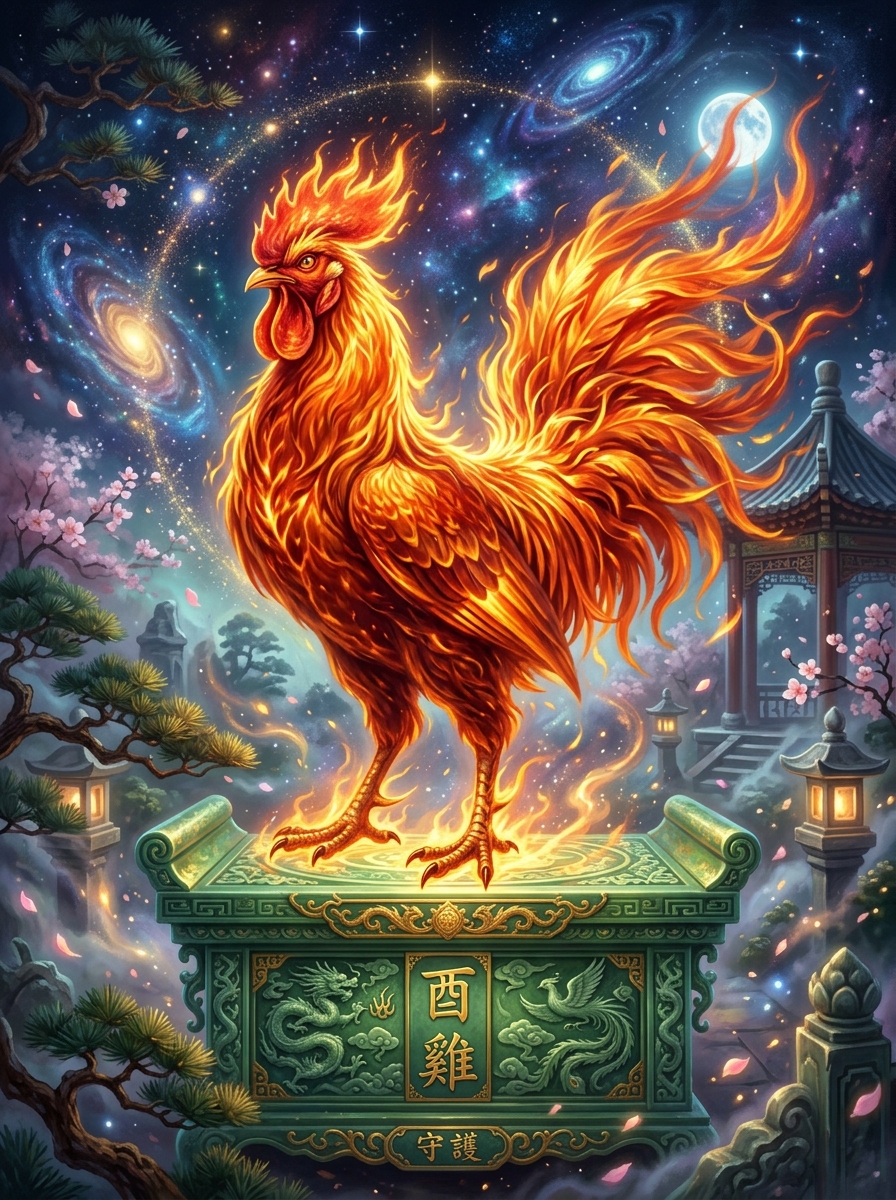
The Rooster is the Chinese zodiac’s calibration engine: observant, proud, disciplined, and constitutionally incapable of blending into the background. This archetype does not simply want to be seen—it wants to be correct, timely, and faultlessly assembled. Its gift is discernment under pressure. Its risk is that discernment hardens into critique, performance, or anxiety dressed up as competence. That tension is the Rooster’s central drama, and it reveals itself the moment you understand what the bird is actually defending.
The Core Dynamic — Precision as a Defense and a Gift
The Rooster belongs to the earthly realm and the ritual of the daily round. Where other signs drift on instinct, the Rooster organizes instinct into sequence, method, and announcement. It notices what others overlook: the crooked hem, the missing detail, the change in tone, the social misalignment everyone else will pretend not to have seen. This makes the Rooster indispensable—and exhausting, when the inner editor starts speaking in public.
The driving motive is not vanity, though vanity can be a symptom. Underneath the feathers lies a deep fear of embarrassment, of being caught underprepared, of appearing foolish or inefficient. The Rooster compensates by sharpening itself: more polish, more control, more proof. It scans the environment for defects because the world feels more manageable when everything is named and ordered. This is why the Rooster trusts the inspectable—metrics, schedules, dress codes, rehearsal—more than vague reassurance. For the broader symbolic system that explains why animal signs function as psychological architecture rather than costume, see the mechanics and meaning of the zodiac.
At its healthiest, this hypervigilance produces a person who brings clarity where others bring fog. The Rooster can plan, sort, edit, and rally. It has a near-instinctive aversion to waste and deception. But the same engine that powers excellence can also power burnout. The Rooster needs to learn that not everything valuable is polished on arrival—some things are honest because they are still rough.
The Psychological Architecture — How the Rooster’s Mind Works
The Rooster’s mind is built around competence, self-respect, and social readability. It wants to be legible because it wants to be trusted. Admiration matters, but only after visible effort has earned it. This is not random personality; it is a coherent psychological architecture shaped by the sign’s elemental role in the zodiac cycle.
The Rooster compensates for internal uncertainty by externalizing order. When the world feels chaotic, it creates a clean desk, a strict morning routine, a precise wardrobe. The inner editor—that voice that spots the typo, the logical gap, the social misstep—is both the Rooster’s best asset and its most persistent critic. A healthy Rooster learns to consult the editor without letting it run the whole show. An immature one confuses perfection with integrity and becomes brittle.
The trust in the inspectable
The Rooster prefers concrete proof over emotional appeal. It trusts what can be counted, compared, or rehearsed. This shows up as immaculate taste, strong opinions about timing, and a near-instinctive response to sloppiness. In teams, the Rooster becomes the quality-control conscience: the person who catches the mistake, tightens the timeline, and prevents public embarrassment. But this gift has a shadow. The same precision can make the Rooster intolerant of ambiguity, and intolerant of people who move at a slower, more intuitive rhythm.
For a deeper look at how each sign’s function fits into the larger symbolic map, the zodiac wheel shows that the Rooster’s job is calibration—not decoration, not domination.
The Shadow of the Standard — When Precision Becomes a Cage
The Rooster’s shadow manifests when the fear of imperfection turns outward. A stressed Rooster scans for defects in others because it cannot tolerate uncertainty in itself. Critique becomes a way to stabilize inner doubt. Performance becomes armor. Even well-intentioned helpfulness can curdle into control if the Rooster believes only it knows the proper way.
The classic shadow pattern is brittle pride. When pride is healthy, it becomes dignity. When wounded, it becomes defensiveness, sarcasm, or the need to win the room. The Rooster may act as if it is merely stating facts, when in fact it is defending identity. Facts can be revised; identity, when over-identified with competence, feels existentially threatened by a small mistake. This is why the Rooster’s psychological maturation requires separating self-worth from flawless execution.
The cost of perfectionism
A Rooster locked into shadow mistakes anxiety for excellence. It works harder, polishes more, and criticizes louder—but the underlying panic never quietens. The sign’s deeper work is to recognize that order can be a form of care without being a weapon. Maturity means learning to let a detail go, to trust another person’s timing, to speak truth with tact rather than surgical precision. That lesson is not softness; it is freedom.
For readers interested in how similar dynamics play out in the Western zodiac, the sign of Capricorn shares the Rooster’s affinity for discipline and structure, though Capricorn’s flavor is less social and more mountainous. The Rooster is the dawn crow, not the winter peak.
The Rooster in Action — Love, Work, and the Daily Round
The Rooster’s core dynamic—precision as a defense and a gift—expresses itself concretely in relationships and career. This section maps those expressions without re-explaining the dynamic; it simply shows the shape the archetype takes in the world.
In love and partnership
A Rooster in love does not chase dreamy ambiguity. It wants reliability, evidence of effort, and a partner who respects time. Grand declarations matter less than follow-through. The Rooster needs respect more than flattery; it needs to feel that its labor is seen and its advice is not casually dismissed. In return, it must learn not to turn intimacy into an inspection. Love cannot survive if every conversation feels like a performance review.
Traditional Chinese zodiac compatibility favors the Ox and the Snake with the Rooster. The Ox offers steadiness and a temperament that does not flinch from commitment. The Snake brings depth and a more subtle intelligence that appreciates exactness without feeling bullied by it. The Dragon can create an electric bond, though the pairing requires a shared mission to avoid a contest of wills. More challenging is the Rabbit, whose gentler, evasive style may feel frustratingly indirect to the Rooster. For a broader psychological lens on why relational chemistry often hinges on complementary defenses, see this guide to zodiac sign compatibility.
At work and in community
Professionally, the Rooster thrives as the fixer, the editor, the quality-control officer. It brings clarity to fog, order to chaos. It often has excellent recall for details and a real talent for naming the problem instead of circling it. The Rooster does not like half-done work because it understands that neglect compounds. In a healthy environment, this makes the Rooster the backbone of any team that values precision. In a toxic one, the Rooster can become the resident scold, alienating colleagues with unsolicited corrections.
The sign’s affinity for ritual and routine is not mere preference; it is spiritual technology. The Rooster does better when life is not perpetual improvisation. Morning order, clean boundaries, organized spaces, and clear deadlines all support its nervous system. This is one reason the Rooster is often drawn to professions with clear structures: editing, accounting, law, fashion, or any field that rewards visible competence.
Timing, Elements, and the Path to Dignity
Chinese zodiac practice includes auspicious elements that help the Rooster move in harmony with its own nature. These are not mechanical guarantees; they are symbolic alignments that reinforce the sign’s strengths and soften its edges.
Lucky colors, numbers, and directions
Traditional lucky colors for the Rooster include gold, brown, yellow, and white. Gold echoes the sign’s solar pride; brown supports practicality; yellow adds confidence; white sharpens distinction. Lucky numbers are commonly 5, 7, and 8—numbers that mirror the Rooster’s desire for structure and distinction. The most commonly associated direction is west, which connects to completion, harvest, and the setting sun—fitting for a sign that likes to finish well.
The five elements of Rooster years
The Rooster appears every twelve years, each time with an elemental coloring: Metal Rooster (most exacting and disciplined), Water Rooster (more diplomatic and perceptive), Wood Rooster (principled and growth-oriented), Fire Rooster (visible, ambitious, dramatic), and Earth Rooster (grounded, realistic, strong on follow-through). These are not personality cages; they are tonal shifts. Knowing the element tells you whether the Rooster you encounter is likely to be a strategist, a stylist, a reformer, or a fortress.
The highest expression
The Rooster’s deepest destiny is not flawlessness; it is lucidity. When the sign matures, it stops needing to dominate the room to feel safe. It learns that real authority does not require a loud peck at every flaw. Beauty can coexist with imperfection; truth can be delivered with tact. At its best, the Rooster is a guardian of standards, an honest witness, and a maker of order who understands why order matters. It does not just decorate the day—it announces it. That is its mythic role: to call attention to what is ready, what is real, and what can no longer hide in the dark.
To place the Rooster inside the wider astrological imagination, the zodiac wheel reveals how each archetype contributes a necessary function. The Rooster’s function is simple to say and difficult to live: see clearly, speak cleanly, and stand upright in the morning light.
Related
- Chinese Zodiac Rat: The Mind That Finds the Door Before It Opens
- Chinese Zodiac: The Pig and the Art of Generous Fortune
- Chinese Zodiac Goat: The Graceful Soul, the Quiet Strategist, and the Art of Soft Power
- Chinese Zodiac Tiger: Courage, Magnetism, and the Cost of Living Wild
- Virgo Moon, Leo Rising: The Heart That Performs Its Own Repair
Comments
Loading comments…