Chinese Zodiac: The Pig and the Art of Generous Fortune
The Pig’s Core Dynamic: Abundance with a Moral Center
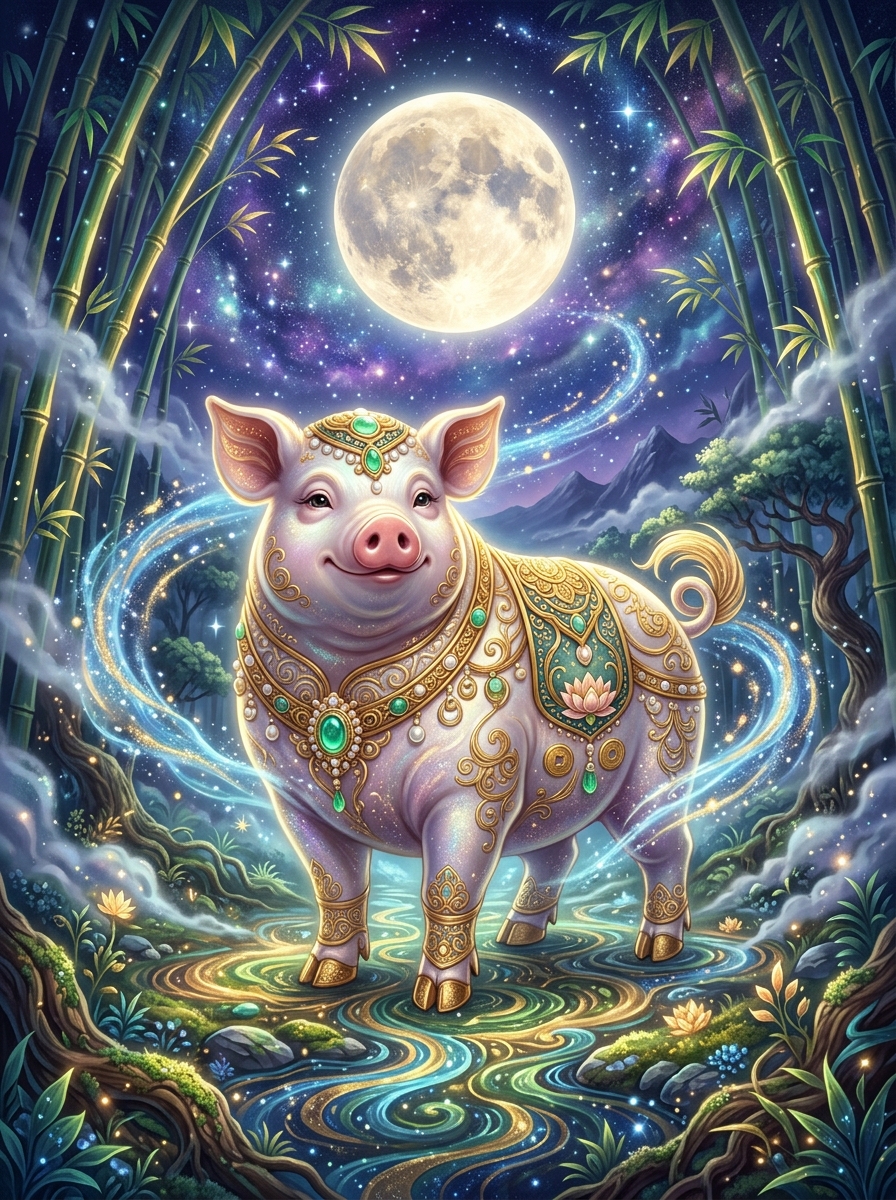
The Pig is the Chinese zodiac’s closing sign, and it embodies a rare synthesis: pleasure that does not corrupt, generosity that does not deplete. In the twelve-animal cycle, the Pig arrives after the Dog’s vigilance, the Rooster’s precision, the Monkey’s cleverness — and proposes a different kind of intelligence. It treats life as something meant to nourish, not to measure. The Pig’s fortune is not luck in the sense of random windfalls; it is the earned abundance that comes from trusting that enough exists, and that sharing it does not leave you empty.
This dynamic is often mistaken for simple indulgence. But the Pig’s love of comfort, food, and warmth is only the surface. Deeper is a moral center: the sign instinctively knows that to take more than needed is to poison the well, and to give without discernment is to invite misuse. The Pig’s generosity is selective, not scattershot. It gives freely to those who honor its trust, and withdraws into stubborn privacy when that trust is broken. Understanding the Pig requires seeing it through the larger mechanics of the zodiac itself — how each sign builds on the last to create a coherent psychological map. The Pig does not drop out of the sky; it grows from the accumulated wisdom of the previous eleven animals, and its role is to bring the cycle home with an open hand.
Psychological Roots: How the Pig Forms Its Trust
The Pig experiences the world through embodied trust. It does not primarily analyze or strategize; it feels what is safe, what is warm, what is sincere. This makes it porous — receptive to atmosphere, emotionally intuitive, and unusually good at noticing who needs more or who is quietly left out. The sign’s social talent is not charisma but oxygen: it makes a room less guarded, less performative.
But this porousness has a cost. The Pig requires a secure environment to remain open; when life becomes emotionally noisy or exploitative, the same sensitivity that fuels its generosity can turn inward. The sign may retreat into routines, pleasures, or mild stubbornness that looks like laziness from outside. In reality, it is overload management. The Pig prefers a world humane enough not to require constant defense.
This psychology shares a family resemblance with the steadier earth-sign temperament of Taurus, which clings to value, and the emotional protectiveness of Cancer, which clings to belonging. But the Pig differs: it wants both value and belonging, plus a little joy around the edges. If Taurus is the vault and Cancer the shell, the Pig is the table set with care — a place where enough is on display and guests are welcomed without condition, as long as they mean no harm.
The Shadow and Maturation: When Generosity Becomes Self-Erasure
The Pig’s most common shadow is not excess but over-accommodation. Because generosity feels like the right social language, a Pig-born person may give too much, too soon, internalizing the expectation that sweetness equals virtue. When the internal ledger of fairness tips — when the Pig realizes it has been taken for granted — resentment builds in silence. The sign does not enjoy public rupture. It would rather stop offering access than confront the imbalance directly.
This is where the shadow deepens: the Pig’s softness can become a trap. The “nice” persona hides a private fatigue, a quiet irritation, and sometimes a hidden appetite for control through withdrawal. Maturation for the Pig means learning that generosity without boundaries is not virtue — it is self-erasure. The sign must integrate its own wants and limits as firmly as it offers warmth to others. When it does, its generosity becomes durable, not desperate. It learns to say no with the same grace with which it says yes.
The Pig’s maturing also involves letting go of the need to be liked by everyone. The sign’s deepest strength — its ability to create ease — works best when it is directed toward those who reciprocate. In relationships, this means choosing partners who respect warmth without exploiting it, who understand that softness is not weakness. The classic harmonious match in Chinese astrology is the Rabbit, whose tact and discretion match the Pig’s sincerity, or the Goat, which shares its love of beauty and kindness. The Tiger can be exciting but risks overwhelming the Pig’s need for predictability; the Snake’s subtle calculation may put the Pig on guard. These pairings are not impossible, but they require the Pig to hold its ground — to insist that trust be earned, not assumed.
Living the Pig: Love, Work, and Daily Expression
Once the Pig’s dynamic is understood — generous yet guarded, warm yet selective — its concrete manifestations fall into place without requiring separate, repetitive sections. In love, the Pig falls best when affection feels unembarrassed by basic human needs. This sign wants a partner who remembers the small things, keeps promises, and does not punish tenderness. Passion matters less than decency. The love language of the Pig is not mystery; it is felt security. A relationship works when the Pig does not have to guess where it stands.
In work, the Pig excels in environments that value consistency, craftsmanship, and human welfare. It is often good with the ordinary logistics of living well — finance, hospitality, design, caregiving — not because it is driven by ambition, but because it has a talent for sustaining long projects and relationships without needing constant novelty. The Pig can be materially intelligent in a quiet way: not flashy, not speculative, but reliable. It does best in roles that honor its need for autonomy and its dislike of manipulative politics. The sign’s luck increases when its nervous system is not under siege.
In daily life, the Pig’s lucky elements — colors like yellow, gray, and brown; numbers like 2, 5, and 8 — are not superstitious talismans but markers of conditions that reduce friction. Yellow grounds the Pig in stability, gray gives it composure, brown connects it to earth. A calm room, a fair schedule, a dignified pace: these are the real sources of the Pig’s fortune. The sign is at its strongest when it can remain open without feeling hunted.
The Pig in the Zodiac Cycle: Completion as Wisdom
Because the Pig closes the cycle, it carries a finishing energy often misread as depletion. But completion, in this context, is harvest — the wisdom to gather what has grown, honor what has been learned, and release what no longer serves. The Pig is the sign most likely to remind us that fulfillment is not the same as excess. Enough is a profound word.
This gives the Pig an understated spiritual function: it asks whether pleasure is life-enhancing or merely numbing, whether generosity is genuine or self-erasing, whether comfort is restorative or evasive. In Jungian terms, the Pig stands close to the shadow of the “nice” persona, and its maturity comes from integrating those undercurrents without becoming cynical. The sign’s real fortune is not luck as accident, but abundance as an ethical practice — a way of being that insists the world can be nourishing, and that we have a role in making it so.
To appreciate the Pig fully, compare it with the solar confidence of Leo, the relational tact of Libra, or the dreamy permeability of Pisces. Each answers the same question — how to hold desire and connection — in a different key. The Pig’s answer is the most earthbound: create a life where care is concrete, pleasure is clean, and trust is not endlessly negotiated. That is the harvest the Pig offers: not a promise of easy riches, but the quieter assurance that enough exists, and that sharing it is the most sensible thing a person can do.
Related
- Dream About a Pig: Greed, Comfort, Instinct, and the Hidden Cost of Plenty
- Chinese Zodiac: The Ox and the Intelligence of Endurance
- Chinese Zodiac Rat: The Mind That Finds the Door Before It Opens
- Pisces Moon, Taurus Rising: The Soft Current Behind the Steady Face
- Virgo Moon, Pisces Rising: The Inner Critic Behind the Veil
Comments
Loading comments…