The Alchemy of Connection: A Psychological Guide to Zodiac Sign Compatibility
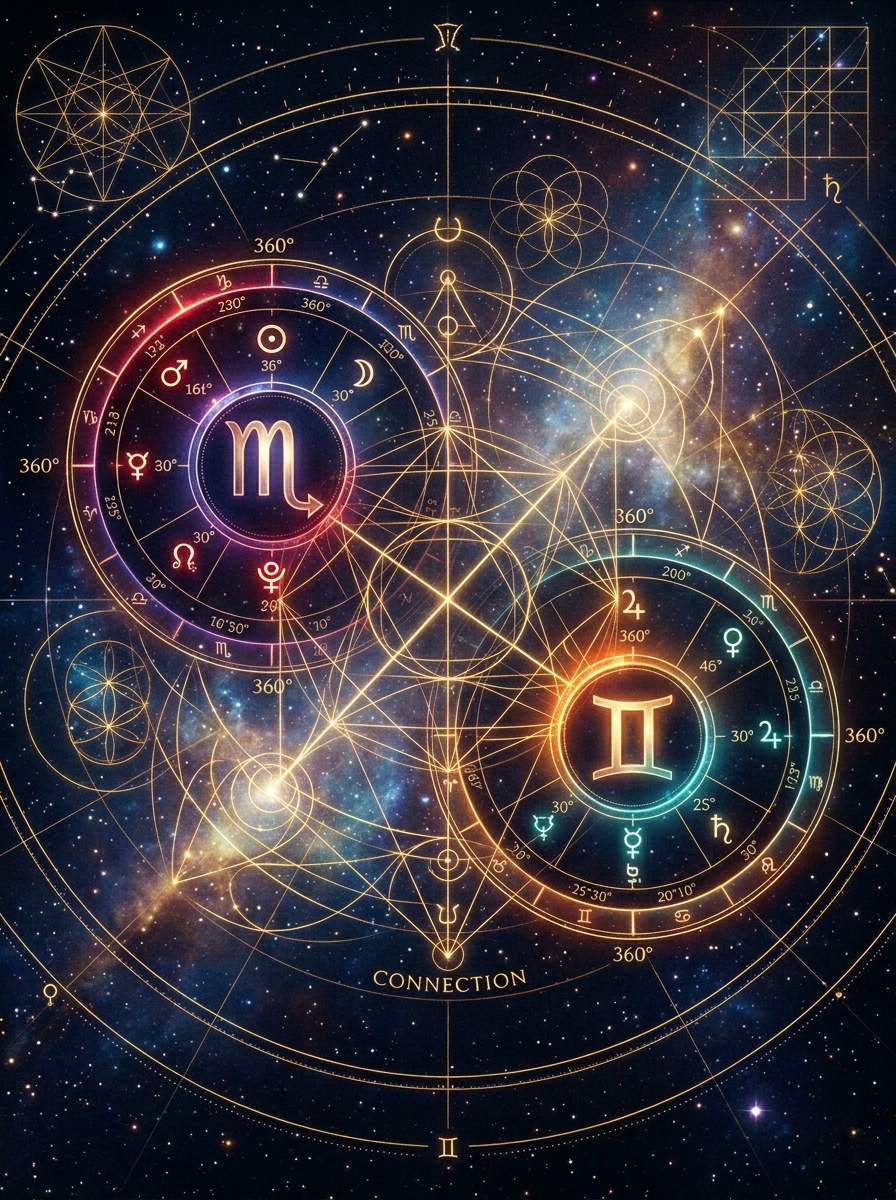
Introduction: The Cosmic Mirror of Relationship
For centuries, humanity has looked to the stars not merely to map the physical heavens, but to chart the labyrinth of human connection. Relationship astrology, or synastry, is one of the most enduring facets of the Western esoteric tradition. Yet, in modern pop culture, zodiac compatibility has often been reduced to a deterministic parlor game—a binary scorecard declaring relationships either "destined" or "doomed" based on Sun signs alone.
To look at compatibility through this narrow lens is to miss the entire point of the astrological project. As the Swiss psychologist Carl Jung observed, the meeting of two personalities is like the contact of two chemical substances: if there is any reaction, both are transformed. Astrology, when integrated with psychological depth and evolutionary principles, offers a language for this very transformation. It is not a rigid verdict, but a dynamic, elemental alchemy. It reveals how different facets of our psyches interact, friction points where we are challenged to grow, and harmonic resonances where we find shelter.
By shifting our focus from fatalistic matches to the psychological underpinnings of elements, modalities, and polarities, we can use astrology as an empowering tool for self-discovery and relational empathy. In this comprehensive guide, we will dismantle the clichés of pop-astrology compatibility and explore the rich, complex mechanics of how birth charts interact, drawing on the wisdom of archetypal pioneers like Liz Greene and Steven Forrest.
Astrological Compatibility by Element
The four classical elements—Fire, Earth, Air, and Water—represent the primary building blocks of the psyche. In the framework of psychological astrology, which correlates closely with Jung's four psychological functions (Intuition, Sensation, Thinking, and Feeling), the elements describe our fundamental orientation to reality. How we perceive the world, how we process experience, and what we require to feel secure or inspired is dictated by our elemental balance. When two charts interact, the elemental dialogue determines the basic energetic chemistry of the relationship.
Fire and Air: The Alchemical Dance of Spirit and Mind
Fire (Aries, Leo, Sagittarius) represents the intuitive, vitalizing principle. It seeks meaning, adventure, and self-expression. Air (Gemini, Libra, Aquarius) represents the intellectual, objective principle. It seeks communication, perspective, and social connection.
When Fire and Air meet, they create a highly collaborative, intellectually stimulating bond. Air provides the oxygen of ideas, theories, and conceptual frameworks that keep the flames of Fire burning brightly. Fire, in turn, supplies the passion, warmth, and kinetic energy to turn Air's abstract concepts into lived reality. In Jungian terms, this is the partnership of Intuition and Thinking. They inspire one another to look beyond the immediate horizon.
However, this combination can lack grounding. Because both elements are yang (masculine, active, and outward-focused), a relationship dominated by Fire and Air can become a whirlwind of projects, discussions, and grand visions that never materialize. Without the stabilizing influence of Earth or the emotional depth of Water, this partnership risks burnout, intellectual detachment, or an inability to navigate the mundane responsibilities of daily life.
Earth and Water: The Sanctuary of Form and Feeling
Earth (Taurus, Virgo, Capricorn) represents the sensation function—the physical body, material security, and practical systems. Water (Cancer, Scorpio, Pisces) represents the feeling function—emotional depth, intuition, and psychological vulnerability.
Earth and Water are yin (feminine, receptive, and inward-focused) elements. Their partnership is naturally nurturing and stabilizing. Earth provides a solid container, a physical structure, and reliable boundaries for Water's shifting, tidal emotions. In return, Water irrigates Earth's dry, pragmatic landscapes, infusing them with meaning, art, and emotional significance. Together, they build homes, families, and long-term security. They speak a shared language of silence, comfort, and shared history.
The shadow side of this highly compatible pairing is stagnation. If Earth becomes too rigid or Water becomes too melancholic, the relationship can devolve into a muddy swamp of routine, emotional dependency, or mutual enabling. Without the spark of Fire to initiate change or the breeze of Air to introduce fresh perspectives, Earth-Water partnerships can resist necessary growth, choosing comfortable familiarity over evolution.
Element Clashes and Internal Growth
When elements that speak completely different languages meet—such as Fire and Water, or Earth and Air—the relationship demands conscious effort and psychological maturity.
A Fire-Water pairing represents the meeting of steam and ash. Fire's urge to act and express can feel insensitive to Water's delicate emotional ecology. Water's moods and need for quiet introspection can feel like a wet blanket to Fire's spontaneous enthusiasm. Yet, if both partners are conscious, Fire teaches Water courage and joy, while Water teaches Fire empathy and depth.
Similarly, an Earth-Air pairing brings together the pragmatist and the theorist. Air may find Earth boring or overly concerned with material details, while Earth views Air as flighty, impractical, and lost in the clouds. Through conscious integration, Air helps Earth look up and see the bigger picture, while Earth helps Air bring its ideas down to earth, creating tangible results.
Compatibility by Modality
While the elements describe what substance we are made of, the three modalities—Cardinal, Fixed, and Mutable—describe how we direct that energy in time and space. The modalities explain our conflict resolution styles, our relationship to change, and our natural pace in life. Understanding modality dynamics prevents couples from misinterpreting style differences as personal attacks.
+------------------+------------------------------------------------------+
| Modality         | Primary Energetic Orientation                        |
+------------------+------------------------------------------------------+
| Cardinal         | Initiates action, drives change, establishes crisis   |
| Fixed            | Sustains focus, builds stability, resists intrusion  |
| Mutable          | Adapts to circumstances, disperses energy, reframes  |
+------------------+------------------------------------------------------+
Cardinal Signs: The Drivers of Change
The Cardinal signs (Aries, Cancer, Libra, Capricorn) mark the beginnings of the seasons. They are characterized by initiatory force, leadership, and a forward-moving momentum. In relationships, Cardinal energy wants to take charge, solve problems immediately, and establish new directions.
When two Cardinal dominant partners come together, there is never a shortage of ambition or action. They are builders and creators. However, they can easily clash over control. If Aries wants to move forward immediately, Capricorn wants to plan the structural path, Libra wants to negotiate the collaborative terms, and Cancer wants to ensure emotional safety first. The resulting power struggle can feel exhausting. Learning to take turns leading is the primary spiritual lesson of a multi-Cardinal relationship.
Fixed Signs: The Anchors of Commitment
The Fixed signs (Taurus, Leo, Scorpio, Aquarius) occur during the height of the seasons. They represent concentration, stabilization, preservation, and endurance. In relationships, Fixed energy is intensely loyal, deeply committed, and highly resistant to outside disruption.
A partnership between two Fixed dominant individuals is incredibly durable. They rarely give up on each other and can weather severe life storms together. However, because both are deeply anchored in their ways, conflict can lead to legendary standoffs. When a Taurus and a Scorpio lock horns, or a Leo and an Aquarius disagree, neither wishes to back down or compromise. The relationship can freeze into icy silences or repeat the same arguments for years. To thrive, Fixed partners must learn that yielding is not a defeat, but a form of evolutionary strength.
Mutable Signs: The Chameleons of Fluidity
The Mutable signs (Gemini, Virgo, Sagittarius, Pisces) represent the transition points of the seasons. They are characterized by flexibility, versatility, adaptability, and change. Mutable energy is comfortable with ambiguity, values communication, and is quick to compromise.
Two Mutable dominant partners will enjoy a relationship that is highly fluid, open, and intellectually varied. They talk constantly, change their plans easily, and encourage each other's individual growth. The danger for a highly Mutable couple is a lack of direction, boundary confusion, or relationship drift. Without a solid anchor, they may adapt so completely to each other's moods and external circumstances that they lose their own center or fail to make concrete commitments. They must deliberately cultivate routines and shared anchors to avoid floating apart.
Opposite Signs: The Magnetic Pull of Polarities
One of the most fascinating phenomena in astrology is the intense attraction between opposite signs—signs that sit 180 degrees across from each other on the zodiac wheel. In traditional astrology, opposites were sometimes viewed with suspicion as aspects of tension. Modern psychological astrology, however, recognizes opposites as the ultimate mirrors. They represent our projection screens: we are often magnetically drawn to our opposite sign because they consciously embody the qualities that lie dormant, repressed, or unintegrated in our own shadow.
Aries and Libra: The Axis of Self and Other
Aries represents the raw, instinctual ego, independence, and the courage to fight. Libra represents relationship, harmony, diplomacy, and the search for balance.
When Aries and Libra meet, the attraction is immediate and electrical. Aries is drawn to Libra's grace, refinement, and relational intelligence. Libra is captivated by Aries' raw confidence, decisiveness, and willingness to stand alone. However, Aries can view Libra as indecisive, people-pleasing, or superficial, while Libra can find Aries selfish, crude, or unnecessarily combative.
Psychologically, Aries must learn from Libra that relationship does not require the death of the self, and Libra must learn from Aries that conflict can be a healthy tool for clearing the air and establishing authentic boundaries.
Taurus and Scorpio: The Axis of Form and Depth
Taurus represents the simple pleasures of the physical world, stability, peace, and material self-reliance. Scorpio represents the psychological underworld, transformation, vulnerability, and shared emotional currency.
Taurus seeks to keep life simple, comfortable, and predictable. Scorpio knows that life is complex, dark, and constantly changing. This polarity produces an incredibly intense, passionate chemistry. Taurus offers Scorpio a calm, solid harbor from their emotional storms. Scorpio offers Taurus an invitation to dive beneath the surface and experience true intimacy.
The struggle arises when Taurus resists Scorpio's demands for deep psychological excavation, viewing it as unnecessary drama, while Scorpio accuses Taurus of emotional superficiality or material greed. Their synthesis requires Taurus to accept the inevitability of change and death, and Scorpio to appreciate the beauty of peace and simple presence.
Gemini and Sagittarius: The Axis of Information and Wisdom
Gemini is the local reporter, gathering facts, exploring multiple viewpoints, and focusing on the immediate environment. Sagittarius is the philosopher-explorer, seeking the overarching truth, meaning, and the distant horizon.
Gemini keeps Sagittarius from becoming an arrogant, dogmatic preacher by reminding them of the messy, contradictory details of real life. Sagittarius keeps Gemini from getting lost in endless gossip, trivial facts, and mental loops by offering a moral compass and a sense of destiny.
When out of balance, Gemini can find Sagittarius self-righteous and impractical, while Sagittarius can view Gemini as superficial, scattered, and lacking core conviction. Together, they must learn to bridge the gap between the small details and the grand design.
Cancer and Capricorn: The Axis of Care and Structure
Cancer represents the archetypal mother, the inner home, emotional vulnerability, and childhood. Capricorn represents the archetypal father, the public arena, social responsibility, and maturity.
Cancer builds the emotional foundation, while Capricorn builds the structural roof. In relationship, this pair can build an incredibly stable, nurturing life. Capricorn protects and provides for Cancer's vulnerable inner world, while Cancer softens Capricorn's cold, professional armor.
If they fall into shadow roles, Cancer can become a needy child, manipulating through moods, while Capricorn becomes a distant, critical parent, isolating behind work. They must both integrate both poles within themselves: Cancer must find their own authority, and Capricorn must reclaim their inner child.
Leo and Aquarius: The Axis of the Individual and the Collective
Leo is the king, centering the world around the creative heart, personal self-expression, and individual drama. Aquarius is the revolutionary, looking at the system, the community, and the collective future.
Leo teaches Aquarius how to feel, how to play, and how to shine as a unique individual rather than hiding behind intellectual groups. Aquarius teaches Leo how to step off the stage, how to serve a cause larger than the ego, and how to look at life objectively.
The friction here involves Leo's need for personal validation and attention clashing with Aquarius's cool, egalitarian detachment. To thrive, Leo must learn to share the spotlight, and Aquarius must learn to warm up their clinical heart.
Virgo and Pisces: The Axis of Order and Chaos
Virgo is the craftsman, focusing on analysis, daily rituals, physical health, and practical service. Pisces is the mystic, dreaming of oceanic unity, spiritual surrender, and universal compassion.
Virgo organizes the kitchen; Pisces dreams of the infinite. Virgo keeps Pisces grounded in the physical body and the daily checklist, preventing them from dissolving into escapism. Pisces keeps Virgo from drowning in anxiety, perfectionism, and micro-management by offering the grace of surrender and faith in the unseen.
The shadow emerges when Virgo becomes hyper-critical and cynical, or when Pisces becomes helpless, playing the martyr or victim. Their integration lies in recognizing that the sacred is found in the ordinary, and the ordinary is infused with the sacred.
Adjacent Signs: Daily Comfort vs. Astrological Chemistry
A common source of confusion in relationship astrology is the dynamic between adjacent signs—signs that sit right next to each other on the zodiac wheel (such as Aries and Taurus, or Libra and Scorpio). Because they represent consecutive stages in the evolutionary journey of the zodiac, they belong to different elements, different polarities, and different modalities. They share no common astrological ground.
The Minor Semi-Sextile Aspect: Growing Pains
In aspects, adjacent signs are in a semi-sextile relationship (30 degrees apart). In traditional astrology, this was often ignored or viewed as a minor irritant. Psychologically, it represents the friction of transition.
An adjacent sign represents the stage of development we have either just left behind or are about to enter. Because they are so close yet so fundamentally different, adjacent signs often find each other baffling. For example, Gemini (Air, Mutable, Yang) is fascinated yet exhausted by Taurus (Earth, Fixed, Yin). Gemini wants to talk, move, and explore; Taurus wants to sit, eat, and stabilize.
Similarly, Libra (Air, Cardinal, Yang) seeks harmony, pleasant conversation, and light social interactions. Scorpio (Water, Fixed, Yin), sitting right next door, wants intense psychological honesty, silent bonding, and absolute commitment. The transition from Libra's polite agreement to Scorpio's raw confrontation can feel like jumping from a sunny terrace into a dark basement.
Learning from Neighbors: The Mirror of Evolution
Despite their differences, adjacent sign relationships are incredibly common and hold immense evolutionary value. They represent a step-by-step path of personal development.
[ Aries: Impulse ] ---> [ Taurus: Stabilization ] ---> [ Gemini: Curiosity ]
A Aries partner can teach their adjacent Taurus partner how to take risks and initiate action when life becomes too stagnant. The Taurus partner, in turn, can show the Aries how to slow down, build resource security, and finish what they start.
For adjacent partners to succeed, they must abandon the expectation of effortless chemistry. They must recognize that their partner represents a foreign country with its own laws, language, and customs. Instead of trying to convert the neighbor to their own way of living, they must become curious travelers, learning to appreciate a completely different way of being in the world.
Sun Sign Compatibility vs. Full Birth Chart Synastry
When people ask, "Are Aries and Capricorn compatible?", they are asking a question based on a tiny fraction of their astrological identities. The Sun sign represents the core ego, the creative spark, and the path of self-actualization. It is the hero of the story—but a hero does not live in a vacuum. A human being is a complex planetary ecosystem. To evaluate compatibility based solely on Sun signs is like trying to appreciate a complex orchestral symphony by listening to only the violin section.
The Sun as the Central Ego
While the Sun sign is not the whole story, it remains the vital center. It represents our primary sense of identity and where we need to shine. If two partners have conflicting Sun signs (such as a square aspect between Leo and Scorpio, or an opposition between Aries and Libra), it indicates that their core life paths and ego expressions may challenge each other.
However, this challenge is not a death sentence. A square between Sun signs can create immense creative friction that drives both individuals to achieve great things together. It prevents the relationship from becoming lazy or complacent. The key is whether the rest of the chart supports this core ego challenge.
The Moon: Emotional Safety and Subjective Needs
If the Sun is the day, the Moon is the night. In the psychology of relationships, Moon sign compatibility is often far more critical for daily domestic harmony than Sun sign compatibility. The Moon represents our emotional nervous system, our unconscious habits, our childhood conditioning, and what we need to feel safe when our defenses are down.
If a couple has compatible Sun signs but incompatible Moon signs (for example, a Sun trine in Fire, but one has a Moon in sensitive Cancer and the other has a Moon in detached Gemini), they may share great creative projects but struggle deeply when living together. The Gemini Moon partner will want to talk through their feelings intellectually, while the Cancer Moon partner will need quiet holding, emotional validation, and withdrawal. If their Moons do not understand each other, they will constantly trigger each other's emotional insecurities.
Venus and Mars: The Mechanics of Desire and Action
Venus and Mars are the classic celestial lovers, representing the polarity of attraction and pursuit.
- Venus represents our aesthetic tastes, our relationship values, how we express affection, and how we attract love. It is our capacity for appreciation and harmony.
- Mars represents our libido, our drive, our assertion, how we pursue what we want, and how we handle anger. It is our capacity for passion and boundary-setting.
In synastry, connections between Venus and Mars (such as one partner's Venus conjunct the other's Mars) create powerful romantic and sexual chemistry. However, Venus also determines our relationship expectations. If one partner has Venus in freedom-loving Sagittarius and the other has Venus in security-minded Cancer, they will have vastly different ideas of what a romantic date or a committed partnership looks like, regardless of their Sun signs.
The Ascendant and Houses: Where the Relationship Lives
The Ascendant (or rising sign) represents the persona, the mask we wear when meeting the world, and the lens through which we view reality. It also determines the house structure of our birth chart.
In synastry, we overlay one partner's chart onto the other's. If your partner's planets fall into your Seventh House of partnerships, they will naturally evoke a desire for commitment and cooperation. If their planets fall into your Fourth House of home and roots, they will feel like family, bringing a sense of deep safety. If their planets fall into your Twelfth House of the unconscious, they will trigger deep spiritual, psychological, or karmic lessons, sometimes dragging repressed shadow material into the light.
Understanding these complex overlays requires the skill of a professional astrologer, illustrating why simplistic internet compatibility grids are fundamentally inadequate.
Beyond the Stars: What Astrological Compatibility Cannot Decide
As powerful as astrology is as a tool for mapping psychological dynamics, it has strict limits. One of the greatest mistakes a seeker can make is to surrender their agency to a birth chart. A chart can show the structural architecture of a relationship—the elemental currents, the potential conflict zones, and the pathways of ease—but it cannot predict the ultimate success or failure of a bond.
Astrological Predisposition vs. Conscious Choice
Astrology maps potential, not fate. A highly "compatible" chart on paper (filled with easy trines and sextiles) can result in a lazy, uninspiring relationship if both individuals are unwilling to do the conscious work of growth. Conversely, a highly "incompatible" chart (filled with difficult squares and oppositions) can become a legendary partnership of profound evolutionary growth if both partners use the tension as a catalyst for self-awareness.
The chart shows the hand of cards you are dealt; consciousness is how you play them. Two people who are committed to communication, psychological maturity, and mutual respect can overcome almost any astrological mismatch.
Carl Jung's Psychological Types and the Projection of the Shadow
When we experience intense attraction or intense irritation toward another person, we are often engaging in what Carl Jung called projection. We project our own unacknowledged, unintegrated psychological traits—our shadow—onto the other person.
Astrological synastry is a perfect map of these projection dynamics. If we have a weak, unintegrated Mars in our chart, we may constantly attract partners who are angry, aggressive, or highly competitive, projecting our own repressed assertiveness onto them. Instead of blaming the partner or the "bad match," psychological astrology invites us to ask: What part of my own chart is this person living out for me? By taking back our projections, we free our partners from the burden of carrying our shadow, allowing us to love them for who they actually are.
Evolutionary Growth Through Relationship Friction
From the perspective of evolutionary astrology, relationships are not designed to make us happy and comfortable; they are designed to make us conscious. The friction points in a relationship—the areas where we disagree, misunderstand, and hurt each other—are not design flaws. They are the very places where our egos are forced to stretch and evolve.
When we view compatibility not as a state of static perfection, but as a journey of mutual awakening, every relationship becomes a sacred path. The stars do not dictate our destiny; they merely light the road, showing us where to tread softly, where to build bridges, and where to leap into the transformative unknown.
Frequently Asked Questions
Is it possible for two "incompatible" Sun signs to have a successful marriage?
Absolutely. Sun sign compatibility represents only a tiny fraction of the overall relationship dynamic. A successful, lasting marriage depends on the alignment of many other planetary factors, particularly the Moon signs (emotional compatibility), Venus signs (shared values), and Saturn placements (commitment and longevity). Furthermore, what pop astrology labels as "incompatible" (such as a square between a fire sign and an earth sign) often provides the necessary tension and chemistry that keeps a relationship alive and growing over decades. Without some structural tension, relationships can become stagnant and lose their spark.
How does the Moon sign affect daily relationship compatibility compared to the Sun sign?
While the Sun sign represents your conscious ego, identity, and future goals, the Moon sign rules your subconscious, your emotional habits, your domestic needs, and your instinctual reactions to stress. In a cohabitating relationship, Moon compatibility is often far more crucial for daily peace than Sun compatibility. If Moon signs are incompatible (for example, a highly sensitive Water Moon living with a detached, analytical Air Moon), partners may struggle to feel safe, comforted, or understood during vulnerable moments. Understanding and honoring each other's Moon signs is key to building domestic harmony.
What does it mean if my partner's planetary placements fall into my Twelfth House?
The Twelfth House is the realm of the subconscious, secrets, dreams, and karma. When your partner's planets (especially personal planets like the Sun, Moon, Venus, or Mars) fall into your Twelfth House, it creates a highly psychic, deeply spiritual, and sometimes confusing connection. You may feel an immediate, unexplainable soul bond or a sense of familiarity. However, this overlay can also trigger your deepest insecurities, secrets, or repressed shadow material. It requires high psychological maturity, as it is easy to project your fears or illusions onto a partner whose planets occupy this space.
How do the three modalities (Cardinal, Fixed, Mutable) influence how couples handle conflict?
The modalities dictate a person's natural pace and approach to change and conflict. Cardinal signs (Aries, Cancer, Libra, Capricorn) want to address conflict immediately and drive toward a solution, though they may clash over who makes the decisions. Fixed signs (Taurus, Leo, Scorpio, Aquarius) resist sudden changes and can become stubborn, leading to long standoffs where neither partner wants to yield. Mutable signs (Gemini, Virgo, Sagittarius, Pisces) are highly adaptable and willing to compromise, but they may avoid confrontation altogether or drift away from resolving the root issue. Recognizing these styles helps couples avoid taking stylistic differences personally.
Why are opposite signs so intensely attracted to each other, yet prone to power struggles?
Opposite signs sit directly across from each other on the zodiac wheel, representing two sides of the same coin. This relationship creates a powerful magnetic polarity because each partner possesses the qualities that the other has repressed or lacks. This attraction is driven by the psychological urge to become whole by integrating the opposite archetype. However, the very qualities that attract can also trigger power struggles when the ego feels threatened by the partner's contrasting approach to life. The challenge for opposite signs is to move from projection to integration, learning to balance both perspectives.
Comments
Loading comments…