Chinese Zodiac: The Dragon — Power, Magnetism, and the Art of Command
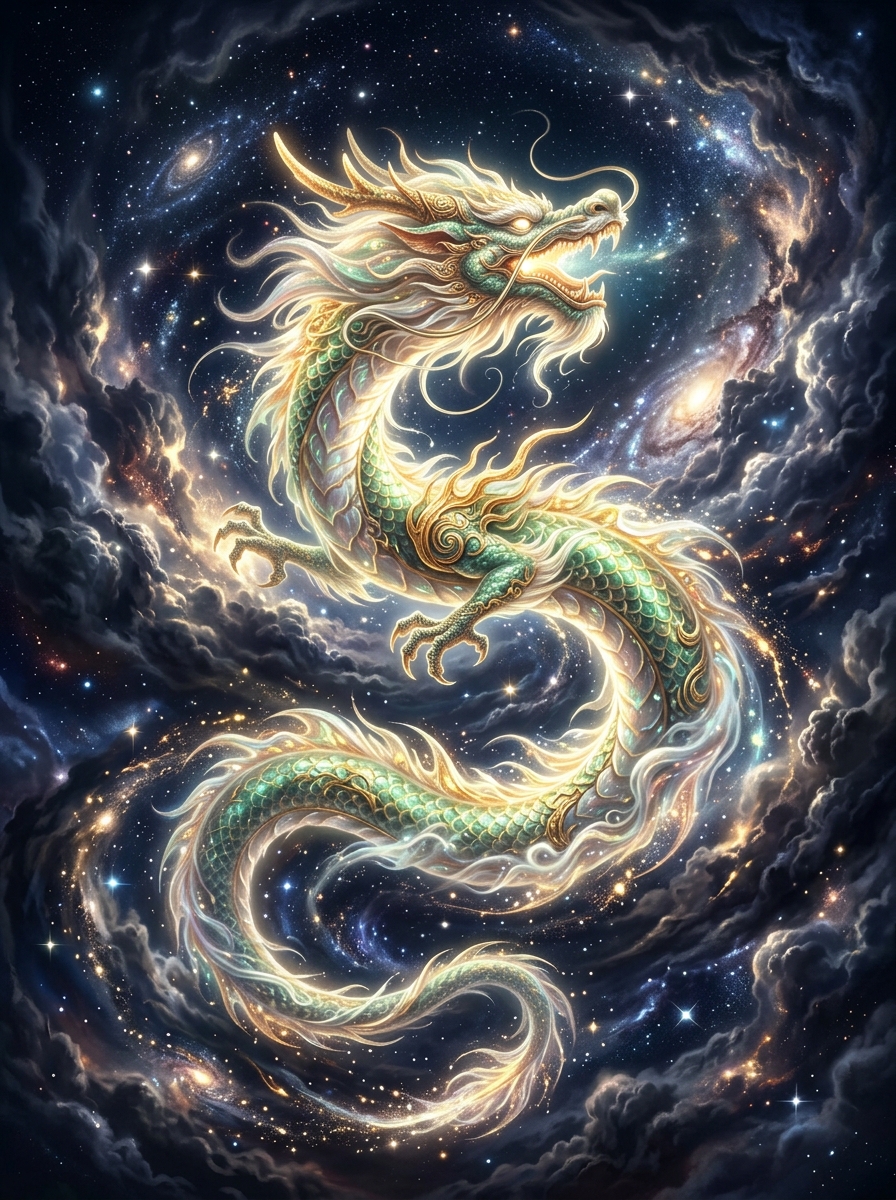
The Dragon as sovereign spark
Among the twelve animals of the Chinese zodiac, the Dragon is the only mythical creature—and that distinction is not decorative. It signals a different order of being. The Dragon does not represent a temperament so much as a threshold: a living conduit for collective momentum, charisma, and the will to enlarge whatever it touches. Its core thesis is simple and useful: Dragon energy is meant to lead, but it fulfills itself only when power serves a vision larger than ego. That tension—between radiance and inflation—is the key to reading the sign accurately.
For a broader map of how the Chinese zodiac operates as a symbolic system, see the zodiac’s mechanics and meaning and the foundational wheel itself. The Dragon does not sit politely inside that circle; it surges through it. Understanding that surge—its source, its shape, and its necessary discipline—is the work of this page.
The architecture of Dragon psychology
People born in Dragon years share an unmistakable signature: presence before words. The Dragon enters a room as if it has already taken psychic attendance. This is not social performance; it is psychological volume—an inner pressure that pushes outward. That pressure often looks like confidence, but it is more exact. The Dragon trusts its own timing and has little patience for mediocrity, evasiveness, or timid half-measures. When healthy, this creates leadership with heat: generosity, momentum, the ability to galvanize others. When distorted, it becomes volatility, vanity, or the conviction that being impressive is the same thing as being right.
The Dragon’s personality is built around expansion: bigger plans, larger emotional amplitude, stronger ideals. It is instinctively drawn to the spectacular, not out of vanity alone, but because it feels most alive when life has scale. This can produce entrepreneurs, artists, reformers, and leaders who sense possibility faster than others do. The Dragon’s style overlaps, in spirit, with the solar magnificence of Leo and the initiating force of Aries—though the Dragon is culturally distinct and not interchangeable with Western symbolism. If Aries is a spear thrust, the Dragon is a banner unfurled from a high tower. It does not merely want to move; it wants to be seen moving.
Yet the Dragon’s chief vulnerability is not anger—it is inflation: the subtle belief that intensity equals truth and that specialness exempts one from ordinary limits. The Dragon can become impatient with processes that require humility—apprenticeship, compromise, repetition, waiting. It may overidentify with its own potential, confusing promise with accomplishment. The sign thrives when challenged by realities that do not flatter it. In that sense, the Dragon has something to learn from Capricorn: endurance, craftsmanship, and respect for time. The Dragon wants the peak; Capricorn knows how to build the mountain.
At its best, the Dragon brings courage under pressure, strategic instinct, and a rare ability to make others believe in a difficult future. Its mind leaps in images and synthesized impressions, making it brilliant in crisis or invention but less patient with mundane administration. The task is not to domesticate the fire, but to give it a vessel strong enough to hold heat without cracking.
How Dragon energy matures
Maturity for the Dragon is the transition from raw power to stewardship. The sign’s natural charisma means it rarely lacks followers, but the question is what it does with them. An immature Dragon mistakes intensity for identity, using its magnetism to fill emotional space rather than to build something lasting. A mature Dragon learns that authority is not volume, that brilliance needs structure, and that the highest form of command is to make others more alive rather than merely more impressed.
This maturation is not a loss of fire—it is a refinement. The Dragon must internalize that its power is real but not self-justifying. It becomes most magnetic when it stops trying to prove anything. Its job is animation: bringing life, courage, and scale wherever stagnation has settled. When the Dragon can hold its own radiance without becoming blinded by it, it moves from being a force of nature to being a sovereign presence—responsible for the fire it carries.
Practical steps toward this maturity often involve relationships and work that impose structure without humiliating the sign. The Dragon needs partners and projects that respect its vision but also challenge its impatience. This is where the alignment with Capricorn’s discipline becomes more than a theory; it becomes a lived practice of building the mountain rather than merely dreaming of the summit.
The Dragon in relationship: application of the dynamic
The same core dynamic—power seeking a worthy container—plays out in love and work. The Dragon does not need admiration alone; it needs someone who can meet force without becoming submissive, competitive, or starstruck. True compatibility requires both respect and friction. Too much friction, and the Dragon becomes combative. Too little, and it grows bored or domineering.
Traditional Chinese astrology favors the Rat with the Dragon because the Rat’s intelligence navigates the Dragon’s scale without trying to outshine it; the Rat translates vision into strategy. The Monkey matches the Dragon’s quick mind and improvisational wit, often supplying the cleverness the Dragon lacks when it gets too grand. The Rooster gives form and discernment—if the Dragon is the blaze, the Rooster is the polished edge that keeps the blaze from becoming smoke. Together, these pairings can be formidable in love or business, provided neither person confuses criticism with contempt.
The Dragon works with the Tiger when both honor strength without dominating the horizon; the electricity is real but power contests are likely if both insist on center stage. With the Snake, fascination deepens: the Snake’s poise steadies the Dragon’s impulsiveness, though both can be strategic enough to keep parts of themselves hidden. For a psychological guide to how different signs relate in temperament, see zodiac sign compatibility. The Dragon’s relational style often resembles a more combustible version of Libra at its best—charismatic, socially intelligent, aware of balance—except that the Dragon wants not just harmony but magnitude.
The most difficult relationships involve partners who feel overshadowed or who refuse to be impressed. The Dragon can struggle with cautious, deeply private, or rigidly routine-oriented people, not because those qualities are bad, but because the Dragon experiences them as narrowing. Incompatibility is often about tempo: one person wants expansion; the other wants containment. Such bonds are not doomed but require conscious translation. The Dragon must learn that every pause is not an insult, and every critique is not an attack. The other person must learn that Dragon intensity is not necessarily aggression; sometimes it is enthusiasm with poor volume control.
Refining the fire: element, birth years, and lucky correspondences
The Dragon is not a single undifferentiated force. In Chinese astrology, the sign is shaped by the elemental cycle, and each Dragon year carries a distinct flavor. The element reveals how the Dragon expresses power: through fire, structure, diplomacy, abundance, or metal’s precision. The year tells you the engine; the element tells you the tuning.
A Wood Dragon is idealistic, socially minded, oriented toward growth rather than conquest. Fire Dragon is the most dramatic—bold, fast, inspired, and difficult to ignore; the question is not whether it can ignite, but whether it can sustain. Earth Dragon is the most grounded, with patience and a better relationship with limits—a mountain with a hidden furnace inside. Metal Dragon brings sharper will and cleaner boundaries, highly effective but less forgiving. Water Dragon is the most adaptive and psychologically nuanced—intuitive, flexible, able to move around obstacles rather than crash through them.
Traditional Dragon associations favor gold, silver, and red, along with the numbers 1, 6, and 7, and the eastern or southeastern directional field. These are resonance markers, not magic tricks. They help the Dragon stay aligned with its own frequency rather than scattering it. The practical lesson is simple: the Dragon does well when its environment reflects dignity, vitality, and clarity. Dense clutter, petty aesthetics, and exhausted routines drain it faster than it may admit. A lucky setting is one that feels alive but not chaotic—strong colors, good light, clean lines, and evidence that someone cares.
Dragon years recur every twelve years, but a person’s sign is determined by the lunar new year, not January 1. Someone born in early January or early February may belong to the previous animal year. Precision matters as much as myth. For readers exploring the sign as part of a larger symbolic pattern, remember that astrology works through repeated forms, not isolated labels. The Dragon is strongest when read as one node in a living structure—which is why the zodiac wheel remains the foundational map. The Dragon’s power, properly refined, is not just lucky; it is sovereign in the best sense: not above others, but responsible for the fire it carries.
Comments
Loading comments…