The Celestial Compass: Understanding the Zodiac's Mechanics and Meaning
What is the Zodiac?
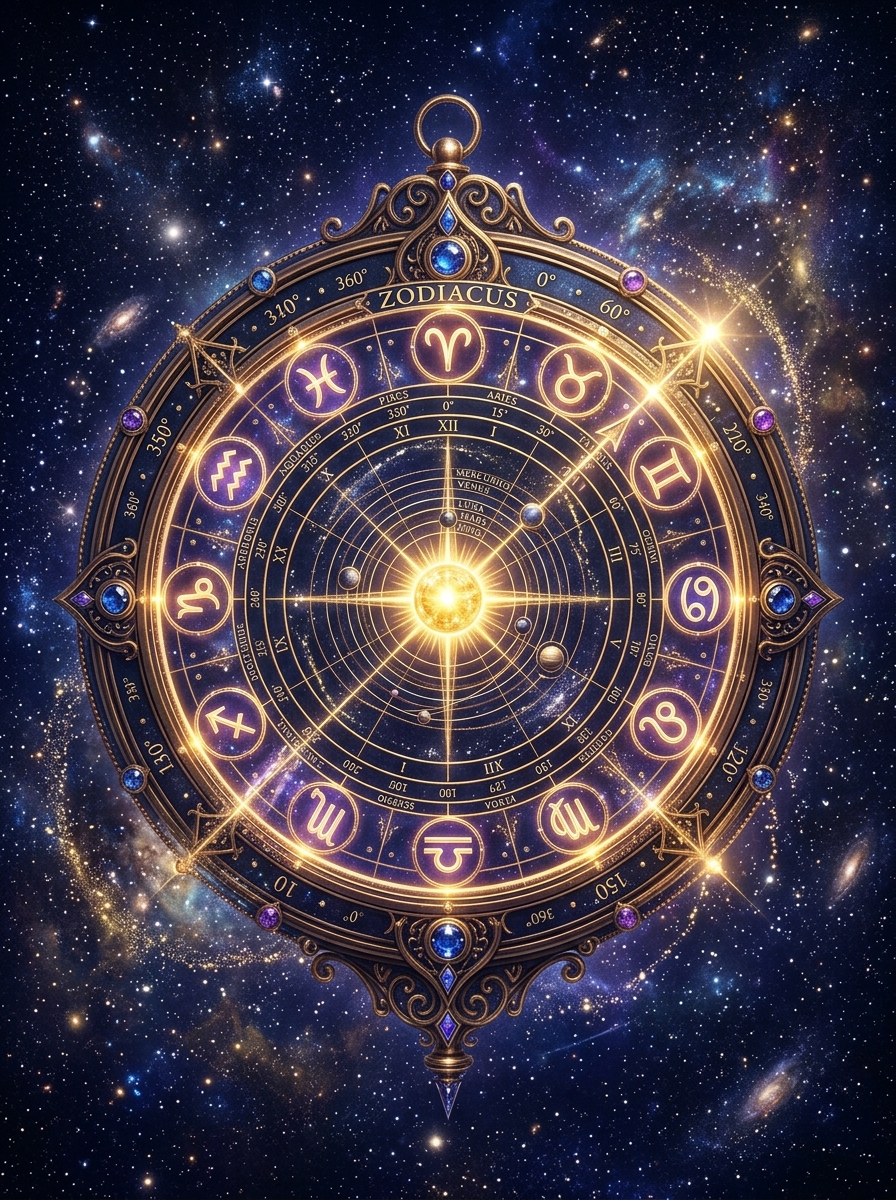
The zodiac is the foundational map of astrology, a celestial coordinate system that has guided human orientation for millennia. Astronomically, the zodiac is defined as a 360-degree belt of space extending approximately 8 degrees north and south of the ecliptic—the apparent path of the Sun across the celestial sphere over the course of a year. Within this band, the Sun, the Moon, and the principal planets of our solar system appear to travel. By dividing this 360-degree circle into twelve equal segments of 30 degrees each, we arrive at the twelve signs of the zodiac.
This division is not merely arbitrary; it serves as a precise geometric grid. In the Western esoteric tradition, this coordinate system acts as a bridge between the macrocosm of the cosmos and the microcosm of human experience. When we look at a birth chart, we are looking at a snapshot of the solar system mapped onto this 360-degree wheel. Each planet is positioned at a specific degree, minute, and second of a particular zodiac sign. For example, if the Sun is at 15 degrees of Aries, it means the Sun occupied the fifteenth degree of the first 30-degree segment of the zodiac at the moment of birth.
From a psychological perspective, as pioneered by Carl Jung, the zodiac represents a projection map of the human psyche. Jung observed that the astrological signs and planets are symbolic representations of archetypes residing in the collective unconscious. The zodiacal belt, with its geometric divisions, organizes these archetypes into a structural framework. Rather than viewing the zodiac as a literal source of celestial influence, modern psychological astrology sees it as a mirror. The movement of the planets through these twelve segments reflects the unfolding patterns of human development, offering a symbolic language to describe the complexities of personality and fate.
Historically, the development of the zodiac was a joint triumph of astronomy and mythology. In ancient Mesopotamia, early observers recorded the movements of the planets against the backdrop of the stars. Over centuries, these observations were formalized into the mathematical zodiac we use today. By establishing a fixed coordinate system, ancient astronomer-astrologers could calculate planetary positions with remarkable accuracy. This mathematical framework allowed astrology to transition from simple omen-reading to a sophisticated system of personal and mundane analysis. In the centuries that followed, Hellenistic, Persian, and Medieval scholars refined this geometry, preserving the symbolic associations while anchoring them to rigorous mathematical calculations.
Today, the zodiac remains a highly sophisticated system of archetypal navigation. As Western esoteric writers like Steven Forrest point out, it is not a rigid cage determining our fate, but a fluid landscape of psychological potentials. By studying the mechanics of the zodiac, we are not looking at a static superstition, but at a dynamic model of cosmic cycles that mirrors the evolutionary growth of the soul. Understanding the structural layout of this map is the first step toward self-discovery.
Tropical vs. Sidereal Zodiac: The Seasonal vs. The Stellar
One of the most common points of confusion for modern students of astrology is the distinction between the Tropical and Sidereal zodiacs. Both systems utilize the same twelve signs and divide the ecliptic into 30-degree segments, yet they align their starting points differently. This divergence represents a profound symbolic and astronomical divide, representing two distinct ways of mapping humanity's relationship to the cosmos.
The Tropical Zodiac
The Tropical zodiac is the system used by the vast majority of Western astrologers. It is a seasonal zodiac, anchored to the relationship between the Earth and the Sun. The starting point of the Tropical zodiac—0 degrees of Aries—is defined by the vernal equinox, the exact moment the Sun crosses the celestial equator from south to north, marking the beginning of spring in the Northern Hemisphere.
Because the Tropical zodiac is tied to the seasons, it reflects the cyclical flow of life on Earth. Aries represents the initial burst of spring energy, the emergence of new growth; Cancer aligns with the summer solstice, the peak of light; Libra marks the autumnal equinox, the point of balance and harvest; and Capricorn corresponds to the winter solstice, the deepest dark and the return of the light. Astrologers like Liz Greene emphasize that the Tropical zodiac represents the psychological journey of the ego as it navigates the cycles of life, growth, decay, and rebirth. In this framework, the signs are archetypal stages of human development, intimately connected to the earth's natural rhythms. The focus is developmental, psychological, and process-oriented.
The Sidereal Zodiac
In contrast, the Sidereal zodiac is used in Vedic astrology (Jyotish) and by a minority of Western siderealists. It is a stellar zodiac, anchored to the actual physical constellations in the night sky. Instead of starting at the vernal equinox, the Sidereal zodiac aligns 0 degrees of Aries with a specific physical star or celestial point, such as Spica (in the Lahiri ayanamsa) or Revati.
As a result, the Sidereal zodiac reflects the positions of the planets relative to the background stars. Because it is tied to the constellations rather than the Earth's seasonal cycles, the Sidereal zodiac is often described as representing a more cosmic, karma-oriented level of reality. While the Tropical zodiac describes the psychological personality and the seasonal landscape of the soul, the Sidereal zodiac is seen as mapping the soul's deeper destiny, spiritual alignment, and past-life patterns. It is an astronomical snapshot of the galaxy itself, rather than our solar system's seasonal relationship with Earth.
The Growing Divergence
Due to the astronomical phenomenon known as the precession of the equinoxes, the vernal equinox slowly drifts backward against the background stars at a rate of approximately one degree every 72 years. Consequently, the Tropical and Sidereal zodiacs are no longer aligned. At the beginning of the common era, the two systems roughly coincided. Today, however, they are separated by approximately 24 degrees. This offset is known as the ayanamsa.
This means that if your Tropical Sun sign is 20 degrees of Aries, your Sidereal Sun is actually located at approximately 26 degrees of Pisces. Neither system is objectively "correct" or "incorrect." Rather, they operate on different planes of symbolic meaning. The Tropical zodiac measures our psychological relationship to the Earth's seasonal cycles, while the Sidereal zodiac measures our alignment with the wider cosmos. Understanding this difference is essential for any modern student of astrology who wishes to navigate both Western and Eastern traditions without confusion.
The Twelve Signs and Their Qualities
The twelve signs of the zodiac are not just individual archetypes; they are organized into a highly structured matrix based on two primary categories: the Elements (triplicities) and the Modalities (quadruplicities). This classification system provides a dynamic framework for understanding how the signs interact and express themselves.
Elements and Modalities
The four elements—Fire, Earth, Air, and Water—represent the basic substances of life and the psychological temperament of the signs:
- Fire (Aries, Leo, Sagittarius): Represents vitality, intuition, inspiration, and the spark of consciousness. It is dynamic, expressive, and seeks to initiate action through passion and faith.
- Earth (Taurus, Virgo, Capricorn): Represents stability, practicality, physical reality, and the material world. It is grounded, reliable, and seeks to manifest concrete results.
- Air (Gemini, Libra, Aquarius): Represents intellect, communication, social connection, and abstract thought. It is conceptual, objective, and seeks to build bridges of understanding.
- Water (Cancer, Scorpio, Pisces): Represents emotion, intuition, the subconscious, and deep sensitivity. It is receptive, empathetic, and seeks connection with the unseen currents of feeling and spirit.
The three modalities—Cardinal, Fixed, and Mutable—describe how these elements express their energy:
- Cardinal (Aries, Cancer, Libra, Capricorn): The initiators. They correspond to the beginning of the seasons and represent action, leadership, crisis, and starting new projects.
- Fixed (Taurus, Leo, Scorpio, Aquarius): The stabilizers. They correspond to the middle of the seasons and represent persistence, determination, concentration, and consolidation.
- Mutable (Gemini, Virgo, Sagittarius, Pisces): The adaptors. They correspond to the end of the seasons and represent flexibility, transition, dissolution, and integration.
The Twelve Archetypes Detailed
Aries (Cardinal Fire): The pioneer, the warrior. Ruled by Mars, Aries represents the raw impulse of existence, the courage to initiate action, and the assertion of individuality. Individuals with strong Aries placements are often direct, competitive, and impatient. They thrive on challenge and seek to carve out new paths where others fear to tread. In the psychological system of Steven Forrest, Aries is the archetype of the freedom fighter, seeking to break free from conformity. The shadow of Aries is unrestrained ego, leading to combativeness, insensitivity, and a disregard for the needs of others.
Taurus (Fixed Earth): The builder, the preserver. Ruled by Venus, Taurus seeks physical security, sensual pleasure, and connection to the natural world. It represents stability, quiet determination, and a slow, methodical pace. Taurus energy is deeply anchored in the senses, valuing beauty, quality, and material comfort. Psychologically, Taurus represents the stabilization of the ego through physical manifestation. The shadow of Taurus is inertia, greed, and extreme stubbornness, refusing to adapt to changing environments.
Gemini (Mutable Air): The messenger, the explorer. Ruled by Mercury, Gemini is curious, adaptable, and focused on gathering and dispersing information. It represents intellectual agility, dual perspective, and social versatility. Gemini seeks to understand the world through cataloging facts and connecting disparate ideas. In the evolutionary system, Gemini represents the child-like mind, asking questions without judgment. The shadow of Gemini is superficiality, restlessness, and a lack of grounding, scattering focus and failing to integrate knowledge.
Cancer (Cardinal Water): The nurturer, the protector. Ruled by the Moon, Cancer represents emotional security, the home, the family, and the connection to the past and the subconscious. Cancer energy is highly protective and sensitive, often retreating into its shell to guard its deep feelings and those it loves. Liz Greene highlights Cancer as the archetype of the mother, representing the source of emotional nourishment and psychological safety. The shadow of Cancer is emotional manipulation, dependency, and defensiveness.
Leo (Fixed Fire): The creator, the sovereign. Ruled by the Sun, Leo seeks self-expression, creative validation, and the realization of individual identity. It represents warmth, generosity, pride, and theatricality. Leo energy demands to be seen and celebrated, radiating its creative light like the Sun itself. In psychological terms, Leo represents the ego's need to define itself through individual creative acts. The shadow of Leo is narcissism, arrogance, and a constant need for external applause, overshadowing others in the process.
Virgo (Mutable Earth): The craftsman, the analyst. Ruled by Mercury, Virgo seeks self-improvement, order, and service. It represents discrimination, attention to detail, efficiency, and the refinement of skills. Virgo energy is dedicated to analyzing processes and making things function as perfectly as possible. Psychologically, Virgo represents self-purification and humility, recognizing the need for personal growth and correction. The shadow of Virgo is hyper-criticism, perfectionism, and anxiety, getting lost in the details and missing the larger picture.
Libra (Cardinal Air): The diplomat, the peacemaker. Ruled by Venus, Libra is focused on relationship, harmony, and aesthetic balance. It represents the search for objective justice, compromise, and partnership. Libra energy seeks to harmonize conflicting perspectives and create beauty in the social sphere. In the Western esoteric tradition, Libra is the balancer of scales, seeking equilibrium. The shadow of Libra is conflict avoidance, codependency, and indecisiveness, sacrificing personal truth to maintain superficial peace.
Scorpio (Fixed Water): The alchemist, the detective. Traditionally ruled by Mars and modernly by Pluto, Scorpio explores the depths of the psyche, desire, power, and transformation. It represents psychological intensity, emotional regeneration, and honesty. Scorpio is unafraid of the dark and seeks true intimacy. Psychologically, Scorpio is the archetype of the transformer, confronting the shadow and integrating repressed energies. The shadow of Scorpio is control, obsession, and vindictiveness, refusing to forgive or surrender.
Sagittarius (Mutable Fire): The seeker, the philosopher. Ruled by Jupiter, Sagittarius seeks meaning, truth, and expansion through travel, philosophy, and direct experience. It represents optimism, vision, and a quest for the horizon. Sagittarius energy is expansive, free-spirited, and hungry for wisdom. Evolutionary astrology views Sagittarius as the explorer of the higher mind, expanding horizons. The shadow of Sagittarius is dogmatism, carelessness, and moral superiority, preaching truths without living them or ignoring practical realities.
Capricorn (Cardinal Earth): The architect, the authority. Ruled by Saturn, Capricorn seeks structural stability, social achievement, and the mastery of material reality. It represents discipline, responsibility, patience, and time. Capricorn energy understands that anything of lasting value requires hard work and structure. In psychological terms, Capricorn represents the master of the material domain. The shadow of Capricorn is coldness, authoritarianism, and ruthlessness, valuing social status and control over human connection.
Aquarius (Fixed Air): The reformer, the visionary. Ruled by Saturn and Uranus, Aquarius focuses on collective progress, individuality, and systemic reform. It represents group consciousness, intellectual independence, and egalitarian ideals. Aquarius energy challenges conventions to build a better future for the collective. Psychologically, Aquarius represents the rebel with a cause, breaking outmoded structures. The shadow of Aquarius is emotional detachment, fanaticism, and alienation, loving humanity in the abstract but struggling with individual humans.
Pisces (Mutable Water): The mystic, the dreamer. Ruled by Jupiter and Neptune, Pisces represents the dissolution of boundaries, spiritual unity, and imaginative depth. It represents compassion, artistic sensitivity, and surrender to the cosmic whole. Pisces seeks to transcend physical limitations and connect with the infinite. Psychologically, Pisces represents the return to the source, dissolving the individual ego. The shadow of Pisces is escapism, martyrdom, and confusion, getting lost in illusions and failing to establish healthy boundaries.
The Astronomy of Precession and the Great Platonic Year
To fully grasp the mechanics of the zodiac, one must understand the astronomical reality of the precession of the equinoxes. This phenomenon is caused by a slow, gravity-induced wobble in the Earth's rotational axis, akin to a spinning top that begins to waver as it loses speed.
The Wobbling Axis
The Earth is not a perfect sphere; it is slightly flattened at the poles and bulges at the equator. The gravitational pull of the Moon and the Sun on this equatorial bulge causes the Earth's axis to trace a circle in the sky over a vast period of time. This wobble shifts the orientation of the Earth's axis relative to the background constellations.
Consequently, the intersection of the celestial equator and the ecliptic—which defines the vernal equinox—slowly moves westward along the ecliptic. This retrograde motion means that every year, the Sun reaches the equinox position slightly earlier in its orbit relative to the stars. This shift is minute, amounting to roughly 50.3 arcseconds per year, but over centuries, it accumulates into a substantial difference. Over approximately 72 years, the equinox shifts by one full degree of arc. This means that over a period of roughly 2,160 years, the equinox shifts through an entire 30-degree segment of the zodiac.
The Great Platonic Year
The time it takes for the Earth's axis to complete one full 360-degree cycle of precession is approximately 25,772 years. This cycle is known as the Great Platonic Year. If we divide this cycle into twelve segments, we arrive at the concept of Astrological Ages. Each age corresponds to the constellation in which the vernal equinox Sun rises.
Each astrological age lasts roughly 2,148 years. For the past two millennia, the vernal equinox has been located in the constellation of Pisces, marking the Age of Pisces. As the precession continues, the vernal equinox is slowly moving into the constellation of Aquarius, transitioning us into the much-discussed Age of Aquarius. This shift has inspired a wealth of esoteric and psychological literature, with authors like Liz Greene and Steven Forrest exploring how these cosmic ages correlate with shifts in collective human consciousness, culture, and mythology. The transition from one age to another is rarely sudden; it is a gradual blending, like two musical notes creating a chord across centuries.
The Psychological and Esoteric Dimension: Carl Jung and Archetypes
While the astronomical mechanics provide the structural grid, it is the psychological and esoteric applications that breathe life into the zodiac. In the twentieth century, the field of astrology underwent a major transformation, moving away from prediction and towards character analysis and self-actualization.
Carl Jung's Influence
Swiss psychiatrist Carl Jung was instrumental in this shift. Jung studied astrology throughout his life, using it to understand the psychological profiles of his patients. He recognized that the symbols of the zodiac were not external forces dictating human behavior, but internal psychic realities. In Jungian psychology, the zodiac is viewed as a symbolic map of the collective unconscious, containing the archetypes that govern human behavior and development.
Jung’s concept of synchronicity—the idea of meaningful coincidences that cannot be explained by cause-and-effect—offered a philosophical explanation for how astrology functions. Under a synchronistic worldview, the positions of the planets do not cause events on Earth. Instead, the celestial patterns and human psychological experiences occur simultaneously, reflecting a deeper, underlying unity in the cosmos. As the hermetic maxim states, "As above, so below."
Liz Greene and Psychological Astrology
Astrologer and analyst Liz Greene further developed Jung’s ideas, creating a robust framework for psychological astrology. Greene emphasized that the birth chart is not a static map of fate, but a blueprint of the individual psyche. The challenges and tensions within a chart represent internal conflicts that the individual must integrate to achieve psychological wholeness (individuation).
In this light, the zodiac signs are not simple personality descriptions. Instead, they are paths of development. A Scorpio Sun, for example, is not naturally destructive or secretive; rather, their path involves learning to navigate the depths of the unconscious, confront their shadows, and harness the power of emotional transformation. The zodiac becomes a tool for self-discovery, allowing individuals to understand their innate patterns and potentials.
Steven Forrest and Evolutionary Astrology
Steven Forrest expanded this psychological approach into evolutionary astrology. Forrest focuses on the growth of the soul over time, viewing the birth chart as a record of the soul's intentions for the current lifetime. In his books, Forrest emphasizes the choices inherent in every astrological configuration.
No sign or aspect is inherently good or bad; every symbol has a spectrum of expression, ranging from its highest potential to its lowest shadow. The goal of evolutionary astrology is to guide the individual toward the healthiest expression of their chart, helping them navigate their karmic challenges and fulfill their creative potentials. This approach empowers the individual, highlighting free will and conscious choice within the framework of the birth chart.
Synthesizing the Map: How to Read Your Birth Chart
To apply the mechanics and meanings of the zodiac practically, one must learn to synthesize the different elements of a birth chart. A chart is not just a list of signs; it is a complex, three-dimensional landscape consisting of planets, signs, houses, and aspects.
The Planetary Actors
If the zodiac signs describe the "how"—the style and energetic quality—the planets describe the "what"—the active parts of the psyche. The Sun represents the core self, the creative identity, and the path of vitality. The Moon represents the emotional nature, the subconscious habits, and the need for safety. Mercury governs the intellect, communication, and processing of information. Venus represents relationships, values, and aesthetic appreciation. Mars governs drive, desire, physical energy, and assertiveness.
The outer planets—Jupiter, Saturn, Uranus, Neptune, and Pluto—represent collective and transpersonal energies. Jupiter indicates where we seek growth, expansion, and meaning. Saturn represents discipline, structure, limits, and the lessons we must master. Uranus represents breakthrough, rebellion, and sudden change. Neptune represents imagination, spiritual longing, and the dissolution of ego boundaries. Pluto represents power, shadow work, and deep, systemic transformation.
The Houses: The Arena of Life
While the signs describe the energetic qualities and the planets describe the psychological functions, the twelve houses of the chart describe the "where"—the specific areas of life where these energies play out. The houses represent the earthly stage.
The First House represents the self, the physical body, and the initial projection into the world (the Ascendant). The Second House governs personal finances, values, and self-worth. The Third House rules local communication, short trips, siblings, and the immediate environment. The Fourth House represents the home, the family, ancestral roots, and the private self. As we move through the houses, the scope expands from the personal to the social and collective, culminating in the Twelfth House of the subconscious, hidden dynamics, and spiritual transcendence.
Planetary Aspects: The Inner Dialogue
Aspects are the geometric angles formed between planets in the birth chart, indicating how these different parts of the psyche communicate with one another. The major aspects include the conjunction (0 degrees), sextile (60 degrees), square (90 degrees), trine (120 degrees), and opposition (180 degrees).
- Conjunctions represent a blending of planetary energies, creating a powerful focus of force in a specific area of the chart. It represents concentration and intense focus.
- Sextiles and Trines represent harmonious flow, where the planets support one another and talents manifest naturally, often without conscious effort. They are gifts that must be actively utilized to prevent laziness.
- Squares and Oppositions represent tension and conflict, forcing the individual to take action, resolve internal contradictions, and grow through crisis. They are the engines of developmental progress.
By synthesizing the planet (what), the sign (how), the house (where), and the aspects (relationship), an astrologer can paint a detailed portrait of an individual's psychological landscape.
Frequently Asked Questions
What is the difference between my Sun sign, Moon sign, and Rising sign?
Your Sun sign, Moon sign, and Rising sign (or Ascendant) form the "big three" of your birth chart, representing the core structure of your personality. Your Sun sign represents your essential identity, your conscious ego, and the path of growth you are here to pursue. It is the central organizing principle of your character.
Your Moon sign represents your emotional landscape, your subconscious reactions, and what you need to feel safe and nurtured. It describes your private, inner self that only those close to you see.
Your Rising sign is the sign that was rising on the eastern horizon at the exact moment of your birth. It represents your persona, the mask you wear in public, and the lens through which you view and interact with the world. It also determines the layout of the houses in your chart.
Why do some astrologers say my sign has changed because of the precession of the equinoxes?
This claim is based on a misunderstanding of the two different zodiac systems. The idea that your sign has changed assumes that Western astrology uses the Sidereal zodiac, which is tied to the physical constellations. Because of precession, the physical constellations have indeed shifted relative to the calendar dates.
However, Western astrology uses the Tropical zodiac, which is not tied to the physical constellations, but to the Earth’s seasonal cycle. The starting point, 0 degrees of Aries, is always fixed at the vernal equinox, regardless of which background constellation the Sun is rising in. Therefore, your Tropical Sun sign remains the same, as it measures your position within the seasonal grid, not the stellar constellation.
What are the shadow sides of the zodiac signs?
In psychological astrology, every sign has a positive expression and a shadow side. The shadow represents the unconscious, unintegrated aspect of the sign, which often manifests when the energy is expressed in an extreme or defensive manner.
For example, the shadow of Aries can manifest as impatience, aggression, and selfishness. The shadow of Taurus can express as stubbornness, possessiveness, and resistance to change. The shadow of Gemini can lead to superficiality, duplicity, and restlessness. Understanding the shadow of each sign allows individuals to recognize their unhealthy patterns and work toward integrating them, turning the shadow energy into a constructive force.
Can two people have the exact same birth chart?
While it is mathematically possible for two people born at the exact same location and time to share the same birth chart, their lived experiences will still differ. A birth chart represents the potential, the archetypal layout of the psyche, and the questions the soul has set out to answer.
It does not dictate how an individual will choose to answer those questions. Factors such as environmental upbringing, conscious choice, and cultural context play a significant role in how the archetypal potentials are expressed. Two people with the same chart will face similar themes and psychological dynamics, but they may express them differently based on their free will and level of consciousness.
How do retrogrades affect the planets in the zodiac?
A retrograde occurs when a planet appears to move backward in the sky from our perspective on Earth. This is an optical illusion caused by the differing orbital speeds of the Earth and the other planets.
Symbolically, a retrograde planet represents a time when the energy of that planet is turned inward. Instead of expressing the planetary function externally, we are invited to reflect, review, and internalize it. For example, during a Mercury retrograde, we are encouraged to review our communications, reconsider our plans, and look inward for answers, rather than focusing solely on external actions and progress. It is a time for introspection and realignment.
What is the role of Chiron, the "Wounded Healer," in the zodiac?
Chiron is a minor planet (or comet/asteroid) that represents our deepest psychological wound and our capacity to heal others through that same vulnerability. Discovered in 1977, Chiron bridges the inner personal planets (up to Saturn) and the outer transpersonal planets (beginning with Uranus).
In the birth chart, the sign and house placement of Chiron indicate where we experience a sense of inadequacy, rejection, or persistent pain. However, it also indicates where we hold unique wisdom and healing gifts. By working to understand and integrate our Chironic wounds, we transform our deepest liabilities into our greatest assets, serving as a source of guidance for others on a similar path.
Comments
Loading comments…